PART 3
I gripped my phone tighter.
“Who filed it?”
“An attorney representing Shawn and Hannah.”
For several seconds, I couldn’t hear anything except the wind moving through the pine trees around the lake.
My daughter.
Hannah was my only child. She was the little girl who used to run down this same driveway in yellow rain boots, carrying a fishing pole nearly as tall as she was. She was the teenager who sat beside her mother on the porch while Susan taught her how to braid a fishing line. She was the young woman who cried into my shoulder at her mother’s funeral and promised me that we would take care of each other.
And now, apparently, her husband had been trying to take possession of the one property her mother had deliberately protected.
Or at least, that was what I thought until my attorney spoke again.
“Walter, there is another problem. The filing claims that you became medically incapable of managing your affairs last year. According to the paperwork, you authorized Shawn to act on your behalf.”
My stomach tightened.
“I never did that.”
“I know. That’s why I’m concerned.”
“I have never given Shawn power of attorney. Not once.”
“Then somebody has either forged your signature or submitted false information. I need you to preserve everything and let the sheriff handle the immediate situation.”
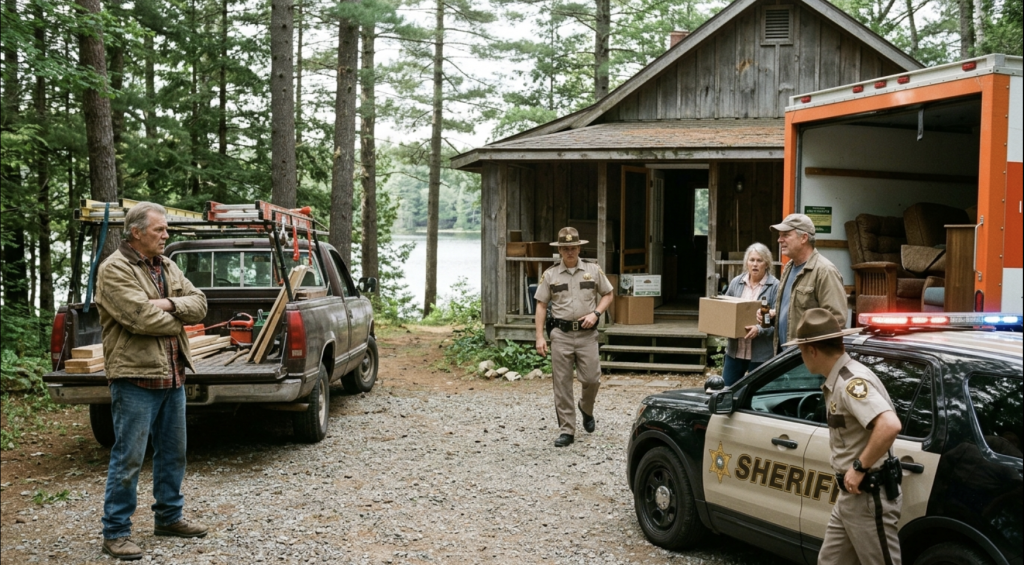
I stared through the cabin’s open doorway.
Susan’s coffee mug was still hanging beside the sink.
Her green raincoat was still on its hook.
And strangers were standing inside the home where we had spent twenty-seven years building a life together.
I had spent three years grieving my wife, learning how to eat dinner alone, how to sleep on the side of the bed that no longer smelled like her shampoo, and how to walk past the photographs on the mantel without stopping every time.
Now someone had taken that grief and treated it like an opportunity.
“I’m coming,” my attorney said. “I’ll be there in approximately thirty minutes. Until then, don’t touch the deed.”
The call ended.
I lowered my phone and turned toward the sheriff.
“Deputy, my attorney says there was another filing with the county recorder. Someone has apparently claimed I was medically incapable of managing my own affairs.”
The deputy’s expression changed.
“Did you authorize anyone to act for you?”
“No.”
“Have you ever been declared legally incapacitated by a court?”
“Absolutely not.”
He nodded slowly, then turned toward Greg and Brenda.
“I’m going to need both of you to explain exactly how you obtained access to this property and who gave you that document.”
Greg shifted his weight.
“My son told us everything was arranged.”
“Your son-in-law?” the deputy asked.
“Shawn. He’s married to Walter’s daughter.”
“That doesn’t answer my question. Did you personally see Walter sign this deed?”
Greg looked away.
“No.”
“Did you see his late wife sign it?”
Brenda answered before her husband could.
“Shawn showed us the paperwork. He said the cabin had been transferred to him and Hannah, and that they wanted us to move up here before winter.”
“Did he tell you Walter had approved your moving in?”
“Yes.”
“Did you speak to Walter about it?”
“No.”
The deputy looked at Greg.
“Did you change the door code?”
Greg hesitated.
“Shawn gave us the new code.”
“That’s not what I asked.”
Greg exhaled sharply.
“Yes. I changed it.”
“On whose authority?”
“My son’s.”
The deputy wrote something in his notebook.
“Your son does not appear to have any legal authority over this property. I’m going to ask you to stop unloading your belongings until ownership and the circumstances of this document can be investigated.”
Greg’s face reddened.
“You can’t just tell us to stop. We’ve paid for this move. We’ve got a truck full of furniture.”
“Then I suggest you contact the person who told you this move was authorized.”
Greg pulled out his phone.
For the first time since I had arrived, he looked genuinely nervous.
He walked several steps away and called Shawn.
I couldn’t hear everything Shawn said, but I heard Greg’s side of the conversation clearly enough.
“What do you mean, you can’t come here?”
A pause.
“Your father-in-law is standing right here with a sheriff!”
Another pause.
“Shawn, they have the document!”
Greg listened for several seconds, then suddenly lowered his voice.
“What do you mean, the other papers?”
My eyes narrowed.
The other papers.
Greg turned his back to us, but the deputy noticed his reaction too.
“Sir,” the deputy said, “I need you to remain where I can see you.”
Greg ended the call.
“What other papers?” I asked him.
He stared at me.
“I don’t know what you’re talking about.”
“You just asked Shawn about other papers.”
“That was none of your business.”
“I’m afraid it became my business when you moved into my property.”
He opened his mouth to respond, but the deputy stepped between us.
“Let’s keep this calm.”
I nodded, though it was becoming increasingly difficult to control the anger rising inside me.
I wasn’t a violent man. I had spent forty years working in construction management, where I had learned that shouting rarely fixed a problem and that the loudest person in the room was often the one with the least useful information.
But this was different.
These people had entered Susan’s sanctuary without asking me. They had changed the lock code, unloaded their belongings, and announced that they were entitled to a property they did not own.
And now there were mysterious documents claiming that I had surrendered control of my own affairs.
I looked at the cabin again.
Susan had always been the practical one between us.
When we bought this property, it was little more than a weather-beaten fishing shack with a sagging roof, cracked windows, and a porch that looked ready to collapse. We spent six summers repairing it ourselves. Susan planted wildflowers beside the steps. I rebuilt the deck. We installed the kitchen cabinets together, arguing about measurements and laughing when we discovered we had put one cabinet in backward.
It had become our retreat.
Not because it was valuable, although the lakefront property was worth considerably more than we had paid for it.
It was valuable because it held our life.
And Susan had understood something I had not fully appreciated until she was gone.
People sometimes see a family’s possessions as an invitation.
They mistake love for entitlement.
They believe that because they are related to someone, they are allowed to take what that person has spent a lifetime building.
Susan had wanted to make sure that never happened to this cabin.
Twelve years earlier, after a relative had tried to pressure us into selling another family property, she insisted that we meet with an estate attorney. We transferred the cabin into a trust, named me the sole trustee, and documented exactly what should happen after my death.
Hannah would eventually inherit the property.
Until then, it would remain under my control.
It was a simple arrangement, carefully documented and reviewed.
At least, I had thought it was.
The sound of tires on gravel interrupted my thoughts.
A silver sedan pulled into the driveway, followed by a second vehicle.
A woman stepped out of the first car, carrying a leather briefcase.
My attorney, Margaret Ellis, had arrived.
Margaret was in her early sixties, with silver-streaked hair and the kind of steady expression that made people think twice before attempting to bluff their way through a conversation.
She had handled Susan’s estate and helped establish the trust. She knew the history of the property better than almost anyone outside our family.
She walked directly toward me.
“Walter.”
“Margaret.”
She glanced at the U-Haul, the scattered boxes, and the deputy standing near the front door.
Then she held out her hand.
“Where is the document?”
The deputy passed her the folded deed.
Margaret opened it carefully, examined the first page, and turned to the signature block.
For several seconds, she said nothing.
Then she looked at me.
“This is not your signature.”
“No.”
“Have you ever seen this document before?”
“Never.”
She examined Susan’s signature next.
Her expression hardened.
“Walter, Susan did not sign this.”
“I know.”
“No,” she said quietly. “I need you to understand something. This isn’t merely a questionable deed. The document claims to have been executed six months before Susan died, but it was supposedly notarized by a person who did not receive a notary commission until the following year.”
The deputy leaned closer.
“Are you certain?”
“I have the county’s recorded notary information in my office. I checked it this morning when I first learned about the filing.”
She turned the document so the deputy could see the notary block.
“The date is impossible.”
Brenda sank onto the porch step.
Greg stared at the paper.
For the first time, neither of them had anything to say.
Margaret placed the document back in the deputy’s hands.
“Please preserve the original. We will need a forensic examination of the signatures, the notary information, and the filing history.”
Then she turned toward Greg.
“Mr. Lawson, who prepared this document?”
“I told you. Shawn gave it to us.”
“Did he tell you who drafted it?”
“He said his lawyer handled everything.”
“Which lawyer?”
Greg swallowed.
“I don’t know the name.”
“Did you pay anyone for the transfer?”
“No.”
“Did you pay any taxes or recording fees associated with it?”
“Shawn said those were taken care of.”
Margaret exchanged a glance with the deputy.
“Then I strongly recommend that you preserve every text message, email, and document related to this move.”
Greg folded his arms.
“We haven’t done anything wrong. We were told the property belonged to our son.”
Margaret’s voice remained calm.
“Whether you personally knew the document was fraudulent is a separate question from whether the transfer is valid. At this point, the trust’s records do not support your claim of ownership.”
She turned to the deputy.
“I will provide certified copies of the trust agreement, the recorded property history, and the relevant estate documents. The cabin has not been transferred out of the trust.”
The deputy nodded.
“That’s helpful. I’ll document the scene and the statements made here. The appropriate authorities can determine whether a criminal investigation is warranted.”
Greg looked as though he wanted to argue, but Brenda caught his sleeve.
“Greg,” she whispered. “Let’s just go.”
He shook his head.
“We can’t just leave everything here.”
“You can arrange to remove your belongings after the deputy tells you what you’re permitted to do,” Margaret replied.
The deputy made several calls and continued documenting the incident. After speaking with his supervisor, he instructed Greg and Brenda not to remove or alter anything that might be relevant to the investigation.
Their moving truck remained in the driveway.
The boxes stayed on the porch.
And the cabin’s door code was reset.
But even as the immediate situation began to settle, I couldn’t stop thinking about Greg’s phone call.
What do you mean, the other papers?
There was something else.
Something Shawn had not expected us to discover.
Margaret seemed to sense that I was thinking the same thing.
“Walter, we need to discuss this somewhere private.”
We moved to her car, away from the cabin and the others.
She opened her briefcase and removed a thick folder.
“I’ve been reviewing the trust records because of the filing I discovered yesterday. There are several things I want to show you.”
My heart sank.
“How many?”
“Three issues that need immediate attention.”
She opened the folder.
“The first is the forged deed. We’ve already discussed that.”
She placed a second document beside it.
“The second is the claim that you authorized Shawn to act on your behalf. This document purports to give him authority over certain financial and property matters.”
I stared at the page.
It contained my name, my address, and what appeared to be my signature.
But I had never seen it before.
“When was this supposedly signed?”
“Last September.”
“I was in the hospital last September for a minor procedure. I was home the following day. I never signed a power of attorney.”
“Do you have medical records confirming the dates?”
“Yes.”
“Good. Keep them. We’ll preserve the originals and have the signature examined.”
She set that document aside and opened the third section of the folder.
“This is the part that concerns me most.”
It was a bank statement.
I recognized the account number at the top. It belonged to a small investment account Susan and I had established years ago to cover maintenance expenses for the cabin.
I leaned forward.
“What am I looking at?”
“Three withdrawals made over the past eight months.”
She pointed to the entries.
The first was for $18,000.
The second was for $24,500.
The third was for $31,000.
I read the amounts twice.
Together, they totaled $73,500.
“That money was supposed to pay for repairs, property taxes, and insurance,” I said. “I haven’t withdrawn anything from that account in over a year.”
“Exactly.”
I looked at her.
“Who withdrew it?”
“The transaction records show that the funds were transferred to an account held by a company called Lakeshore Property Solutions LLC.”
“I’ve never heard of it.”
“I checked the registration records. The company was formed eleven months ago.”
“Who owns it?”
Margaret hesitated.
“According to the filing, the registered manager is Shawn.”
For a moment, I couldn’t speak.
My son-in-law had not merely sent his parents to occupy the cabin.
Someone had apparently been moving money out of an account connected to the property.
And he had created a company that I had never authorized.
“Does Hannah know about this?” I asked.
“I don’t know.”
I wanted to believe she didn’t.
I wanted to believe my daughter had simply trusted her husband and had been given a false explanation of what was happening.
But Margaret did not make assumptions, and neither could I.
“Can he access the account?”
“The bank records indicate that someone submitted a document claiming to authorize changes to the account’s administration. We’re working to determine whether that document was accepted and who initiated the transfers.”
“Then we need to stop it.”
“We do. I’ve already contacted the bank’s fraud department to request a review and protective restrictions. You’ll need to verify your identity directly with them as well.”
I looked back toward the cabin.
The gray clouds had begun to lift above the water. A few ripples moved across the lake, and the familiar shoreline looked exactly as it had when Susan was alive.
That was the cruelest part.
The world had not changed.
The trees still stood where they had stood for decades. The old dock still leaned slightly to the left. Susan’s flower beds were waiting for spring.
But something inside my family had changed so completely that I no longer knew what to believe.
“Margaret,” I said, “I need to ask you something.”
“Go ahead.”
“Did Susan ever tell you she was worried about Shawn?”
She looked down at the folder.
For a moment, I thought she might refuse to answer.
Then she closed it.
“Yes.”
The word hit me harder than any of the documents.
“When?”
“About six months before she died.”
I stared at her.
“Why didn’t you tell me?”
“Because Susan asked me not to disclose the details unless certain circumstances arose. She wanted to give your family an opportunity to resolve its problems privately. At the time, there was no evidence of a fraudulent transfer, and she did not want to create conflict based on suspicion alone.”
“What was she worried about?”
Margaret took a breath.
“She was concerned that Shawn was pressuring Hannah to make financial decisions she didn’t fully understand. Susan had noticed several inconsistencies in things he had told them about investments and property.”
“Did she think he was stealing?”
“She didn’t know. She wanted the situation examined carefully before making accusations.”
I rubbed my forehead.
“Did she leave anything in writing?”
Margaret looked at me for several seconds.
“Yes.”
She opened the folder again and removed a sealed envelope.
My name was written on the front in Susan’s handwriting.
I recognized it immediately.
The rounded letters.
The small flourish at the end of my name.
The way she always wrote my first name slightly larger than the rest.
My throat tightened.
“Where did you get that?”
“Susan gave it to me shortly before she died. She instructed me to keep it with the trust records and deliver it to you if someone attempted to transfer the cabin without your authorization.”
I stared at the envelope.
Three years.
Three years of grief, loneliness, and learning to live without the woman who had been my partner since I was twenty-four.
And now, standing beside a lake that had witnessed nearly every chapter of our marriage, I was holding a message she had left for a day she feared might come.
I carefully opened the envelope.
Inside was a single handwritten letter.
My dearest Walter,
If Margaret is giving you this letter, then something has happened that I hoped would never happen.
I need you to remember that the cabin was never just a piece of property to us. It was the place where we built our happiest memories, where we watched our daughter grow up, and where we promised each other that family would always mean honesty, kindness, and respect.
I love Hannah. Nothing will ever change that.
But loving someone does not mean allowing them—or the people they love—to make decisions that destroy what we have worked our entire lives to protect.
If Shawn ever tries to take control of the cabin, please do not assume Hannah understands what is happening. Ask questions. Look at the records. Give her the chance to tell you the truth.
And Walter, please remember this: protect your daughter, but do not let anyone use your love for her against you.
There is something I discovered about Shawn that I never had the opportunity to discuss with you properly. Margaret has the records. She knows where I left them.
I hope you never need to read this letter.
But if you do, please be strong enough to look at the truth, even if it hurts.
All my love, always,
Susan.
I read it once.
Then I read it again.
By the time I reached the end, my hands were trembling.
Susan had known something was wrong.
She had seen warning signs.
And she had left instructions because she feared someone might eventually attempt exactly what had happened that morning.
I pressed the letter against my chest and closed my eyes.
For three years, I had imagined that the worst thing grief could do to a person was make every ordinary moment feel empty.
I had been wrong.
Sometimes grief left you vulnerable to a second loss: the discovery that someone you loved had been carrying a burden you never knew existed.
Margaret waited until I had folded the letter.
Then she spoke.
“There’s one more thing Susan asked me to preserve.”
“What?”
“A small storage box.”
She opened the back compartment of her briefcase and removed a key attached to a paper tag.
“It’s in the records room at my office. Susan gave it to me shortly before she died. She told me not to open it unless the cabin’s ownership was challenged.”
I looked at the key.
“What is in the box?”
“I don’t know. She sealed it herself.”
For the first time that morning, I felt something other than anger.
Fear.
Not fear of losing the cabin. The cabin was a building, a piece of land, a collection of memories.
I could rebuild a porch. I could replace a roof. I could survive losing a property.
What frightened me was the possibility that Susan had discovered something about our family that she had been unable to tell me.
Something that had followed us into the years after her death.
Something that might explain why Shawn had been so eager to take control.
I looked at Margaret.
“Let’s go to your office.”
She nodded.
Before we left, I walked back to the cabin one more time.
Greg and Brenda were standing beside the U-Haul, speaking quietly to the deputy. Greg’s earlier confidence had vanished. Brenda looked close to tears.
I stopped several feet away from them.
“Mr. Lawson,” I said.
He looked up.
“I want to make something clear. I didn’t call the sheriff because I wanted to humiliate you. I called because someone entered my home without permission, and now there are documents that appear to have been falsified.”
Greg rubbed his face.
“We were told everything was legal.”
“Then you should cooperate fully with the investigation.”
“We didn’t know about any forgery.”
“I hope that’s true.”
He looked down at the gravel.
For a moment, I saw something that looked like shame.
Then he said something I hadn’t expected.
“Walter, I think you need to talk to your daughter before you decide what Shawn has done.”
I stared at him.
“Why?”
Greg glanced toward Brenda.
She shook her head slightly, as though silently begging him not to say anything more.
But he continued.
“Because Hannah was crying when Shawn asked us to move.”
My heart tightened.
“What do you mean?”
“She told him she wasn’t sure this was the right thing to do. She said you hadn’t agreed to it. Shawn told her you were getting older and that you had already promised him the cabin.”
“I never promised him anything.”
“I know that now.”
“Did Hannah believe him?”
Greg hesitated.
“She wanted to.”
Those four words stayed with me long after I left the driveway.
She wanted to.
Not necessarily because she was cruel.
Not necessarily because she wanted my property.
Perhaps because believing her husband was easier than confronting the possibility that he had lied to her.
I understood that possibility.
But understanding it would not erase the consequences.
As Margaret and I drove toward town, I took out my phone and called Hannah.
She answered on the fourth ring.
“Dad?”
Her voice sounded thin and strained.
“Where are you?”
“At home.”
“Is Shawn there?”
“No. He left early this morning.”
I looked out the passenger window as the trees passed by.
“Hannah, I need you to listen carefully. I went to the cabin today.”
Silence.
Then she whispered, “Oh, no.”
My stomach dropped.
“What do you mean, ‘Oh, no’?”
“Dad, I can explain.”
I closed my eyes.
Those were the words I had been afraid to hear.
“Then explain.”
She began to cry.
“I didn’t know he was going to have his parents move in today.”
“But you knew he was planning to transfer the cabin.”
Another silence.
“Dad, Shawn said you were going to let us take it over.”
“I never said that.”
“I know.”
The answer came so quietly that I almost missed it.
I sat up straight.
“What did you say?”
“I said I know. I know you never agreed to it.”
My grip tightened around the phone.
“Then why did you let this happen?”
“Because Shawn told me the paperwork was already finished. He said Mom had arranged everything before she died, and that you had agreed to let us manage the cabin until it became mine.”
“Hannah, your mother never transferred the cabin. She helped establish the trust specifically to protect it.”
“I know that now.”
“How long have you known?”
She sobbed.
“Dad, please. I need to explain everything. I just didn’t know how to tell you.”
My chest felt tight.
I wanted to be angry.
I wanted to demand answers.