The Green Notebook
I walked out onto the porch with my heart going like a hammer, and I didn’t feel my feet touch a single step.
It was nine degrees outside. The snow had drifted against the barn in long blue curves, and the yard light buzzed over a gray Buick parked by the mailbox with its engine running. Inside it, a man in a wool overcoat sat very straight, with a leather briefcase on his knees and his eyes closed, as if he were praying or just resting.
I knocked on the window. He rolled it down.
“Mr. Dawson? Grandpa says it’s time.”
He opened his eyes. Silver hair, a trimmed gray mustache, the calm face of a man who has delivered a great deal of bad news to a great many dining rooms.
“Thank you, Katie,” said Walter Dawson. “I’ve been warming up for forty minutes. I’d have knocked sooner, but your grandfather was very particular about the timing.”
“He planned this?”
“He planned it,” said Mr. Dawson, “the way he plans a harvest.”
I should tell you about my grandfather, because everything that happened at that table grew from the kind of man he is.
His name is Henry Voss. He is eighty-one years old. He was born in a farmhouse four miles from the one we sat in that night, in Marshall County, Iowa, and he has never lived more than ten miles from the place where he was born. He farmed six hundred and forty acres of corn and soybeans for fifty-eight years. He married Dorothy Pruitt in 1964, in a small white church, and they raised three children on that land: my mother, Ellen, who died of cancer when I was fourteen; my uncle Gary; and my aunt Linda.
When my mother died, I came to live with my grandparents for a while, and then for good. I was fourteen and furious at the whole world. Grandpa never once told me to calm down. He put me on the tractor. He said, “Drive straight. The field doesn’t care how you feel, and neither does the corn, and that’s a kind of mercy.”
It was the kindest thing anyone had said to me in months.
I’m twenty-nine now. I teach seventh-grade science at the middle school in town, and I live in a small house a mile down the road. I drive Grandpa to his appointments. I fix his coffee on Sundays. I’d do a great deal more for him, and he lets me do almost none of it.
That’s Grandpa. He’d rather give than be given. It’s a stubbornness that runs in the Voss blood, and it’s why nobody noticed, for six years, that he was running the cleverest experiment of his life.
In the spring of 2019, a tractor engine let go beside him.
A connecting rod, they told us later. It punched through the block with a sound like a cannon, and the pressure wave knocked Grandpa flat on the gravel. He lay there for a minute, blinking at the sky. When Grandma got to him, he was sitting up, shouting that he was fine, except he was shouting at a volume that made her flinch, because he couldn’t hear himself.
The doctor in Marshalltown said it was acoustic trauma. Most of the high-frequency hearing in both ears, gone. Permanent. He’d be able to hear a low rumble, a loud voice, a slammed door, but conversation would turn to mush.
Grandpa took it the way he took drought and hail and the price of corn. He went home, ate supper, and said, “Well. I won’t have to listen to the radio.”
For eleven months, he really was nearly deaf. The family adjusted. They spoke louder, slower, and, more and more, they spoke about him instead of to him. That was the first thing he noticed. People who raise their voices at an old man tend to forget they’re still talking to a person.
In February of 2020, I drove him to an audiologist in Des Moines. They fit him with two tiny devices, no bigger than a grain of rice, that tucked behind the ear and made his world come back in a rush. He sat in the car afterward, in the parking lot of a medical building, and he cried. I’d never seen him cry. Not at my mother’s funeral, though I know he wept alone in the barn.
“I can hear the turn signal,” he said. “Katie, I can hear the turn signal.”
“That’s wonderful, Grandpa.”
“I can hear your voice. You’ve got your mother’s voice. I’d forgotten.”
I started crying too. We sat there in the Buick, two Voss people, bawling in a parking lot.
Then he blew his nose, wiped his eyes, and said, in a completely different voice, “Don’t tell anyone.”
“Tell them what?”
“That I can hear.”
I didn’t understand at first. I thought he was embarrassed, or proud, or afraid of fuss. But on the drive home, he explained it, watching the fields go by in the winter light.
“Your grandmother knows. Dr. Patel knows. You know. That’s enough.”
“Why not tell the family? They’d be so happy.”
“Would they?”
I started to answer. Stopped.
“Katie,” he said gently, “I’m eighty-one years old. I’ve got six hundred and forty acres, a paid-off farmhouse, and some money in the bank. I love my children. But I’ve watched your aunt and uncle for a long time, and I’ve started to wonder how much of the love is for me, and how much is for the land.”
“Grandpa, that’s not…”
“I’d like to find out.” He tapped his ear and smiled, a small, secret, crooked smile. “People say the truest things to a man they think can’t hear.”
So that was the plan. A simple one. He would sit at the end of the table and nod and cup his hand behind his ear and say, “What’s that?” and “Speak up, now.” And he would listen.
I told him it was cruel. He said it wasn’t cruel to listen. It’s only cruel to do something about what you hear, and he hadn’t decided yet.
I told him it would break his heart.
“Maybe,” he said. “But I’d rather have a broken heart than a blind one.”
I made a promise. I would not tell. Not Grandma’s sister, not my aunt, not anyone. He asked me to swear, and I did, with my hand on the dashboard of that old Buick.
I’ve never been so sorry for a promise, or so proud I kept it.
Here is what six years sounded like.
At the first Thanksgiving after the hearing aids, Aunt Linda carried the turkey to the table and said, to her husband, in a stage whisper: “I’m just saying, Dad’s not going to be around forever. Somebody should start thinking about the farm.”
Grandpa, at the head of the table, cupped his ear. “What’s that, Linda?”
“I said pass the potatoes, Dad!”
At the next Easter, Uncle Gary stood in the machine shed, pricing the combine on his phone. Out loud. To his son. “A John Deere S680, in this condition? Hundred and eighty, easy. Maybe two hundred. The old man doesn’t know what he’s got.”
Grandpa was sitting on an overturned bucket three feet away, oiling a hinge.
“Gary,” he said. “Hand me that rag.”
Gary handed it over without looking.
At a cousin’s birthday party, my cousin Brett, thirty-three years old, tall and soft and a man who has never once held a job longer than eleven months, leaned over Grandpa’s chair and said to his girlfriend: “The old man’s basically a vegetable at this point. We should put him somewhere and split it. Assisted living, whatever. The land’s worth more than he is.”
Grandpa looked up, smiled gently, and said, “Brett, would you pass the rolls?”
Brett passed the rolls.
I watched all of it. Every year. I’d sit across the table with my hands clenched in my lap, and my grandfather would catch my eye and give the smallest shake of his head. Not yet.
I thought I would explode. Some nights I lay awake in my little house, shaking with a rage so big it felt like a second heartbeat.
Then one evening, in the fall of 2021, he showed me the notebook.
It was a small green spiral pad, the kind you buy at the feed store for a dollar. He kept it in the pocket of his barn coat. I found him at the kitchen table one night, after supper, with a pencil, writing in careful block letters.
“What’s that?”
“Records.”
“Of what?”
He turned the page toward me. Dates. Names. Quotations, in his steady hand.
Nov 25, 2020. Linda to Doug: “Dad’s lasting longer than Mom’s doctor said. It’s inconvenient.”
Mar 14, 2021. Gary, machine shed: “Won’t need the Case IH after he’s gone. I’ll sell it before the funeral.”
Jul 4, 2021. Brett, to girlfriend: “Vegetable.”
I put my hand over my mouth.
“I’m not keeping score,” Grandpa said quietly. “I’m keeping a ledger. There’s a difference. A man ought to know what’s owed.”
“Grandpa, this is awful.”
“It’s accurate.” He closed the notebook. “I’m not angry, Katie. I thought I would be. But mostly I’m just, I’m sad. It’s like watching a field you’ve planted come up wrong, and knowing that you’re the one who sowed it.”
“You didn’t do this.”
“I raised them.” He looked out the window at the dark yard. “Some of it’s mine.”
He said it so simply that I couldn’t answer.
Grandma died in April, eight months before that Christmas.
Dorothy Voss, seventy-nine, in her own bed, in the farmhouse, with the window open and the lilacs just coming in. Heart failure, the doctors said, though I think she simply ran out of reasons to stay awake. She’d been ill for two years. In the last month, she asked me to sit with her every evening, and we’d talk about nothing, the garden, the church choir, her sister in Ohio.
On the last night, she took my hand.
“Katie, you’ve been very good to him.”
“I love him, Grandma.”
“I know. I want you to keep loving him. When I’m gone, he’ll try to carry it all by himself.” She smiled, faintly. “He’s a proud man. He doesn’t like being looked after.”
“I’ll look after him anyway.”
“Good.” Her fingers tightened on mine. “And Katie. Whatever he does, about the farm, about Linda and Gary, I want you to stand with him.”
“Of course.”
“Even if it’s hard.”
“Even if it’s hard.”
She died four hours later, while I was in the kitchen making tea. Grandpa was beside her. He held her hand and told her, in a low voice, about the first time he’d seen her, at a church social in 1962, in a yellow dress, laughing at a joke he hadn’t made.
I stood in the doorway, with the kettle shrieking behind me, and I understood that my grandfather was the strongest man I’d ever known, and that he was going to be lonely for the rest of his life.
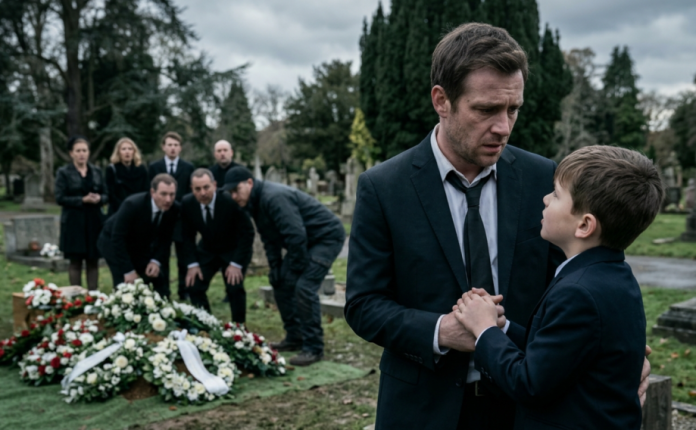
At the funeral, Aunt Linda cried loud and beautifully, in a black dress that cost more than my car. Uncle Gary stood at the back, looking at his phone. Brett came late and left early.
And at the reception afterward, in the church basement, with ham sandwiches on a folding table, I heard Linda say to a cousin, in a low, clear, practical voice: “Well. That’s one down. Now we just have to wait for Dad.”
I didn’t tell Grandpa. I didn’t need to. He was standing by the coffee urn, six feet behind her, with a paper cup in his hand.
I saw him write it in the notebook that night.
Which brings us to Christmas.
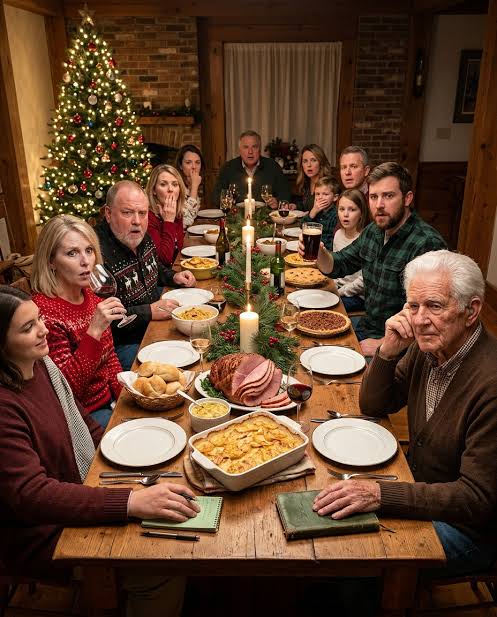
Twenty-two people crowded into that farmhouse, and the old place creaked with the weight of them. Cousins and their kids, in-laws, a great-aunt in a wheelchair. The long dining table, which seats sixteen when pushed to its limit, had been extended with two card tables at the end. Grandma’s good china, the white with the gold rim, was out. A ham. Scalloped potatoes in the big blue dish. Three kinds of pie, though nobody’s was as good as hers.
Grandpa sat at the head, in his good cardigan, the gray one Grandma had knitted. He’d shaved carefully. His thin white hair was combed flat. He looked frail, I’ll admit. He’d lost fifteen pounds since April. But his eyes, behind the old-fashioned glasses, were clear as creek water.
“Dad,” Aunt Linda said, at the start, pouring herself the first of what would be four glasses of wine. “You look wonderful.”
“What’s that?”
“I said you look WONDERFUL.”
“Oh. Thank you, dear.”
I sat at his right hand. He’d asked me to. All through dinner, I felt him beside me, still as a stone, eating slowly, listening.
The conversation began pleasantly enough. The weather, the roads, a cousin’s new baby. Aunt Linda talked about a vacation to Maui. Uncle Gary talked about a truck. Brett, who’d arrived forty minutes late with a bottle of wine and a girlfriend named Tiffani, held forth on cryptocurrency.
Halfway through the main course, something shifted.
I felt it before I heard it. A change in the air, like a barometer dropping. Aunt Linda leaned toward her brother, with her glass in her hand, and lowered her voice to a level she believed was private.
“I talked to a realtor.”
“Oh?” said Gary.
“The south parcel alone. A hundred and sixty acres. He says it’s worth one point two. Easily.”
“Million?”
“Gary.”
“I’m just saying, that’s real money.”
“I know it’s real money. It’s the whole reason we’re sitting here.” She laughed, a short bright laugh. “He’s not going to last the winter, you know.”
“Look at him,” Gary agreed.
At the head of the table, my grandfather lifted a forkful of scalloped potatoes and chewed it slowly.
“I mean, honestly,” Linda said, warming to it, “when he dies, the farm pays off my mortgage. The boat. Brett’s student loans. It’s the only reason we still come out here.”
She laughed again.
Gary laughed.
Brett, from the far end of the table, raised his glass. “To the south parcel.”
Tiffani giggled. A few of the cousins chuckled, uncertainly, the way people do when they’re not sure if they’re allowed to be uncomfortable.
I felt something in me snap.
I started to rise. I don’t know what I was going to say. Something terrible, probably. My hands were on the edge of the table.
And then Grandpa set down his fork.
He did it neatly. Beside his plate, parallel to the knife, the way he’d done ten thousand times in that dining room. It made no sound at all.
Then he lifted his eyes and looked straight down the table at his daughter.
“Linda,” he said.
His voice was clear as a church bell. Not loud. It didn’t need to be.
“I’ve heard every word you’ve said since 2020.”
The room didn’t go quiet.
It went dead.
I have been in a lot of silences. The silence of a hospital corridor. The silence after a slammed door. I have never heard a silence like the one that came down over that table. It was physical. It pressed on my ears. A spoon, somewhere, clinked against a plate, and the sound was like a gunshot.
Aunt Linda’s wine glass stopped halfway to her mouth.
“Dad,” she said. “What?”
“Every Thanksgiving. Every birthday. Every Christmas.” He reached up with two fingers and tapped the tiny device behind his right ear. “I got these in February of 2020. I can hear a pin drop in the next room.”
Nobody moved.
“I heard you say I was a vegetable, Brett.”
Brett’s face went the color of milk.
“I heard you price my combine, Gary. Two hundred thousand, you said. In my machine shed. While I oiled a hinge.”
Gary opened his mouth. Nothing came.
“And Linda.” He turned back to her, and his voice was very gentle, which was the worst of it. “I heard you tell your husband that you’d stop coming out here the day I was in the ground.”
Linda made a small, choked noise.
“I kept a notebook,” Grandpa said. “Six years. Everything you said. Dates and all.”
He reached into the pocket of his cardigan and drew out a small green spiral pad. He set it on the white tablecloth, between the potatoes and the ham, and smoothed it flat with his hand.
Then he turned to me.
“Katie,” he said. “Would you please go get Mr. Dawson from the porch? He’s been waiting in his car. Tell him it’s time.”
That’s how I came to be knocking on a car window in nine-degree weather, asking an attorney to come in for pie.
Walter Dawson walked up the porch steps in his overcoat with his briefcase in hand. He stamped the snow off his shoes on the mat, and I opened the door, and together we walked back down the long hallway to the dining room, past the coat rack and the photographs of three generations, a wedding, a christening, a boy and girl in matching sweaters on a hay wagon.
The family had not moved. Twenty-two people sat frozen at that table, like a photograph of themselves.
Mr. Dawson entered the room. He nodded to the head of the table.
“Henry.”
“Walter. Thank you for coming. I’m sorry about the cold.”
“I’ve been colder.” He set his briefcase on the sideboard and unlatched it. “Shall I begin?”
“Please.”
That’s when Aunt Linda dropped her glass.
It hit the edge of her plate and rolled. Red wine bled across Grandma’s good white tablecloth in a long, slow stain, and nobody moved to stop it.
“Dad,” Linda whispered. “Dad, what is this?”
“It’s Christmas dinner,” said Grandpa. “I thought we’d have a conversation.”
I’ll give you the next twenty minutes as plainly as I can, because I’ve told it a number of times and I still don’t always get the order right.
Mr. Dawson stood beside Grandpa’s chair and opened a folder. He read, in a steady courtroom voice, from a document I could see was seven pages long.
“This is the Last Will and Testament of Henry James Voss, executed on the twelfth of November of this year, in the presence of two witnesses, and notarized. It supersedes all prior wills.”
“Prior wills?” Gary said.
“There was one, executed in 1998. It divided the estate in thirds between Gary, Linda, and Ellen, who is now deceased, with Ellen’s third to pass to her daughter, Katie.” He turned a page. “The 1998 will is revoked.”
“Revoked,” Linda repeated, faintly.
“Mr. Voss has made certain changes. I’ll summarize.”
He did.
The farm, six hundred and forty acres, the house, the buildings, the equipment, was not going to be divided at all. Not sold, not split, not touched. It was going into a trust, in perpetuity, to be operated as a working farm, with a farm manager chosen by a board of three trustees. One of the three trustees was me.
“Katie?” said Uncle Gary.
I couldn’t answer. I hadn’t known. Grandpa hadn’t told me that part.
The second trustee was a man named Raymond Okafor, who had farmed the adjoining land for thirty-one years and whom Grandpa described as “the only neighbor who ever returned a borrowed tool.” The third was Walter Dawson himself.
“The farm will not be sold,” Mr. Dawson read. “Not in whole, not in part, not to any family member, at any time. The income from the operation will be distributed as follows.”
He turned the page.
A third to the upkeep and wages of the farm. A third to a scholarship at the community college in Marshalltown, in Dorothy Voss’s name, for students from farming families. And the remaining third, in equal shares, to Grandpa’s descendants, on a schedule, in annual payments, with conditions.
“Conditions?” Linda said sharply.
“I’ll come to those.”