PART 3
Instead, I took a breath and continued downstairs.
Advertisement
My basement apartment looked painfully familiar. The little kitchen where I’d cooked dinner after long workdays. The secondhand couch I’d bought with my own money. The small bookshelf I’d assembled by myself. The bathroom mirror I’d replaced after the original one cracked.
For nine years, I’d treated that basement as my home.
I’d paid $800 every month, even when my car needed repairs, even when I was saving for emergencies, and even when my friends invited me on trips I couldn’t afford because I didn’t want to fall behind on my responsibilities.
Now, standing there with empty boxes in my hands, I realized how little of that sacrifice anyone remembered.
I started packing the last few things.
A few minutes later, Brittany appeared at the top of the stairs.
“So, are you really leaving everything behind?” she asked.
I glanced at her. “I’m taking my belongings.”
She folded her arms.
“I meant the furniture. The kids need somewhere to sit downstairs. Ryan said you were probably going to leave the couch.”
I stared at her, wondering whether she’d actually heard herself.
“The couch is mine.”
“Well, it’s not like you’re using it anymore.”
“Brittany, I bought that couch. With my money.”
She rolled her eyes.
“Fine. Whatever. I was just asking.”
She turned to leave, then stopped halfway up the stairs.
“Honestly, Emily, I don’t understand why you’re acting this way. We’re family. Family is supposed to help each other.”
I almost smiled.
There it was again.
That magical word everyone remembered whenever they wanted something from me.
Family.
Funny how nobody had mentioned family when I was paying $800 a month while Ryan and Brittany lived upstairs without contributing a cent.
Funny how nobody had offered to cover my expenses when my car broke down last winter.
And funny how, when Mom demanded another $300 from me, she hadn’t suggested that Ryan take responsibility for the additional utility bills.
I lifted the couch cushion and checked underneath it for a missing earring.
“You’re right,” I said quietly. “Family should help each other.”
Brittany looked pleased, apparently believing she had finally gotten through to me.
Then I added, “That’s why you and Ryan should start helping my parents pay their bills.”
Her expression changed immediately.
“You’re unbelievable.”
“No,” I replied. “I’m just done.”
She stomped upstairs.
A moment later, I heard her complaining to Ryan about my attitude. He responded loudly enough for everyone in the house to hear.
“She thinks she’s better than us because she has a job!”
I paused with a box in my hands.
Then I laughed.
Not because it was funny, but because I finally understood something I’d spent years trying to deny.
My family didn’t resent me because I was selfish.
They resented me because I had become useful.
And now that I’d stopped being useful, they needed a reason to make me the bad person.
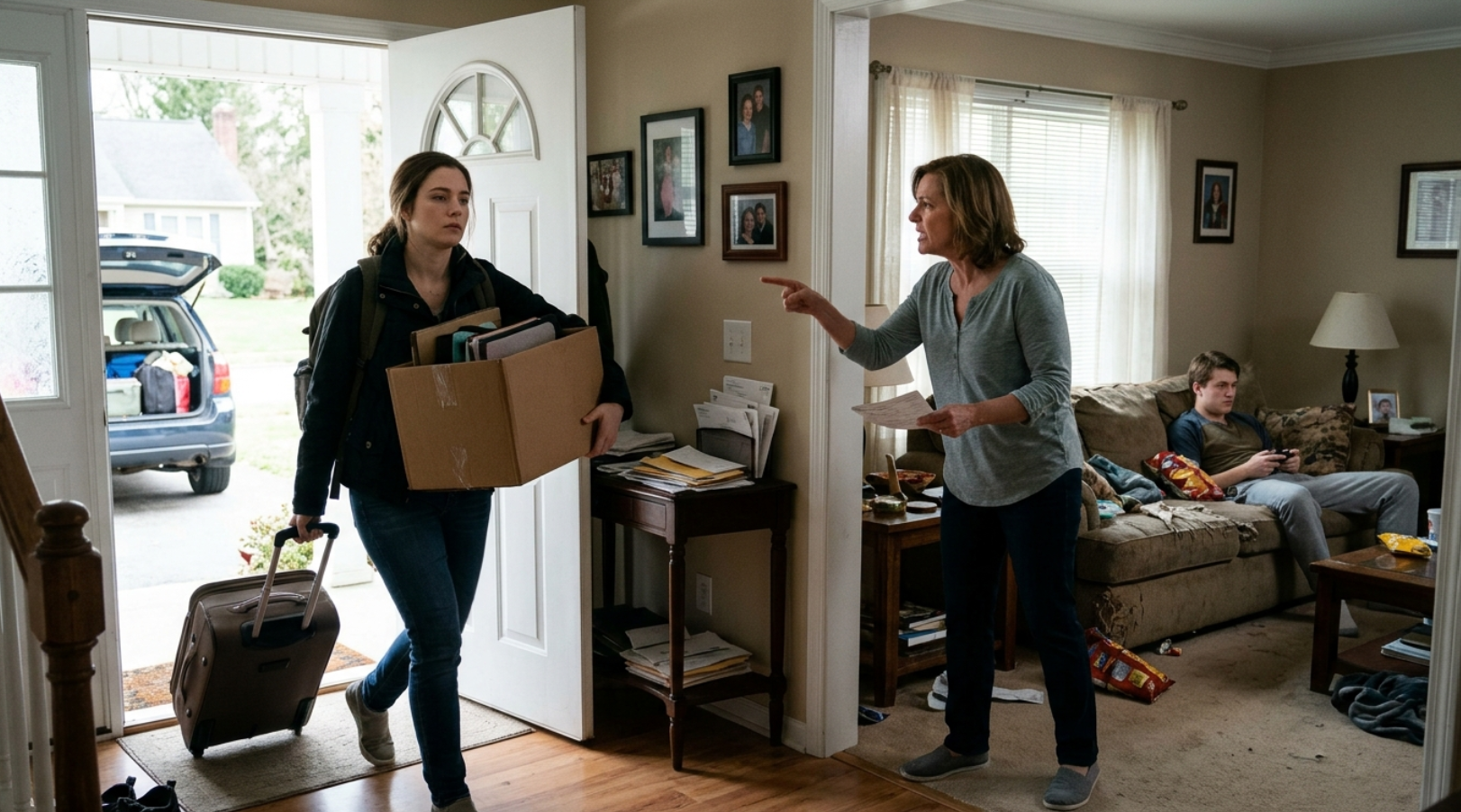
I finished packing the remaining boxes and carried them upstairs.
Mom was waiting in the living room.
She stood beside the dining table, holding a stack of papers. Her face was tight with anger, but beneath it I noticed something else.
Fear.
She tried to hide it when she saw me.
“Emily, we need to discuss something before you leave.”
I set my box down near the front door.
“If this is about money, the answer is no.”
“Could you stop being difficult for five minutes?”
“Could you stop treating me like an extra paycheck?”
David suddenly became very interested in the pattern on the living room rug. Jenna, however, looked directly at Mom.
Mom took a deep breath.
“Your father and I have bills. We have a mortgage. We have insurance. We have property taxes. We have responsibilities.”
“I know.”
“And your brother is going through a difficult period.”
“I know that, too.”
“Then why can’t you understand that we need help?”
I looked at her for a long moment.
“Because you didn’t ask everyone to help. You asked me.”
Mom’s jaw tightened.
“Ryan has two children.”
“And I have bills.”
“Ryan’s situation is different.”
“How?”
She looked at me as if the question itself were offensive.
“Because he has a family!”
I felt something inside me finally settle.
For years, I’d believed that if I worked hard enough, behaved well enough, and helped enough, eventually my mother would look at me with the same pride she showed Ryan.
But there was no finish line.
There would always be another reason he deserved more and I should expect less.
I picked up my box.
“Then I guess he can help you now.”
I walked out.
Mom called after me, but I didn’t turn around.
And for the first time in my life, I didn’t feel guilty.
I felt free.
The following week was peaceful.
I unpacked my kitchen, bought a small dining table from a thrift store, and finally hung the pictures I’d kept in boxes for years. I started sleeping better. I cooked meals without worrying about someone upstairs complaining about the smell. I watched television without hearing children running overhead.
My new apartment wasn’t luxurious.
But every dollar I spent there belonged to me.
On Wednesday evening, Jenna came over with pizza.
She found me sitting cross-legged on the floor, trying to assemble a bookcase.
“You know,” she said, handing me a slice, “most people celebrate moving into a new apartment with wine.”
“Most people don’t spend nine years funding a family drama.”
She laughed.
Then her expression softened.
“Can I ask you something?”
“Sure.”
“Do you think your dad knew what your mom was doing?”
I stopped tightening a screw.
“I don’t know.”
That was the truth.
Dad had always been the quieter parent. He worked hard, avoided arguments, and usually let Mom make the household decisions. When I was growing up, I’d mistaken his silence for agreement.
Now I wasn’t sure what to think.
“He believed me when I told him about the rent increase,” I said. “But I don’t know what else he knows.”
Jenna nodded.
“Maybe you should talk to him.”
I thought about it.
Then I looked at the half-assembled bookcase.
“Maybe I will. But not until I’m ready.”
Jenna didn’t push me.
That was one of the things I appreciated most about her. She never treated my boundaries as an invitation to negotiate.
My family could have learned something from her.
Unfortunately, they were about to learn it the hard way.
On Friday morning, I received an email from Dad.
The subject line read: Can we talk privately?
I stared at it for several minutes before opening it.
Emily,
I know things have been difficult lately, and I understand why you needed to leave.
I owe you an apology for not asking more questions sooner.
Your mother has been telling me things about the money you’ve been giving her, and I think we need to sit down together.
Please don’t feel pressured to come back to the house. We can meet somewhere else.
Love,
Dad.
I read the message twice.
Then a third time.
Something about it unsettled me.
Mom had been telling Dad things about the money?
What exactly had she told him?
I replied that I could meet him for coffee on Sunday.
He agreed.
For the next two days, I tried to put the email out of my mind. I went to work, finished my reports, and spent Saturday morning buying groceries.
But on Sunday, when I walked into the coffee shop and saw Dad sitting at a table near the window, I knew something was wrong.
He looked older than I remembered.
His shoulders were slumped, and there were dark circles beneath his eyes. A cup of coffee sat untouched in front of him.
He stood when he saw me.
“Hey, kiddo.”
I hugged him.
For a moment, neither of us said anything.
Then he pulled out a chair.
“Sit down, Emily.”
I did.
Dad rubbed his hands together before speaking.
“I want you to know something first. I’m not asking you to move back home. I’m not asking you to pay anything. And I’m not going to tell you that you should forgive your mother.”
I blinked.
That wasn’t the conversation I’d expected.
“Okay,” I said cautiously.
He looked down at the table.
“I need to explain what I thought was happening with your money.”
I waited.
“Your mother told me you were paying $800 a month because you wanted to save money while living at home. She said it was your idea, and that you were happy to help with the mortgage.”
“That part is partly true,” I said. “I agreed to pay rent when I moved into the basement. But I never agreed to pay more because Ryan moved in.”
Dad nodded.
“I understand that now.”
He took a breath.
“She also told me that, after Ryan and Brittany arrived, you offered to cover the increased utility bills. She said you were comfortable with the arrangement.”
My stomach tightened.
“Dad, I never offered that.”
“I know.”
His voice cracked slightly.
“I know now.”
He reached into his jacket and pulled out a folded piece of paper.
“I found this in the desk drawer while looking for some mortgage documents.”
He slid it across the table.
It was a printed email.
The message was from Mom to Dad, sent about two months earlier.
I read it slowly.
Mark,
Emily has agreed to take on more of the household expenses while Ryan gets back on his feet. I think it’s best if we let her handle the additional utility payments for now.
She has a steady job and no children, so it makes sense.
Please don’t bring it up with Ryan. He’s already embarrassed about his situation.
I stared at the screen-printed words.
Then I looked up.
“I never saw this.”
Dad shook his head.
“I know. She sent it to me, not you.”
“Did you believe her?”
He closed his eyes briefly.
“Yes.”
The answer hurt more than I expected.
Not because Dad had intentionally betrayed me, but because he hadn’t questioned why the daughter who had always paid her bills suddenly seemed willing to shoulder more of everyone’s burden.
He had simply accepted the version of events that made the household run smoothly.
“I should have asked you,” he continued. “I should have checked. I thought I was doing the right thing by trusting your mother, and I didn’t realize how much I was overlooking.”
I folded the paper and set it down.
“What do you want me to do with this?”
“Nothing. I just thought you deserved to know.”
He paused.
“And there’s something else.”
I felt my stomach tighten.
“What?”
Dad looked toward the window before turning back to me.
“Your mother has been telling me that Ryan and Brittany will only need to stay for a few months. But yesterday, I overheard them discussing something that worries me.”
“What were they discussing?”
“Whether they could stay permanently.”
I stared at him.
“Permanently?”
He nodded.
“Ryan said the children are settled in at school, and Brittany said they couldn’t afford another place right now. Your mother seemed to agree with them.”
I leaned back in my chair.
The situation suddenly looked much worse than I’d imagined.
Ryan hadn’t been treating our parents’ house as temporary accommodation.
He’d been treating it as a long-term solution.
And Mom had been willing to make that happen, provided someone else continued paying the bills.
For nine years, that someone had been me.
Now that I was gone, the arrangement was beginning to collapse.
“Dad,” I asked carefully, “can you afford the house without my rent?”
He didn’t answer immediately.
That silence told me more than any explanation could have.
Finally, he said, “We can manage if we’re careful. But with four extra people living there, the costs have increased considerably.”
“Then Ryan needs to contribute.”
“I agree.”
“Does Mom agree?”
Dad looked away.
“That’s the problem.”
That evening, my phone began ringing again.
Mom.
I let it go to voicemail.
Then came a text.
Your father has been filling your head with nonsense.
Another arrived a minute later.
I don’t know what he told you, but you need to remember that this family sacrificed a lot for you.
I stared at the message.
What sacrifices?
They had provided a roof over my head when I was growing up. They had fed me, clothed me, and supported me through school as best they could.
I would never pretend those things meant nothing.
But I had also worked, paid my rent, bought my own food, and covered my personal expenses for years. I had never asked them to fund my adult life.
And I had never agreed to become responsible for Ryan’s.
I typed a response, deleted it, and put my phone down.
Then it rang again.
This time, it was Ryan.
I answered because I wanted to hear what he had to say.
“What?” I asked.
“Wow. That’s how you answer your own brother?”
“Ryan, I’m tired. What do you want?”
“Mom says you and Dad have been talking about the house.”
I said nothing.
He continued.
“Look, I know things got heated, but you need to stop making this into some huge betrayal. You’re acting like we robbed you.”
“You didn’t rob me. Mom charged me more rent because you moved in for free.”
“We’re not staying for free forever.”
“When do you plan to start paying?”
He hesitated.
“That’s not the point.”
“Then what is the point?”
“The point is that Mom and Dad are struggling, and you’re sitting in your nice little apartment pretending you don’t care.”
I looked around my living room.
My thrift-store table. My secondhand bookcase. The boxes I still hadn’t unpacked.
My nice little apartment.
I’d earned every inch of it myself.
“Ryan, if you care so much about Mom and Dad’s finances, why don’t you get a job and help them?”
His voice sharpened.
“I am looking for work.”
“Since when?”
“That’s none of your business.”
“Exactly.”
He went silent.
Then he said something I would remember for a long time.
“You’ve always been jealous of me.”
I almost dropped the phone.
“Jealous of what?”
“Mom always loved me more. You know that. You always wanted to be the favorite, and now you’re punishing us because you didn’t get your way.”
I closed my eyes.
There it was.
The explanation he’d probably been repeating to himself for years.
If I wasn’t helping him, it must be because I was jealous.
If I wanted equal treatment, it must be because I resented his happiness.
If I refused to pay his bills, it must be because I wanted to hurt his children.
Anything was easier than admitting he had become comfortable living on other people’s generosity.
“Ryan,” I said quietly, “I don’t want to be the favorite. I just want to be treated like a person instead of a financial resource.”
He scoffed.
“Whatever. Mom was right about you.”
Then he hung up.
I sat on the couch for a long time afterward.
Part of me wanted to cry.
Another part wanted to call Dad and ask whether this was what my family had always thought of me.
But eventually, I realized that I didn’t need Ryan to understand me.
I didn’t need Mom to admit she had been unfair.
And I didn’t need to win an argument to justify living my own life.
I only needed to stop participating in a situation that was hurting me.
So I blocked Ryan’s number for the night and went to bed.
For once, I didn’t lie awake rehearsing what I should have said.
Three days later, Mom showed up at my apartment.
I discovered her standing outside my door when I returned from work, holding a folder and wearing the same expression she used whenever she expected me to cooperate.
I didn’t invite her inside immediately.
“What are you doing here?”
“We need to talk.”
“About what?”
She glanced down the hallway.
“Can we please do this inside?”
I hesitated.
Then I stepped aside, mostly because I didn’t want my neighbors listening to our conversation.
Mom walked in and looked around my apartment.
Her eyes moved over the secondhand furniture, the small kitchen, and the pictures I’d finally hung on the wall.
“You’ve made yourself comfortable,” she remarked.
“I have.”
She set the folder on my dining table.
“Your father tells me you’ve been discussing our financial situation.”
“Dad and I had coffee.”
“And now he thinks I’m some terrible person.”
“I didn’t say that.”
“You didn’t have to.”
She opened the folder.
Inside were several bills, a printed mortgage statement, and a handwritten list of expenses.
She pushed them toward me.
“Look at these.”
I glanced at the papers but didn’t touch them.
“Why?”
“Because your father and I need help.”
I looked at her.
“Mom, I already explained that I’m not paying rent for a house I don’t live in.”
“This isn’t rent.”
“Then what is it?”
“An emergency contribution.”
I stared at her.
She had brought me a list of bills and expected me to start paying them again under a different name.
“An emergency contribution to what?”
“To the family.”
I took a slow breath.
“Mom, you have a working-age son living in your house with his wife. Why are you asking me?”
Her expression hardened.
“Because Ryan is trying to get back on his feet.”
“And I’m already on mine.”
“That doesn’t mean you can’t help.”
“Why does helping always mean I have to give up something?”
She opened her mouth, but I continued before she could answer.
“Why didn’t you ask Ryan to pay $800 a month when he moved in? Why didn’t you ask him to cover the additional utilities? Why didn’t you ask him to buy groceries for his own children?”
“Because he can’t afford it!”
“Then how is he going to afford to live anywhere else?”
Mom looked furious.
“You’re being cruel.”
“No, Mom. I’m asking a practical question.”