PART 2 — THE SECRET GRANDMA OPAL HAD KEPT FOR FORTY YEARS
“Good,” Opal repeated, tightening her grip on my hand. “Because if my son finds out what you’ve bought, he’ll be standing on this porch before sundown.”
I stared at her, confused.
“Ron? Why would he care about an abandoned house?”
Opal looked toward the old barn, then slowly shook her head.
“Because that house is the one thing he spent forty years trying to keep out of this family.”
My stomach tightened.
“What are you talking about?”
Instead of answering, she started toward the front steps.
“Help an old woman inside, sweetheart. There are some things I need to see before I explain.”
I took her arm and guided her across the uneven walkway.
Nate was working in the kitchen when we entered, kneeling beside an open electrical panel.
He looked up, surprised.
“Grandma? What are you doing here?”
Opal smiled at him.
“Apparently, visiting the only grandson with enough sense to buy something worth fixing.”
Nate laughed.
“Well, don’t compliment me yet. You haven’t seen the plumbing.”
But Opal wasn’t laughing.
She studied the walls, the old staircase, and the doorway leading into the dining room.
Then she asked a question that made Nate stop working.
“Have you opened the cellar?”
Nate wiped his hands on a rag.
“Not completely. The outside entrance is blocked by a fallen tree, and the interior door is nailed shut. Why?”
Opal closed her eyes.
“Of course it is.”
I exchanged a look with my husband.
“Grandma,” Nate said carefully, “what’s going on?”
She walked toward the dining room without answering.
Her cane tapped against the worn wooden floor.
When she reached the far wall, she stopped beneath an old wooden cabinet built into the plaster.
“Your grandfather made this,” she whispered.
Nate frowned.
“Grandpa built that?”
“Before you were born. Before your father was married. Before this house belonged to the Millers.”
She ran her fingers across the cabinet’s decorative molding.
“Your grandfather, Walter, grew up here.”
I felt a sudden chill.
“Wait. This was your family’s house?”
Opal nodded.
“His parents owned this land. Nearly sixty acres originally. The house, the barn, the orchard, and the creek.”
Nate slowly stood.
“Nobody ever told me that.”
“Your father made sure of it.”
The room fell silent.
Outside, a truck passed along the gravel road, sending dust drifting through the afternoon sunlight.
Opal lowered herself into one of our folding chairs.
“Your grandfather died believing this property would eventually return to our family. He trusted Ronald to make certain it happened.”
“What happened instead?” I asked.
Opal looked directly at Nate.
“Your father made a decision that Walter never forgave him for.”
Nate pulled another chair closer.
“Grandma, you’re scaring me.”
She reached into her purse and withdrew a small envelope, yellowed around the edges.
Inside was an old photograph.
It showed a much younger Opal standing beside a handsome man in overalls.
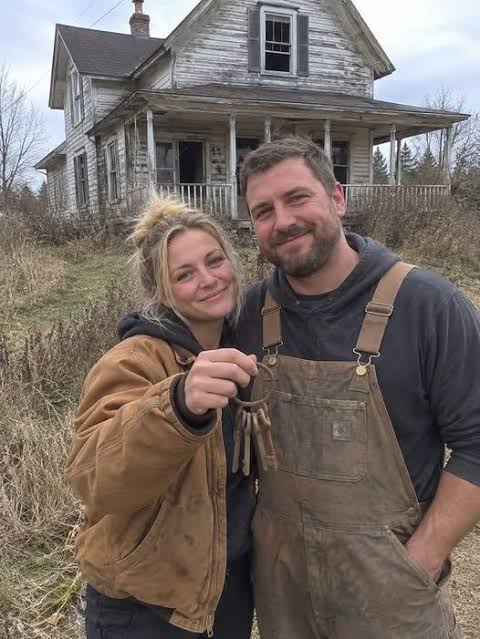
Behind them stood the same farmhouse we had just purchased.
The porch was straight then.
The shutters were painted green.
And a little boy stood between them, holding a wooden toy tractor.
“That’s Dad,” Nate said quietly.
Opal nodded.
“He was eleven.”
I studied the picture.
There was something unsettling about seeing my father-in-law smiling in front of a house he’d never once mentioned.
“Why did the Millers end up owning it?” I asked.
Opal’s expression hardened.
“Because Ronald persuaded Walter to sign papers he didn’t fully understand.”
Nate stared at her.
“What kind of papers?”
“Your grandfather was recovering from a stroke. Ronald told him the documents would protect the land from creditors. Instead, they transferred ownership to a company Ronald controlled.”
I felt my mouth go dry.
“Are you saying Ron took the property?”
“I’m saying he persuaded his own father to give up control of everything he’d worked for.”
Nate sank into the chair.
“But the Millers?”
“The company eventually sold the property to Harold Miller. Ronald told everyone the family had lost the land because of unpaid debts.”
Opal looked toward the window.
“After Walter died, I learned enough to know that wasn’t the entire truth. But by then, the documents had been signed, the money had disappeared, and Ronald refused to discuss it.”
“Why didn’t you tell anyone?” Nate asked.
Opal looked down at her trembling hands.
“Because I was afraid of losing my son. And every year I stayed silent, telling the truth became harder.”
There was no anger in Nate’s face.
Only disbelief.
For a long moment, none of us spoke.
Then Opal reached into her purse again.
This time, she removed a small brass key attached to a faded red ribbon.
“I kept this after Walter died.”
She placed it in Nate’s palm.
“What does it open?” he asked.
“The cabinet.”
Nate walked across the room and examined the old wooden doors.
He found a tiny keyhole beneath the lower shelf.
The brass key fit perfectly.
With a quiet click, the lock opened.
Inside were three narrow drawers.
The first contained old receipts and a handful of faded photographs.
The second held a leather-bound notebook.
But the third drawer wouldn’t move.
Nate tugged gently.
“It’s stuck.”
Opal shook her head.
“There’s a latch underneath.”
He reached beneath the cabinet and found a small metal lever.
The drawer slid forward.
Inside was a sealed brown envelope.
Written across the front in faded blue ink were three words.
FOR MY FAMILY.
Nate looked back at his grandmother.
“Is this Grandpa’s handwriting?”
Tears filled her eyes.
“Yes.”
He carefully opened it.
Inside were several pages, folded together, and a handwritten letter dated just months before Walter’s death.
Nate began reading silently.
As his eyes moved down the page, the color slowly drained from his face.
“Nate?” I whispered.
He didn’t answer.
Instead, he handed me the letter.
The first paragraph described how Walter had discovered the property transfer after his stroke.
The second explained why he’d stopped trusting Ronald with his financial affairs.
But it was the final paragraph that made my hands begin to shake.
“If this letter is ever found, I want my descendants to know that Ronald was not the only person involved. There were three signatures on the original agreement, and the third belongs to someone who has spent years pretending to be innocent.”
Beneath those words was a name.
Judith.
Judy.
My mother-in-law.
I looked up slowly.
“Grandma… Judy helped him?”
Opal’s face crumpled.
“She witnessed the agreement. I confronted her once. She told me it was none of my business.”
Nate took the letter back.
For the first time since I’d known him, his hands were trembling.
All those years, his parents had spoken endlessly about responsibility.
Hard work.
Independence.
They had handed their three other children checks for $20,000 while congratulating us for being capable enough to manage without help.
And now we were standing inside a house that held a secret they had never wanted uncovered.
“Did they give us that card because they knew we were saving for a house?” I asked.
Opal studied me.
“I don’t know why they excluded you. But I do know your father has always been uncomfortable with how much Nate reminds him of Walter.”
Nate gave a short, bitter laugh.
“Grandpa used to tell me never to borrow what I could earn.”
“He also believed a man’s character showed in what he did when nobody was looking,” Opal replied.
She reached across the table and covered Nate’s hand.
“That’s why I wanted to see this house. Walter made me promise that if it ever came back into the family, I would tell the truth.”
I looked around the worn dining room.
The broken plaster.
The unfinished floors.
The ceiling stained by years of rain.
We had spent two exhausting years saving every dollar we could.
We’d sacrificed weekends, vacations, and nearly every comfort.
And somehow, without knowing its history, we’d bought the very home my husband’s grandfather had lost.
Nate stood and walked toward the window.
“Does Dad know this cabinet exists?”
“I don’t think he ever found the hidden drawer,” Opal said.
“Then we should make copies of everything,” I replied.
Nate nodded.
“I’ll photograph it all tonight.”
But Opal wasn’t finished.
She pointed toward the leather notebook.
“Open that, too.”
Nate lifted it carefully.
The first pages contained Walter’s handwritten records of crops, livestock, and household expenses.
Then came a list of property boundaries.
And near the back, an old survey drawing.
Nate unfolded it across the table.
“Grandma, this says the original property extended past the creek.”
“It did.”
“But the auction paperwork only lists eight acres.”
Opal leaned closer.
“That’s because the land was divided before the Millers bought the house.”
Nate traced the boundary lines with his finger.
“Who owns the rest?”
Opal hesitated.
“I don’t know who owns all of it now.”
He turned another page.
There was a notation beside the barn.
A small rectangle was marked beneath the building.
“What is that?” I asked.
Opal stared at it.
Then she pressed one hand against her mouth.
“Oh, Walter.”
“What?” Nate asked.
She tapped the drawing.
“He told me he was keeping something safe beneath the barn. He said he wanted to make certain Ronald couldn’t touch it.”
“What was it?”
“I never knew. Walter said I’d understand when the time came.”
Nate stared toward the backyard.
The old barn stood beyond the kitchen window, half-hidden beneath climbing vines.
For the first time, I wondered whether the property we’d bought held far more than rotting floorboards and forgotten furniture.
Then my phone rang.
I glanced at the screen.
JUDY.
Nate saw the name.
“Don’t answer,” he whispered.
But before I could silence the call, a text message appeared.
“We heard about the Miller property. Your father-in-law and I need to speak with you immediately.”
Another message followed.
“Do not start digging anywhere around the old barn.”
I slowly turned the phone toward Nate.
He read the message once.
Then again.
His face changed.
“How does Mom know about the barn?”
Opal reached for the phone.
When she saw the warning, all the color disappeared from her face.
“Sweetheart,” she whispered, “lock the back door.”
I stared at her.
“Why?”
She looked toward the window, where the barn stood quietly in the afternoon sunlight.
“Because Ronald wouldn’t care about that collapsing building unless he knew exactly what your grandfather hid beneath it.”
Before Nate could answer, we heard the unmistakable crunch of tires on the gravel driveway.
A black SUV rolled past the front gate.
I recognized it immediately.
Ron and Judy.
They weren’t supposed to know we were here.
They weren’t supposed to know about the cabinet.
And they certainly weren’t supposed to know about the survey.
Nate folded his grandfather’s letter and slipped it into his pocket.
Then he looked at me.
“Put the notebook somewhere safe.”
Outside, a car door slammed.
A second later, Ron’s voice rang across the porch.
“Nathan! Open this door. We need to talk before you make a terrible mistake.”
Opal slowly rose from her chair.
She gripped her cane, straightened her shoulders, and looked toward the entrance.
For the first time that afternoon, she didn’t appear frightened.
She looked furious.
“Forty years,” she whispered. “I’ve kept quiet for forty years.”
Then she turned to her grandson.
“Open the door, Nate.”
He hesitated.
“Grandma—”
“Open it,” she repeated. “Your father has spent his entire life believing he can bury the truth.”
She stepped toward the hallway.
“And today, he’s going to learn that some things refuse to stay buried.”
But just as Nate reached for the doorknob, someone outside shouted something that stopped all three of us cold.
It wasn’t Ron.
It was Judy.
“RONALD, THE BARN DOOR IS OPEN!”
Opal froze.
Nate looked toward the kitchen window.
And that was when we saw it.
The heavy wooden doors of the barn, which Nate had chained shut the previous evening, were standing wide open.
A fresh set of tire tracks crossed the weeds behind it.
Someone had already been there.
And whatever Walter had hidden beneath that barn…
Someone else had come looking for it first.
END OF PART 2 — TO BE CONTINUED IN PART 3
PART 3 — My in-laws gave their other three children $20,000 each to help them purchase homes