“Non così in fretta,” I said into the microphone, in the Italian Ottavia had spent a year teaching me. Not so fast.
Aria’s brother’s hand stopped an inch from mine.
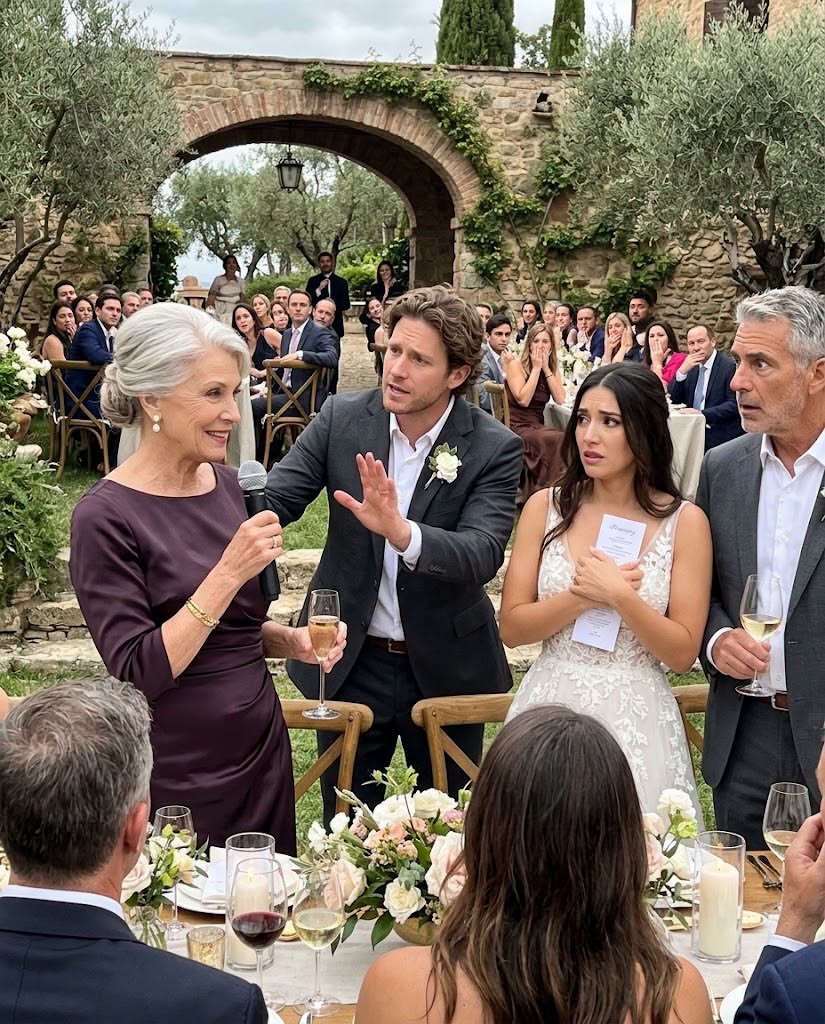
A hundred and forty guests sat under the olive trees with cream-colored cards in their fingers. The late sun lay gold across the courtyard stones. Somewhere a violinist had stopped mid-phrase. And at the head table, Aria’s father, Salvatore Ferrante, a broad, silver-haired man who had kissed both my cheeks at the airport, was staring at me as if the wine in his glass had turned to vinegar.
“Buonasera,” I said. “Mi chiamo Margaret Toland. Sono la madre dello sposo.”
The courtyard went so silent I could hear the leaves.
I should tell you how I got there.
My name is Margaret Toland. I’m sixty-eight, and I taught Latin at a public high school in Dayton, Ohio, for thirty-seven years. Latin is a dead language, which people think means a useless one. I spent my career proving otherwise to teenagers who had no intention of being persuaded. I taught them that a language is a house, and if you learn where the doors are, you can walk into any room built from the same bricks.
I was widowed at fifty-nine. My husband, Paul, was a high school band director who died of a heart attack in the parking lot after a Friday night football game, still holding his baton. Our son Drew was twenty-nine. He had Paul’s long jaw and his habit of whistling when he was nervous.
Drew never went to college. He apprenticed with a heating and air-conditioning contractor at eighteen, started his own company at twenty-six, and now has eleven employees and a fleet of white vans with his name on the doors. He is the hardest-working person I know, and the most trusting. He gives people the benefit of the doubt the way other men give tips.
When he called me eighteen months ago, I heard it in his voice before he said a word.
“Mom. I met someone.”
Her name was Aria Ferrante. She was thirty-four, from a small town in Puglia, in the heel of Italy. She had come to Ohio on a hospitality exchange to study hotel management and had stayed to work at a boutique inn in Cincinnati, where Drew had gone to fix a failing boiler. He told me she laughed at him for talking to the boiler. By the end of the week, he’d asked her to dinner.
I met her at Thanksgiving. She was lovely. Dark hair, quick eyes, a warm, theatrical way of talking with her hands. She brought a tray of almond pastries she’d made herself and kissed me on both cheeks. She called me “Mamma Margaret.” I’ll admit it touched me.
When Drew proposed, on a bridge in Cincinnati at sunset, I cried at my kitchen table for an hour. Paul would have loved her, I thought. Paul loved anyone who loved our boy.
The wedding would be in Italy, at her family’s hotel, in the hill town of Monte Alto. Drew asked if I would come.
“Mom, I wouldn’t do it without you.”
I said I’d be there. And that night, after I hung up, I sat in Paul’s old armchair with a cup of tea and thought about what I could give them that wasn’t a toaster.
The idea came to me the way good ideas do, sideways.
I’d been a language teacher my whole life. I knew Latin, the mother of Italian. I had read Virgil in the original at nineteen. Italian, I thought, wouldn’t be so hard. The bones were already in my head. I only needed the flesh.
I found Ottavia through a notice on the corkboard at the Dayton public library. Native Italian speaker offers conversation lessons. Patient with beginners and the elderly. The phone number was written in a shaky, elegant hand.
Ottavia Ruggiero was eighty-one, a tiny woman from Bologna with white hair in a knot and a cardigan buttoned wrong. She’d come to Ohio in 1968 to marry an American engineer and stayed after he died. She lived in a bungalow filled with plants and the smell of garlic. She opened the door, looked me over from head to foot, and said, “You are too old to be this stubborn. Good. Come in.”
We met Tuesdays and Fridays. She taught me the way she’d been taught, by shouting, mostly, and by feeding me. I conjugated verbs over minestrone. I learned subjunctives over espresso so strong it made my teeth hum. When I butchered a sentence, she’d throw up her hands and cry, “Madonna! You murder it!” and then pat my cheek and make me say it again.
Two hours of practice every night, at my kitchen table, with flash cards and a radio tuned to an Italian station I got through the internet. I listened to newscasts, soap operas, a call-in show about soccer. I understood almost nothing the first three months. Then one morning in March, I heard a woman on the radio say something about the price of tomatoes, and I laughed out loud, because I’d understood the joke.
I told no one. Not Drew. Not Aria. Not my sister. I wanted it to be a surprise, my gift: a toast in Aria’s own language, at her own wedding, from the strange American mother-in-law who’d come all that way.
I wrote it in January. It took me three weeks and six drafts, and Ottavia corrected every line with a red pencil and a look of long suffering. At the end, she read the final version aloud, slowly, and put it down on the table.
“It is good,” she said. “It is not perfect. But it has a heart. In Italy this is more important.”
I had it memorized by April. I could recite it in the shower, in the car, in my sleep.
I also saved sixty thousand dollars.
I’d been putting money aside for years, a little from every paycheck, a little from Paul’s life insurance, a little from selling his band instruments. It was meant for Drew’s first house. They’d been talking about buying one in Dayton. I had a cashier’s check made out to the couple, in a cream envelope, to be given at the wedding.
I wanted their marriage to begin on solid ground.
We landed in Bari on a Wednesday in June. Salvatore met us at the airport with his wife, Concetta, and Aria’s brother, Matteo, a trim, smooth man of thirty-six with expensive loafers and a way of smiling with only the lower half of his face.
They embraced us like returning soldiers. Salvatore kissed Drew on both cheeks, then took my hands and said, in careful English, “Signora Margaret. Welcome. Our home is your home.”
I thanked him. I understood, perfectly, the rapid Italian that followed, a joke to Concetta about how tired Americans looked. I said nothing. I smiled the polite, vague smile of a woman who has just stepped off a long flight and understands nothing at all.
It was a game I’d decided to play. I wanted to hear how they spoke when they thought I couldn’t follow. I wanted to know the real family before the performance of one.
I didn’t know yet what I’d hear.
The hotel was called the Albergo Ferrante, and it sat on a rocky hill above Monte Alto, a town of white stone and red tile with a clock tower and a church with a crooked steeple. It had twenty-two rooms, a terrace overlooking the olive groves, and a dining room with a ceiling painted with faded cherubs. It was beautiful and run-down in the way that old things are when love has outlasted money.
They put us in a suite on the second floor. A balcony. Lace curtains. A ceiling fan that ticked.
The first two days were wonderful, and I’ll admit that. We toured the town. Concetta cooked for hours, enormous meals with seven courses, bowls of orecchiette and platters of grilled fish, and Drew ate until he groaned. Aria held his hand under the table. Salvatore told stories about the hotel’s history, how his grandfather had built it in 1931, how it had survived the war and an earthquake and a bank.
“Now, the roof,” he said, with a theatrical sigh. “The roof is another story.”
I understood the next thing he said to Matteo, under his breath.
“Quel tetto ci sta uccidendo.” That roof is killing us.
I said nothing. I sipped my wine.
It was in the little things, at first. A phrase here. A glance. Concetta, in the kitchen, speaking quickly to a cousin: “La vecchia maestrina non capisce niente. Guarda come si veste.” The old schoolteacher understands nothing. Look how she dresses.
A burst of laughter from the cousin.
Matteo, to Aria, over coffee, with a flick of his eyes toward me: “Sembra una zia di campagna.” She looks like a country aunt.
Aria laughed. Not unkindly. But she laughed.
I smiled at all of them, and asked Drew in English to pass the bread.
I told myself it was nothing. Families gossip. A mother-in-law is always a target. I’d been one myself, once, to a woman who found my cooking amusing. I decided not to let a few jokes ruin what I’d come for.
Then came Tuesday night.
The restaurant was a little place in the old town, with a terrace over a steep, narrow street where laundry hung between the windows. We sat at a long table under a string of lights. Salvatore, Concetta, Matteo, Aria, Drew, and me. There was wine in a rough clay pitcher. The waiter brought plate after plate. Drew was happy, flushed, one arm around the back of Aria’s chair.
When the bill arrived, Drew, being Drew, reached for it. Salvatore protested, with a theatrical wave. Drew insisted. “Please. I want to.” He stood, kissed Aria on the head, and went inside to pay.
The moment his back disappeared through the doorway, something in the table changed.
It was subtle. Like a hand being slipped out of a glove.
Salvatore leaned back in his chair. He picked up his wine. He turned to his daughter and said, in Italian, easily, at a normal speaking voice:
“Rilassati. La vecchia non capisce una parola.”
Relax. The old woman doesn’t understand a word.
My hands were in my lap. I kept them there. I felt the blood go out of my fingers.
I looked at my wine. I turned the stem a quarter turn. And I listened.
I’ll give you what he said as best I can, because I wrote it down that night in my room, in a notebook, in a trembling hand, trying to get every word.
Salvatore spoke first, to Matteo.
“Il discorso è pronto?” Is the speech ready?
“Pronto,” Matteo said. He was smiling that half-smile. “L’ho scritto io. Ho fatto stampare cento quaranta copie. Ogni invitato ne avrà una accanto al bicchiere.”
It’s ready. I wrote it myself. I had a hundred and forty copies printed. Every guest will have one beside their glass.
“E dice?” And it says?
Matteo laughed. “Che il cibo del Sud è rozzo. Che il paese è un buco senza storia. Che l’albergo è una pensione per poveracci.”
That Southern food is crude. That the town is a hole without history. That the hotel is a boarding house for the poor.
Concetta gasped, delighted. “E lei lo dirà?” And she will say it?
“Lei parlerà in inglese,” Matteo said. “Io farò finta di tradurre. Ma la gente leggerà il biglietto. Penserà che sono parole sue.”
She will speak in English. I will pretend to translate. But the people will read the card. They’ll think it’s her words.
I sat perfectly still. My heart had begun to pound so hard I thought they must hear it.
Salvatore chuckled. “L’americana piangerà. Se ne andrà di corsa. E il figlio, vergognoso, resterà qui.”
The American will cry. She’ll run off. And the son, ashamed, will stay here.
“E allora?” And then? Aria’s voice. Quiet. Matteo’s smile widened.
“Allora,” Salvatore said, “lui non vorrà lasciarti sola. Lo conosci. È buono come il pane. Resterà. E quando si ferma, trasferirà i soldi.”
Then he won’t want to leave you alone. You know him. He’s good as bread. He’ll stay. And when he stays, he’ll transfer the money.
I stopped breathing.
“Duecentodiecimila euro,” Salvatore said. “Per il debito della banca. Il tetto. Il resto.”
Two hundred and ten thousand euros. For the bank debt. The roof. The rest.
“E la busta?” Concetta asked, glancing at my purse. The envelope in my purse. “La signora ha una busta. L’ho vista in aeroporto.”
The lady has an envelope. I saw it at the airport.
“Seguirà,” Salvatore said, nodding. “Quando lei se ne va piangendo, la prenderemo. Una madre vuole sempre aiutare il figlio.”
It will follow. When she leaves crying, we’ll take it. A mother always wants to help her son.
I looked at my daughter-in-law-to-be.
Aria wasn’t protesting. That was the moment my stomach turned over. She was sitting with her hands in her lap, her face pale and thoughtful, and she was saying, in a low, practical voice, “Il bonifico deve partire prima di lunedì. La banca chiude venerdì.”
The wire must go before Monday. The bank closes Friday.
I felt something inside me go very cold and very quiet, the way a house goes quiet when the power fails.
I picked up my glass. I took a slow sip of wine. It tasted of cherries and iron.
And then the door opened, and Drew came out into the lights, smiling.
“All paid, Mom,” he said. And he bent and kissed my cheek.
I’ll tell you something about that kiss.
He smelled like soap and the faint chemical sweetness of the restaurant. His cheek was warm. His whiskers brushed my skin. I remember thinking, with absurd clarity, that he’d missed a spot shaving.
I almost broke then. I’ll admit it. I had my mouth open. I had a sentence half-formed. Drew, we’re leaving. Now.
But I looked at the table. At Salvatore, smiling benignly, spearing a piece of cheese. At Concetta, dabbing her lips. At Matteo, scrolling his phone. At Aria, who had turned, with a perfectly warm smile, and put her hand on Drew’s arm.
And I thought: If I say it now, they’ll deny it.
They’d laugh. They’d say I’d misunderstood. The old American woman, with her year of lessons, had mistaken a joke. Drew, who loved Aria and wanted desperately to believe in all of it, would take their side. I knew my son. He’d rather doubt his mother than doubt the woman he’d asked to marry him.
I needed proof.
I smiled. I said, in English, “That was a lovely dinner.”
“The best,” Salvatore said warmly.
I raised my glass.
That night, in the suite, with Drew asleep in the other room and the ceiling fan ticking above me, I sat on the edge of the bed with a notebook and wrote down every word I’d heard.
My hands shook so badly I had to stop twice.
When I finished, I read it over. Then I did what a Latin teacher does when she finds an error in a text. I made a plan.
I’d been trained for it. Thirty-seven years of reading ancient historians had taught me to ask the same questions of any document. Who wrote it? For whom? What did they want? What did they leave out?
What did they want? Money. Two hundred and ten thousand euros, plus sixty thousand dollars.
Who was the audience? A hundred and forty guests, and one son.
What was the weak point? The speech.
They’d built the whole scheme on a single assumption. That I couldn’t understand them. That assumption was false. And a scheme built on a false assumption, like a house with a bad foundation, will stand just fine until someone presses on it.
I decided to press.
The next morning, I asked Matteo for a favor.
He found me on the terrace, over coffee. I’d gotten up early. I wore my reading glasses and held a sheet of paper, and I did my best impression of a flustered old schoolteacher.
“Matteo, dear,” I said, in slow, simple English. “I wonder if you could help me. I’ve prepared a little toast for the wedding. In English. Drew said you might translate.”
His eyes lit. I watched him try to hide it.
“Of course, Signora. It would be my honor.”
“It isn’t long.” I handed him the paper. “I just want to say a few kind words. About Aria. About the family. About the beautiful hotel.”
I’d written it carefully. Every sentence was warm. Every sentence was true.
Aria has taught my son to laugh at boilers.
I have never seen him as happy as he is in the light of her family.
I thank the Ferrante family for the generosity of their table.
He scanned it. His mouth twitched. “Beautiful,” he said. “I will make it perfect.”
“And Matteo?” I touched his sleeve. “There’s one more thing. I’d like to thank your grandmother. Nonna Lucia. I understand she built the hotel’s kitchen. It would mean a great deal to me.”
I’d learned about Nonna Lucia from a cousin’s gossip, in Italian. She was ninety-four, bedridden, and the only person in the family who’d said, in my hearing, a kind word about America.
Matteo hesitated. A flicker passed across his face, almost like guilt. Then it was gone.
“Of course, Signora. I will include it.”
I smiled. I thanked him. I watched him walk away with my toast folded in his pocket.
Then I went upstairs, and I made a phone call to a woman in Dayton.
Ottavia answered on the fourth ring.
“Pronto?”
“Ottavia. It’s Margaret. I need your help.”
I told her everything. It took twenty minutes. I could hear her breathing on the line, and at one point, a clatter, as if she’d dropped a pot.
When I finished, she was silent.
“Ottavia?”
“Those bastardi,” she said, softly, with a vehemence that made me start. “Those, porci. In my village we have a word for such men. I will not say it to a lady.”
“I’m not sure what to do.”
“You will do what a teacher does,” she said. “You will let them make the mistake. And then you will correct it.”
“In front of a hundred and forty people?”
“Where else? Margherita.” She’d never called me that. “You have studied for a year. You have worked harder than any student I ever had. This was not for nothing. God does not give a woman a language for no reason.”
I closed my eyes.
“What do I say?”
She told me. Not word for word. She gave me a principle. And I realized, as she spoke, that it was the same principle I’d taught my students for thirty-seven years.
Say the truth, in their own language, and let them hear it.
I needed two things. Proof, and a witness.
The proof came on Thursday.
Matteo had told me, with a flourish, that the toast would be “printed on cards, for the guests, so everyone could follow along.” He said it was a tradition, a courtesy to the foreign relatives. He’d handled the whole thing at a print shop in the next town.
I went there alone, on a borrowed bicycle, on a hot, bright afternoon. It was a tiny shop, run by a bald man in an apron. I walked in and said, in my best Italian, which I’d been hiding for a week, “Buongiorno. I’m the mother of the groom. I’d like to see the cards you printed for the wedding.”
The man blinked. “You speak Italian, Signora?”
“A little. I’m still learning.”
“But the young man said…” He stopped. Looked embarrassed.
“What did he say?”
“That you didn’t. That I should speak English to you, if you came.”
I smiled. “I came to see the cards.”
He hesitated. Then, with a shrug, he reached under the counter and took out a sample, a cream-colored card with gold edges, my name printed at the top in elegant script. Il brindisi della madre dello sposo. The toast of the groom’s mother.
I read it. All of it. My hands, I noticed, had stopped shaking.
It was everything Matteo had promised. A few lines, in flowing Italian, that no mother-in-law in her right mind would ever say. A sneering comment on the “poverty” of the hotel. A joke about Southern cooking. A line about the town being “a hole in the map.”
And at the bottom, one more insult, aimed at a woman who’d done nothing to deserve it. “Nonna Lucia, che ha costruito una cucina per i maiali.” Nonna Lucia, who built a kitchen for pigs.
I put the card down very gently.
“May I take a photograph?”
“Of course, Signora.”
I took six. Then I took a seventh, of the printed order slip on the counter, which carried Matteo’s name, his phone number, and a signature in blue ink. Ordinato da: M. Ferrante. Pagato: contanti.
“Signor,” I said, when I’d finished. “Do you have a copy of the toast I actually submitted? Did he send you the English version?”
“Yes, Signora. He sent me nothing in English. Only this.” He pointed to the Italian. “He said it was the translation.”
“But it isn’t a translation.”
“No.” He looked at the card, then at me, and some old, plain honesty came into his face. “I thought it was strange. A mother does not say such things. But I am only the printer.”
“You’re an honest man,” I said. “Thank you.”
He bowed his head. “Signora. Forgive me. I did not know.”
“There’s nothing to forgive. I’d like to buy the sample. And I’d like to ask a favor.”
“Anything.”
“Do you still have the other hundred and thirty-nine?”
“They are boxed. Matteo comes tomorrow to collect.”
“Would you change them?”
He frowned. “Signora?”
I took out a sheet of paper and laid it on the counter. It was my real toast, in the Italian I’d written myself, with Ottavia’s red-pencil corrections. Six paragraphs. Every word true.
“Could you print this instead?”
He looked at the paper. He looked at me. And then, slowly, a smile spread across his weathered face.
“For you, Signora,” he said, “I would print it in gold.”
I want to tell you what I told Drew, and why I didn’t tell him everything.
I tried, on Friday morning. We were alone on the terrace, with the olive groves silver below. He was sipping coffee in his shirtsleeves, looking out over the valley, and he looked so happy that my heart contracted.
“Drew,” I said. “I need you to postpone the transfer.”
He turned. His smile faltered. “Mom. We’ve talked about this.”
“Please. Just a week. Just until after the wedding.”
“The bank closes Friday. Aria says the hotel’s in real trouble. It’s a short-term thing. I’m not just giving them money, Mom. I’m investing. In the family. In our future.” He set down his cup. “Can you just, can you please just be happy for me?”
I’d rehearsed what I’d say. I’d planned a calm, measured explanation. But I looked at my son, a man of thirty-eight with Paul’s jaw and his wide, hopeful eyes, and I knew, with an absolute certainty, that anything I said before the wedding would be heard as jealousy.
“I am happy for you,” I said. “I’m so happy. I just need you to trust me.”
“I do trust you.”
“Then wait.”
He studied me. A long pause. Then he said, gently, “Mom. I know it’s hard. Dad’s gone. You’re afraid I’ll go too. But this is a good thing. They’re good people.”
I felt something crack, very softly, inside my chest.
“Drew.”
“Yeah?”
“Whatever happens tomorrow,” I said, “I want you to remember that I love you.”
He laughed, startled. “Mom. It’s a wedding.”
“I know.”
“What’s going to happen?”
I touched his cheek. He was warm, and young, and trusting.
“A toast,” I said.
Saturday dawned clear and bright.
I woke before the others, in the dim blue light, and lay for a long time looking at the ceiling fan. I thought of Paul. I thought of the baton in his hand in the parking lot. I thought of the way he’d looked at me, at our own wedding, in a rented tuxedo two sizes too big, with his ears turning red.
Peggy, he’d whispered, at the altar. What if I mess it up?
Then we’ll mess it up together, I’d said.
I got up. I showered. I put on the emerald-green dress I’d bought in Dayton in April, a plain, elegant silk with a fitted waist. I’d chosen the color because Ottavia said it was the color of strength. I pinned my gray hair up. I put on Paul’s mother’s pearl earrings.
In the mirror, a sixty-eight-year-old woman looked back at me, steady-eyed, with a fine web of lines around her mouth.
You’ve stood in front of thirty-five teenagers at eight in the morning and made them love the ablative absolute, I told her. You can do this.
She didn’t look convinced. But she nodded.
The wedding took place at four in the afternoon, beneath olive trees that had been planted before Columbus sailed. They’d set up a courtyard behind the hotel, with white chairs in neat rows and an arch of white roses and a long table under the trees. The sun came through the silver leaves in coins of light. A string quartet played.
A hundred and forty guests. I counted. Habit.
Salvatore, in a cream linen suit, kissed my hand. “Signora. You look magnificent.”
“Thank you, Salvatore.”
“Today is a great day.”
“Yes,” I said. “I think it will be.”
He beamed. He had no idea.
Drew stood at the arch, in a charcoal suit, trembling a little. He looked so much like Paul in that moment that my knees went weak. I put a hand on a chair. He saw me, and grinned, and mouthed, Mom.
I mouthed back, I’m here.
Aria came down the aisle on her father’s arm, in a flowing ivory gown with a veil of old lace. She was radiant. She was, I’ll admit, breathtaking. I watched her walk toward my son, her face luminous, her eyes on his, and I thought, with a terrible, clear sorrow, I wish I knew what’s true.
She took his hands. They exchanged vows, in English and Italian, in the golden light. Drew’s voice cracked on the word always. Aria’s eyes filled. The priest, a round old man with a face like a happy walnut, blessed them, and the courtyard erupted in applause.
I clapped, too. I want you to know that. My hands moved. I even cried a little, because I couldn’t help it.
Then the waiters came out with silver trays.
They passed out champagne in tall flutes. And beside each glass, laid carefully on the white tablecloth, lay a cream-colored card with gold edges.
I watched the guests pick them up. They tilted them toward the light. A few murmured appreciation at the elegant printing. A woman near me leaned to her husband and said, in Italian, “Che bella usanza.” What a lovely custom.
I looked at my own place at the table. There was a card there, too. My name at the top. I didn’t touch it.
Matteo rose.
He tapped a spoon against his glass. He was radiant. He had a microphone in one hand and a folded sheet in the other, and his face glowed with the pleasure of a man who has waited a long time for a certain moment.
“Friends! Family! Honored guests!” he said, first in Italian, then in English. “We have a special treat. The mother of the groom, Signora Margaret Toland, has traveled all the way from America to say a few words.”
A murmur. Applause.
“Unfortunately,” Matteo said, with a regretful smile, “Signora Toland does not speak our language. So I have the honor to translate. The cards beside your glasses contain her toast, in Italian, so you may follow along.”
He turned. He gestured toward me with a flourish.
“Signora?”
The guests turned.
A hundred and forty faces. Warm, expectant, curious. A few smiled encouragingly. I saw Concetta, in the second row, press her lips together to hide a smile. I saw Salvatore, at the head table, lean back, arms folded, grinning like a man about to watch a fire he’d set himself.
I saw Drew. He was beaming at me, from the head table, with his whole face. Go, Mom.
I stood.
I smoothed the emerald silk. I took a breath that filled me to the toes. And I walked, slowly, across the stone courtyard, toward the microphone.
I placed my printed card face down on the stone wall, beside a pot of geraniums.
Matteo held out the microphone with a gracious little bow. His eyes were bright with anticipation. I took it.
Then I did something he hadn’t expected. I didn’t hand it back.
I raised my glass.
And without waiting for him to translate a word, I turned to the head table, and I looked directly at Salvatore Ferrante.
“Buonasera,” I said.
My voice carried clear and low across the courtyard. In Italian. In the Italian of a woman who had studied for a year.
“Mi chiamo Margaret Toland. Sono la madre dello sposo.”
Matteo’s smile froze.
“E parlo italiano,” I said. And I speak Italian.
The silence was total. I heard a fork clatter against a plate. I heard a woman gasp, somewhere near the back.
Salvatore Ferrante’s smile didn’t fade. It stopped, the way a clock stops, in the middle of a tick. He sat there, with his arms folded, and I watched the color leave his face.
“Parlo italiano da un anno,” I went on. “L’ho studiato di nascosto, per fare una sorpresa. Per ringraziare la famiglia di mia nuora nella sua lingua.”
I’ve been learning Italian for a year. I studied in secret, to surprise you. To thank my daughter-in-law’s family in their own language.
I turned to the guests.
“Vorrei chiedervi una cosa,” I said. “Guardate il biglietto accanto al vostro bicchiere.”
I’d like to ask you something. Look at the card beside your glass.
A rustle. A hundred and forty heads bent.
“Leggete la prima riga,” I said. “Poi ditemi: è questo che ho scritto io?”
Read the first line. Then tell me: is this what I wrote?
Here’s what they read.
I’d never seen the cards myself, not the final ones. The printer had kept his word, but I’d asked him to swap only the last sixty. The rest, the first eighty, still carried Matteo’s insults, because I wanted the proof to exist in a hundred and forty hands. By the way I’d arranged it, half the guests held my real toast, and half held his fake one. They would compare. They would talk.
I watched a woman in a green hat read hers and go rigid. She turned to her husband. She whispered. He took her card and read it, and his mouth fell open.
“Che cosa?” a man barked. “Che cosa dice?”
The card in his hand said that Monte Alto was a hole in the map.
A woman across the aisle held up her own. “Questo dice che la nostra cucina è rozza!”
And a third: “Il mio dice qualcosa di diverso!”
Guests began holding up their cards, comparing, murmuring, turning. A ripple of confusion became a wave. In a matter of seconds, a hundred and forty people were reading, whispering, frowning, and passing cards back and forth across the tables.
“Signori,” Matteo said, in a high, strained voice. “Signori, per favore, c’è un errore, un errore di stampa…”
He lunged for the microphone.
I stepped back, out of reach, and I smiled.
“Matteo,” I said, in Italian, in the warm, patient voice I used for slow students. “Please. Let the guests read.”
“Cari amici,” I said. Dear friends.
I gave them the toast I’d written. The real one. I’d memorized it in April. I could have said it in my sleep, and in a sense, I was.
“Vengo da lontano. Da una piccola città dell’Ohio, dove ho insegnato latino per trentasette anni. Ho imparato che una lingua è una casa, e che chi impara a parlarla entra in una stanza dove prima era straniero.”
I come from far away. From a small town in Ohio, where I taught Latin for thirty-seven years. I learned that a language is a house, and that whoever learns to speak it enters a room where once she was a stranger.
A hush fell. The cards drooped in their hands.
“Mio marito è morto quindici anni fa. Mio figlio è tutto ciò che mi rimane. Quando mi ha detto che avrebbe sposato Aria, ho pianto di gioia.”
My husband died fifteen years ago. My son is all that remains to me. When he told me he’d marry Aria, I cried with joy.
I saw Drew’s face. He had gone very still. He was looking at me with an expression I’d never seen. Dawning. Confused. Afraid.
“Ho studiato italiano per un anno intero, di nascosto, per fare questo brindisi. Volevo ringraziare questa famiglia con la sua stessa lingua. E in questi giorni, ho ascoltato.”
I studied Italian for an entire year, in secret, to make this toast. I wanted to thank this family in its own language. And these past days, I have listened.
Salvatore Ferrante rose from his chair.
“Signora,” he said. His voice was strangled. “Signora, forse non è il momento…”
“Salvatore,” I said, in the same calm, warm tone. “Siediti.”
Sit down.
He sat. I don’t think he meant to. His body simply obeyed.
I looked at the hundred and forty faces, and I told them.
I told them in Italian, in plain, simple words, because I’d learned from Ottavia that the plainest words are the hardest to argue with. I told them what I’d heard at a restaurant table on Tuesday night. I told them that the card in their hands, the one in Italian under my name, was not my toast. That I hadn’t written a word of it. That it had been composed by someone else, and printed in my name, and that its purpose was to shame me.
I told them it called their food crude and their village a hole.
I told them that I had never believed either.
“Questo paese,” I said, “è il più bello che ho visto. Questa cucina è la migliore che ho mangiato. E questa famiglia mi ha accolto a braccia aperte, anche se,” I paused, “alcuni lo hanno fatto per interesse.”
This town is the most beautiful I’ve seen. This cuisine is the best I’ve eaten. And this family welcomed me with open arms, even if some of them did it out of self-interest.
A murmur ran through the guests, a low, building hum.
I did not look at Aria. I couldn’t. If I looked at her, I knew, I would falter.
“Non voglio fare scandalo,” I said. “Voglio solo che la verità sia detta, nella lingua in cui doveva essere detta.”
I don’t want to make a scandal. I only want the truth to be spoken, in the language in which it should be spoken.
Then, because it mattered more than anything, I turned toward the back of the courtyard, where a wheelchair had been parked beneath an olive tree. In it sat a tiny, white-haired woman in a black shawl, a blanket across her knees, a younger woman beside her. She’d been wheeled out for the ceremony, I’d been told, over her daughter’s objections.
Nonna Lucia. Ninety-four years old.
“Nonna Lucia,” I said, gently, in Italian. “Volevo ringraziare lei, in particolare. Per la cucina dove ha cucinato per questa famiglia per settant’anni. È la cosa più preziosa di questo albergo.”
I wanted to thank you, in particular. For the kitchen where you’ve cooked for this family for seventy years. It is the most precious thing in this hotel.
The old woman lifted her head. Her eyes, black and bright as olives, found mine across the courtyard.
She lifted one trembling hand and pressed it to her heart.
And a sound rose from the guests, soft at first, then fuller. It was applause. Not for me. For her. A slow, rolling, affectionate wave. A man near the front stood up. Then a woman. Then, row by row, a hundred and forty people rose to their feet under the olive trees, and clapped for a woman who had cooked for a village for seventy years.
Nonna Lucia wept openly. She wiped her eyes with the corner of her shawl.
And then, in a thin, cracked, perfectly clear voice, she said something that carried to every corner of the courtyard.
“Ma chi ha scritto quel biglietto?”
But who wrote that card?