My brother “accidentally” backed his truck through my $12,000 glass sunroom—because I refused to hand him the keys to my paid-off SUV for his 25th birthday.“Guess my foot slipped,” he smirked.
Dad said, “A stingy nobody like you doesn’t deserve nice things.”
I did not react. At 8:04 a.m., my brother called screaming from the driveway.
My brother accidentally backed his truck through my $12,000 glass sunroom because I refused to hand him the keys to my paid off SUV for his 25th birthday. Guess my foot slipped. He smirked.
Dad said, “A stingy, nobody like you doesn’t deserve nice things.” I did not react. At 8:04 a.m., my brother called screaming from the driveway. The jade plant had been on the sunroom window sill for 7 years.
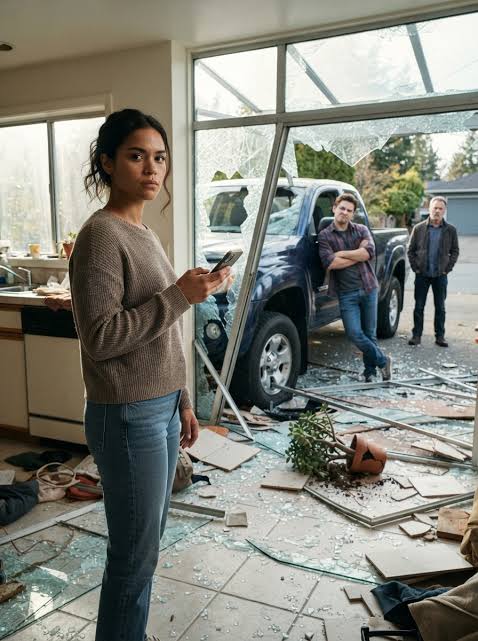
My mother put it there the afternoon I moved in, set it on the sill, turned the pot once so the thickest stem faced the glass, and said it would outlast everything else in the house if I just left it alone. She was right about the plant. The sunroom was $12,000 of tempered glass panels, aluminum framing, and ceramic tile I had laid myself over two weekends in October.Troy’s truck went through the east wall at 10:14 p.m. on March 3rd. The glass didn’t shatter the way I expected. It folded.
I had bought the house 7 years earlier, 3 months after my mother’s funeral. Her life insurance paid out $68,000 between me and my father, Marshall, $34,000 to each of us. Marshall took his half and moved it into a savings account he mentioned twice in the years that followed, always in the context of how carefully he was managing it.I took my half and made the down payment on a three-bedroom house on Delmare Street, 2 miles from where I grew up. The mortgage was $1,140 a month. I worked as a delivery dispatcher at Hendricks Trucking, earning $48,000 a year, logging routes and incident windows and driver check-ins, keeping things running on schedule.
I brought that same discipline home. I budgeted. I showed up.
I paid things down. By year three, the Telluride was paid off. A 2019 Kia dark gray worth around $28,000 at Current Market.
I didn’t take vacations. I planted things in the backyard and laid tile on weekends and built the sun room from a kit I ordered in September, and assembled piece by piece across two Saturdays in October. My mother died 7 years before that night, which means she never saw the sunroom.She saw the house once the day I moved in before the morphine made traveling difficult. She brought the plant from her own window sill, a jade in a ceramic pot, set it on the sunroom sill, adjusted it once, and said what she said about it lasting. 3 weeks later, she was gone. My brother Troy was 18.
My father Marshall had not fallen apart the way some people do. He still answered his phone, still picked up odd jobs as a handyman, still showed up at Christmas. But something in him had dimmed, and it never fully came back on.
So I did what I did. Nobody asked. There was no conversation about it.
My mother had said to look after Troy in the week before she died. Said it clearly and I took it as an instruction even when I probably should have understood it as a wish spoken by someone on morphine who was running out of time to say things. 2 years before March 3rd, I started paying Marshall’s phone bill, $85 a month. He had mentioned twice in passing that recurring expenses were harder to manage on variable job income, not as a request, just as a fact about his situation.
And a month after the second time, I added his phone carrier to my autopay without saying anything. A few months after that, I found a cancellation notice from Troy’s insurance company on his kitchen counter when I came over to drop something off. I didn’t say anything that day either.
I thought about it for 3 weeks and then called the carrier and switched the payment method to my account. $140 a month. So, $225 total every month for 24 months. $5,400 moving out of my account and into their lives without ceremony or acknowledgement. I never mentioned it.Troy never thanked me. Marshall never said anything about it. The three of us went on having the occasional birthday dinner and holiday gathering, and those payments ran in the background, the way all silent support runs in families, invisibly, until the people receiving it need to pretend it never existed.
Troy worked part-time at a tire shop on Route 9, $19,000 a year, give or take, depending on hours. His truck was a 2020 F-150 with $22,000 still owed on the loan and a $380 monthly payment that Marshall had co-signed because Troy’s income alone hadn’t qualified him. The truck made him look better off than he was, which I think was part of the point.
Troy cared about how things looked. He’d always been that way. Not lazy, not stupid, but oriented toward the appearance of a life rather than the construction of one. Over the years, I had watched Troy make a series of decisions that kept him at the same threshold, staying part-time at the tire shop because full-time meant accountability, letting Marshall co-sign for the truck because it was a truck he couldn’t otherwise afford, living rentree on Birwood Court because the arrangement was easier.
He wasn’t reckless in the way people are when they’re actively destroying themselves. He was reckless the way people are when someone nearby has always absorbed the gap. I had been absorbing part of that gap for 2 years without saying so.
Marshall had been absorbing the rest and building a story about why it was someone else’s fault. For his 25th birthday, Marshall made dinner at his rental on Birwood Court. Six of us at the folding table he used for everything.
Marshall at the head, Troy beside him, Kira across from me, and two of Troy’s friends from the tire shop at the far end, pasta from a box, garlic bread from a foil sleeve, a grocery store sheetcake with blue frosting. I had wrapped a $200 Visa gift card in tissue paper and brought a jacket Troy had pointed at once in a catalog, a canvas work jacket, dark olive, the kind he would actually wear. He opened the gift bag first, looked at the jacket, draped it over the back of his chair.He opened the card, read the amount, set it on the table face down. Then he looked at me across the folding table.
I want the tellide, he said.
Not a question, no setup. He said it with his arms flat on the table and his chin level. The way you state a thing you’ve already decided.
What do you mean?
I said the SUV.
You drive to work and back. You live alone in a three-bedroom house and you water your plants. I have Kira. I have a life.I have actual places I need to be. He tilted his head slightly, like he was pointing something obvious out to someone slow.
You barely use that car, Karen. Give me the keys. You can keep the plates and handle the transfer paperwork. I’ll figure out the registration.
The folding table had six people at it, and I could hear the refrigerator cycle on in the kitchen. Kira was looking at her plate. Troy’s two friends had both shifted their attention to their food with a specific stillness of people who had been told this was coming, and had decided they weren’t going to be caught having an opinion either way.
No, I said. It was the only word I had ready, and it was the only word that was true.
Troy’s jaw set.
Karen, I’m serious.I know, I said. The answer is still no.
That car has been sitting in your driveway for how long? 3 years. You drive it to work and you drive it home. I have a truck with payments I can barely cover. And you’ve got a paid off SUV sitting in the garage you don’t even need.
It’s my car, Troy.
It’s mom’s money that bought it, he said. That’s what everyone knows. That was family money.
I used my share of mom’s insurance for the down payment on the house. The car I paid for myself.
Then give me the house, he said.He smiled when he said it like it was a joke, but he didn’t fully walk it back.
Marshall reached it then.
Don’t be selfish, he said.
He set his fork down and looked at me with the expression he used when he decided he was being reasonable.
Your brother is asking for one thing. One thing, Karen. You’ve got that car sitting in the driveway paid off. Your mother’s insurance money went into this family. That means all of us.
I used my share of that insurance on the down payment, I said again. Every mortgage payment since then has been mine.Don’t make it a ledger, Marshall said. We’re family.
Then ask me like family, I said. Don’t tell me it’s already decided.
Troy opened his mouth. Marshall looked at his plate. Neither of them had anything left after that.
I looked at my father. 58 years old, hadn’t paid his own phone bill in two years. His name was on Troy’s truck loan as co-signer because Troy’s income hadn’t qualified a loan. He lived in a two-bedroom rental on Birwood Court and talked about family money as if it were a thing he managed.
I thought about saying any of that. I picked up my jacket instead.
I have an early morning, I said.Troy started to say something. I was already standing. I picked up my bag, said good night to Kira, and walked out of the birthday dinner.
I drove home on Delmare Street with the radio off, thinking about Troy’s face. Not hurt when I said no. Surprised. The expression of a person who had expected a different outcome, who had been told a different outcome was coming.
I sat at the kitchen table for a while in the dark. The plant was on the sunroom window sill where it always was.
I made tea. I went to bed.
At 10:14 p.m., I heard it.
A deep compressing crack from the back of the house. Then aluminum shrieking at a point it was never designed to flex. Then glass folding inward, not breaking. Folding.I was out of bed before the truck engine cut off.
By the time I reached the kitchen doorway and looked through toward the sunroom, Troy’s truck had punched through the east wall and come to rest with its front end inside the room. One glass panel had dropped hole and cracked in a single long fracture against the ceramic tile.
Two others had shattered across the aluminum framing in pieces small enough to scatter to the far wall. The tile I’d laid myself was split where the front tire had settled.
The smell hit me before anything else. Cold night air through the open east wall, exhaust, broken ceramic. The truck’s engine was still running, headlights throwing white light across the interior and casting the aluminum framing in hard shadows.
Soil from the plant had fanned across the tile in a pale arc. Three of the hanging baskets along the north rail were intact. One had fallen and split.
The sun room in normal light was the most finished room in the house. Where the weekend work showed most clearly, where the tile pattern I’d measured and cut three times was laid out exactly as I’d planned it.Now there was a truck in the middle of it.
Troy climbed out of the driver’s side and stood in the broken glass. He looked at the debris around his boots, at the split tile, at the bent framing. Then he looked at me standing in the kitchen doorway.
He smiled.
Guess my foot slipped.
I looked past him. Marshall’s car was at the curb beyond the side gate, headlights on, engine running, his silhouette visible through the driver’s window.
He had not gotten out.He got out then. Came through the side gate, picked his way around the truck, and stopped a few feet from the kitchen doorway. He looked at the sunroom, the glass, the bent framing, the cracked tile, the jade plant on the floor where it had been knocked from the window sill, pot cracked at the base, soil spread in a circle across the tile, but the stems still upright and green.
Then he looked at me.
A stingy nobody like you doesn’t deserve nice things.
He said it steadily like a man reading something he had written down earlier.
Your mother’s insurance bought this house. That was family money, not your personal savings account. Troy needed a car. You have two. He asked you one time for one thing and you said no like it would cost you your life.
You sit in a house you didn’t earn. Driving a car you barely use. Growing plants in a glass room while your brother rides around in a truck he can barely afford.You don’t get to act hurt. You got everything. He got nothing. And you wonder why his foot slipped.
He turned and walked back through the side gate. Troy followed. Marshall pulled out of the side street without cutting his headlights.
I stood in the kitchen doorway and listened until the sound of the engine was gone.
Then I walked into the sun room.
The plant was on the floor at the base of the cracked window sill frame. The ceramic pot had a clean split running from the rim down to the base on one side, but it was holding itself together.
The soil had spilled in a ring, but the roots were compact and intact. They hold shallow and tight. Catch them early enough and they survive most things.I picked the plant up, carried it to the kitchen counter, and pressed the loose soil back around the base with two fingers. Looked at it for a moment under the kitchen light.
That was my reaction.
Not screaming, not crying, picking up the plant and putting it somewhere it wouldn’t get more damaged.
Here is something about working dispatch for 8 years. You learn to move in straight lines when everything around you is crooked.
A driver calls in a collision at 6:00 a.m. on a bridge. A delivery is sitting on a dock in three counties. A customer is calling from a warehouse expecting a truck that is now wrapped around a guardrail.
You do not stop to feel the shape of the problem. You identify what you can control and you move there first. The rest organizes itself in sequence if you start with the right step.The plant was a step I could take, so I took it.
Then I stood in the kitchen with the plant on the counter and looked at what was left to do, and I started doing it in order.
If you’ve been listening to Betrayal Unfolded and this story is landing somewhere real, stay with it. What happened next is what they didn’t see coming.
I got my phone from the nightstand and started photographing the sun room at 10:30 p.m. 71 photos. The east wall from three distances, both lateral walls, the truck’s position relative to the framing, the cracked tile, the shattered panels, the bent aluminum at the impact point, the license plate, and the timestamp showing on my phone when each photo was taken.
Then I opened the Ring app.
The sideyard camera had captured everything.10:13 p.m. Troy’s truck idling at the far end of the driveway. Troy visible through the cab, turning his head left, then right, checking both directions deliberately before he reversed.
10:14 p.m. The truck accelerating backward into the wall.
10:15. Troy stepping out and standing there with his hands loose at his sides and an expression that was not regret.
And throughout every frame, Marshall’s car at the curb, headlights on, door never opening, his silhouette in the driver’s seat.
He checked both directions before he reversed. That is what the footage showed. That is what checking looks like when you are about to do something on purpose.
I called the police non-emergency line at 10:38.The officer arrived at 11:15, photographed the scene herself, took my statement, recorded the footage from my phone screen, and filed the report before she left.
She said, “Deliber property destruction over $10,000 met the felony threshold in our state. $12,000 of sunroom glass and framing cleared it.”
She gave me the case number on a card.
I called a 24-hour tow at 11:30. Troy’s truck was on my property, disabled in my sun room, and abandoned by its owner.
Property owner authority to remove unauthorized vehicles is standard and not complicated.
The tow driver arrived at midnight, hooked the front end, and pulled the truck out of the wall frame backward, which brought the last standing panel down in one clean drop.He loaded the truck onto the flatbed. I watched from the kitchen with the plant on the counter.
Petra came through the side gate at 12:45 a.m. She lives next door, a postal carrier, 34, who doesn’t talk much, but shows up when things are wrong and doesn’t require an explanation.
She had seen the police lights through her window, and waited until the tow truck was gone. She brought a blanket draped over her arm and two mugs of chamomile.
She sat on the porch, stepped below the kitchen door, and handed me one.
She looked at the boarded up east wall. The officer had helped me prop a sheet of plywood over the opening before she left. Just enough to keep the night air from moving through the house freely.
Petra looked at it for a few seconds without saying anything. Then she sat down on the porch step and wrapped her hands around her mug.“The plant okay?” she asked.
“Yes,” I said. “The pot cracked, but the plant is fine.”
She nodded like that was good news, which it was.
She didn’t ask about Troy. She didn’t ask about Marshall. She had seen the police and the tow truck, and she had a reasonably clear picture of the general shape of the night.
She sat with me.
20 minutes passed.She said, “Do you want me to stay?”
“Yes,” I said.
She stayed until 2:00 a.m. She went home.
I lay on the couch and didn’t sleep much. And when I did, I kept half hearing the sound of the glass folding.
At 8:04 a.m., my phone rang.
Troy’s name on the screen. I watched it ring four times and go to voicemail.His message was 6 seconds of yelling, “Where is my truck? What did you do?”
Something slamming in the background.
I set the phone on the counter face down and opened the Ring app again.
10:13 p.m. The check left, the check right, the deliberate reverse.
I almost answered the phone. My hand was on it, but the plant was on the counter beside me, soil still loose where I’d pressed it back in the night before, and I thought about my mother turning the pot once on the window sill the day I moved in, adjusting it so the thickest stem had the best angle to the glass.
I let it go to voicemail.At 8:30, I called my homeowner’s insurance and opened a claim. The deductible was $1,500.
The agent said that with a police report naming the responsible party and footage showing deliberate damage, their subrogation team would pursue Troy for the claim amount once it settled.
I emailed the footage file while we were still on the phone.
On Monday, day three, I drove to the attorney’s office.
Petra’s brother-in-law had given me the referral the previous year for a different matter. Said the man was precise and didn’t charge for time he hadn’t earned.
I brought everything. The case number, the footage on a USB drive, a written damage estimate from a contractor I’d called Saturday morning, $12,000 for the glass panels and framing, $1,00 including the tile work, and three months of bank statements with the monthly transfer lines highlighted, $85 to Marshall’s phone carrier, $140 to Troy’s insurance carrier, 24 rows of them.The attorney reviewed everything in 40 minutes. He asked three questions.
Was the truck registered in Troy’s name?
Yes.
Was Marshall present at the scene?
Camera shows him at the curb the entire time.
Were the bank payments voluntary or under any documented agreement?Voluntary. No agreement. No request.
He drafted the demand letter.
$14,150.
12,000 for the sun room. 1,500 for the emergency repairs, 350 for the tow, 300 for lumber and sheeting.
Both Troy and Marshall named as respondents, Marshall for documented presence and complicity.
The letters went out certified mail by day 7. Delivery confirmation on both addresses by day 8 morning.Troy’s truck was still at the impound lot, accumulating $75 a day in storage on top of the $350 tophe. By day seven, he owed $800 just for the release.
He called Marshall.
Marshall told him he’d figure something out and called me that evening to leave a voicemail.
This is getting out of hand. Corin, we need to sit down before this goes further.
I almost called him back. I was in the Hendricks parking lot at the end of my shift with his name on my screen.
Then I thought about what the attorney had said, “Don’t discuss the civil claim outside formal channels.”And I put the phone in my bag and drove home.