The frost was so thick on the windshield that morning that I had to scrape it twice.
It was the first week of November. Cold enough for frost. Not cold enough for snow. That in-between kind of cold in Iowa that gets into your bones and stays there until April.
By the time I got the truck warmed up, Mom had already been out in the barn for an hour and a half.
She was seventy-four years old. She still got up at four-thirty every morning. She still pulled on Dad’s old brown Carhartt coat, the one with the torn left pocket she refused to let anybody fix. And she still walked out to that barn in the dark with a flashlight in one hand and a coffee thermos in the other.
She never missed a feeding. Not once. Not when she had the flu in 2019. Not the morning after Dad’s funeral. Not ever.
“Jess,” she said when I came into the barn, “we’re about out.”
She was standing by the feed bin, looking down into it. I came over and looked too. There was maybe enough left for one more day. Two, if we stretched it.
“I thought Luke picked some up last week,” I said.
“He did. Ten bags. That was all they had.” She snapped the lid shut. “We need twenty more to get through to the next delivery.”
Our family had raised cattle outside Redfield, Iowa, for three generations. My great-grandfather bought the first hundred and sixty acres in 1931, right in the middle of the Depression, when everybody told him he was crazy. My grandfather added another eighty. My dad added the big red barn and built the herd up to almost two hundred head.
Now it was just under a hundred. Mom had sold some off after Dad died eight years ago. She said she didn’t need that many to stay busy, and she was right. A hundred head of cattle is plenty for one seventy-four-year-old woman, even with help.
My younger brother Luke and I did the heavy work. He lived in the old farmhouse down the road with his wife and two boys. I’d moved back from Des Moines three years ago, after my divorce, and I lived in the little apartment over Mom’s garage.
We fixed fences. We hauled hay. We dealt with the vet and the broken water lines and the tractor that never wanted to start.
But Mom still made the decisions. All of them. That was just how it was.
“Weather’s turning tonight,” she said, looking out the barn door at the gray sky. “Radio says freezing rain starting around four.”
“I heard.”
“Roads’ll be glass by dark. I want that feed in the barn before then.”
“I’ll run into town after breakfast.”
“I’ll come with you.”
I opened my mouth to tell her she didn’t need to. That I could handle twenty bags of feed by myself. That it was cold, and her knees had been bothering her, and she should stay home by the stove.
Then I closed my mouth again. You don’t tell Ellen Carter what she doesn’t need to do. I learned that around age six.
“Okay,” I said. “After breakfast.”
She nodded. She reached out and patted the nose of Rosie, our oldest cow, who was leaning her big head over the gate.
“Don’t you worry, girl,” she said softly. “We’ll get you fed. We always do.”
Redfield is a small town. If you blink, you’ll miss it. One stoplight, one gas station, a Casey’s, two churches, a bar called The Rusty Spur, and Dawson Farm Supply, right at the edge of town where Main Street turns back into a county road.
Dawson’s had been there since 1962. Old Hank Dawson’s father built it. Then Hank ran it for almost forty years. Now Hank’s son, Travis, was the manager.
I’d gone to school with Travis. He was two grades ahead of me. He grew up three farms down from ours, on the old Dawson place with the leaning silo. When we were kids, he used to ride his bike over to our farm on summer afternoons, and Mom would give him a glass of lemonade and a peanut butter sandwich, and he’d help Dad stack hay bales for a dollar an hour.
Hank had died two years ago. A heart attack, right behind the counter, ringing up a bag of dog food for Mrs. Ostrander. Half the county came to the funeral.
Since then, things at Dawson’s had changed.
Travis put in a new computer system. He got rid of the coffee pot that used to sit by the register, where farmers would stand around for an hour arguing about the weather and the price of corn. He put up a sign that said “NO CREDIT — ALL ACCOUNTS PAYABLE AT TIME OF PURCHASE.” He started carrying fancy dog treats and expensive work boots and less of the stuff people around here actually needed.
People grumbled. But people still shopped there, because what else were they going to do? The nearest other supplier was a big chain store in Perry, almost forty miles away.
Mom was quiet on the drive into town. She sat in the passenger seat with her hands folded in her lap, watching the bare fields go by. Every once in a while, she reached over and touched the dashboard of the truck, like she was patting an old horse.
It had been Dad’s truck. A 1998 Ford with two hundred and sixty thousand miles on it. She refused to sell it.
“You okay, Mom?” I asked.
“Fine.”
“You’re quiet.”
“I’m always quiet.”
“You’re quieter than usual.”
She didn’t answer. She just looked out the window at the Dawson place as we drove past it. The old leaning silo. The empty pasture. The farmhouse with the porch light still on in the middle of the morning.
Travis didn’t live there anymore. He’d moved into one of those new houses in Adel, the kind with the three-car garages and the big front windows. The Dawson farmhouse had been sitting empty for almost two years.
We pulled into the gravel lot at Dawson Farm Supply a little after eight.
There were only two other trucks in the lot. Inside, the store was warm and smelled the way it always smelled, like grain dust and leather and motor oil. A radio was playing country music somewhere in the back.
A young kid with red hair and a Dawson’s vest came out from behind the counter. His name tag said “CALEB.” He couldn’t have been more than nineteen.
“Morning, ma’am. Help you find something?”
“Cattle feed,” Mom said. “The fourteen percent. Twenty bags.”
“Yes, ma’am. Got some right over here.”
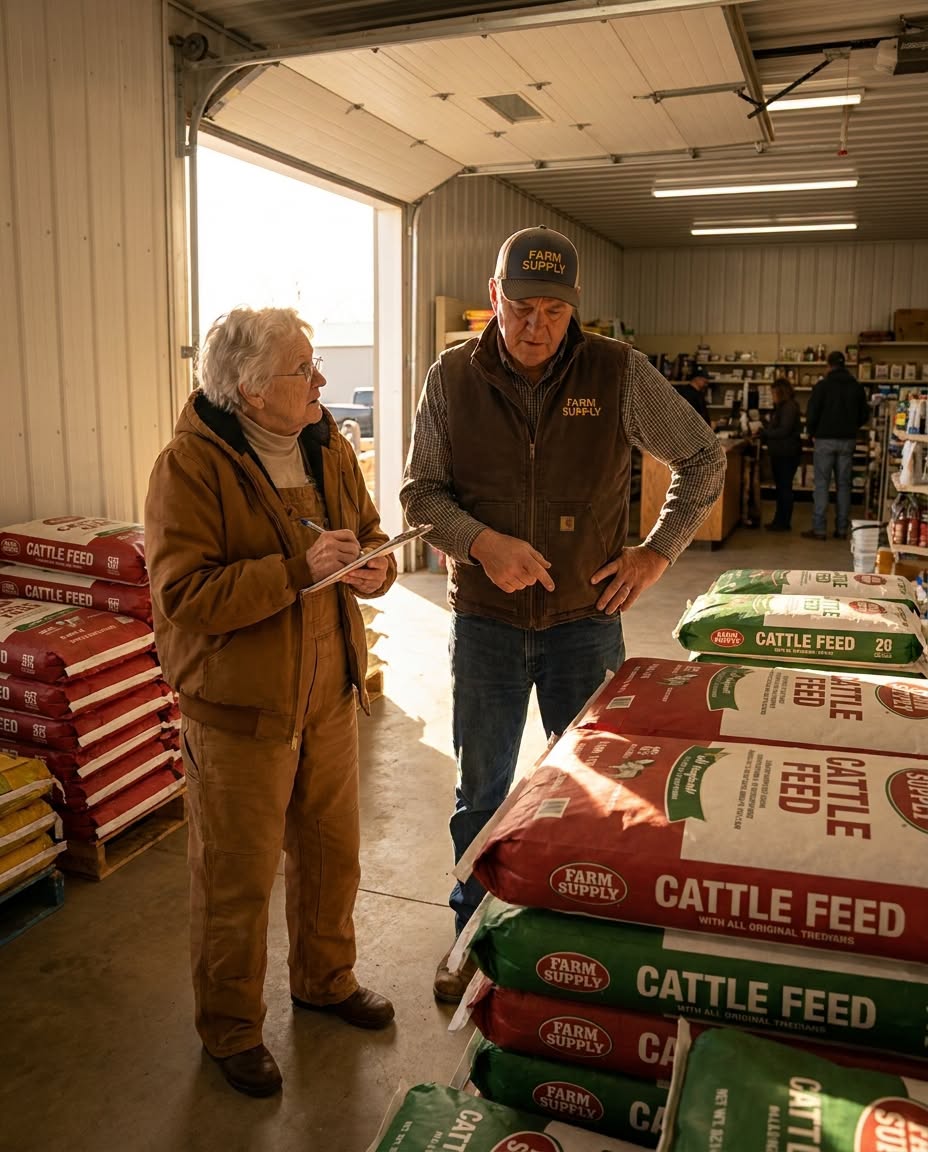
He led us to the back of the store, near the big rolling loading door. There was a pallet there, stacked high with fifty-pound bags. Mom walked right up to it and turned one of the bags over to read the label. She does that every single time, even though it’s always the same.
Same brand we’d used for years. Same weight. Same mix.
She counted the bags. Exactly twenty.
“That’s the last of it?” she asked.
“Yes, ma’am,” Caleb said. “Truck’s not due back till next Thursday. Everybody’s been stocking up because of the weather.”
“Well, then, we’ll take all twenty.”
“Sure thing.”
He went and got a big flat cart and started loading the bags onto it, two at a time, grunting a little with each one. I went over to help him.
We’d gotten about eight bags onto the cart when the office door opened behind the counter.
“Hold up.”
Caleb stopped with a bag of feed halfway onto the cart.
Travis Dawson came walking across the store toward us. He was forty-six now, a little thick around the middle, with his dad’s wide shoulders and his mother’s sharp, narrow face. He had on a pressed button-down shirt and a fleece vest with the Dawson Farm Supply logo stitched on the front. He was holding his phone in one hand.
He didn’t look at me. He looked at Mom.
“Sorry, Mrs. Carter,” he said. “Those are reserved.”
Mom frowned. She doesn’t frown often. When she does, people usually take a step back.
“Since when?” she asked.
“Since about five minutes ago.”
Caleb looked confused. “Nobody told me, Travis.”
“I’m telling you now. Put them back on the pallet.”
“Wait a minute,” I said. “What do you mean, reserved? They were sitting right here. Nobody said anything about them being reserved.”
Travis finally glanced at me.
“Hey, Jess.”
“Hey, Travis. What’s going on?”
He sighed, like I was being difficult.
“A commercial customer called a few minutes ago,” he said. “They want every bag of feed I’ve got left. All of it. And they offered to pay extra for it.”
“How much extra?” I asked.
“That’s between me and the customer.”
Mom looked at the bags. Then she looked at him.
“But we were here first,” she said.
She didn’t say it angry. She said it the way you’d point out to somebody that it was raining. Just a plain fact.
Travis shrugged.
“Business is business, Mrs. Carter.”
I felt my jaw tighten.
Mom needed that feed. Not wanted. Needed. We had ninety-seven head of cattle in that barn and one day of feed left. The nearest other supplier was almost forty miles away, in Perry. And the forecast was calling for freezing rain starting that afternoon. By tonight, every road in the county would be a skating rink.
If we couldn’t get feed today, we might not be able to get any for days.
And Travis Dawson knew all of that.
Mom had been buying supplies at that store since before I was born. Since before Travis was born. She’d bought her first pair of work gloves there in 1972, when she was twenty-one years old and a brand-new farm wife who didn’t know a heifer from a steer.
Travis knew that too. He had sat at our kitchen table and eaten her peanut butter sandwiches. She had bandaged his knee when he wrecked his bike in our driveway when he was nine. She had sent his family a casserole every single week for three months in 1993, after his mother passed.
I opened my mouth. I had a whole lot of things I wanted to say to Travis Dawson.
Mom put her hand on my arm. Just lightly. Just enough.
I closed my mouth.
She looked at Travis for a long moment. Then she nodded slowly.
“Well,” she said, “I understand. You’ve got to make a living.”
Travis smiled. He actually looked relieved.
“Glad you see it that way, Mrs. Carter. I knew you would.”
Then he turned to Caleb.
“Put them back.”
Caleb hesitated. He looked at Mom. He looked at me. Then he looked down at the floor, and slowly, one bag at a time, he started lifting the feed off the cart and stacking it back on the pallet.
Every thud of a fifty-pound bag hitting that pallet felt like a slap.
I stood there with my fists balled up in my coat pockets. I couldn’t believe Mom was just letting this happen. Ellen Carter, who once chased a cattle buyer off our property with a broom handle for trying to cheat Dad out of two hundred dollars.
But she didn’t say another word. She just walked over and stood quietly beside the counter.
Travis went back behind the register. He started tapping on the computer screen, ringing up something for somebody else, acting like we weren’t even there anymore.
The printer next to the register started buzzing. It was printing out a receipt. Maybe for the commercial customer. Maybe for our order that wasn’t going to happen anymore. I couldn’t tell.
Mom stood there watching him.
I stood there watching her.
I was waiting for her to say something. To argue. To tell him off. To remind him about the casseroles and the lemonade and the bandaged knee. To do anything at all.
She didn’t. She just stood there in Dad’s old brown coat with her hands folded in front of her, perfectly calm, perfectly patient.
Finally, after what felt like a very long time, she spoke.
“Travis,” she said. “Could I borrow your pencil?”
He looked up, a little surprised.
“Sure, Mrs. Carter.”
He handed her a yellow pencil from the cup by the register. The kind with Dawson Farm Supply printed on the side in green letters. They’d been giving those pencils out for free since the 1960s.
The receipt was still sticking out of the printer. Mom reached over, tore it off, and turned it over to the blank side.
She held the pencil for a second. Just held it. Like she was thinking about whether she really wanted to do this.
Then she bent down over the counter and wrote six numbers.
She wrote them slowly and carefully, the way she writes everything. Her handwriting is shaky now. She has arthritis in both hands. But every number was clear.
Then she straightened up, set the pencil down, and slid the receipt across the counter toward him.
“Would you mind checking these against your old ledger?” she asked.
Travis barely glanced at the paper. He looked like he was about to brush it off. Tell her he was busy. Tell her the old ledgers were all in storage. Tell her he’d look into it later.
Then he stopped.
He looked again.
He picked the receipt up off the counter and held it closer to his face. I watched his eyes move across those six numbers once. Then twice.
All the color slowly drained out of his face.
“Where did you get those numbers?” he asked.
His voice was different. Quieter.
Mom looked right at him.
“Your father gave them to me.”
The store was so quiet I could hear the radio in the back. Some country song about a pickup truck.
Travis’s expression changed. Something flickered across his face. Confusion. Then something that looked almost like fear.
“My father?” he said.
Mom nodded.
“Thirty-two years ago.”
Travis stared at the receipt in his hand. He stared at it for so long that Caleb, who was still standing by the pallet, cleared his throat nervously.
Then, without another word, Travis turned around and hurried into the back office. He didn’t close the door all the way. I could hear him moving things around in there. Drawers opening. Boxes scraping across the floor.
I turned and looked at my mother.
“Mom. What numbers?”
She picked up the pencil again and turned it slowly between her fingers. Then she set it down on the counter, very carefully, lined up perfectly straight with the edge.
“Something your dad and I agreed never to use,” she said, “unless we had to.”
“What does that mean?”
She didn’t answer.
“Mom. What does that mean?”
“Hush, Jessie,” she said gently. “Just wait.”