Eleven weeks away, and the porch light was still on.
I saw it from the truck, just past the mailbox with the bent red flag. Nana’s cottage sat at the end of a short drive off a county road in New Jersey, and the light above the front door had a little moth stuck inside the glass. I remember that stupid moth. I remember it because I’d changed the bulb for her the last time I was home.
My name is Caleb Whitaker. I work on a power-line crew, which means I get sent where the damage is and stay until the lights come back.
I’d been in Ohio, then western Pennsylvania, then back down toward home. I’d called Nana every Sunday I could. The last time, she asked if I still had the key to her side door.
I told her I did. I thought she was checking because she worried about me losing things.
I didn’t know she was running out of time.
The first thing I saw inside the cottage was the bowl she used for loose change, sitting by the phone with two dimes and a paper clip in it. The second was the folded note from my mother, Diane, saying Nana had been taken to St. Catherine’s and that I should wait for her to call before visiting.
There was no number to call. No room number. No word about whether Nana was awake.
I called Diane anyway.
“She needs rest,” she said. “Don’t make this harder.”
I’d been home less than an hour. My work boots were still muddy.
I asked what hospital floor Nana was on, and Diane said she’d call me later.
I knew better than to argue with her on the phone. I also knew the note was not an answer.
So I showered, changed shirts, and drove to St. Catherine’s.
My father, Paul, had the medical papers that let him speak for Nana. I learned that when a nurse asked if I was on the approved list and then looked embarrassed for asking. Paul had put his name down. Diane had put hers down. Mine wasn’t there.
I told the desk clerk I was Nana’s grandson. She told me she understood. Then she pointed at the visiting hours sign.
I went to the cafeteria. I bought a coffee I didn’t want and sat by the vending machines until shift change. It was the same trick I used on job sites when a supervisor couldn’t be found and the schedule still had to move.
Wait. Watch. Don’t make a scene until you know what’s going on.
I went up again after 9:00.
The room was quiet except for the little machine beside her bed making a soft, regular beep. Nana looked smaller than I’d ever seen her. Her gray hair was flat on one side, and one hand lay outside the blanket.
I said her name.
Her eyes opened.
“I knew you’d come,” she whispered.
I took her hand. It was warm, and her thumb moved once across my knuckle. I didn’t want to ask anything about my parents. I didn’t want her last minutes to be about them. But she squeezed my hand and told me not to let them win. Then she said, “Check the blue velvet box.”
I asked her where it was.
She was already tired. Her eyes closed again, and the nurse came through the door before I could ask a second time.
I left the room because I didn’t want to get thrown out while she was still there.
Two days later, I found out Nana had died from my mother’s Facebook post.
I was in the cottage kitchen when I read it. Diane had written that Nana passed peacefully, surrounded by family. The words were in one of those neat little blocks Facebook offers you when you say someone has died. I read “surrounded by family” more than once.
I wasn’t there. My cousin Sarah wasn’t there either. I called her, and she said she hadn’t been told Nana was near the end.
“I thought you knew,” Sarah said.
I didn’t. Neither did she.
I wanted to write a reply under my mother’s post. I typed three different things and deleted all of them. Then I put my phone facedown and stood at Nana’s sink. A red plastic cup with a crack in the rim was still beside the dish soap. Nana had used it for rinsing paintbrushes, even though she had other cups.
That was the sort of thing I remembered. Not the last big holiday. Not what people wore to the funeral. The cup.
The funeral was small, and I went because I wasn’t going to let my mother decide whether I said goodbye. Paul stood with her near the front. Neither of them asked why I hadn’t been there at the hospital. Neither of them mentioned the post.
Afterward, Diane told me the will reading would be the next week. She said it like she was giving me an appointment I had to keep.
I went back to the cottage before the meeting because I couldn’t stop thinking about the box. Nana had kept things in odd places. A recipe card in the phone book. A screwdriver in the silverware drawer. Once she put a whole pack of batteries in the flour bin and then blamed the batteries for being hard to find.
I searched the bedroom closet and the pantry. I checked the small cabinet under the stairs, where she kept old holiday lights. No blue box.
There was a narrow shelf in the hall cupboard, up above the coats. I had to stand on a chair to reach it. My fingers brushed a plastic bag, an old scarf, then something soft with velvet worn thin at the corners.
The box was about the size of a paperback book. I didn’t open it. I stood there holding it while the chair creaked under me.
I was on my way to the will reading the next morning. I had the box with me in the truck, tucked behind the passenger seat. I told myself I’d look at it later, after I knew what my parents were doing with the estate.
That was not the whole reason. I was afraid it would hold some small thing I couldn’t put back.
The will reading was at my parents’ house. I had spent enough of my childhood in their living room to know where not to sit. The couch had pale cushions nobody was allowed to eat on. The end tables stayed empty except for whatever had been arranged on them. I used to get corrected for leaving a glass ring on the wood.
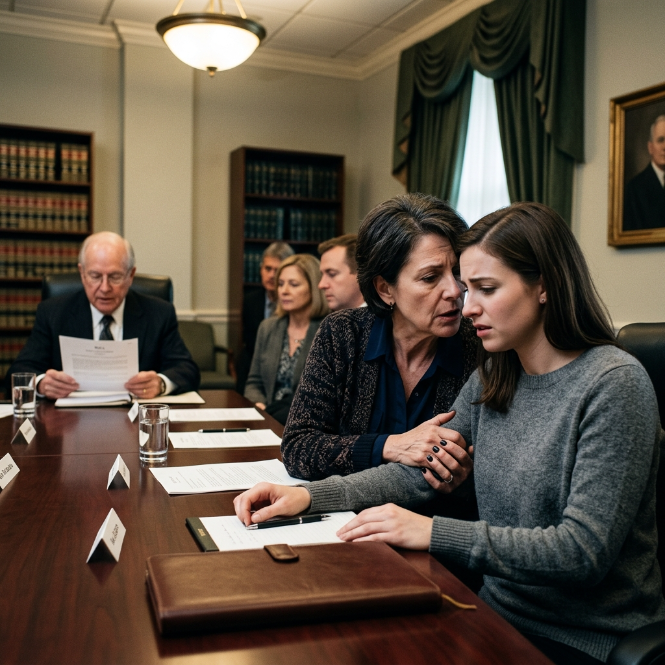
Paul was standing by the fireplace. Diane wore black cashmere and pearl earrings. Sarah sat beside me, keeping both hands around a paper cup of coffee.
Mr. Caldwell, Nana’s lawyer, opened his folder.
Before he said anything, my mother leaned over and dug her nails into my arm.
“If you get a single penny, I’ll make sure you regret it.”
I kept my eyes on the folder. I didn’t tell her to let go. I should have. I didn’t.
Mr. Caldwell read the first five pages. The bank accounts went to my parents. Diane got Nana’s personal property. Paul had the right to deal with the sale of two small parcels. There were instructions about bills, taxes, and the few items Nana had already promised to other relatives.
I listened. I kept track.
On the fifth page, my mother’s fingers eased off my arm. Paul took a slow breath and leaned against the fireplace. It looked like the meeting was going the way they expected.
Then Mr. Caldwell turned a page, stopped, and looked at the papers beneath the will.
“Is there a problem?” Paul asked.
Mr. Caldwell pulled one sheet from the back of the folder. He said there was an amendment filed three days before Nana died.
My mother said there must be some mistake. Her voice had lost the flat edge it usually had when she was telling me what I was allowed to do.
Mr. Caldwell said the amendment had been signed in his office, witnessed by two people, and recorded with the county clerk. He’d checked the filing that morning.
I kept still. I could feel the blue box against my hip through the side of my coat.
Paul asked who the witnesses were. Mr. Caldwell told him. Diane asked if Nana had been medicated. Mr. Caldwell said she’d spoken with her alone before the signing and had been clear about what she wanted.
My father looked at me then. Not angry. Not yet. He looked like he was trying to work out what I knew.
I didn’t know. Not really.
Mr. Caldwell read the first line of the amendment. Nana had changed who would receive the cottage and what would happen to its contents. The house, its land, and the money in the account she’d kept for repairs would go to me, not my parents.
Paul straightened up.
Diane looked at the lawyer. “She wouldn’t do that.”
Mr. Caldwell set the page on the table. He said Nana had also named me as the person responsible for carrying out that part of the will.
My mother turned toward me. “You must have been talking to her.”
I wanted to tell her that I’d been working in three states, and that the last time I saw Nana alone before the hospital was months earlier. I wanted to say I had asked for nothing. Instead, I looked down at my hands.
Sarah had stopped holding her coffee. She had put it on the floor without noticing.
My mother asked for a copy of the amendment. Mr. Caldwell said she would get one. Paul asked if the cottage could be sold to settle other estate expenses. Mr. Caldwell said the amendment made the cottage mine, subject to the usual probate steps, and the other listed assets would cover the estate’s bills.
No one said anything for a little while.
Then Diane asked if I was planning to sell it.
I said I didn’t know.
That was true. I knew the house needed work. The porch step shifted if you stepped on the left side. The bathroom fan rattled. Nana had been putting off repairs because she didn’t like strangers in the house. I also knew I’d been sleeping in motels for months and didn’t own much beyond my truck and a few tools.
My mother said, “You can’t take care of that place.”
I didn’t answer. She’d said things like that all my life. Sometimes she was right. I’d let bills sit unopened. I’d walked away from conversations instead of finishing them. I had a bad habit of assuming people would know I cared without me saying it.
But I could take care of a house. I had fixed worse things in the rain with less time.
Mr. Caldwell gave us copies. He explained the next steps. The amendment had been filed before Nana died, and there was no reason to think it was invalid. If my parents wanted to challenge it, they could do that through the court. He would not decide the matter in his living room.
Paul didn’t say he planned to challenge it. He didn’t say he wouldn’t.
The meeting ended without anybody raising their voice. That was how my family did damage. Quietly, with a lot of careful words.
Sarah drove behind me to the cottage. She had been invited to stay with her parents, but she said she didn’t want to go back there yet. I let her follow because I didn’t want to be alone with the box.
We sat at Nana’s kitchen table. The house still smelled faintly of the lemon cleaner she used on the counters. Sarah picked at a loose thread on her sleeve while I set the blue box in front of us.
I opened it.
There was no jewelry. No cash. No little bundle of keepsakes. Just a brass key, two folded papers, and a small envelope with my name written in Nana’s handwriting.
The first paper was a copy of the recorded amendment. I had already seen that. The second was a note from Mr. Caldwell confirming that Nana had asked him to keep the box in the cottage until I found it.
Sarah looked at the envelope.
I let it sit there for a minute. Then I opened it.
Nana had written only a few lines. She said the brass key was for the back door, because the old one I had was worn and stuck if I turned it too fast. She said the cottage was mine because I had always treated it like a home, even when everyone else treated it like an address. Then she wrote that the money set aside for repairs wasn’t a gift to make me rich. It was enough to fix what needed fixing and keep the place out of trouble for a while.
That part didn’t surprise me.
The last line did.
She wrote that when she’d heard I was coming home from the crew, she’d asked the neighbor to change the porch bulb before she went into the hospital. She knew I’d come by. She didn’t want me arriving in the dark.
I read it once. Then again.
READ THE NEXT PART: 👇👇
PART 3 – At my grandmother’s will reading, my mother dug her nails into my arm and whispered