PART 3
Dr. Reyes closed her eyes for a moment.
Then she said something that changed everything.
“Mrs. Dunmore, your husband didn’t just help build Willow Creek. He was the principal benefactor who made this facility possible. The original building was named in his honor.”
I felt the room grow strangely quiet.
“What?”
She stood up and walked toward the door.
“Please come with me. There’s something you need to see.”
“I can’t go anywhere without permission from my son, apparently.”
The bitterness in my voice surprised even me.
Dr. Reyes turned around.
“Your son may have signed those papers, but that doesn’t mean he has the right to keep you here against your wishes. I’m going to have our social worker review everything immediately.”
For the first time in days, someone was speaking to me as if I were a human being rather than a problem someone had paid to store away.
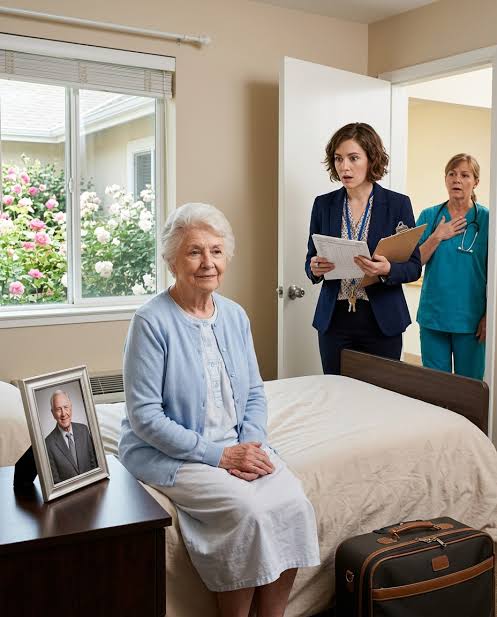
She helped me into a wheelchair, although I insisted I could walk. At seventy-eight, I still had enough pride to dislike being pushed around.
We passed the nurses’ station, the dining room, and the little library where residents spent their afternoons reading newspapers.
Finally, we reached the entrance hall.
Above the reception desk hung a large bronze plaque.
I had walked past it every day since arriving, but I had never paid attention to the words engraved on it.
Dr. Reyes stopped beneath it.
I leaned forward and read.
THE FRANKLIN AND MARGARET DUNMORE RESIDENCE
Established through the generosity of Franklin Dunmore and his wife, Margaret, in the belief that every person deserves dignity, independence, and a place to call home.
My hand flew to my mouth.
There was my name.
Not simply the name of a woman who had been abandoned by her son.
My name was engraved in bronze above the entrance of the very building where my son had left me.
I stared at the plaque until the letters blurred.
“Frank never told me,” I whispered.
Dr. Reyes’s eyes softened.
“He insisted that the gift remain private. He didn’t want the residents to feel indebted to him. The original building opened more than twenty years ago, and the foundation that supports this facility still carries your family’s name.”
I remembered that period of our lives.
Frank had spent months working late, meeting with lawyers, accountants, and people from the local community. He told me he was working on a project that would matter long after we were gone.
I had been busy raising Scott and caring for my aging mother. I never pushed him for details.
When the project was finished, Frank simply came home one evening, kissed my forehead, and said, “We did something good today, Maggie.”
I hadn’t realized how much he had done.
Dr. Reyes continued.
“Your husband also established a charitable trust. I reviewed the historical records when I took this position. His intention was that this facility would never become a place where people were treated as burdens.”
She paused and looked directly at me.
“I think he would be heartbroken to know what happened to you.”
For the first time since Scott had driven away, I began to cry.
Not because I was helpless.
Not because I wanted my son to come back.
I cried because my husband, who had been gone for six years, had somehow left a piece of himself waiting for me in the very place where I thought my life had been taken away.
And suddenly, I remembered something.
Three months before Frank died, he had asked me to visit his lawyer with him.
I had been tired that day. Frank was recovering from a long illness, and I assumed he wanted to update his medical directives.
But his lawyer had placed a thick folder in front of us.
“Maggie,” Frank had said, holding my hand, “I need you to promise me something. If anyone ever tries to make you feel as though you no longer have a say in your own life, you call Eleanor.”
Eleanor Price had been our family attorney for almost thirty years.
I had not spoken to her since Frank’s funeral.
At the time, I thought his words were simply the fears of a dying man.
Now, sitting beneath the bronze plaque bearing our names, I understood that he had been thinking about something I had never considered.
He had been preparing for the possibility that one day, someone might try to take my choices away from me.
“Dr. Reyes,” I said, wiping my cheeks, “I need to make a telephone call.”
“Of course.”
“I need Eleanor Price.”
Dr. Reyes nodded immediately.
“I’ll arrange it.”
But before we returned to my room, she turned toward the receptionist.
“Please make a note that Mrs. Dunmore is not to be pressured into signing anything. And I want a complete review of the admission documents, including every authorization provided by her son.”
The receptionist looked startled.
“Yes, Doctor.”
For the first time, the people at Willow Creek were no longer looking at me as someone who had been abandoned.
They were looking at me as someone whose story they had not yet understood.
And neither had I.
Because what I discovered the following morning would prove that Scott’s betrayal had begun long before he packed my suitcase.
It had begun months earlier, with a document bearing my signature.
A signature I had never written.
Friday morning, Eleanor Price arrived at Willow Creek carrying a leather briefcase and wearing the same determined expression I remembered from every difficult negotiation she had ever handled for Frank.
She was seventy-two now, with silver hair and reading glasses perched on the end of her nose.
The moment she saw me, she dropped her briefcase onto the chair and wrapped both arms around me.
“Oh, Maggie,” she whispered. “I should have checked on you sooner.”
I held her tightly.
“I didn’t know I needed checking on.”
She pulled away and studied my face.
“Tell me exactly what happened.”
So I told her everything.
The painters. The suitcase. Scott’s kiss on my forehead. The empty weekends. The disconnected telephone. The nurse who told me my house had been sold.
Eleanor listened without interrupting.
When I finished, she opened her briefcase.
“First, we need to establish what authority Scott actually has. Being your son doesn’t automatically give him the right to make every decision for you. And even a valid power of attorney does not give someone permission to use your assets for personal benefit or disregard your legal rights.”
She took out several documents.
“This is the power of attorney Frank arranged for you. It names Eleanor Price as your primary agent if you become unable to manage your affairs, with a successor agent designated under specific conditions.”
I frowned.
“But the receptionist said Scott had power of attorney.”
“That’s what his paperwork claims.”
She placed a second document beside the first.
“And this is a copy of the document Scott submitted to Willow Creek.”
I looked at the signature at the bottom.
Margaret Ellen Dunmore.
It looked remarkably like mine.
The capital M. The loop in the g. The long tail on the final r.
But there was something wrong with it.
“I didn’t sign that.”
Eleanor’s expression hardened.
“I didn’t think you had.”
She pointed to the date.
It was dated six weeks before Scott took me to Willow Creek.
Six weeks.
I remembered that week clearly. Scott had visited me on a Sunday afternoon, bringing groceries and a bouquet of flowers.
He had been unusually affectionate.
He’d asked whether I was sleeping well, whether I was remembering my medication, whether I had ever considered moving somewhere with more help.
I told him I was perfectly capable of living in my own home.
He smiled and said he understood.
Then he asked me to sign a stack of papers.
“Just routine insurance forms, Mom,” he had said. “I don’t want you worrying about boring things.”
I had refused.
I told him I wanted Eleanor to review anything involving my finances.
Scott had laughed.
“Mom, it’s just paperwork. You don’t trust your own son?”
That question had hurt me enough that I almost changed my mind.
Almost.
But I remembered Frank’s warning.
So I put the papers aside and told Scott I would review them later.
He left without arguing.
At the time, I thought I had avoided an unnecessary disagreement.
Now I realized he might have used copies of my old signatures to create the document in front of me.
“Eleanor,” I whispered, “if this is a forgery, what happens to my house?”
She didn’t answer immediately.
Instead, she asked me a question.
“Did you ever give Scott permission to sell it?”
“Never.”
“Did you sign a sales agreement?”
“No.”
“Did you authorize anyone to transfer the title?”
“No.”
Eleanor closed the folder.
“Then we have serious questions to investigate. We need to obtain the property records, the sale documents, and the financial records. We also need to establish whether your house has actually changed ownership or whether Scott merely told Willow Creek that it had.”
My heart began pounding.
“Could he really have sold my house without my permission?”
“Someone may have submitted documents claiming that you authorized the transaction. Whether the transfer is legally valid depends on the facts, the applicable law, and what the records show. We won’t assume anything until we have them.”
I nodded, trying to steady my breathing.
Then Eleanor reached into her briefcase again.
“There is one more thing.”
She placed a sealed envelope on the bed.
My name was written across the front in Frank’s handwriting.
Margaret.
I recognized the shape of every letter.
I had not seen his handwriting in six years.
My fingers trembled as I touched the envelope.
“Where did you get this?”
“Frank left it with me shortly before he died. He instructed me to give it to you only if you ever found yourself in a situation where someone was trying to control your life against your wishes.”
I looked up at her.
“Why didn’t you give it to me before?”
“Because he specifically asked me not to. He said that if you never needed it, you should never have to carry the burden of knowing what was inside.”
I stared at the envelope.
For six years, my husband had been gone.
And now, somehow, he was speaking to me again.
I carefully opened it.
Inside was a handwritten letter and a smaller envelope containing a document with the seal of a financial institution.
I unfolded the letter.
Maggie, my love,
If Eleanor is giving you this letter, then something has happened that I hoped would never happen.
First, I want you to remember that you are not weak because you need help, and you are not selfish because you want to remain independent.
You gave our son everything we could reasonably give him. You loved him, raised him, and supported him. But love does not mean surrendering your dignity.
I have made arrangements to ensure that you will always have choices, even if someone tries to take those choices away from you.
Eleanor knows what to do.
Do not let anyone frighten you into signing something you do not understand.
And Maggie, please remember this: the home we built together belongs to the life we shared. No one has the right to erase that life simply because they believe you are too old to defend it.
I love you today, as I loved you when I carried you across the threshold in 1982.
Forever yours,
Frank.
I pressed the letter against my chest.
For a moment, I could almost hear him in our kitchen, asking whether I wanted tea.
Then I opened the smaller envelope.
Inside was a letter from a bank trustee confirming the existence of a protected fund established by Frank years earlier for my care, housing, and personal independence.
Eleanor explained that the fund was separate from the charitable foundation associated with Willow Creek. Its exact terms and current balance would need to be confirmed, but the documents showed that Frank had taken deliberate steps to protect my financial future.
I looked at her.
“Does Scott know about this?”
“Not from anything I’ve seen.”
“Could he have been trying to get control of it?”
“Possibly. That’s one of the questions we need to investigate.”
I thought of Scott’s sudden concern about my medication. His questions about my memory. The papers he wanted me to sign.
Then I remembered the last time he visited me before the nursing home.
He had stood in my living room, looking around at the furniture Frank and I had collected over forty-four years.
He’d said, “Mom, you don’t need such a big house anymore.”
I had laughed.
“It’s the only home I’ve ever wanted.”
Scott hadn’t laughed with me.
He had looked at the staircase, the dining room, and the framed photographs on the wall.
Then he said something I hadn’t understood until now.
“Things change, Mom. Sometimes other people have to make decisions for us.”
I had thought he was talking about the painters.
Now I wasn’t so sure.
Eleanor gathered the documents.
“I’ll contact the property registry and the relevant financial institutions. I’ll also arrange for an independent assessment of your wishes and capacity, so nobody can claim that you’re unable to make your own decisions simply because you disagree with them.”
“Will I have to stay here?”
“Not if you are legally free to leave and suitable arrangements can be made. We’ll review your admission status and speak with the appropriate authorities. I don’t want you making any sudden decisions before we understand the paperwork, but I won’t let you be ignored.”
I took her hand.
“Eleanor, I don’t want revenge.”
She gave me a small, sad smile.
“What do you want, Maggie?”
I thought of my garden.
The rosebush Frank had planted beside the kitchen window.
The little wooden bench where we used to drink coffee on Sunday mornings.
The kitchen where Scott had learned to bake pancakes, and where I had once believed that raising a child meant that, no matter what happened, he would always remember who loved him first.
“I want my home back,” I said.
“And I want my son to understand that being someone’s mother doesn’t mean I stop being a person.”
Eleanor nodded.
“Then that’s where we’ll begin.”
She packed the documents and stood.
At the door, she paused.
“One more thing, Maggie. I want you to prepare yourself. If Scott believed you had no resources, no support, and no way to challenge him, he may have made decisions he never expected anyone to examine.”
I looked down at Frank’s letter.
For the first time in days, I wasn’t waiting for Sunday.
I was waiting for the truth.
And somewhere across town, my son was about to discover that the mother he had abandoned had never been as powerless as he believed.