PART 3
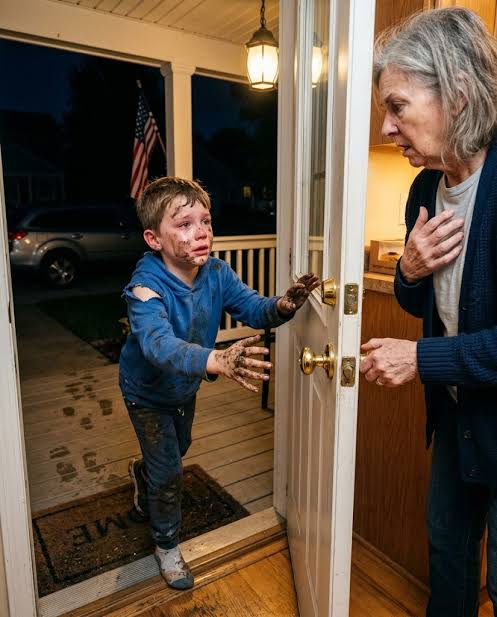
He looked toward the window.
Then he whispered six words that made my stomach tighten.
“Grandma, please don’t make me go back.”
I wanted to ask a hundred questions.
Instead, I took his backpack, helped him remove his remaining sneaker, and led him into the kitchen.
I made him hot chocolate because that was what Matthew used to do whenever Noah had a bad day.
I put two marshmallows in the mug.
Noah stared at them for several seconds.
Then his face crumpled.
“My dad used to make it like this.”
I pulled out the chair beside him.
“I know, sweetheart.”
“He always said two marshmallows were the correct amount. Three was showing off.”
I laughed softly through my tears.
“That sounds exactly like your father.”
Noah held the warm mug between his hands, but he didn’t drink.
For several minutes, the only sound in the kitchen was the ticking of the clock above the refrigerator.
Then he spoke.
“Mom says I make everything harder.”
I felt something cold settle in my chest.
“When does she say that?”
“When I ask questions. When I need a ride. When I can’t find something. When I ask if she’s coming home for dinner.”
He swallowed.
“She says she already has enough problems without me adding to them.”
I wanted to stand up and drive straight to Rachel’s house.
I wanted to demand an explanation.
But Noah was watching my face, and I realized he was waiting to see whether telling the truth would make another adult angry.
So I took a breath.
“You are not a problem, Noah. You’re a twelve-year-old boy who lost his father. You deserve to be cared for.”
He looked down at the mug.
“That’s what Dad used to say.”
I reached across the table and held his hand.
“Then your father was right.”
For a moment, I thought he might finally tell me everything.
Instead, he asked whether he could sleep in the guest room.
I made up the bed, left the hallway light on, and promised I would be just across the hall.
At 11:30, I checked on him.
He was sitting upright against the pillows, staring at his phone.
“Can’t sleep?”
He shook his head.
“Grandma, if someone records something bad happening, does that mean they’re trying to get somebody in trouble?”
I sat on the edge of the bed.
“Not necessarily. Sometimes a recording helps people understand what happened. Sometimes it helps protect someone who isn’t being heard.”
He rubbed his thumb across the edge of his phone.
“What if the person in the recording is your own mother?”
I didn’t answer immediately.
I wanted to tell him that parents made mistakes, that grief could make people behave in ways they never would have before, that his mother might be struggling more than we understood.
But I couldn’t promise him that everything was fine when he was clearly terrified.
“Then we listen carefully, sweetheart,” I said. “And we try to understand the truth.”
He nodded, but he still didn’t show me the phone.
That night, I slept very little.
At six the next morning, I found Noah sitting at the kitchen table in his pajamas.
His breakfast was untouched.
“Did you sleep at all?”
“A little.”
I poured myself coffee and sat beside him.
“Your mother is probably worried about you. We need to let her know you’re safe.”
His shoulders immediately stiffened.
“Please don’t call her yet.”
“Noah, I won’t send you anywhere without taking your concerns seriously. But I can’t promise to keep secrets if someone is hurting you or putting you in danger.”
He stared at me.
Then he nodded slowly.
“Okay.”
I contacted Rachel and told her Noah was safe with me. I asked her to speak with me calmly before making arrangements for his return.
Her response arrived less than a minute later.
Bring him home immediately. You are making this situation worse.
I read the message twice.
Then another arrived.
He is my son, Ruth. You have no right to interfere with my parenting.
I put my phone facedown.
Noah had been watching me.
“She’s mad, isn’t she?”
“She sounds upset.”
“She’s always upset.”
He said it so quietly that I almost missed it.
I reached for his hand.
“We’re going to take this one step at a time.”
But I was beginning to understand that this wasn’t simply a disagreement between a grieving mother and a grandmother who wanted more time with her grandson.
Something was happening inside that house.
And Noah had been carrying it alone.
Rachel arrived at my house just after nine.
She didn’t knock.
She rang the bell repeatedly, then began pounding on the front door.
“Ruth! I know he’s in there!”
Noah was sitting on the living-room sofa. The moment he heard her voice, he stood so quickly that his knee struck the coffee table.
I saw his face change.
“Grandma, please.”
I moved between him and the front door.
“You can stay here while I speak with her.”
“Don’t let her take my phone.”
I turned toward him.
“What?”
He looked frightened by his own words.
“Nothing.”
Before I could ask another question, Rachel shouted again.
I opened the door but kept the conversation on the porch.
She looked exhausted. Her hair was uncombed, and dark circles shadowed her eyes. For one brief moment, I saw the woman who had sat beside my son through his final weeks.
Then she looked past me.
“Where is he?”
“Inside.”
“Then move.”
“Rachel, we need to talk.”
“No, we don’t. You have spent months undermining me. You let him stay here, feed him, buy him things, and now he thinks he can run away whenever he doesn’t get what he wants.”
“He came here frightened.”
“He’s a child! He doesn’t understand what he wants.”
“Then help me understand why he’s frightened.”
Her expression hardened.
“Because his father died, Ruth. Because he’s confused. Because everyone keeps reminding him of Matthew instead of letting him move forward.”
I stared at her.
“I haven’t mentioned Matthew to him this morning.”
“You don’t have to. Everything in this house reminds him of his father. You keep his fishing pictures everywhere. You talk about their trips. You let Noah believe that living in the past is somehow better than having a mother who is still alive.”
Her words hurt because they contained a fragment of truth.
My home was full of Matthew.
His photograph stood beside the fireplace. His old fishing cap hung near the back door. A framed picture of him and Noah sat on the bookshelf.
I had never considered those things harmful.
But Rachel wasn’t looking at the pictures.
She was looking at me as though I had stolen something from her.
“Matthew is dead,” she said, her voice breaking. “And I am the one left to raise his son.”
“I know how much you’ve lost.”
“No, you don’t!”
For a moment, neither of us spoke.
Then she lowered her voice.
“You have no idea what it is like to wake up every morning and remember that the person you built your life around is gone. You get to visit your memories, Ruth. I have to live with what is left.”
I saw the grief beneath her anger.
I wanted to embrace her.
I wanted to tell her that she didn’t have to carry everything alone.
But then she said something that made me stop.
“And Noah needs to learn that the world doesn’t revolve around his feelings.”
I looked at her.
“He needs to know his feelings matter.”
“He needs discipline. He needs structure. He needs to stop using his father’s death as an excuse.”
From behind me came a small, broken sound.
Rachel turned.
Noah was standing in the hallway.
His face had gone pale.
“I never used Dad as an excuse,” he whispered.
Rachel’s eyes narrowed.
“What did you say?”
Noah immediately looked at the floor.
“Nothing.”
“Come here.”
He didn’t move.
“I said come here, Noah.”
He took one step backward.
It was such a small movement, but I saw it clearly.
A child stepping away from his own mother.
Rachel noticed it, too.
Her face changed.
“You have got to be kidding me.”
She looked at me.
“This is what you’ve done. You’ve taught him to be afraid of me.”
“No,” I said quietly. “I’m trying to understand why he already is.”
She turned away, wiping her eyes angrily.
“I’ll see you in court.”
I didn’t think she meant it literally.
Three weeks later, I received a formal notice informing me that Rachel had filed an application seeking to prevent me from interfering with her parental authority and demanding that Noah be returned to her full-time care.
She described me as an elderly widow who was unable to recognize the emotional needs of a grieving child.
She claimed I was encouraging Noah to reject his mother.
She said his repeated requests to stay with me were the product of manipulation.
And she insisted that my house was becoming a place where Noah was being taught to resent her.
I read the papers at my kitchen table.
Then I called a family-law attorney.
Her name was Helen Morris, and she listened without interrupting as I explained everything.
When I finished, she folded her hands.
“Mrs. Alden, the court will take a parent’s rights seriously. Your love for your grandson is important, but love alone won’t determine the outcome.”
“I understand.”
“We need documentation. School records, missed pickups, messages, information from the counselor, and a clear account of what Noah has experienced. We also need to avoid coaching him or asking him to choose sides.”
“I would never do that.”
“I believe you. But we have to make sure his voice is heard independently.”
She paused.
“Has Noah told you about any specific incident that made him afraid to return home?”
I thought of his question about recording something bad.
“Yes,” I said. “But he hasn’t told me everything.”
Helen leaned forward.
“Then don’t pressure him. If he discloses something concerning, write down his words as accurately as possible, including when he said them. If you believe he’s in immediate danger, contact the appropriate authorities rather than waiting for the hearing.”
I promised I would.
For the next two weeks, I gathered what I could.
The school provided attendance records and documented missed meetings.
Noah’s baseball coach confirmed the dates Rachel hadn’t arrived to collect him.
Ms. Patel, the school counselor, provided information she was permitted to share and followed the proper procedures for raising concerns about Noah’s welfare.
Helen helped me organize the documents.
But every time I looked at them, I felt sick.
Each page described a small failure.
A missed pickup.
An unanswered message.
An assignment left incomplete.
A child who apologized for needing help.
Together, they formed a picture I could no longer ignore.
Rachel wasn’t necessarily a monster.
She was a grieving woman who appeared to be struggling.
But whatever she was experiencing, Noah was paying the price.
And the court would have to decide whether the home he knew was still the home where he could thrive.
Two nights before the hearing, I found Noah sitting on the back steps.
He had his father’s old baseball glove in his lap.
The leather was cracked, and one of the seams had begun to loosen.
Matthew had bought it for him when he was seven.
I sat beside him.
“That’s a good glove.”
“Dad said I’d grow into it.”
“Did you?”
He smiled faintly.
“Yeah. He said that meant he had to buy me another one.”
We sat quietly.
Then Noah said, “Grandma, do you think Dad knew?”
“Knew what, sweetheart?”
“That things were going to get bad.”
I felt the familiar ache of missing my son.
“I think your dad knew your mother was hurting. He worried about everyone. But I don’t know what he understood about what would happen afterward.”
Noah stared at the glove.
“He told me something before he went back to the hospital.”
I turned toward him.
“What did he say?”
“He told me that if Mom and I ever started fighting, I should remember that she loved me.”
I waited.
“He said people can love you and still make mistakes. And that I shouldn’t think every bad day meant someone stopped loving me.”
My eyes filled with tears.
“That sounds like Matthew.”
Noah’s voice became smaller.
“But what if the bad days don’t stop?”
I didn’t know what to say.
So I told him the truth.
“Then the adults have to help make things better. It’s not your job to fix everything by yourself.”
He pressed his lips together.
“Mom says I’m all she has left of Dad.”
I closed my eyes briefly.
“And sometimes,” he continued, “I think she looks at me and sees him. Then she gets sad, and I feel like I have to be more like Dad so she won’t be sad anymore.”
“Oh, Noah.”
“I try to be quiet. I try not to ask for anything. I even stopped telling her about school because she gets upset when I do badly.”
He rubbed the glove’s worn thumb.
“But I can’t be Dad. I don’t know how to be Dad.”
I wrapped my arms around him.
“You don’t have to be.”
He began crying then, not loudly, but with the exhausted helplessness of a child who had been trying to solve an impossible problem.
“You’re allowed to be Noah,” I whispered. “You can miss your father. You can love your mother. You can be angry, confused, scared, or happy. You don’t have to make anyone else’s grief easier.”
He held on to me.
And for the first time since Matthew died, he cried without apologizing.
When he finally pulled away, he wiped his face with his sleeve.
“Grandma?”
“Yes?”
“If the judge asks me what I want, can I tell the truth?”
I brushed his hair away from his forehead.
“Especially then.”
He nodded.
Then he reached into his pocket and took out his phone.
“There’s something I need to show you.”
My heart began beating faster.
He opened an audio file, but before he pressed play, he looked at me.
“Promise you won’t make me listen to it more than once?”
“I promise I won’t make you listen to anything you’re uncomfortable with. But if this recording involves something that puts you in danger, we’ll need to get help.”
He nodded.
Then he pressed play.
At first, I heard only muffled sounds.
A door closing.
Footsteps.
A woman’s voice.
Rachel’s voice.
“You went through my things?”
Noah’s recorded voice answered quietly.
“I was looking for my math book.”
“Don’t lie to me.”
“I wasn’t lying.”
There was a sharp noise, followed by a long silence.
Then Rachel spoke again.
“You think your grandmother can give you everything you want? You think you can just run to her every time you don’t like what I say?”
“No, Mom.”
“Then stop acting like a helpless little boy.”
“I just wanted to know if you were coming home.”
“I have a life, Noah!”
Her voice rose.
“I cannot spend every second of every day taking care of you and your feelings!”
Then came Noah’s voice, so faint I almost couldn’t hear it.
“I miss Dad.”
The room went silent.
For several seconds, Rachel said nothing.
When she finally spoke, her voice was cold.
“So do I. But I don’t get to hide at your grandmother’s house whenever things become difficult.”
The recording ended.
I sat perfectly still.
Noah was watching me.
“Was that bad?” he asked.
I took his hand.
“It was painful to hear, sweetheart.”
“Am I in trouble for recording it?”
“I can’t promise what the legal consequences might be. We’ll ask Helen how to handle it properly. But you did the right thing by telling me you were frightened.”
He swallowed.
“I didn’t want to get Mom in trouble.”
“I know.”
“I just wanted somebody to believe me.”
I pulled him into my arms.
“I believe that you’re hurting. And I believe you deserve to be heard.”
That night, Helen advised us not to circulate the recording or confront Rachel with it. She would determine the appropriate way to raise it with the court and whether any further professional assessment was necessary.
She also reminded me that one recording could not tell the whole story.
I understood.
I wasn’t trying to destroy Rachel.
I wanted Noah to have a safe, stable home and the chance to heal.
But I couldn’t stop thinking about Matthew’s final words to me.
Don’t let Noah disappear inside himself.
My son had been afraid that his boy would become so busy making things easy for everyone else that he would forget he was allowed to need people.
Now, two days before a judge would decide where Noah should live, I finally understood what Matthew had been trying to tell me.
The morning of the hearing, Noah wore a white shirt and a navy-blue tie.
I had bought the tie for Matthew’s funeral, but Noah had never worn it.
When I helped him straighten the knot, he looked at himself in the mirror.
“Do I look grown-up?”
“You look handsome.”
“Dad would have hated this tie.”
I laughed through my nerves.
“He would have said it made you look like a junior bank manager.”
Noah smiled.
For a few seconds, he looked like the little boy I remembered.
Then the smile faded.
“Grandma, what happens if the judge sends me home?”
I knelt in front of him.
“We’ll listen to what the judge says, and we’ll talk to Helen about the next steps. I can’t promise you the outcome, but I promise I won’t stop making sure your concerns are heard.”
He nodded.
I wanted to give him certainty.
But the truth was that I was terrified.
Rachel had a lawyer.
She had parental rights.
And I was a sixty-seven-year-old widow asking a court to intervene in the life of my only grandchild.
We arrived at the courthouse early.
Rachel was already there.
She wore a cream-colored suit and had carefully styled her hair. She looked composed, almost serene.
When she saw Noah, she approached him.
“Hi, sweetheart.”
He looked at the floor.
“Hi, Mom.”
She touched his shoulder.
“You know we need to get through this nonsense, right? Once the judge understands that you’re grieving, we’ll go home and work things out.”
Noah didn’t answer.
Rachel’s fingers tightened slightly around his shoulder.
“You don’t need to be afraid of telling the truth.”
He looked up at her.
For one second, I thought she might genuinely mean it.
Then she leaned closer and whispered something I couldn’t hear.
Whatever she said, Noah stepped away from her.
Rachel straightened immediately.
Helen appeared beside me.
“Let’s go inside,” she said gently.
The courtroom was smaller than I expected.
There were wooden benches, a raised desk for the judge, and a clock that seemed to tick louder than any clock I had ever heard.
I sat beside Helen.
Noah sat between us.
Rachel sat with her attorney on the opposite side.
When the judge entered, everyone stood.
Her name was Judge Eleanor Whitcomb.
She appeared to be in her early sixties, with silver hair and an expression that gave nothing away.
She reviewed the file before looking at us.
“This is an application concerning the living arrangements and welfare of a twelve-year-old child following the death of his father,” she said. “I understand that the mother and paternal grandmother disagree about the child’s current circumstances.”
She glanced at Rachel’s lawyer.
“You may proceed.”
Rachel’s attorney spoke first.
He described his client as a devoted mother struggling with the devastating loss of her husband.
He acknowledged that Noah had experienced grief and that his school performance had declined.
But he argued that those circumstances did not justify separating a child from his surviving parent.
He described my home as a place where Noah was encouraged to dwell on the past rather than adapt to his new family circumstances.
He said I had mistaken ordinary grief for neglect.
And he suggested that Noah’s request to live with me had been influenced by the attention and freedom he enjoyed in my home.
I sat very still.
Some of his words hurt because they made me sound like a selfish old woman who wanted to replace my son’s wife.
But I reminded myself that this was not about my pride.
It was about Noah.
Helen presented the school records.
She described the missed pickups, the unanswered notices, and the counselor’s concerns.
She was careful not to suggest that a grieving parent was automatically unfit.
Instead, she focused on the practical question before the court: whether Noah’s current circumstances were meeting his emotional and developmental needs.
Rachel’s attorney responded that the incidents had been exaggerated and that my involvement had made the family conflict worse.
Rachel then addressed the judge herself.
Her voice trembled at precisely the right moments.
“I lost my husband eight months ago. I am trying to raise our son alone. I have struggled, I admit that. But I love Noah more than anything in the world.”
She wiped her eyes.
“Ruth has never accepted that Matthew is gone. She keeps him alive in every conversation, every photograph, every tradition. Noah needs his mother, not a grandmother who is trying to take my place.”
I felt the words strike deep.
Because the truth was, I missed Matthew every single day.
I missed his phone calls.
His terrible jokes.
The way he used to stand in my kitchen and eat food straight from the pan.
But I had never wanted to take Rachel’s place.
I wanted Noah to have a mother who could comfort him without making him feel guilty for missing his father.
When it was our turn, Helen asked me to describe the changes I had observed in Noah.
I spoke about the missed pickups, the forgotten school forms, and the apologies that had become part of his daily language.
I described the night he arrived at my house frightened and asked me not to make him go back.
Then Helen asked the question I had been dreading.
“Mrs. Alden, do you believe Rachel loves her son?”
I looked across the courtroom.
Rachel was staring at me.
“Yes,” I said.
Her expression shifted slightly.
“I believe she loves him. I believe she is grieving, and I believe she has been struggling in ways I may not fully understand.”
I paused.
“But loving a child and meeting his needs are not always the same thing. Noah shouldn’t have to pretend he’s fine because his mother is hurting. He shouldn’t have to stop being a child to make the house easier for the adults.”
My voice cracked.
“I’m not asking the court to punish Rachel. I’m asking the court to make sure Noah has somewhere he can sleep without being afraid, somewhere he can talk about his father without feeling guilty, and somewhere he can ask for help without apologizing for existing.”
The courtroom fell silent.
I returned to my seat.
Noah took my hand beneath the table.
His fingers were cold.
Judge Whitcomb looked down at her notes, then toward Rachel.
“Mrs. Alden has described a concerning pattern. Some of the individual incidents may be explainable, but the court must consider their cumulative effect on the child.”
She turned to Rachel’s attorney.
“Your client has described her grief. I do not dismiss that grief. But this hearing concerns Noah’s welfare, not simply the intentions of the adults around him.”
Rachel lowered her head.
For a moment, I thought the judge might make a decision immediately.
Instead, she turned toward Noah.
“Noah, I would like to hear from you. You are not in trouble, and you do not have to say what you think either adult wants to hear. You may speak in a way that protects your privacy, and we can arrange for you to speak with me without the adults present if that is more comfortable.”
Noah stared at the table.
The judge waited.
“Can you tell me, in your own words, where you would like to live and why?”
Noah’s shoulders began to shake.
Rachel leaned forward.
“Sweetheart, remember what we talked about.”
Judge Whitcomb immediately looked at her.
“Mrs. Alden’s grandson is entitled to answer my question without prompting. Please allow him to speak.”
Rachel sat back.
Noah reached into his pocket.
He pulled out his phone with shaking hands.
Then he looked directly at the judge.
“May I play what happened last night?”
The judge’s expression sharpened.
“What does the recording contain?”
Noah swallowed.
“Something my mom said to me. I recorded it because I was scared nobody would believe me.”
Rachel’s face lost its color.
“Your Honor, I object,” her lawyer said quickly. “We have not been provided with this recording, and we have serious concerns about its authenticity and context.”
Judge Whitcomb raised one hand.
“I will not decide the admissibility of an unreviewed recording on the spot. Noah, please put the phone down for now. We will handle this carefully.”
Noah lowered the phone.
But Rachel was no longer looking at the judge.
She was staring at her son as though she had never seen him before.
And for the first time that morning, she looked genuinely frightened.
Not of losing an argument.
Not of losing face.
But of what her own child might finally reveal.
READ THE NEXT PART: 👇👇
PART 4 — My Grandson Played One Recording in Court—and Changed His Family’s Future Forever