CHAPTER 1
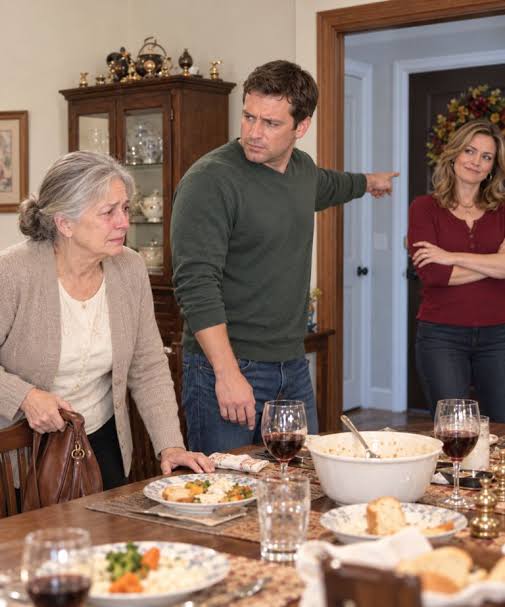
My son gestured toward his front entrance and warned me, “Either you apologize to Khloe right now or you walk out of my house and never come back.” My nine-year-old grandson sat crying nearby while my daughter-in-law watched with folded arms. I took my handbag and walked away. Neither of them understood how much of their comfortable existence had depended on the help I gave without drawing attention to it.
My son, Theo, had never addressed me with such cruelty before that night. Standing beside the dining table, he indicated the doorway and repeated, “Either you apologize to Khloe right now or you walk out of my house and never come back.” Hugo, my nine-year-old grandson, kept his gaze fixed on his dinner, struggling to hold back tears.
Certain details of that evening remain painfully clear: the circular stain from Theo’s water glass, Cheyenne reaching beneath the table to clasp her brother’s hand, and the suffocating quiet after the ultimatum. At sixty-eight, I felt as though I had become an unwelcome stranger at my own family’s table.
The argument had begun innocently when Hugo asked if I could join everyone for Thanksgiving. Before I could respond, Khloe announced that she preferred to celebrate with only her immediate family that year.
I could have respected that decision. Parents are entitled to choose their holiday arrangements. But she went further, telling me she was weary of my suggestions and resented feeling criticized inside her own house.
She cited my reminder that Hugo should put on an extra layer before going outside, along with something I’d said about Cheyenne’s bedtime. I’d regarded both as harmless expressions of concern, though I could admit that being a worried grandmother didn’t automatically entitle me to offer advice.
“Maybe I should have kept those opinions to myself,” I said. “But I wasn’t trying to hurt you.”
Khloe accused me of insisting on being right and of making Theo feel guilty whenever anyone disagreed with me. When I softly objected to the way she was addressing me, she shoved her chair backward.
“If you really cared about your grandchildren,” she said, “you would know when you’re not welcome.”
Hugo’s eyes were wet, and Cheyenne had become unnaturally quiet. I wanted to reassure them that disagreements between adults weren’t their responsibility. Before I had the chance, Theo brought his palm down on the tabletop.
“That’s enough, Mom. Khloe has put up with this for far too long. Apologize to my wife.”
I asked whether he truly understood what he was demanding. He rose and presented his ultimatum: apologize or leave forever. Khloe stood beside him, arms still crossed. Neither appeared concerned that their children were witnessing everything.
Rather than shout back, I rose, collected my purse, and answered, “I understand.” I leaned down to embrace Hugo and Cheyenne, assuring them of their grandmother’s love and reminding them that adult disagreements were never their fault. The door closed after I stepped out.
I remained in my car for a while, hoping Theo might come outside, perhaps to express regret that the children had seen the confrontation. He never appeared. Eventually I drove to the silent home I’d shared with my husband, Sebastian, before he passed away six years ago.
To understand why leaving hurt so much, you need to understand how thoroughly my life had become intertwined with Theo’s household. He was my only boy. After Sebastian’s death, being alone with the empty chair where he once drank his coffee and described his day had become almost unbearable.
I’d worked as a nurse for decades. Retirement brought a reasonably comfortable pension but also long, unstructured days. Initially I visited Theo and Khloe twice weekly, helping with school collections, breakfast, and hectic afternoons.
Soon those visits expanded until I was arriving before the children got out of bed. I prepared their breakfast, checked backpacks, drove them to appointments and activities, and came back to straighten the kitchen or put on laundry. I purchased food, cooked evening meals, cleaned up afterward, and often stayed until every outstanding task was done.
Cheyenne attended dance lessons, while Hugo had homework and a crowded calendar. I moved between obligations with the same practiced efficiency I’d once brought to hospital rounds. I could identify Hugo’s lunchbox instantly and knew exactly where Cheyenne stored her preferred hair accessories.
In those early days, Theo expressed his gratitude frequently. Having people depend on me eased the loneliness waiting at home.
Over time, however, polite requests became expectations. Khloe started leaving schedules and written instructions on the counter. Theo informed me of the following day’s pickup without first asking whether I was free. My own plans rarely entered the conversation.
I understood that both parents worked and were struggling to balance employment with raising two children. Their household was theirs to manage, too. Yet whenever I rescheduled a medical visit to transport one of the children, nobody knew what I’d sacrificed. They simply saw me arrive punctually, as usual.
I should have established limits long before that dinner. Instead, I reassured myself that helping was what relatives were supposed to do. I took pride in being reliable even when the arrangement increasingly resembled employment without a finishing time.
Our financial arrangement evolved in much the same way. Two summers before the argument, Khloe was anxious about a roof leak. I spent almost $25,000 replacing it, unwilling to risk water entering the bedrooms where my grandchildren slept.
I also covered Cheyenne’s dance fees, costumes, and transport. The household phone charges came automatically from my account each month. Groceries and clothing for the children regularly went into my shopping basket, and whenever another unexpected bill appeared, I was usually the first to offer assistance.
I’d even agreed to co-sign the financing for Theo’s truck. Sebastian and I had been careful savers, and I believed those resources could provide the younger generation with greater stability.
I didn’t require anyone to pay me back. What troubled me was realizing that voluntary generosity had quietly become a permanent assumption in everyone else’s financial planning.
They also knew nothing about the physical price I was paying. For close to a year, I’d undergone treatment for osteoporosis and persistent joint pain. My physician advised against carrying heavy objects, remaining upright for extended periods, and failing to rest after lengthy drives.
I kept the diagnosis and recommendations from Theo and Khloe. I feared they would interpret my condition as criticism or an excuse to withdraw help, although my years in nursing should have taught me the danger of concealing symptoms.
On particularly painful evenings, I sat wearing my coat because my knees hurt too much to climb upstairs immediately. Housework left my fingers rigid, and long afternoons aggravated my back. Every night I resolved to take things easier the following morning. Then the telephone rang, and the resolution disappeared.
After I’d finished cleaning her kitchen one day, Khloe remarked that someone who’d spent the whole day at home had no reason to feel exhausted. I assured her I was all right. Later, placing medication on my bedside table, I wondered how telling the truth had come to feel so intimidating.
I postponed physiotherapy sessions to accommodate Cheyenne’s dance timetable. I also delayed purchasing the supportive chair my doctor recommended after Theo mentioned another shortage of money. Nobody explicitly ordered me to make either sacrifice. I made those decisions myself, and acknowledging that was part of understanding what had happened.
Every sacrifice had an easy justification. I pictured Cheyenne beaming in her dance outfit or Hugo waving as he entered school, and immediately felt guilty for craving a quiet morning. Somehow I’d forgotten that I could adore my grandchildren without disobeying medical advice.
Savings reserved for my own treatment were gradually being spent on their household, while almost nobody asked about my well-being. I was frightened to disappoint them; they had become accustomed to never hearing a refusal. The confrontation finally exposed what we’d all allowed to develop.
My older sister, Nora, had warned me for years. Following her divorce, she’d settled in Newport, Oregon, in a coastal home with a guesthouse overlooking nearby marshes.
Whenever she invited me, I claimed I was needed for a school run or one of Khloe’s arrangements. Eventually she asked, “Camila, who will take care of you when you don’t have the strength to take care of everyone else?”
I responded with a laugh. Admitting the truth would have meant recognizing that constant activity helped me avoid facing Sebastian’s absence. Feeling indispensable seemed easier than grieving.
The next morning, with my sore knee resting on another chair, I called Nora from my kitchen. She immediately sensed my distress. “Camila, what’s wrong?”
“Is the guesthouse still available?” I asked. She confirmed that it was and asked if I’d finally decided to visit. “Not just a visit,” I told her. “I need to move for a while. I need treatment, and I need some rest.”
She didn’t insist on hearing the entire explanation. “Then come here, little sister,” she said. “We’ll figure things out one day at a time.” Since Theo had ordered me toward the exit, I’d felt that belonging anywhere required me to earn it. Nora’s response challenged that belief.
Once we ended the call, I retrieved the carefully organized financial records Sebastian had left behind. I made a list of the recurring phone charges, dance payments, bank transfers, groceries, and truck financing. The totals were startling. What I’d considered occasional assistance had become a meaningful share of another family’s regular expenses.
I contacted my bank to halt automatic transfers, cancel an additional card, and protect the savings I still had. I also requested information about my continuing obligations as a guarantor on Theo’s vehicle loan. Co-signing a debt creates responsibilities that cannot simply be canceled at will.
The following Tuesday, wearing my gray coat and carrying the documents, I met Preston Hail at the bank. He’d assisted me after Sebastian’s passing and seemed surprised by my requests. He carefully explained which transfers could end immediately and which arrangements required advance notice to providers.
“Are you certain?” he asked when we reached the recurring transfers. “You’ve kept some of these going for a long time.”
“I know,” I told him. “That’s why I need to stop.”
We canceled the transactions within my control, arranged modifications to the others, and transferred my accessible savings into an account solely under my name. Preston offered no criticism. He simply respected my right to make decisions about my own resources.
Three days afterward, as I prepared to leave for Newport, Khloe telephoned. She showed no curiosity about my health. Instead, she opened with, “What have you done?”
The phone and dance charges hadn’t been paid as she’d anticipated, and she was angry I hadn’t notified them. I explained that my medical needs required me to use my money differently.
“But we’ve always relied on you,” she said. “Do you know what kind of problems this causes us?”
Without waiting for an answer, she moved to another subject. “Anyway, you’re still coming over at one to watch the kids, right? I’ve made plans with a friend.” Apparently the previous dinner’s ultimatum had already been forgotten.
Looking at my suitcase, only partly filled, I realized how completely the need to be useful had crowded out my own needs.
“No, Khloe,” I said. “I’m not coming this afternoon. You’ll need to make another arrangement.”
She called me selfish. I heard her out, still anxious about upsetting her, but this time I didn’t reverse my decision.