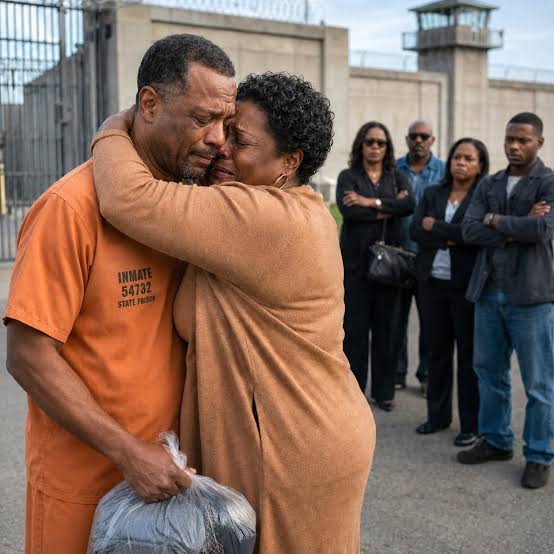
My uncle got out of prison and the whole family closed the door on him, except my mom, who hugged him as if the guilty one were someone else. Years later, when they were going to take our house away, he just said: “Come, I’m going to show you why they locked me up.”
The footsteps stopped outside the office.
My uncle Raymond put one finger against his lips.
Then my father’s voice came through the darkness.
“Raymond.”
He didn’t sound drunk anymore.
That frightened me more than if he had been shouting.
“You always were too sentimental,” Dad said. “Couldn’t just let dead things stay buried.”
Raymond shifted in front of me.
Not dramatically.
Just enough that his body was between mine and the door.
I was eighteen years old, nearly six feet tall, and for the first time in my life I understood that my uncle still saw me as the little boy he had once promised to protect.
Dad tried the door.
Locked.
“You brought David here?”
Raymond said nothing.
My father laughed.
“Of course you did.”
I looked at the yellow folder in my hands.
ORIGINAL BIRTH CERTIFICATE: DAVID RAYMOND BARNES.
Barnes.
My mother’s maiden name.
I had lived my entire life as David Malone.
My school records.
Social Security card.
Driver’s permit.
Everything said Malone.
Why did an original document say Barnes?
I leaned toward Raymond.
“What does this mean?”
He whispered:
“Not yet.”
Then Dad spoke again.
“David, whatever he showed you, he’s lying.”
I almost answered.
Raymond gripped my shoulder.
“No.”
The single word was barely audible.
Dad continued from the other side.
“You know what he is. You know why he went away.”
My heart pounded.
I had spent my entire childhood hearing the same story.
Raymond Barnes had robbed the payroll room at Malone Transport.
A hundred eighty thousand dollars in cash.
A night guard named Dennis Cole had surprised him.
Raymond attacked Dennis with a tire iron and fled.
Police found part of the money in Raymond’s apartment.
He took a plea.
Eleven years.
Served almost nine.
Simple.
Ugly.
Finished.
Except nothing about the room around me looked finished.
I could see the edge of photographs even in the darkness.
My father counting money.
My uncle in handcuffs.
My mother standing beside a man I recognized from old family albums.
My grandfather, Elias Barnes.
The man who supposedly died from a heart attack before I was old enough to remember him.
Raymond leaned toward my ear.
“When I say run, go through the back office.”
“There’s nowhere—”
“There is.”
“How do you know?”
“Because I worked here before your father put his name on the wall.”
My stomach twisted.
Dad knocked again.
Then his voice softened.
“David.”
That was the voice he used when he wanted something.
When I was ten and he needed me to tell Mom he had been home earlier than he really had.
When I was fourteen and he wanted me to lie about who had wrecked the Buick.
When the bank started calling and he told me not to mention certain envelopes to Mom.
“Son, open the door.”
Son.
Raymond closed his eyes.
Dad continued:
“He’s dangerous.”
I looked at my uncle.
He had spent three years living in our backyard shed without raising his voice at anyone.
He fixed my bicycle.
Taught me how to replace brake pads.
Left half his dinner when he thought Mom wasn’t eating enough.
Dangerous wasn’t the word that came to mind.
“Raymond stole from this family,” Dad said. “He nearly killed a man. Don’t let him ruin you too.”
Raymond whispered:
“Ask him what color the cash straps were.”
I frowned.
“What?”
“Ask.”
I raised my voice.
“Dad?”
Silence.
“What color were the bands around the stolen money?”
Nothing.
Then:
“What kind of question is that?”
“The money Raymond stole.”
“I know what you mean.”
“So what color?”
Dad sounded irritated.
“How the hell would I remember?”
Raymond looked at me.
Then he whispered:
“Red.”
My father said through the door:
“Blue, I think.”
Raymond almost smiled.
Police reports I later read would show that the recovered bills were bundled with red Federal Reserve straps.
Only three people had officially known that before trial.
The payroll manager.
The detective.
And the person who packed the money.
Raymond.
But that wasn’t why he had asked.
He whispered:
“Your father told police they were blue.”
“What does that prove?”
“That he claimed he watched me take them.”
My stomach dropped.
“He testified?”
Raymond nodded.
Dad had never told me that.
Our family story made it sound like evidence had spoken for itself.
Fingerprints.
Money.
A wounded guard.
A confession.
No one ever mentioned my father had been the key witness.
A metallic scrape came from outside.
Raymond stiffened.
“He has a key.”
A second later, something entered the lock.
Raymond shoved the yellow folder under my shirt.
“Back wall.”
I moved.
There was an old metal filing cabinet pushed against peeling paneling.
Raymond pulled it sideways.
Behind it was a narrow door.
“You knew this was here?”
“I built it with your grandfather.”
The office door opened.
Light spilled in.
I slipped behind the hidden panel just before Dad entered.
Through a crack, I could see everything.
My father stood in the doorway holding a flashlight.
Behind him was Uncle Robert Malone, his older brother.
I had not seen Robert in almost two years.
Dad’s family had always treated Raymond like dirt.
Now I understood why.
Robert closed the door.
Dad looked around.
“Where’s the boy?”
Raymond stood alone near the desk.
“Gone.”
Dad smiled.
“No, he isn’t.”
My mouth went dry.
Dad stepped farther inside.
His flashlight swept across the photographs.
Then his smile disappeared.
“You kept this.”
Raymond said:
“I kept everything.”
Robert cursed.
“What the hell is wrong with you?”
“For nine years? A lot.”
Dad looked at the wall.
Then at Raymond.
“You had your chance.”
“My chance?”
“You took the deal.”
“I took a deal because you said Elena would lose David if I didn’t.”
Elena.
My mother.
My father’s voice changed.
“You chose.”
“You forged the custody petition.”
My knees almost gave way.
Robert stepped forward.
“Keep your voice down.”
Raymond laughed once.
“There’s nobody left to protect you from hearing it.”
Dad moved close enough that their faces were inches apart.
“You think some moldy papers change anything?”
“They changed enough to bring you here.”
Dad’s eyes narrowed.
That sentence mattered.
I didn’t understand why yet.
Then I saw Raymond’s right hand.
He was holding his old flip phone low against his thigh.
Recording.
My heart hammered harder.
Dad said:
“The statute on half this stuff is ancient.”
Raymond replied:
“Murder doesn’t get old.”
Everything stopped.
Even Robert looked at my father.
Dad’s face turned flat.
“What did you say?”
Raymond’s voice was quiet.
“Elias.”
My grandfather.
“Don’t.”
“He didn’t die of a heart attack.”
Robert looked at Dad.
“Tom?”
My father’s name was Thomas Malone.
Nobody called him Tom except his brother.
Dad pointed at Raymond.
“This is exactly why nobody believes you. Prison scrambled your head.”
Raymond moved toward the photographs.
He pulled down one showing my grandfather’s truck.
The front end was crushed against a concrete barrier.
I had never seen that photograph.
Our family albums contained pictures of Grandpa Elias smiling beside trucks, at Christmas, holding me as a newborn.
Never this.
Raymond turned it toward Dad.
“Brake line.”
Dad said nothing.
“You cut it.”
“You can’t prove that.”
The words came too quickly.
Robert whispered:
“Tom.”
Dad spun toward him.
“Shut up.”
Raymond’s eyes met mine through the crack.
He knew I was listening.
“You told everyone Elias collapsed behind the wheel.”
Dad scoffed.
“He had heart disease.”
“The autopsy said his heart stopped after the collision.”
“Same difference.”
“No.”
Raymond stepped closer.
“The mechanic told me the brake hose had been sliced.”
Dad laughed.
“Then where’s your mechanic?”
“Dead.”
“Convenient.”
“But he wrote it down.”
My father’s face changed.
There.
A tiny movement.
But enough.
Raymond had surprised him.
“Your father kept maintenance logs,” Raymond continued. “Every truck. Every repair. He knew somebody was siphoning money from Barnes Freight.”
Barnes Freight.
Not Malone Transport.
“He was going to remove you from the company.”
Dad’s jaw tightened.
“I built that company.”
“You married his daughter and worked in his office.”
“I doubled the routes!”
“With his trucks.”
“I saved that place.”
“You stole from it.”
Dad stepped toward Raymond.
Robert grabbed his arm.
“Tom, stop talking.”
Dad jerked free.
“I’m not afraid of him.”
“You should be afraid of yourself.”
Raymond tapped his phone.
My father saw it.
The room exploded.
Dad lunged.
Raymond moved sideways.
Robert shouted.
The phone hit the floor.
I pushed through the hidden door before I could think.
“Stop!”
Everyone froze.
Dad stared at me.
Then at the yellow folder under my shirt.
His face collapsed.
“You stupid kid.”
I had never heard him call me that.
Not even drunk.
“What is this?”
I pulled out the folder.
“Why does my birth certificate say Barnes?”
Dad’s eyes moved toward Raymond.
“That’s an old record.”
“Why was my name changed?”
“You were adopted.”
“By you?”
“Of course by me.”
“When?”
He hesitated.
I knew immediately.
“You don’t know.”
“David—”
“When?”
“I’d have to check.”
Raymond said:
“He never adopted you.”
Dad whirled.
“Shut your mouth.”
Raymond looked at me.
“Your legal name was changed through an amended certificate filed after he married your mother.”
“Which is legal,” Dad snapped.
Raymond shook his head.
“Not with a forged acknowledgment from a dead man.”
I stared.
“What dead man?”
Nobody answered.
I looked at my father.
Then Raymond.
“My real father?”
Raymond’s face softened.
“No.”
That somehow confused me more.
“Thomas is your biological father.”
Dad almost looked relieved.
Then Raymond added:
“But you were born before they married, and Elias insisted your mother keep Barnes as your surname until Thomas proved he could be trusted.”
I looked down at the certificate.
Father: Thomas Eugene Malone.
Mother: Elena Marie Barnes.
Child: David Raymond Barnes.
Raymond.
My middle name.
“Grandpa named me after you?”
“My sister did.”
His voice cracked.
“She said if anything ever happened to her, she wanted you to remember there was another man in the family who loved you.”
I couldn’t speak.
Dad scoffed.
“Very touching.”
Raymond’s expression hardened again.
“The name mattered because of Elias’s will.”
My father went still.
There it was.
The real thing.
Money.
Property.
Inheritance.
The reason adults suddenly stop pretending.
“What will?”
I asked.
Raymond looked at my father.
“Tell him.”
Dad said nothing.
“Tell him why you needed his name changed.”
Robert backed toward the door.
“I’m leaving.”
Dad grabbed him.
“No.”
Robert looked terrified now.
That frightened me.
Raymond opened the yellow folder.
He pulled out another document.
“My father left Barnes Freight to Elena.”
Mom.
“Seventy percent.”
Then he looked at me.
“Twenty percent to you.”
My knees weakened.
“And ten percent to me.”
I stared at him.
“Then why was it Dad’s?”
“Because Elias died before probate was complete.”
Raymond pointed at my father.
“And Thomas produced a codicil.”
“A what?”
“A document changing the will.”
Dad laughed.
“It was valid.”
“No.”
“You lost that challenge.”
“I was arrested before the hearing.”
Raymond looked at me.
“The new document gave your mother the house and gave Thomas controlling interest in the company as her husband and David’s guardian.”
My father stepped forward.
“Because Elias understood who actually ran the business.”
Raymond ignored him.
“The signature was forged.”
Dad shouted:
“You cannot prove that!”
Raymond said:
“Elias was in Buffalo the day you claimed he signed it in Queens.”
Silence.
“The toll records are in the file.”
Dad’s face turned gray.
“How did you get those?”
“Your father-in-law kept everything.”
Robert whispered:
“Jesus Christ.”
I flipped through pages.
Photocopies.
Bank records.
A will.
A second will.
Handwriting samples.
A payroll ledger.
A police report.
Then a photograph.
My mother standing outside a courthouse holding me as a baby.
Raymond beside her.
Behind us, Grandpa Elias.
On the back, someone had written:
DAVID RAYMOND BARNES — BENEFICIARY.
I looked at Dad.
“You knew?”
He said:
“This is family business you don’t understand.”
“I’m eighteen.”
“You load boxes at a market.”
That cut deeper than it should have.
“You dropped out of school.”
“To help you.”
“No one asked you to.”
I stared at him.
Mom crying over coins.
The foreclosure notices.
The auto shop gone.
The car gone.
My hands raw from loading produce before sunrise.
No one asked you to.
Raymond said quietly:
“He says that because accepting what you did would mean admitting what he did.”
Dad rounded on him.
“What I did?”
“You mortgaged a house Elena already owned before the marriage.”
My head snapped up.
“What?”
Dad’s face changed again.
Raymond continued:
“The house in the Bronx was bought with proceeds from the sale of her share in a Barnes property.”
Dad said:
“Our house.”
“It was titled to her.”
“We refinanced.”
“With a signature she says she never gave.”
My stomach turned.
The foreclosure.
Mom had kept saying she didn’t understand how the mortgage got so large.
Dad told her she had forgotten signing papers.
She had believed him.
Or pretended to.
“Did you forge Mom’s signature?”
Dad’s eyes flashed.
“Watch your mouth.”
“Did you?”
“I kept that roof over your head for eighteen years.”
Raymond laughed.
“With her money.”
Dad moved toward me.
Raymond stepped between us.
“Don’t.”
My father looked at him.
“You think prison made you tough?”
“No.”
Raymond’s voice became strangely calm.
“Prison taught me how much a man can survive when he has one reason not to die.”
He glanced at me.
Dad saw it.
For the first time, something like fear appeared in his face.
Then sirens sounded outside.
Faint.
Getting closer.
Robert swore.
Dad looked toward the window.
“What did you do?”
Raymond smiled.
“Nothing.”
The office door opened.
My mother stood there.
I had never seen her look like that.
She wore slippers.
No coat.
Hair loose.
Behind her stood a woman in a navy coat and two police officers.
Mom looked at Dad.
“You followed them.”
Dad stared.
“Elena.”
Her whole body shook.
But she did not look away.
The woman beside her introduced herself.
“Diane Mercer. Attorney.”
Dad laughed.
“You brought a lawyer?”
Mom said:
“Raymond did.”
I looked at him.
He shrugged.
“I told you I wasn’t opening that room until it was time.”
Attorney Mercer looked around.
Then at Raymond’s phone on the floor.
“Did you get it?”
Raymond picked it up.
“Most.”
Dad’s face darkened.
“You set me up.”
Raymond’s smile disappeared.
“No, Thomas.”
“You followed me to evidence you already knew existed and talked about things nobody forced you to discuss.”
One officer stepped forward.
“We’re going to need everyone separated.”
Dad backed away.
“This is insane.”
Mom looked at him.
“Did you cut my father’s brakes?”
He stopped.
For all the evidence in that room, for all the accusations, that was the question that mattered.
Because it came from her.
His wife.
The woman who had spent years doubting her own memory while he controlled every version of the past.
“Elena.”
“Did you?”
“No.”
She stared at him.
“Raymond says the mechanic knew.”
“He’s a convicted felon.”
“Raymond says you planted the payroll money.”
“He confessed!”
Raymond spoke.
“I pled.”
Mom turned toward him.
Their eyes met.
Something passed between them.
Thirteen years of guilt.
Maybe longer.
Then she looked back at Dad.
“Why did he plead?”
Dad said nothing.
Mom’s voice cracked.
“Tell David.”
I looked at Raymond.
He sat down slowly.
And then he finally told me why he went to prison.
The night the warehouse money disappeared, Raymond had been twenty-nine.
Mom was twenty-six.
I was nine months old.
Grandpa Elias had been dead for four months.
Raymond already suspected Dad had forged the codicil.
He also suspected Dad had been stealing payroll money to cover gambling debts and buy control of freight routes through side companies.
Raymond arranged to meet a lawyer the following morning.
Dad found out.
That night, he called Raymond to the warehouse.
When Raymond arrived, the payroll safe was open.
Money was missing.
Security guard Dennis Cole was unconscious beside the loading dock.
Dad was standing over him.
Raymond called 911.
Then Dad told him police would find Raymond’s fingerprints everywhere.
They did.
He had worked there for twelve years.
The missing money?
Dad had hidden thirty-five thousand dollars in Raymond’s apartment using a spare key Mom had once given him.
And the tire iron used on Dennis?
From Raymond’s truck.
Raymond still planned to fight.
Until Dad showed him something.
A prepared complaint alleging Mom was abusing prescription medication and neglecting me.
Fake medical statements.
Photographs of Mom exhausted after childbirth.
A statement from one of Dad’s friends claiming she left me alone.
If Raymond fought the case, Dad said he would have Mom declared unstable, take me, and make sure she never saw me again.
“I didn’t believe him at first,” Raymond said.
Mom was crying now.
“Then he showed Raymond the petition.”
I looked at her.
“You knew?”
“Not all of it.”
“Mom.”
“I knew your father threatened to take you.”
“Why didn’t you tell anyone?”
Her face collapsed.
“Because I was scared.”
Dad shouted:
“She was sick!”
Mom turned.
“I had postpartum depression.”
The room became still.
“You told everyone I was crazy.”
“I got you help.”
“You used my treatment against me.”
Dad looked toward the police.
“This is marital garbage. None of this proves—”
Raymond continued.
“He offered me a deal.”
Dad went silent.
“If I pled guilty, Elena kept David. The medical petition disappeared. Thomas promised he would leave them alone.”
I stared at him.
“You went to prison for us.”
He shook his head.
“Don’t make it noble.”
“What else is it?”
“I was afraid.”
His eyes filled.
“I was afraid if I fought, your mother would lose you before I could prove anything.”
“How long were you supposed to serve?”
“Eleven years.”
“You gave eleven years?”
“I gave a plea.”
He looked at the floor.
“They took the years.”
I couldn’t breathe properly.
All my life, family members had called Raymond weak.
Thief.
Violent.
Disgrace.
And every time they insulted him, he lowered his head.
Because defending himself would mean exposing the same secret he had sacrificed himself to keep.
Mom knelt beside him.
“I should have told David.”
Raymond shook his head.
“You were surviving.”
“I left you there.”
“You wrote.”
“Not enough.”
“You sent money.”
“Not enough.”
“You came twice.”
She began sobbing.
“The first time you wouldn’t look at me.”
“Because if I did, I was afraid I’d ask you to get me out.”
Mom hugged him.
Just like she had the day he came home from prison.
Except now I understood why she had whispered:
Forgive me, brother.
My father looked disgusted.
“Oh, spare me.”
That was the moment something inside me changed forever.
Not when I saw the birth certificate.
Not when I heard about the will.
When my father watched his wife and her brother grieve thirteen stolen years and reacted with annoyance.
I saw him.
Really saw him.
Dad pointed toward the officers.
“You’re taking the word of a felon against mine?”