PART 3
She was silent for several seconds.
Then she asked, “Claire, are you safe right now?”
“Yes. Patricia is watching television.”
“That’s not what I asked. Do you feel safe staying there tonight?”
I looked toward the living room.
Patricia had turned the television volume up so loudly that I could hear every word from the hallway.
“I don’t know,” I admitted.
“Then don’t force yourself to stay just because it’s your apartment. Go somewhere you feel safe. You can deal with the rest when you’re not alone with them.”
Her words settled something inside me.
I’d spent the entire day thinking about documents, bank statements, legal letters, and what I would say when Daniel came home.
I hadn’t thought about what I needed.
“I might come to your place for the night,” I said.
“Bring whatever you need. And Claire?”
“Yes?”
“You don’t have to convince your husband that being hit is wrong. He should already know that.”
After we hung up, I packed a small suitcase.
I took my laptop, work clothes, medication, and the folder containing my personal financial records. I photographed the condition of the apartment and saved copies of the relevant messages and account statements.
Then I went to the living room.
Patricia was reclining on the sofa, one hand resting on a bowl of grapes.
“Where are you going?” she asked.
“Out.”
“At this hour?”
“It’s six-thirty.”
She frowned.
“Daniel will be home soon. You should prepare dinner.”
I picked up my handbag.
“There’s food in the refrigerator. You’re welcome to make something.”
Her face tightened.
“You’re leaving me here alone?”
“I won’t be here tonight.”
She sat upright.
“After everything I’ve done for you?”
I almost laughed.
What exactly had she done for me?
She had criticized my work, invaded my privacy, rearranged my belongings, and struck me across the face. And now she was presenting herself as the injured party because I wouldn’t prepare her dinner.
“Patricia, I want you to understand something,” I said. “You are not entitled to my labor, and you are not entitled to touch me.”
She stared at me.
Then her expression shifted into the familiar look of wounded innocence.
“I knew you would turn out to be selfish eventually.”
I opened the front door.
“Good night, Patricia.”
“You’ll regret treating me this way!”
I didn’t answer.
As the elevator descended, I felt the first real breath of relief I’d taken since waking that morning.
It wasn’t happiness.
It was the feeling of no longer having to defend my existence to someone who had already decided I was wrong.
And when I reached Emily’s apartment, I discovered that leaving the room had been easier than leaving the marriage I’d imagined I had.
Because I still loved Daniel.
I just didn’t know whether I could love the man he had become.
Daniel arrived home at 9:18 p.m.
I know the exact time because he called me three times in twelve minutes, and I watched each call appear on my screen.
The first message said, Where are you?
The second said, Mom tells me you left her alone.
The third was different.
Claire, why is there an envelope on the table?
I stared at that final message for a long time.
Then I answered.
Read it carefully. We can talk tomorrow.
He called immediately.
I let it ring.
A few seconds later, my phone began vibrating again.
I finally answered.
“What is this?” Daniel demanded.
“Which part?”
“The letter. The bank statements. The hotel reservation. What are you trying to do?”
“I’m setting boundaries.”
“Boundaries?” He gave a short, disbelieving laugh. “You’ve hired an attorney, booked Mom a hotel, and left our home without telling me. That’s not setting boundaries, Claire. That’s declaring war.”
I sat on Emily’s guest bed, looking at the overnight bag beside me.
“Your mother slapped me.”
“We’ve already discussed that.”
“No, Daniel. You discussed how inconvenient it was for you.”
He fell silent.
I continued.
“You asked me to apologize to the person who hit me. You told me to keep her comfortable. You refused to explain why she’d been receiving money from our joint account for seven months. And when I tried to understand what was happening, I found her looking through my property documents.”
“She wasn’t snooping. She was curious.”
“Why was she asking about my equity?”
“I don’t know!”
“Then perhaps you should ask her.”
I heard him move away from the phone.
When he spoke again, his voice was quieter.
“Mom is upset. She’s been through a lot.”
“And so have I.”
“Claire, she’s my mother.”
“And I’m your wife.”
“I know that!”
“Do you?”
The question hung between us.
For a moment, neither of us spoke.
Then Daniel said, “Come home tomorrow. We’ll sit down and work this out like adults.”
“I’ll meet you at home tomorrow afternoon, provided Patricia isn’t there. I want to discuss the money, the assault, and what happens next.”
“You can’t just tell my mother to leave.”
“She’s my guest. I have already spoken with an attorney about the appropriate process. If she refuses to leave, I’ll follow the law.”
He exhaled sharply.
“You’re making me choose.”
I closed my eyes.
“No, Daniel. Your mother made a choice when she hit me. You made a choice when you asked me to accept it. I’m making mine now.”
I ended the call.
For several minutes, I sat perfectly still.
Emily knocked gently on the bedroom door.
“Everything okay?”
I nodded, although my eyes were burning.
“He’s angry.”
“Of course he is. Things are no longer happening the way he expected.”
I wiped my face.
“What if I’ve destroyed my marriage?”
Emily came over and sat beside me.
“Then the question isn’t whether you destroyed it by refusing to be mistreated. The question is why it required your silence to keep it standing.”
I looked down at my hands.
I didn’t have an answer.
But for the first time, I was beginning to ask the right questions.
The following morning, Daniel sent me a photograph.
It showed the first page of the envelope, the attorney’s letter resting beside our wedding photograph.
Underneath it, he’d written:
You really want to do this?
I replied:
Yes. We need to talk.
At two o’clock, I returned to the condo.
Patricia was gone.
Her suitcases had been moved from the guest room to the hallway, and a half-finished cup of coffee sat on the kitchen counter.
Daniel stood near the window wearing the gray sweater I’d bought him for Christmas.
He looked exhausted.
For a second, I wanted to cross the room, wrap my arms around him, and ask him to tell me that everything would be okay.
That instinct frightened me more than his anger.
Because it was the same instinct that had kept me quiet for three years.
He turned when he heard the door close.
“Where were you last night?”
“With Emily.”
“You could have told me.”
“I did tell you I wasn’t staying here.”
“You didn’t say you were leaving the apartment.”
“Daniel, I don’t need permission to spend a night somewhere else.”
He rubbed his forehead.
“Fine. Can we please sit down?”
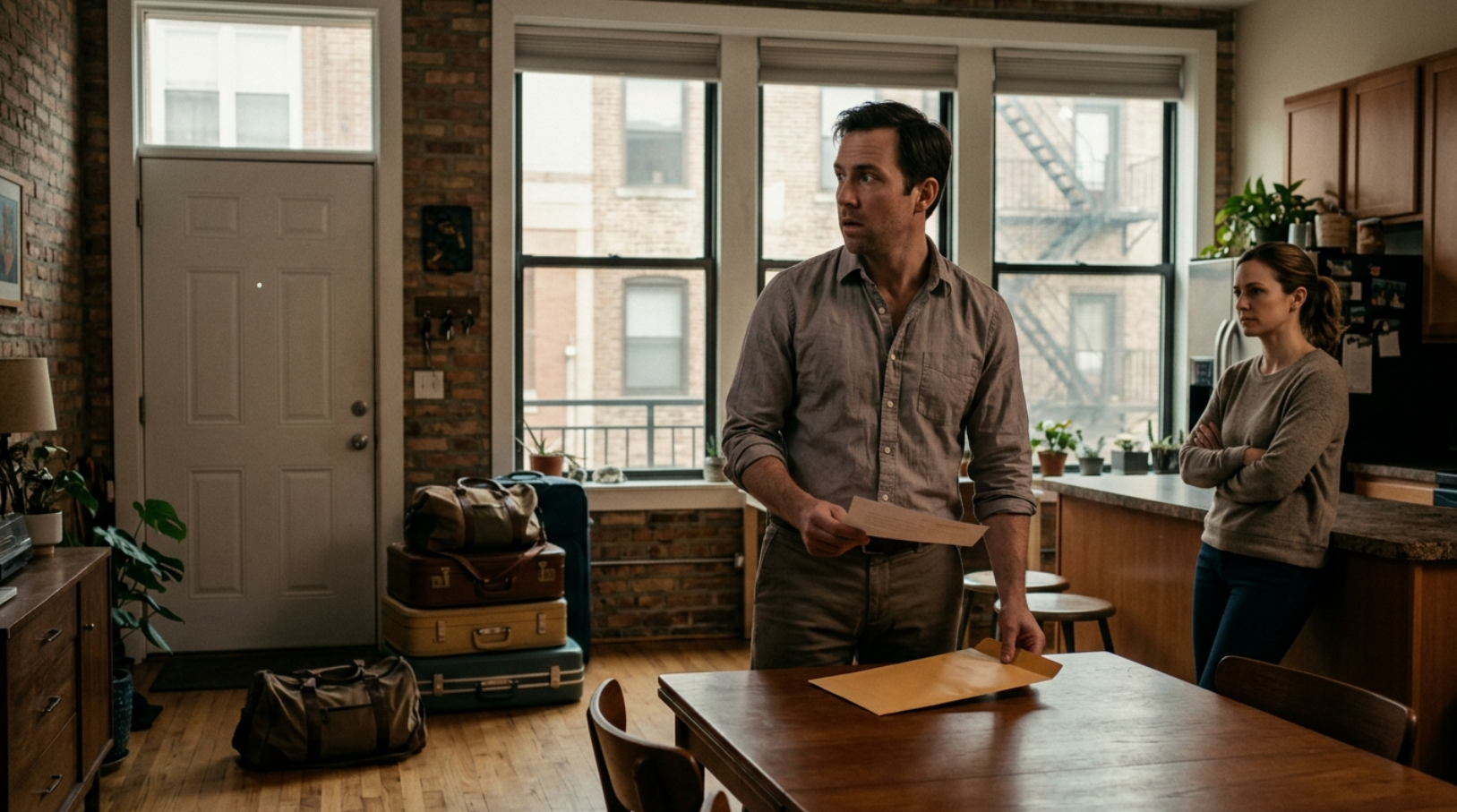
We sat across from each other at the dining table.
The manila envelope was still between us.
Daniel tapped it with one finger.
“I don’t understand how we got here.”
I looked at him.
“Neither do I.”
He opened the envelope and removed the documents.
The first was the attorney’s letter concerning Patricia’s stay.
The second summarized the financial transfers I’d found.
The third outlined the questions I wanted answered before deciding whether our marriage could continue.
He read them slowly.
When he reached the bank statements, his expression changed.
“Where did you get these?”
“Our joint account.”
“Why were you going through our finances?”
“Because I found seven monthly transfers of eight hundred and fifty dollars to your mother.”
He stared at the page.
“That’s what this is about?”
“It’s part of it.”
“She’s been struggling with rent.”
“Then why didn’t you tell me?”
He put the papers down.
“Because I knew you’d react like this.”
I felt a cold stillness settle over me.
“Like what?”
“Like I’m doing something wrong by helping my mother.”
“Helping her isn’t wrong. Hiding recurring payments from your wife is a problem, especially when we agreed to discuss substantial expenses.”
He shook his head.
“You’re making this sound criminal.”
“I’m asking why you concealed it.”
“I didn’t conceal anything. I just didn’t think it needed to become a big discussion.”
“Seven months, Daniel. Seven payments.”
He leaned back in his chair.
“She needed help. I had the money available, and I helped her.”
“From our joint account.”
“Yes.”
“Without telling me.”
He looked away.
I waited.
Finally, he said, “I should have told you.”
It was the first honest sentence he’d spoken since returning.
But it wasn’t enough.
“Why did you tell me she had nowhere to go?”
“Because her landlord is selling the building. She has to move when her lease ends.”
“When?”
He hesitated.
“Next month.”
I frowned.
“Then why is she staying here now?”
“She said she needed time to figure things out.”
“Daniel, you told me she was staying for a few nights while you were traveling.”
“That was the original plan.”
“And when did it change?”
He didn’t answer.
I looked at him carefully.
“Did you invite her to live here permanently?”
His silence was so complete that I heard the refrigerator switch on.
Then he said, “We were discussing it.”
“We?”
“Mom and I.”
“Without me?”
“I hadn’t made a final decision.”
I looked toward the hallway where Patricia’s suitcases had stood.
For the first time, I understood why she had been inspecting my cabinets, asking about my work schedule, and examining my property documents.
She hadn’t simply been visiting.
She had been preparing.
And Daniel had allowed her to believe that our home could become hers without asking the person who owned it.
“How long?” I asked.
“What?”
“How long have you been discussing her moving in?”
He looked down.
“About three weeks.”
Three weeks.
Three weeks of conversations behind my back.
Three weeks of Patricia testing how much control she could exert over me.
Three weeks of Daniel knowing there was a possibility his mother would move into our home while assuring me her visit would last only a few days.
I felt the last fragile piece of my trust begin to break.
“Did you tell her she could have the guest room?”
“Claire—”
“Did you tell her she could live here?”
He swallowed.
“I said we could make it work.”
I stared at him.
“How?”
He rubbed his hands together.
“We could move your office into the bedroom. Mom could use the second room. We’d work out the details.”
I almost couldn’t speak.
“My office is where I work when I’m home. You know that.”
“We’d figure something out.”
“And what would I have to give up next?”
He stood abruptly.
“Why are you acting as if I planned to ruin your life? She’s my mother. She’s getting older. She needs support.”
“I never said you couldn’t support her.”
“Then what do you want from me?”
I stood, too.
“I want you to stop making decisions about my home as if my opinion is optional. I want you to stop expecting me to absorb every insult because confronting your mother makes you uncomfortable. And I want a husband who understands that his wife should not have to negotiate for basic safety.”
His face reddened.
“I never told her to hit you!”
“No. You just told me to apologize afterward.”
He opened his mouth, then closed it.
I picked up the bank statements and placed them back inside the envelope.
“There’s something else you need to know. I contacted an attorney about my options. I haven’t decided whether I want a separation or a divorce. But I’m not going to continue this marriage under the same conditions.”
Daniel looked at me as if I’d spoken in a foreign language.
“You’d throw away three years over one incident?”
I stared at him.
“One incident?”
He looked uncomfortable.
“That’s not what I meant.”
“Then what did you mean?”
“I mean we’ve had a good marriage.”
“We did have good moments. I’m not denying that. But the good moments don’t erase what happens when things become difficult.”
He sat down again.
For a moment, he looked less like the confident regional sales manager who could persuade clients to sign expensive contracts and more like the boy who had spent his childhood trying to keep his mother happy.
I knew that boy existed.
I’d heard the stories about his father’s departure, the years Patricia worked overtime, and the holidays she spent worrying about bills.
I’d always felt compassion for him.
But compassion couldn’t mean allowing the same patterns to continue indefinitely.
“Daniel,” I said softly, “I understand why you feel responsible for your mother. I really do. But responsibility doesn’t mean giving her control over our marriage.”
He looked at the papers.
“What do you want me to do?”
I took a breath.
“First, I want you to acknowledge that she assaulted me. Not that we had an argument. Not that she got upset. She hit me.”
He nodded reluctantly.
“Second, I want you to stop discussing my property and our living arrangements with her without my consent.”
He nodded again.
“Third, I want complete transparency about the transfers and any other financial commitments you’ve made. We’ll review the records with professional advice if necessary.”
He looked up.
“And the marriage?”
I felt tears gathering behind my eyes, but I kept my voice steady.
“The marriage depends on what happens next. Not on what you promise today.”
He looked at the wedding photograph on the sideboard.
Then he asked, almost in a whisper, “Do you still love me?”
The question hurt more than I expected.
“Yes,” I said. “But love isn’t the only thing a marriage needs.”
For a long time, he said nothing.
Then he picked up the envelope.
“I need to talk to Mom.”
“That’s your choice.”
“And you’re not going to stop me?”
“No. But if that conversation becomes another attempt to pressure me into accepting her behavior, I won’t participate.”
He walked toward the front door.
Before leaving, he turned.
“I didn’t think you’d actually go through with this.”
I looked at him.
“That was the problem, Daniel. You thought I’d keep accepting it.”
He left without answering.
And I stood alone in the apartment I’d worked six years to own, wondering whether the man I’d married would ever understand the difference between loving his family and surrendering his judgment to them.
I didn’t know what he would choose.
But I knew what I would no longer accept.