PART 3
Now, for the first time, I wondered whether the person who had promised to protect me had been the one destroying me.
I reached beneath the mattress and found the recorder.
The tiny red light was still blinking.
I pressed the stop button, then held the device against my chest.
I had no idea whether it contained enough evidence to save me. I did not even know who had placed it beneath my pillow.
But I knew one thing.
I needed someone I could trust.
And there was only one person who came to mind.
My father’s attorney.
Arthur Whitmore had represented my family for thirty-two years. He had prepared my father’s will, handled the estate transfers, and helped me establish a charitable trust that supported families living on our land.
Silas had always disliked him.
Whenever Arthur visited Bellamy House, Silas found an excuse to leave the room.
“He treats you like a child,” Silas once complained.
“No,” I had replied. “He treats me like his client.”
Silas had laughed, but there had been no humor in his eyes.
At the time, I thought he was simply jealous of the trust between Arthur and my father.
Now I wondered whether Arthur had seen something I had refused to see.
I reached for the call button.
When the nurse arrived, I asked her to contact my attorney.
She hesitated.
“Do you want me to call your husband first?”
“No.”
The word was quiet, but it was firm.
“I want Arthur Whitmore. Please tell him it is urgent. Tell him I need to see him before tomorrow morning.”
The nurse studied my face for a moment.
Then she nodded.
“I’ll make the call.”
Before she left, I caught her wrist gently.
“One more thing. Please don’t tell my husband.”
Her expression changed.
For the first time, I saw something in her eyes that resembled fear.
“I won’t,” she whispered.
Then she slipped out of the room.
I waited for the hallway sounds to fade before turning on the recorder again.
I wanted to hear what it had captured.
The first few seconds contained only the rustle of fabric and the distant sound of a cart rolling across the floor.
Then Silas’s voice emerged.
“You have seven days, Lenora.”
I closed my eyes.
The recording continued.
“Do you really want to spend them making everything harder?”
There was a pause.
Then his voice again, lower this time.
“You cannot take the house with you.”
Another pause.
“Once the doctors declare you incapable of making decisions, I’ll have the authority to handle the accounts. The property transfers are already prepared. All I need is your signature, or enough time for the court to understand that you can no longer manage your affairs.”
My fingers tightened around the device.
He had prepared property transfers.
I had never signed them.
Silas continued speaking, apparently unaware that anything was recording him.
“Your father should have made this easier. He left everything to you, but he never made sure you understood how to use it. He thought you could protect the estate forever.”
A bitter laugh followed.
“By the time Arthur realizes what I’ve done, the money will be somewhere he can’t reach.”
Then came the sound of a chair moving.
Silas spoke one final sentence.
“Seven days. That’s all I need.”
The recording ended with a click.
For several seconds, I could not move.
I had known my husband wanted my money. I had known he wanted the land.
But I had never imagined he was planning to take everything while I was still alive.
I replayed the final sentence.
Seven days. That’s all I need.
My doctors had given me seven days to live.
Silas had given himself seven days to take my estate.
The coincidence was too cruel to ignore.
I placed the recorder beneath my pillow again.
Then I began to cry.
Not because I was afraid of dying.
I was afraid that the man who had slept beside me for three years might have been counting down to my death long before the doctors ever entered my room.
And if he had done something to make me sick, I needed to find out before there were no days left to investigate.
Arthur arrived shortly after nine the following morning.
He was seventy-two, tall, and slightly stooped, with white hair and the habit of removing his glasses whenever he needed to think carefully.
I had known him since I was a little girl.
He had attended my father’s funeral, stood beside me when the will was read, and helped me settle the estate without selling a single acre.
When he entered my hospital room, he carried no flowers.
He carried a leather briefcase.
That was how I knew he had taken my message seriously.
“Lenora.”
He approached my bed, looked at my face, and stopped.
“Oh, my dear girl.”
For a moment, he seemed unable to speak.
I reached for his hand.
“Arthur, I need you to listen carefully.”
He pulled a chair beside the bed.
“I’m listening.”
“Silas is planning to take the estate. He has prepared property transfers, and he believes I’ll be dead or unable to make decisions within seven days.”
Arthur’s expression hardened.
“Did he tell you this?”
“I have a recording.”
I pulled the device from beneath my pillow and placed it in his hand.
He listened without interrupting.
When Silas’s voice filled the room, Arthur’s face grew increasingly pale.
By the time the recording ended, he had removed his glasses and was cleaning them with a handkerchief, although they were already perfectly clean.
“Where did you get this?”
“A nurse gave it to me.”
“What nurse?”
“I don’t know her name.”
Arthur looked toward the door.
“Did she tell you anything else?”
“Only that my father had instructed her to give it to me when my husband believed I was dying.”
For the first time since entering the room, Arthur looked genuinely startled.
He placed the recorder on the bedside table.
“Your father?”
“Yes.”
Arthur sat very still.
Then he leaned forward.
“Lenora, there is something about your father’s final year that I never discussed with you.”
I tried to sit up, but pain pulled through my side.
“What is it?”
He adjusted the pillow behind my shoulders.
“Your father was worried about Silas long before he died.”
I stared at him.
“Why didn’t you tell me?”
“Because your father asked me not to interfere unless there was evidence of wrongdoing. He feared that if you learned of his suspicions too early, you might confront Silas before we understood what was happening.”
“What suspicions?”
Arthur opened his briefcase and removed a thin folder.
Inside were copies of bank statements, company registrations, and several letters bearing my father’s signature.
“Two months before his death, your father discovered that someone had been attempting to obtain information about the estate’s financial structure. Someone had contacted the banks, asked questions about the trusts, and requested copies of documents that should never have been released without your authorization.”
“Was it Silas?”
“We suspected it. We could not prove it.”
Arthur turned another page.
“Your father also discovered that a company had been registered using an address connected to your husband. That company had been approaching developers on behalf of Bellamy House without your permission.”
I felt the room tilt around me.
“The hotel company?”
“One of them.”
I remembered the polished brochures Silas had spread across the dining table. The promises of a luxury resort beside the river. The enormous figures written in gold.
He had told me the developers were interested in the land.
He had never told me he might already be working for them.
Arthur reached into the folder and removed an envelope.
“This was written by your father three weeks before he died. He instructed me to keep it sealed unless something happened to you that suggested the estate was in danger.”
My hands trembled as Arthur opened it.
Inside was a short letter.
My darling Lenora,
If you are reading this, something has happened that I feared but hoped would never come to pass.
There are people who will love you for who you are. There are others who will love the doors your name can open.
Never confuse the two.
The estate is not merely property. It is a responsibility. If anyone attempts to take it from you through fear, deception, or pressure, remember that you are not as alone as you may believe.
I have made arrangements for a day when you might need to defend what belongs to you.
Look beneath the oldest stone in the west garden.
Your loving father.
I read the letter twice.
Then I looked at Arthur.
“What is beneath the stone?”
“I don’t know. Your father never told me.”
“But you knew about this letter?”
“I knew it existed. I was instructed not to open it unless the conditions he specified were met.”
I turned my head toward the window.
The west garden.
I remembered playing there as a child, hiding between the rose bushes while my father pretended not to see me. There was an old stone bench beneath a cedar tree, and beyond it stood a low wall that had been part of the original property for generations.
I could picture the garden perfectly.
But I could not imagine how anything hidden there could help me now.
“Arthur, I need to know why I’m dying.”
He looked down at his hands.
“I want you to understand something. I am an attorney, not a physician. I cannot tell you what is causing your illness. But I can make sure the right people investigate it.”
“What do you need?”
“First, we must protect your legal rights. Second, we must ensure that your medical team knows you do not consent to your husband making decisions on your behalf. Third, we need to establish exactly what has happened to your body.”
He paused.
“And Lenora, until we know more, do not drink or eat anything your husband brings you unless your medical team has independently verified that it is safe.”
I nodded.
Then I remembered the paper cup.
The brown liquid.
The strange metallic taste.
“The nurse took a drink he brought yesterday. She put it in a clear bag.”
Arthur immediately reached for his phone.
“Do you remember her name?”
“No.”
“What did she look like?”
I described her as carefully as I could.
Arthur made two calls. One was to the hospital administration, requesting that the specimen be preserved and documented. The other was to a physician he trusted, asking for an independent toxicology consultation.
He did not promise me that they would find anything.
He did not tell me that everything would be fine.
Instead, he took my hand and said, “We will follow the evidence wherever it leads.”
It was the first honest promise I had heard in days.
At eleven thirty, Silas returned.
He entered the room carrying a bouquet of lilies and wearing a charcoal suit that made him look more like a businessman attending a board meeting than a husband visiting his dying wife.
The moment he saw Arthur, his smile faltered.
“Arthur. I wasn’t expecting you.”
Arthur stood.
“I’m here to see my client.”
Silas glanced at me.
“Your client?”
“Yes,” Arthur replied. “Lenora has asked me to represent her in all matters relating to her estate and personal legal affairs.”
My husband’s expression changed.
Only slightly.
But I saw it.
The warmth disappeared from his eyes.
“Lenora is very ill. She doesn’t need to be troubled with legal matters.”
“Then you should have no objection to allowing her to make her own decisions without pressure.”
Silas laughed softly.
“This is absurd. I’m her husband.”
“And she is my client.”
For several seconds, neither man moved.
Then Silas set the flowers on the table.
“Of course. Whatever makes her comfortable.”
He approached my bed and bent to kiss my forehead.
I turned my face away.
His lips touched the pillow instead.
When he straightened, his smile remained, but his eyes were cold.
“Arthur, may I speak with my wife privately?”
“No,” I said.
The word surprised all three of us.
It had taken every ounce of strength I possessed to say it, but I had said it.
Silas looked down at me.
“What?”
“I don’t want to speak with you alone.”
For a moment, I thought he might lose control.
Instead, he nodded.
“Of course, darling. You’re frightened. I understand.”
He leaned closer.
“But we need to discuss the estate eventually. You wouldn’t want strangers making decisions about our future.”
“Our future?” I whispered.
His smile tightened.
“Of course.”
I looked directly into his eyes.
“You told me you were waiting for me to die.”
Arthur went perfectly still.
Silas did not move.
Then he laughed.
A short, disbelieving sound.
“Lenora, you are confused. You heard something incorrectly.”
“I heard you.”
“You’re on strong medication.”
“I heard every word.”
He turned toward Arthur.
“This is what I was worried about. The doctors said her condition might affect her judgment. She has been imagining things.”
Arthur’s voice remained calm.
“Then an independent assessment should settle the matter.”
Silas looked at me again.
His face had changed completely.
The caring husband was gone.
In his place stood a man calculating how much damage one weak, dying woman could still cause.
He straightened his jacket.
“Rest, Lenora.”
He walked to the door.
Before leaving, he turned back.
“One more thing. The developers have extended their offer. We have until Friday to respond.”
I stared at him.
“I will not sell Bellamy House.”
His eyes narrowed.
“You may not have a choice.”
Then he left.
The door clicked shut.
Arthur immediately pulled his phone from his pocket.
“I’m contacting the court about emergency protections for the estate. We will also arrange for a second medical opinion and an assessment of your decision-making capacity, independent of anyone your husband has chosen.”
I closed my eyes.
For the first time, Silas had walked out of a room without getting what he wanted.
It was a small victory.
But it was a victory.
And I intended to keep it.
That afternoon, the hospital’s chief physician came to see me with Dr. Pell.
Her name was Dr. Miriam Shaw. She had a serious face, short brown hair, and a manner that made it clear she disliked speculation.
She explained that my test results were unusual enough to justify further investigation.
“We are reviewing your medications, supplements, and recent medical history,” she said. “We are also consulting specialists to determine whether an unrecognized exposure could explain your symptoms.”
“Could something I have been drinking cause this?”
“It is one possibility we must consider. We cannot conclude that without evidence.”
I told her about the tonic Silas had prepared for me every evening.
I described the bitter taste and the faint metallic flavor.
I explained that he had continued bringing it to the hospital even after I became critically ill.
Dr. Shaw listened without interrupting.
Then she asked the question that frightened me more than anything else.
“Has anyone else been preparing your food, medication, or supplements?”
“My husband.”
She exchanged a brief look with Dr. Pell.
It was not an accusation.
It was a recognition that something needed to be investigated.
Dr. Shaw ordered additional tests and instructed the staff to document everything I consumed. She also arranged for the hospital’s safety team to preserve the cup Silas had brought the previous day.
I watched her write the orders.
“Doctor, if someone had been giving me something harmful, would you be able to tell?”
“Sometimes. It depends on the substance, the amount, and how long it has been affecting the body. Some exposures are difficult to detect, especially if testing begins late.”
“And if you found something?”
“We would treat what we could, identify the source if possible, and involve the appropriate authorities if there were evidence of intentional harm.”
After she left, I looked at Arthur.
He had remained silent throughout the consultation.
“Do you think Silas did this?”
Arthur took a long breath.
“I think we have reasons to investigate him. I will not tell you he is guilty until the evidence supports that conclusion.”
I appreciated his honesty.
It was also terrifying.
Because somewhere between the doctor’s diagnosis and Silas’s whispered confession, my life had become a mystery in which the answer might be the very person I had married.
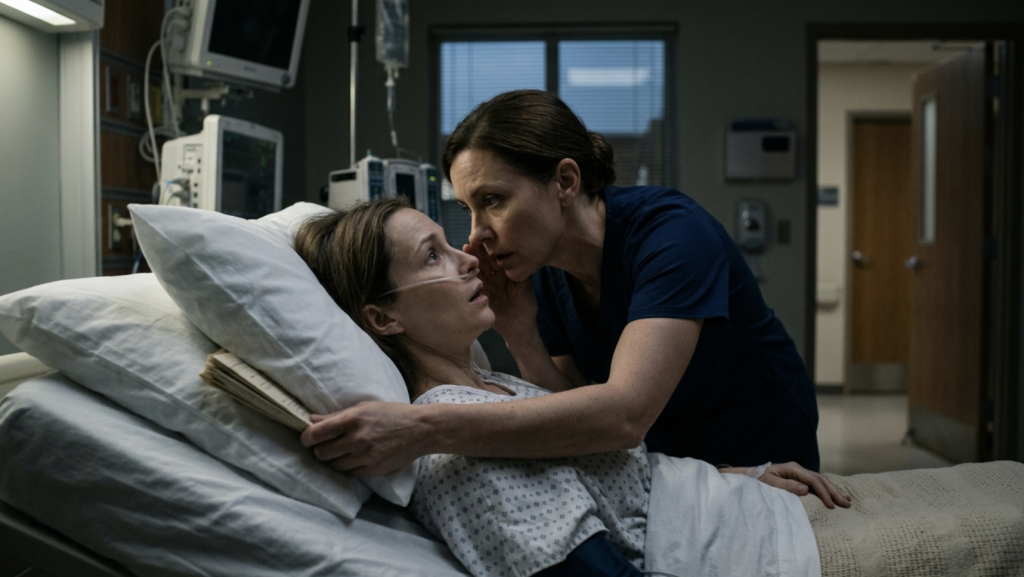
At six that evening, the unfamiliar nurse returned.
This time, she came alone.
She closed the door carefully, checked the hallway, and approached my bed.
Arthur had gone downstairs to meet the hospital administrator.
I studied her face.
“You gave me the recorder.”
She nodded.
“My name is Eleanor Price.”
“Why?”
Eleanor pulled a chair close to my bed.
“Because I knew your father.”
I searched her face.
“My father died four years ago.”
“I know.”
“How did you know him?”
She looked toward the window before answering.
“I worked as a private nurse for your mother during the final months of her life. After your mother passed, your father helped me when my own daughter became ill. He paid for treatment we could never have afforded.”
I had never heard this story.
My father had always helped people quietly. He disliked public gratitude and refused to allow his name to appear on donation lists.
Eleanor continued.
“He was a good man, Mrs. Bellamy. And he was afraid that one day someone would try to take advantage of you.”
“Did he ask you to give me the recorder?”
“He gave it to me nearly two years ago.”
“Two years?”
She nodded.
“He told me to keep it safe. He said I might never need it. But if I ever learned that you were seriously ill and your husband was trying to take control of your estate, I was to find a way to get it into your hands.”
I stared at her.
“Why didn’t you come forward sooner?”
“I didn’t know what was happening until last week.”
She lowered her voice.
“I was assigned to another ward when I heard Silas speaking to a member of the hospital’s administrative staff. He was asking about your medical records, your expected survival, and whether he could have your condition classified as terminal before the end of the week.”
My stomach tightened.
“What did the staff member say?”
“That only your treating physicians could determine your prognosis, and that your records could not be released without proper authorization.”
Eleanor clasped her hands.
“I didn’t want to accuse anyone without evidence. But then I saw him bring you that flask. I watched him try to make you drink from it even though you had not been cleared to take anything by mouth.”
“You took the cup.”
“Yes. I gave it to the appropriate staff member and requested that it be preserved. I did not test it myself. I didn’t want to contaminate it or interfere with an investigation.”
I looked at her for a long moment.
“Do you think he is poisoning me?”
Eleanor’s eyes filled with tears.
“I think you deserve to find out the truth.”
She reached into her pocket and removed a small, folded piece of paper.
“This is the last thing your father gave me.”
I opened it with trembling fingers.
It contained only one sentence, written in my father’s unmistakable handwriting.
If Lenora is ever in danger, tell her to look beneath the oldest stone in the west garden—and make sure she finds the second key.
I looked up.
“The second key?”
Eleanor nodded.
“I don’t know what it opens. Your father never explained.”
For several seconds, I could only stare at the paper.
Then a memory surfaced.
Three months before he died, my father had taken me to the west garden just before sunset. He had stood beside the old stone bench, looking toward the cedar trees.
“Lenora,” he had said, “if you ever feel that everyone around you is telling you what you must do, come here and remember that you are allowed to think for yourself.”
I had laughed and told him he was being dramatic.
He had smiled.
“One day, you may understand.”
I understood now.
Or at least, I was beginning to.
“Eleanor, I need you to do something for me.”
“Anything.”
“Please contact Arthur. Tell him about the note. And don’t let Silas know you have spoken to me.”
She rose.
Before leaving, she turned back.
“Mrs. Bellamy?”
“Yes?”
“Your father loved you very much.”
I swallowed the lump in my throat.
“I know.”
But as the door closed behind her, I realized something painful.
I had spent so much time protecting my father’s estate that I had forgotten the most important thing he had left me.
The belief that I deserved to be protected, too.
The following morning, I received the first unexpected news.
Dr. Shaw entered my room shortly after eight, accompanied by another physician and a hospital safety officer.
They asked Arthur to join us before explaining their findings.
I watched their faces as they settled around the bed.
No one looked relieved.
No one looked ready to offer reassurance.
Dr. Shaw spoke first.
“Lenora, we have reviewed your recent medical history and ordered additional tests. We have not identified a definitive cause yet, but some of your results are concerning enough that we are broadening the investigation.”
“Have you found something in the drink?”
“The laboratory is examining the sample. We do not have a final result.”
I nodded, trying to keep my expectations under control.
Then the second physician spoke.
“Your current prognosis was based on the condition you were in when you were admitted. We are not treating seven days as an exact deadline. We need more information before we can say whether your condition is reversible.”
For the first time in two days, I felt a small opening in the darkness.
“Are you saying I might live?”
“We are saying that we do not yet know the full cause of your illness. We will continue treating your organ dysfunction while we investigate. It would be premature to make a definite prediction.”
Arthur reached for my hand.
I squeezed his fingers.
It was not a promise of survival.
But it was the first reason I had been given not to surrender.
Then the hospital safety officer cleared his throat.
“There is one additional matter. We discovered that someone requested access to your records under a family authorization that we could not verify. We are reviewing the request and preserving the access logs.”
“Who requested it?” Arthur asked.
The officer hesitated.
“Your husband.”
The room became silent.
I looked toward the window.
Silas had been trying to learn how long I had left.
Not because he wanted to save me.
Because he needed to know how much time remained before he could take everything.
Arthur stood.
“I want a copy of the relevant records, and I want all further access restricted according to the patient’s wishes and applicable law.”
The officer nodded.
After they left, I lay quietly for several minutes.
Then I turned to Arthur.
“I want to go home.”
He frowned.
“Lenora, you are critically ill.”
“I know. But my father left something in the west garden. If it could help us protect the estate, I need to find it.”
“We can arrange for the property to be searched without moving you. There is no reason to put your health at risk.”
“I need to see it myself.”
Arthur studied me.
Then he nodded slowly.
“If your physicians determine that you are stable enough for a short visit, we can arrange it safely. Otherwise, we will find another way.”
I accepted his answer.
For the first time, I understood that courage did not mean forcing my body to do what it could not.
It meant refusing to let fear make every decision for me.
That afternoon, Silas called.
Arthur answered on speakerphone at my request.
“Lenora, darling,” my husband began, his voice warm enough to fool anyone who did not know him. “I’ve been thinking about you all morning.”
I said nothing.
“The house feels empty without you.”
Still, I remained silent.
He sighed.
“I spoke with the developers. They’re becoming impatient, but I told them we would have an answer soon.”
Arthur interrupted.
“Any discussion of the estate must be directed through my office.”
There was a pause.
Then Silas laughed.
“Arthur, please. This is a family matter.”
“Your wife has instructed me to represent her interests.”
“My wife is dying.”
The words fell into the room like a dropped glass.
Silas seemed to realize what he had said.
He corrected himself immediately.
“I mean, she’s seriously ill. We need to be realistic about the future.”
Arthur’s voice remained steady.
“Then you should have no difficulty respecting her decisions while she is alive.”
Silas exhaled sharply.
“Put Lenora on the phone.”
Arthur looked at me.
I nodded.
He handed me the phone.
“Lenora?” Silas said.
“Yes.”
“Are you really going to let Arthur turn this into a legal battle?”
“I didn’t start a battle.”
“You’re making accusations.”
“I am asking questions.”
“Questions about what?”
I looked at the recorder on my bedside table.
“About the tonic you keep bringing me. About the property transfers you prepared. About why you need to know how long I have left.”
Silence.
Then his voice changed.
“You have no idea what you’re talking about.”
“Perhaps not. That’s why I’m asking.”
He breathed heavily into the receiver.
“You are confused, Lenora. When you get home, we will sit down and talk like adults.”
“When I get home?”
“Yes.”
“You sound very certain I’ll come home.”
He said nothing.
I could hear faint traffic in the background.
Then he spoke in a voice I barely recognized.
“You have always been difficult when you don’t get your way.”
The sentence hurt more than it should have.
Not because it was cruel.
Because it revealed how he saw me.
I had spent years believing that our disagreements came from different values, different ambitions, different ideas about the future.
But perhaps Silas had never considered me an equal partner.
Perhaps he had always seen me as an obstacle standing between him and what he wanted.
“I need to rest,” I said.
“Lenora—”
I ended the call.
My hands shook so badly that Arthur took the phone from me.
“You did well,” he said.
I shook my head.
“I don’t feel brave.”
“You don’t have to feel brave to do the right thing.”
I looked at him.
“Will he try something else?”
Arthur did not answer immediately.
Then he said, “We will prepare for the possibility.”
Outside, the rain had stopped.
For the first time in days, sunlight slipped through the clouds and rested on the hospital floor.
I watched it for a long time.
Seven days.
That was the number Dr. Pell had given me.
But the more I learned, the less I believed my story was ending.
Something had been hidden from me.
Something my father had protected.
Something Silas desperately wanted before anyone could discover what he had done.
And somewhere beneath the oldest stone in the west garden, the next piece of the truth was waiting.
I had to survive long enough to find it.