PART 3
She shook her head.
“No, Sebastian. Tired people drag their feet. Hurt people walk like they’re trying to outrun something.”
I didn’t know what to say.
She stepped aside to let me enter.
Her house smelled of freshly baked cornbread, cinnamon, and the chicken soup she had been preparing since morning. A small fan rattled in the corner, pushing warm air around the kitchen. There was an old wooden table beside the window, its surface marked with scratches from decades of meals, bills, and family conversations.
Mrs. Jane placed a glass of water in front of me.
“Now tell me what happened.”
I stared at the glass.
“My eye needs surgery.”
Her hands stopped moving.
“What kind of surgery?”
I hesitated.
“The doctor says I might lose my vision if I don’t get it done soon. The problem is that I don’t have the money.”
Her expression changed immediately.
Not to suspicion.
Not to irritation.
To fear.
Real fear for someone else.
“Oh, sweetheart.”
She pulled out the chair beside me and sat down.
“How much do you need?”
I looked at her.
“Fifty thousand dollars.”
For a moment, she said nothing.
I expected her to tell me that she was sorry. I expected her to explain that she couldn’t help, because everyone had bills, everyone had problems, and nobody had enough money for another person’s emergency.
Instead, she lowered her head and pressed her lips together.
“Fifty thousand,” she whispered.
Then she stood up.
“Wait here.”
She walked toward her bedroom.
I heard a drawer open, followed by the soft rustling of papers. A few minutes later, she returned holding a small white envelope. It was worn at the corners, and the flap had been folded and unfolded so many times that it no longer closed properly.
She sat beside me again.
“Sebastian, I need you to understand something before I give you this.”
I stared at the envelope.
“Mrs. Jane, what are you doing?”
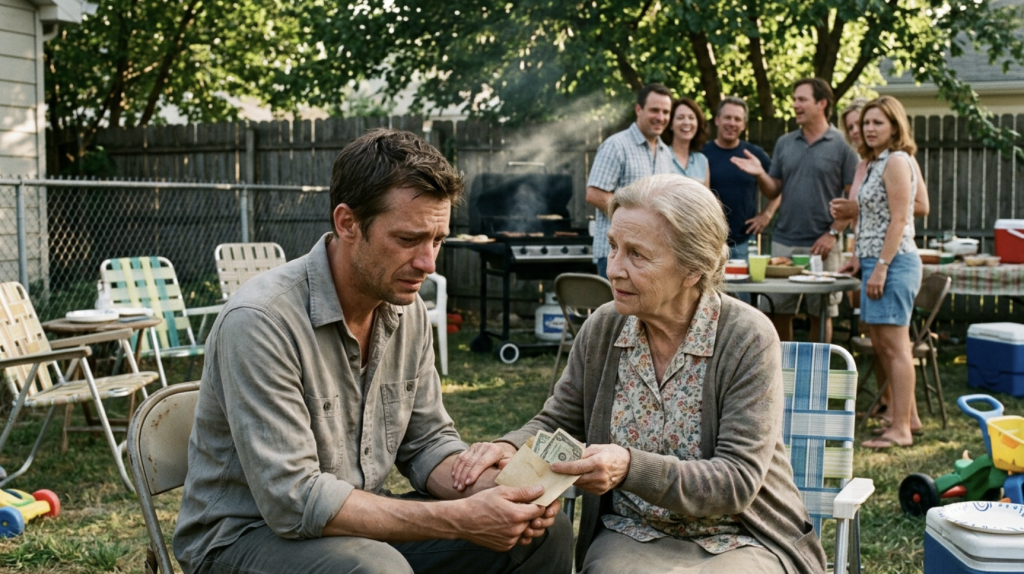
She opened it.
Inside were several hundred-dollar bills, some fifty-dollar notes, and a few smaller bills carefully held together with a rubber band.
“I have twelve hundred dollars,” she said quietly. “It’s everything I have saved.”
I felt my stomach tighten.
Everything?
She was offering me everything she had?
“Mrs. Jane, no. I can’t take that.”
“Listen to me first.”
Her voice was gentle, but there was a firmness in it I had never heard before.
“My husband died six years ago. After he passed, I learned very quickly that people can promise you the world when they think you have something to offer them. But when you are alone, when your house gets quiet, and when you have nobody left to call at night, you discover who truly cares.”
She glanced toward the small framed photograph on the shelf.
It showed her standing beside her late husband, both of them smiling in front of a little house surrounded by flowers.
“I used to save money for emergencies. My husband’s medical bills took almost everything we had. I worked two jobs afterward, and I still work every day because I don’t want to depend on anyone.”
She pushed the envelope toward me.
“But if you truly need an operation to save your eyesight, then this money belongs in your hands more than it belongs in my drawer.”
My throat tightened.
“That’s your entire savings.”
She smiled sadly.
“And you are my neighbor.”
I shook my head.
“I can’t take your money. What if you need it tomorrow? What if something happens to you?”
“Then I’ll deal with tomorrow when it comes.”
She reached across the table and placed her wrinkled hand over mine.
“Don’t let pride make you refuse the kindness you would gladly give someone else.”
I stared at her hand.
My siblings had spent the afternoon explaining why fifty thousand dollars was too much to ask.
Mrs. Jane had spent five minutes explaining why twelve hundred dollars was not too much to give.
And suddenly, the shame I had carried away from that barbecue began to turn into something else.
I felt ashamed of the world I had allowed myself to believe in.
“Why would you do this for me?” I whispered.
She looked almost offended by the question.
“Because I know you, Sebastian.”
She pointed toward the garage bakery behind my house.
“You bring me bread every Sunday when you have extra. You fixed my kitchen cabinet last winter without charging me a penny. When my husband died, you were the one who came over to shovel the snow off my walkway because you noticed I hadn’t opened my front door.”
She paused.
“You never asked me to pay you back for those things. So why should I make you prove that you deserve help now?”
I couldn’t answer.
Because the truth was, I had done those things without expecting anything in return.
I had never imagined that someone would remember them.
I looked down at the envelope, and for the first time that afternoon, tears filled my eyes.
Not because I was afraid of losing my vision.
Because I had discovered that someone who owned almost nothing could make me feel richer than my entire family ever had.
“Mrs. Jane,” I said, my voice trembling, “I need to tell you something.”
She squeezed my hand.
“You can tell me anything.”
I looked at her, then at the envelope.
And I realized I couldn’t do it.
I couldn’t take the money from her.
Not when she believed I might need it for an operation.
Not when she had offered it with such pure love.
So I pushed the envelope gently back toward her.
“I promise I’ll never forget what you just offered me. But please keep your savings. I have another way to handle this.”
She studied my face.
“Are you sure?”
I nodded.
She returned the envelope to her pocket, though I could tell she wasn’t entirely convinced.
Before I left, she packed two containers of chicken soup and a loaf of bread for me.
“Take these home,” she said. “And don’t sit alone with your sadness tonight. Eat something warm.”
I thanked her and walked home.
But halfway down the street, I stopped.
I turned back and looked at her house.
A small light had appeared in her kitchen window.
I made a decision right there.
Mrs. Jane had no idea what she had just done for me.
And I had no idea yet how I was going to repay her.
But I knew one thing.
If the universe had placed forty million dollars in my hands, then perhaps it had also placed a responsibility on my shoulders.
And I was beginning to understand that the money was not meant to make me more powerful than the people who had humiliated me.
It was meant to show me what kind of person I wanted to become.
That night, I sat alone in my bakery.
My little garage was filled with the familiar scent of butter, flour, sugar, and yeast. I had worked there for twelve years, and every corner held a memory.
The first oven I bought with money borrowed from a friend.
The wooden table I repaired three times instead of replacing.
The handwritten recipes my mother had taught me before she died.
And the small notebook where I recorded every dollar I earned, because there had been years when a single unexpected bill could destroy an entire month.
I placed the lottery receipt on the table.
Forty million dollars.
The number looked almost ridiculous beneath the yellow light of my old desk lamp.
I had spent my entire adult life worrying about whether I could afford a new refrigerator, whether the bakery would survive another slow month, and whether I could save enough money to retire without becoming a burden to anyone.
Now I could buy a dozen bakeries.
I could buy the entire street.
I could purchase a mansion with a swimming pool and a driveway longer than the road outside my house.
But none of those things could buy the moment I had experienced at Mrs. Jane’s kitchen table.
I picked up my phone and called my attorney, Daniel Brooks.
Daniel had helped me establish my financial accounts after I confirmed the lottery win. He was one of the few people who knew the truth, and he had repeatedly advised me to protect my privacy.
He answered on the second ring.
“Sebastian, is everything alright?”
“I need to make some changes.”
“What kind of changes?”
“I want to establish a charitable foundation.”
There was a pause.
“A charitable foundation?”
“Yes. I want to help people who are struggling with medical bills, housing costs, and emergencies. People who have nobody to turn to.”
Daniel became quiet.
“That is a significant decision. Have you thought about how much you want to commit?”
I looked at the envelope Mrs. Jane had offered me.
“Not yet. But I know what I want the foundation to stand for.”
“And what is that?”
I looked through the window at the darkened street.
“No one should have to beg their family to be treated like a human being.”
Daniel didn’t respond immediately.
Then he said, “Alright. Let’s schedule a meeting tomorrow.”
After we hung up, I sat in silence.
For the first time since winning the lottery, I felt that the money might actually have a purpose.
But I wasn’t finished with my family.
Not yet.
Because there was something else I needed to understand.
I had spent years believing that my siblings were successful and I was the failure.
Sam had his cars, his boat, and his beautiful house.
Susan had her expensive clothes, her holidays, and her carefully curated social media pictures.
My younger brother, Michael, worked in real estate and often spoke about investments as if everyone who didn’t own several properties was a fool.
At family gatherings, I was the brother who smelled of flour and butter.
The one who arrived in an old sedan.
The one whose business was considered a hobby rather than a real career.
I had allowed them to make me feel small because I had assumed that their financial success meant they understood something about life that I didn’t.
But the previous afternoon had exposed something ugly.
When they thought I had nothing to offer them, they had treated me as though I were nothing.
And when Mrs. Jane thought I had nothing to offer her, she had offered me everything.
I decided that I would not reveal my lottery win immediately.
I wanted to observe my family for a little longer.
Not because I needed revenge.
At least, that was what I told myself.
But if I was honest, a part of me wanted them to experience the discomfort they had so casually handed me.
I wanted them to understand what it felt like to be dismissed.
And I was beginning to realize that the desire for justice could become dangerously close to the desire for revenge.
I would have to be careful.
Because I didn’t want forty million dollars to turn me into the kind of person I had spent my entire life resenting.
The next morning, I opened the bakery at four.
I kneaded dough, shaped croissants, and prepared cinnamon rolls while the neighborhood slowly came alive.
At seven, Mrs. Jane appeared at my door.
She was carrying a small paper bag.
“I made you breakfast,” she announced.
I laughed for the first time since the barbecue.
“Mrs. Jane, I think you’re supposed to be the one receiving breakfast from me.”
She placed the bag on the counter.
“Then consider it a temporary arrangement.”
Inside was a warm biscuit sandwich and a small container of fruit.
I made her coffee and sat with her for a few minutes.
She asked about the bakery, whether business had been good, and whether I had managed to find a solution to my supposed medical problem.
I told her I was handling it.
She nodded, but she didn’t ask for details.
Before she left, I slipped a fresh loaf of bread into her bag.
“Thank you for yesterday,” I said.
She waved her hand dismissively.
“You don’t need to thank me for caring about you.”
Then she stopped at the door.
“Sebastian?”
“Yes?”
“Whatever happens with your family, don’t let them convince you that kindness is a weakness.”
I watched her walk home.
Those words followed me for the rest of the day.
And by evening, I had begun to understand how I would use my money.
I would not announce it at a family dinner.
I would not drive a new car past Sam’s house.
I would not purchase a mansion just to make Susan feel jealous.
Instead, I would build something that reflected the values my siblings had forgotten.
Something that could help people like Mrs. Jane.
And I would wait until the right moment to reveal the truth.
Because sooner or later, my family would discover that the brother they had dismissed was no longer the man they thought he was.
What I didn’t know was that the first person to expose the truth would not be Sam or Susan.
It would be someone who had been listening to every word they said at that barbecue.
Someone who had kept quiet while I was humiliated.
And someone who would soon come to my door with an apology that could change everything.
Three days after the barbecue, my phone rang while I was preparing a batch of blueberry muffins.
The caller was my niece, Emily, Sam’s twenty-three-year-old daughter.
I almost let it go to voicemail.
Emily had always been kind to me, but she rarely called unless she needed something or wanted to ask about one of my recipes.
Still, I wiped my hands on my apron and answered.
“Hey, Emily. Everything alright?”
For several seconds, I heard nothing but breathing.
Then she whispered, “Uncle Sebastian, I’m sorry.”
I stopped working.
“Sorry for what?”
“For what happened at Dad’s house.”
I leaned against the counter.
“You don’t have to apologize for your father.”
“But I should have said something.”
Her voice cracked.
“I sat there and listened to everyone laugh at you. I wanted to tell them to stop, but I was afraid Dad would get angry. And when you left, everyone just went back to eating.”
I closed my eyes.
I hadn’t expected an apology from Emily.
Perhaps because she had been the youngest person at the table, I had assumed she hadn’t understood how deeply the moment had hurt me.
But she had understood.
She had simply been too afraid to speak.
“Emily, you don’t need to carry this for the rest of your life,” I told her. “You were uncomfortable, and you didn’t know what to do.”
“That doesn’t make it right.”
“No,” I admitted. “It doesn’t.”
There was another pause.
Then she said, “There’s something else you should know.”
I straightened.
“What is it?”
“After you left, Dad said something about you.”
I waited.
“He said he was tired of you always acting like a victim. Then Aunt Susan started talking about how you would probably ask everyone for more money next month.”
I felt my jaw tighten.
Emily continued.
“And Uncle Michael said something about your bakery. He said you were never going to become successful because you were too sentimental to run a business properly.”
I stared at the trays of muffins cooling beside me.
It was strange how quickly familiar insults could stop hurting once you understood that the people saying them had never really known you.
“What else did they say?” I asked.
Emily hesitated.
“Dad said he was glad you finally understood your place in the family.”
For a moment, the bakery seemed unusually quiet.
My place in the family.
I had spent forty years trying to find that place.
I had helped my siblings when they were young. I had lent Sam money when he was struggling to start his first business. I had looked after Susan’s children when she needed someone to watch them. I had even helped Michael prepare for a job interview when he was fresh out of college.
I had done those things because they were my family.
But apparently, none of it mattered.
In their eyes, my place had always been beneath them.
“Thank you for telling me, Emily,” I said.
“Are you angry with me?”
“No.”
“Are you angry with Dad?”
I looked at the lottery receipt locked away in my desk.
“I think I’m tired of being angry.”
She exhaled shakily.
“Uncle Sebastian, I need to tell you something else. I don’t know if it matters, but I think you should know.”
“Go ahead.”
“Dad’s business isn’t doing as well as he says.”
I frowned.
“What do you mean?”
“He keeps telling everyone that he’s making a fortune, but I’ve heard him arguing with Mom about money. There are letters from the bank at the house, and he gets angry whenever anyone asks about them.”
I said nothing.
“Last month, he asked me to lend him some money from my savings. I gave him two thousand dollars because he said it was temporary. He promised to return it before the end of the month, but he hasn’t.”
I felt a strange mixture of concern and disbelief.
Sam had spent the barbecue showing off his new SUV and talking about the boat he had purchased.
And now his daughter was telling me he was borrowing money from her.
“Emily, did he explain what happened?”
“He said it was a business problem. But I heard him tell Mom that he had taken out another loan.”
She paused.
“I think he’s in trouble.”
I sat down.
Part of me wanted to say that Sam deserved whatever was coming. After all, he had laughed when I asked for help.
But another part of me remembered the years when we were children, sharing a bedroom and fighting over the last piece of cake.
I remembered him defending me when other boys bullied me at school.
I remembered the time he had stayed awake beside my bed when I was sick.
Those memories had become buried beneath years of arrogance and resentment, but they were still there.
I didn’t want my brother to lose everything.
I simply didn’t want to be treated as though his problems mattered more than mine.
“Emily, listen to me,” I said. “Don’t lend him more money unless you can afford never to see it again. And don’t put your own future at risk trying to rescue him.”
“I know.”
“Good.”
She hesitated.
“Uncle Sebastian, if you ever need someone to talk to, you can call me.”
I smiled sadly.
“Thank you, sweetheart.”
After we hung up, I remained seated for several minutes.
I had intended to use the lottery money to help people.
But I had also imagined that, once my family discovered I was wealthy, I might finally receive the respect I had spent years chasing.
That was a dangerous thought.
If I needed their respect to feel valuable, then I was still allowing them to decide my worth.
I took a deep breath and returned to work.
That afternoon, Daniel arrived at my bakery carrying a thick folder.
We sat at the small table where I usually calculated expenses and prepared invoices.
He had drawn up a preliminary plan for the foundation, including the legal structure, financial safeguards, and a process for evaluating applications.
He also recommended that I avoid making emotional promises or giving large sums directly to people without understanding their circumstances.
“Money can solve many problems,” he said. “But money without boundaries can create new ones.”
I nodded.
“I don’t want to become everyone’s personal bank.”
“Then you need a clear policy from the beginning.”
We discussed medical assistance, emergency housing, food programs, and grants for small businesses.
When Daniel asked whether I wanted to include family members, I thought carefully before answering.
“I want the foundation to help people who qualify based on their needs. My relatives can apply under the same rules as anyone else.”
He looked at me with approval.
“That is probably the healthiest decision you could make.”
After he left, I went back to baking.
For the first time, my future felt larger than the argument in Sam’s backyard.
But the past wasn’t finished with me.
At seven that evening, I received a message from Susan.
It contained no greeting.
No apology.
Just a photograph of a handwritten list of expenses, followed by a short message.
Sebastian, I heard you might be struggling financially. I have some ideas for how you can improve your bakery. We should talk.
I read it twice.
Then I laughed.
She had watched me ask for fifty thousand dollars, refused to help, and now wanted to give me business advice.
I could have told her the truth.
I could have sent her a photograph of the lottery documents.
Instead, I replied with one sentence.
Thank you, Susan. I’ll keep that in mind.
She answered almost immediately.
You really need to think about your future. You can’t keep living like this forever.
I placed the phone facedown.
Then I went into the kitchen and started preparing tomorrow’s dough.
I wasn’t going to spend my life arguing with people who had already decided who I was.
But the following morning, I discovered that Susan had taken my silence as an invitation.
She arrived at the bakery shortly after nine, wearing a cream-colored jacket and carrying a designer handbag.
She looked around the small room as though she were inspecting a property she intended to renovate.
“Sebastian, we need to talk.”
I placed a tray of pastries on the counter.
“Good morning to you too.”
She ignored the remark.
“I’ve been thinking about your situation. Your bakery could be more profitable if you stopped wasting money on unnecessary things.”
I raised an eyebrow.
“What unnecessary things?”
“Giving away bread. Helping neighbors. Spending time on people who don’t contribute to your business.”
I stared at her.
She had somehow managed to turn generosity into a business defect.
Susan opened her handbag and removed a folded brochure.
“My friend owns a consulting company. He helps small businesses modernize. If you followed his advice, you might finally earn enough to stop asking the family for help.”
I glanced at the brochure.
The consulting package cost fifteen thousand dollars.
I looked back at her.
“Is your friend paying you a commission?”
Her expression stiffened.
“That’s not the point.”
“It seems relevant.”
She folded her arms.
“I’m trying to help you.”
I took a slow breath.
“Susan, when I asked for help three days ago, you didn’t offer me a business plan. You didn’t ask whether I was frightened. You didn’t even ask if I had somewhere to turn.”
She rolled her eyes.
“Oh, please. We were having a family barbecue. I wasn’t going to turn the entire afternoon into a tragedy.”
I felt something inside me settle.
Not anger.
Not sadness.
A decision.
“Then I think we’re finished talking.”
She stared at me.
“Excuse me?”
“You heard me.”
For several seconds, she looked as though she couldn’t believe I had challenged her.
Then she picked up the brochure and placed it on the counter.
“Fine. Don’t come crying to us when your business fails.”
She walked out.
I watched her disappear down the street.
Then I picked up the brochure and placed it in the recycling bin.
A few minutes later, Mrs. Jane entered the bakery.
She had seen Susan leaving.
“Everything alright?” she asked.
I smiled.
“Better than it was yesterday.”
She nodded toward the recycling bin.
“Good. Because life is too short to let other people’s opinions become the furniture in your house.”
I laughed.
“Where do you come up with these things?”
“Being married for forty-three years teaches you a few things. Being a widow teaches you the rest.”
She bought two loaves of bread and left.
I watched her go, then returned to my work.
I was beginning to understand that the people who truly loved me did not need to be impressed by my success.
They simply needed to know that I was still there.
And that realization would become even more important when my family finally discovered what I had been hiding.
Because within a week, a single photograph would turn my quiet life upside down.
And the first person to contact me after seeing it would be the very brother who had laughed when I asked him for fifty thousand dollars.