Room 18
“Who gave you this?”
The old clerk’s hand shot across the counter and snatched the brass key right out of my fingers.
I stared at him.
“You did,” I said. “Five minutes ago.”
He looked at the wooden tag dangling from the key. Then at me. Then up at the little security monitor mounted on the wall behind him.
His face had gone the color of skim milk.
“That’s impossible,” he whispered.
I need to tell you how we got there. Because none of it would have happened if my husband had just stopped driving when I asked him to.
We were driving from Denver to St. Louis.
Eight hundred and fifty miles. Thirteen hours, if you don’t stop much. Mark had promised me that morning, standing in our driveway at six a.m. with his coffee thermos and his old Rockies cap, that we’d stop whenever I got tired.
“We’ll take it easy, Viv,” he said. “No rush. We’ll stop in Kansas somewhere. Find a nice little place. Get a good night’s sleep.”
I believed him.
I’ve been married to Mark Holloway for twenty-six years. You’d think I’d know better.
He pushed through the morning. Through the flat brown stretch of eastern Colorado where there’s nothing but wheat and sky and the occasional grain elevator standing up out of the prairie like a lighthouse.
He pushed through lunch. We ate gas station sandwiches in the car outside Burlington.
He pushed through the afternoon. Across the Kansas line. Past Goodland and Colby and Oakley. Past signs for the world’s largest prairie dog and a museum of barbed wire.
“Mark,” I said around four o’clock. “I’m getting tired.”
“Just a little farther,” he said. “Let’s make it to Hays.”
We made it to Hays. He didn’t stop.
“Mark. Hays.”
“Let’s push to Russell. Get a few more miles under us. Then tomorrow’s shorter.”
He pushed through the evening. The sun went down behind us, orange and huge in the rearview mirror. The sky went purple. Then black.
By ten-thirty, I was exhausted.
My back hurt. My eyes burned. I’d been staring at white lines on black asphalt for so long I was seeing them when I closed my eyes.
“Mark,” I said. “Please. I need to stop.”
“There’s nothing out here, Viv. Let’s get to Salina. There’s a Hampton Inn in Salina.”
“That’s another hour.”
“So we’ll be there by eleven-thirty.”
I looked at him. His jaw was set. Both hands on the wheel. Ten and two. Staring straight ahead into the dark like there was something out there he was chasing.
Or running from.
We’d been married twenty-six years.
And after all that time, I knew the difference between Mark being determined and Mark being stubborn.
Determined is when he’s moving toward something.
Stubborn is when he’s moving away.
That night, he was both.
Here’s why we were driving to St. Louis.
Mark’s mother, Frances, is eighty-one. She lives alone in the little brick house in Kirkwood where Mark grew up. She’s lived there for fifty-four years. She raised three kids in it. She buried her husband, Joe, out of it.
Two years ago, she started forgetting things.
Little things, at first. Where she put her glasses. Whether she’d taken her pills. The name of the pastor at her church.
Then bigger things. She left the stove on. She drove to the Schnucks grocery store she’d been going to for forty years and couldn’t find her way home. A neighbor found her two hours later, parked in a church lot, crying.
Then, three weeks ago, she called Mark at two in the morning.
“Joe,” she said. “Joe, when are you coming home? It’s late. I made pot roast. It’s getting cold.”
Mark’s father has been dead for eleven years.
Mark sat on the edge of our bed in the dark holding the phone.
“Mom,” he said. “It’s Mark. Your son.”
There was a long silence.
“I don’t have a son named Mark,” Frances said politely. “I’m sorry. You must have the wrong number.”
She hung up.
Mark’s sister, Diane, lives twenty minutes from Frances. She’d been doing everything. Checking on her every day. Taking her to doctor’s appointments. Paying her bills.
She called Mark the next morning.
“Mark, I can’t do this anymore,” she said. “She can’t live alone. It’s not safe. I found a place. A memory care home in Webster Groves. It’s nice. It’s really nice. They have a garden and a piano and the nurses are kind. But I need you to come. I need you to help me move her. And I need you to be there when we tell her.”
Mark said he’d come.
He said it right away. On the phone. Without hesitating.
And then for three weeks, he found reasons not to.
Work. A conference. The car needed new tires. The weather didn’t look good.
Finally, Diane called me.
“Viv,” she said. “Please. Get him in the car.”
So I got him in the car.
And now here we were. Eleven hours into it. Somewhere in the dark middle of Kansas.
And Mark wouldn’t stop.
I understood why. I’d figured it out somewhere around Hays.
As long as he was driving, he didn’t have to arrive.
As long as he was driving, his mother still knew his name.
Finally, just outside a little town in Kansas, we saw a motel sign.
It came up out of the dark on the right side of the highway. Tall and old-fashioned. A faded blue neon arrow pointing toward an exit.
PRAIRIE REST MOTEL.
And underneath, in flickering red:
VACANCY.
“Mark,” I said. “Stop. Please. Right here.”
He opened his mouth.
“Mark,” I said. “I am fifty-one years old and I have been sitting in this car for eleven hours and if you drive past that sign I will open the door and roll out onto the highway.”
He looked at me.
He took the exit.
The place looked old.
One story. Long and low. Built in an L-shape around a gravel parking lot. White painted cinder block with blue doors. A faded blue sign out front that matched the neon. Flower boxes under the office window with geraniums in them, red and real and carefully watered.
A vending machine humming beside the office. The kind with the spiral coils. Lit up bright in the dark.
But the parking lot was nearly full.
Pickup trucks, mostly. A couple of semis parked along the edge of the lot. A minivan with Nebraska plates. An old Buick with a bumper sticker that said I’D RATHER BE FISHING.
Good enough for us.
Mark parked by the office. He turned off the engine.
He sat there with both hands still on the wheel.
“You go,” he said. “I’ll wait here.”
I didn’t argue. I was too tired.
I went inside.
The office was small and warm and smelled like coffee and old carpet and something sweet, like vanilla. There was a little rack of tourist brochures by the door. VISIT THE GARDEN OF EDEN IN LUCAS, KANSAS! SEE THE WORLD’S LARGEST BALL OF TWINE! A wooden counter with a bell on it. A key rack on the wall behind the counter. Brass hooks with numbers painted underneath. Keys hanging from most of them on little wooden tags.
Real keys. Not key cards. I hadn’t seen real motel keys in twenty years.
The clerk was an older man with glasses.
Seventy-five, maybe. Thin. A plaid flannel shirt buttoned all the way up to the neck. A cardigan over it. Thick glasses that made his eyes look huge. White hair combed straight back with water.
He was sitting on a stool behind the counter with a crossword puzzle book open in front of him.
He barely looked up.
“One room?” he said.
“Yes, please.”
“How many nights?”
“Just tonight.”
He pulled a little computer monitor toward him. An old one. He pecked at the keyboard with two fingers. He squinted at the screen. His glasses were so thick I don’t know how he could see anything at all.
Then he reached beneath the counter.
I heard a drawer slide open. I heard keys jingle. He felt around under there without looking, the way you do with something you’ve done ten thousand times.
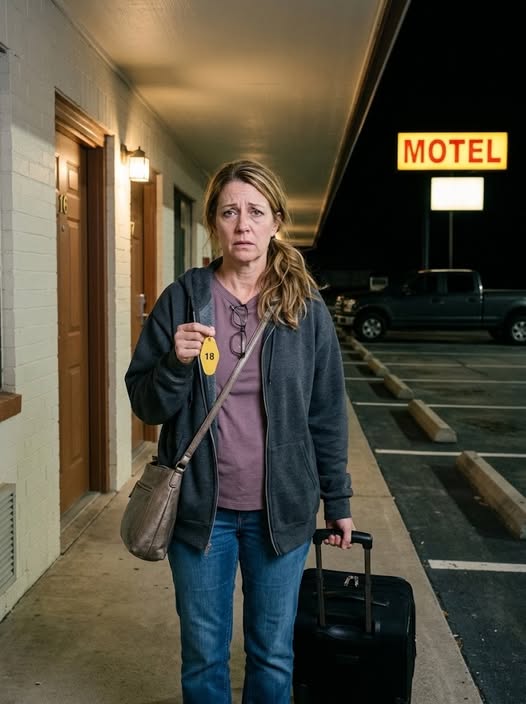
He pulled out a brass key attached to a wooden tag.
He set it on the counter.
18.
“End of the east hallway,” he said.
I paid. Sixty-two dollars, cash. He wrote me a receipt by hand on a little pad with carbon paper. I hadn’t seen carbon paper since the nineties either.
I took the key.
“Thank you,” I said.
He was already back to his crossword.
I went back to the car.
Mark grabbed our overnight bags out of the back seat.
The east hallway was an outdoor walkway, really. A long concrete strip under an overhanging roof, running along the front of the east wing. Blue doors on the left. Little numbers painted on each one in white. A light fixture over every other door, with moths circling it.
We walked down it together.
Room 12.
Room 13.
Room 14.
Then a solid wall.
Just white painted cinder block. The end of the building.
I laughed.
“Well,” I said. “Somebody forgot to build our room.”
Mark set down the bags. He took the key from me. He looked at the wooden tag.
18.
He walked back a few steps. He counted the doors out loud. “Twelve, thirteen, fourteen, fifteen, sixteen, seventeen.”
Then he looked at me.
“Maybe it’s around the corner,” he said.
There was no corner.
At the very end of the walkway, after Room 17, there was just a narrow door. Not blue like the others. Painted the same white as the cinder block, so it almost disappeared into the wall. No number. Just a small metal sign screwed to it at eye level.
SERVICE — STAFF ONLY.
Mark tried the handle. Locked.
Past it, a gray metal door with a push bar and a little red sign. EXIT. It opened out onto the back of the parking lot. I could see the dark shapes of the semis through the little window.
That was it.
No Room 18.
I sighed.
“Wait here,” I said. “I’ll ask.”
I walked back to the office.
The vending machine was still humming. A moth was beating itself against the glass of the office door.
I pushed the door open. The little bell over it jingled.
The clerk was standing behind the counter now. Not sitting. Standing. His crossword book was closed.
I held up the key.
“Excuse me,” I said. “I think there’s been a mistake. We can’t find Room 18.”
He looked at the tag.
Then he froze.
I mean he froze completely. Like somebody had pressed pause on him. His hand was halfway to his glasses. His mouth was a little open.
He stared at the wooden tag in my hand.
18.
Then his hand moved across the counter. Fast. Faster than I would have thought an old man could move.
He grabbed the key.
“Who gave you this?”
I blinked.
“You did,” I said. “Five minutes ago.”
He stared at me. His eyes were huge behind those thick glasses.
“No,” he said.
“Yes. You reached under the counter and gave it to me. I paid you sixty-two dollars. You wrote me a receipt.” I held it up. “See?”
He didn’t look at the receipt. He was looking at the key in his hand. Turning it over. Running his thumb along the wooden tag.
“That’s impossible,” he whispered.
I was too tired to argue.
“Look,” I said. “I don’t care. Really. Can we just get another room? Any room. Seventeen. Twelve. Whatever you’ve got.”
He didn’t answer.
Instead, he turned and looked at the security monitor mounted on the wall behind him. A little black-and-white screen split into four boxes. Four camera views. The parking lot. The front of the office. The west hallway.
And the fourth box.
I couldn’t see what was in the fourth box from where I was standing. The angle was wrong. But I saw the clerk look at it.
And I saw his face change.
He reached beneath the counter and pressed something.
I heard a click.
Loud. Metallic.
Behind me, the office door had locked.
My stomach tightened.
I turned around. I looked at the door. At the little brass deadbolt that had just slid shut by itself.
“Sir?” I said.
He leaned toward me across the counter.
“Where is your husband?” he asked.
His voice was low. Urgent.
“Outside,” I said. “Why?”
The clerk’s face had turned pale. Paler than before.
“Did he go into the service closet?”
“No.”
“Are you sure?”
“I left him at the end of the hallway,” I said. “By the… by the door. The white one. He tried the handle. It was locked.”
The clerk closed his eyes.
He whispered something under his breath. I couldn’t make it out. It sounded like a name.
Then he picked up the phone. An old beige one with a curly cord. He dialed three numbers.
Three numbers.
I started toward the door.
“Please unlock this,” I said. My voice was shaking now. “Please. My husband’s out there.”
He raised one hand.
“Ma’am,” he said. “Just wait. Please.”
Then he spoke into the receiver.
“It’s happened again,” he said.
I stared at him.
“What has?” I said. “What’s happened again?”
He didn’t look at me. He looked down at the wooden tag in his hand.
Then back up at the monitor. At the fourth box.
And he said into the phone, very quietly:
“There’s someone in Room 18.”
Every hair on my arms stood up.
I’d seen enough horror movies. I’d read enough Stephen King. An old motel in the middle of nowhere. A room that doesn’t exist. A key that shouldn’t be there. A clerk who goes pale and locks the door and says it’s happened again.
I thought about Mark. Standing alone at the end of that dark hallway. Under the moths. Next to a white door with no number.
“Unlock this door,” I said. “Right now. Or I swear to God I’ll put this chair through the window.”
I put my hand on the back of the wooden chair by the brochure rack.
The clerk hung up the phone.
He looked at me. And for the first time, I saw that he wasn’t scared of whatever was in Room 18.
He was scared for it.
“Ma’am,” he said. “I’m sorry. I didn’t mean to frighten you. Nobody’s in danger. Your husband’s safe. I promise you.”
“Then why did you lock the door?”
“Because I need you to stay calm,” he said. “And I need you to stay out of that hallway. Just for a few minutes. Until Gabby gets here.” He took a breath. “If somebody comes running down that hallway and starts banging on doors, it’ll scare her. And when she gets scared, she runs. And last time she ran, she went out the back door and halfway across the wheat field in her nightgown before we found her.”
I stared at him.
“Who?” I said.
He looked at the monitor.
“My wife,” he said.
He turned the monitor so I could see it.
The fourth box. The camera view I couldn’t see before.
It showed a small room. Grainy, black and white. Shelves along one wall stacked with towels and toilet paper and cleaning supplies. A mop bucket. A vacuum cleaner.
And in the middle of the floor, sitting on the edge of an old bare mattress, an old woman.
White hair. Long. Loose around her shoulders. A long white nightgown. Bare feet.
She was holding a stack of towels in her lap. Folding them. Unfolding them. Folding them again.
And she was rocking back and forth. Slowly.
Her lips were moving.
“That’s Jean,” the clerk said quietly. “My wife. Fifty-three years.”
I didn’t say anything.
“She has Alzheimer’s,” he said. “Six years now. It’s bad. She doesn’t know me most days. She doesn’t know where she is. What year it is.” He swallowed. “But she always knows where Room 18 is.”
He held up the key.
“I keep this locked in the safe,” he said. “In our apartment. Behind the office. I’ve kept it locked up for three years. Ever since she started going in there at night. I lock it up and I hide the safe key in my sock drawer and I check it every single night before bed.”
He turned the wooden tag over in his fingers.
“She must have found it,” he said. “Tonight. While I was asleep in my chair. And she must have hung it up on the hook for Room 17. Where I keep the spare.”
He shook his head slowly.
“And I reached under the counter,” he said, “and grabbed the key off the hook for 17 without looking. Because my eyes are bad. Because I’ve been doing it for fifty years. And I gave it to you.”
He looked at me.
“I’m so sorry,” he said. “I gave you a key to a room that hasn’t existed since 1994.”
The bell over the door jingled.
I jumped.
The clerk reached under the counter and pressed the button again. The deadbolt clicked open.
A young woman came in fast. Out of breath. Early thirties. Dark hair pulled back in a messy ponytail. Navy blue hospital scrubs. A stethoscope still around her neck. A puffy winter coat thrown over the top.
She looked at the clerk.
“Where is she, Elmer?”
“Eighteen,” he said.
She closed her eyes for a second. Then she opened them. She looked at me.
“Who’s this?”
“Guest,” Elmer said. “I gave her the wrong key. Her husband’s out at the end of the hall.”
The young woman looked at me. Something passed across her face. Then she nodded.
“Okay,” she said. “Come on. Both of you. But walk slow. And let me go first.”
We walked down the east hallway together.
The young woman in front. Elmer behind her, holding a big ring of keys. Me last.
Mark was standing exactly where I’d left him. At the end of the walkway, next to the white door marked SERVICE — STAFF ONLY. The overnight bags at his feet.
He was very still.
He had his ear pressed against the door.
He looked up when he saw us coming. His face was strange. Pale. Confused.
“Viv,” he said quietly. “There’s somebody in there. I can hear somebody. A woman.”
“I know,” I said.
“She’s singing.”
We all stopped.
And in the quiet, under the hum of the vending machine and the buzzing of the moths, I heard it too.
Through the white door. Soft. Thin. A little cracked. An old woman’s voice.
Singing.
“You are my sunshine, my only sunshine…”
The young woman in the scrubs stepped up to the door.
She knocked. Very gently. Two soft taps.
“Jean?” she said. “Jean, honey. It’s me. It’s Gabby. Can I come in?”
The singing stopped.
There was a long silence.
Then, from behind the door, the old woman’s voice. High and anxious.
“Marisol? Is that you, honey? Did you find the towels?”
The young woman closed her eyes.
“Yes, Jean,” she said. “I found the towels. Can I come in?”
“Hurry,” the old voice said. “Hurry. The baby’s coming. I can feel it. The storm’s almost here.”
Elmer unlocked the door with a key from his big ring.
He opened it very slowly.
The young woman, Gabby, slipped inside first. Elmer followed. I stood in the doorway with Mark behind me.
It was a supply closet.
Shelves of towels and toilet paper. A mop bucket. A vacuum. An old bare mattress on the floor.
But it wasn’t just a closet.
I could see it, once I was standing in it. The bones of a room underneath. On the back wall, under a coat of white paint, the faint shadow of old wallpaper. Little blue flowers. In the corner, behind a shelf, the outline of where a doorway used to be. A bathroom. I could see the edge of an old pink sink, half covered by stacks of paper towels.
Room 18.
It used to be a room.
Jean was sitting on the edge of the mattress.
Up close, she was tiny. Bird-boned. The long white nightgown was too big for her. Her feet were bare and pale on the cold concrete floor. Her white hair was a cloud around her face.
She was holding a stack of folded towels in her lap. Pressing them against her chest.
When she saw Gabby, her whole face lit up.
“Marisol,” she said. “Oh, thank God. Where’s Luis? Is Luis getting the car?”
Gabby knelt down on the floor in front of her. Right there on the cold concrete in her hospital scrubs.
“Luis is getting the car,” she said softly. “Don’t worry about Luis.”
“The storm,” Jean said. “Did you hear the siren? It’s coming. It’s coming right for us. We have to get you into the bathtub. The bathtub’s the safest place.”
“I heard it,” Gabby said. “We’re safe. We’re all safe.”
Jean looked down at her own hands. At the towels.
“I’m going to need these,” she said. “When the baby comes. I’m going to need clean towels.” She looked up at Gabby with wide, frightened eyes. “I’ve delivered babies before. At St. Francis. Before Elmer and I bought this place. I know what to do. I promise. I’ll take care of you. I’ll take care of both of you.”
Gabby took the old woman’s hands in both of hers. Towels and all.
“I know you will, Jean,” she said. “You always do.”
I stood in the doorway. I didn’t move.
Behind me, I felt Mark go very still.
Jean looked up past Gabby. She saw me standing there.
She frowned.
“Who’s that?”
Gabby glanced over her shoulder at me. Then back at Jean.
“That’s a friend,” she said. “She’s going to help.”
Jean looked at me for a long time. Her eyes were cloudy. Searching.
Then she smiled.
“Good,” she said. “We need all the help we can get. Babies don’t care about tornadoes.” She patted the towels in her lap. “They come when they come.”
Elmer stood by the shelves. He didn’t say anything. He just watched his wife.
His face was the saddest thing I’ve ever seen.
Gabby talked to Jean for twenty minutes. Kneeling on the concrete. Holding her hands.
She told her the storm had passed. She told her everybody was safe. She told her the baby was here. A girl. Healthy. Seven pounds, two ounces. Perfect.
“A girl?” Jean said. She started to cry. “A girl? Oh, Marisol. Oh, she’s beautiful. Isn’t she beautiful?”
“She’s beautiful,” Gabby said. Her own voice was shaking. “You did so good, Jean. You did everything right.”
“What did you name her?”
Gabby swallowed hard.
“Gabriela,” she said. “We named her Gabriela.”
Jean smiled through her tears.
“That’s a good name,” she said. “That’s a beautiful name.”
She let out a long breath. Her shoulders sagged. All the fear went out of her body, like water draining out of a tub.
“I’m tired,” she said. “I’m so tired.”
“I know,” Gabby said. “Let’s get you to bed. Your real bed. Elmer’s here. He’ll walk you.”
Jean looked up.
She saw Elmer standing by the shelves.
She looked at him for a long moment. Her face was blank. Polite. The way you look at a stranger on a bus.
Then something flickered.
“Elmer?” she said.
Elmer’s face crumpled.
“I’m here, Jeannie,” he said. “I’m right here.”
“You look old,” she said.
He laughed. A wet, broken laugh. “I am old, honey.”
“When did that happen?”
“While you weren’t looking.”
She held out her hand to him.
He came over and took it. He helped her up off the mattress. Slowly. Carefully. Like she was made of glass.
She leaned against him. He put his arm around her.
And they walked out of Room 18 together. Past me in the doorway. Past Mark. Down the east hallway, under the moths, toward the office.
Jean was humming.
You are my sunshine.
Gabby stayed kneeling on the floor for a long moment after they left.
She was looking at the stack of towels Jean had left on the mattress.
Then she put her face in her hands.
I came into the room. I sat down on the edge of the old mattress next to her.
I didn’t say anything. I just sat there.
After a while, she lifted her head. She wiped her eyes with the back of her hand.
“I’m sorry,” she said. “You must think we’re all insane.”
“No,” I said. “I don’t think that.”
“You got the wrong key. You must have been terrified.”
“A little,” I admitted. “He locked me in the office.”
She laughed. A tired, wet laugh. “He does that. He’s afraid people will go running down the hall. Last time she was in here, a trucker heard her singing through the wall and called the sheriff. Thought somebody was being held hostage. Four deputies showed up with flashlights. Jean was so scared she climbed out the back window. Took us an hour to find her in the wheat field.”
“Oh, no.”
“She was fine. Cold. Confused. But fine.” Gabby shook her head. “Elmer started locking the office door after that. So nobody gets between him and her when it happens.”
She picked up one of the towels Jean had been folding. She held it in her lap.
“Who’s Marisol?” I asked quietly.
Gabby looked at the towel.
“My mother,” she said.
I didn’t say anything.
Behind me, I heard Mark come into the room. He sat down on an overturned mop bucket by the door.
“My mother,” Gabby said again. “And my father was Luis.”
She looked around the little room. At the shelves. At the ghost of blue-flowered wallpaper under the white paint. At the edge of the old pink sink behind the paper towels.
“I was born in this room,” she said.
She told us the whole story.
Sitting on that old mattress in the supply closet that used to be Room 18. At midnight. In the middle of Kansas.
June 9, 1994.
Her parents, Luis and Marisol Ortega, were driving from El Paso to Chicago. Luis had gotten a job at a meatpacking plant in Joliet. They had everything they owned in the back of a 1986 Chevy pickup. Marisol was eight and a half months pregnant.
“Two weeks from her due date,” Gabby said. “She told my dad she shouldn’t travel. He said they had to. The job started Monday. If he wasn’t there, they’d give it to somebody else.”
They stopped at the Prairie Rest Motel because Marisol couldn’t sit in the truck anymore. Her back hurt too much.
Elmer gave them Room 18. At the end of the east hallway.
“It was the best room,” Gabby said. “That’s what Elmer told them. It was the biggest one. It had a bathtub. He thought my mom might want a bath for her back.”
At ten o’clock that night, Marisol’s water broke.
At ten-fifteen, the tornado sirens started.
“The nearest hospital was forty minutes away,” Gabby said. “In Salina. My dad went to get the truck. He ran out into the parking lot. And the storm hit.”
She looked up at the ceiling. At the plain white plaster.
“F3,” she said. “It came right across the wheat field. Right over the motel. Took the roof off this whole end of the building. Rooms 16, 17, 18. Gone. Just gone.”
“Oh my God,” I whispered.
“My dad was in the parking lot,” Gabby said. “He got thrown against the side of the truck. Broke his arm and three ribs. He couldn’t get back to her. He couldn’t even stand up.”
“And your mother?”
Gabby smiled. Through tears.
“Jean,” she said.
Jean Voss was fifty-one years old in 1994. Before she and Elmer bought the Prairie Rest, she’d been a labor and delivery nurse at St. Francis Hospital in Wichita for twenty-two years.
When the sirens went off, she heard a woman screaming from the end of the east hallway.
She ran.
Down the walkway in the wind. In her nightgown. In the rain and the hail and the roaring dark.
She found Marisol on the floor of Room 18. In labor. Alone. Terrified.
“Jean picked her up,” Gabby said. “My mom was twenty-two and eight and a half months pregnant, and Jean was fifty-one and five foot two, and she picked her up. Somehow. And she carried her into the bathroom. And put her in the bathtub. Because that’s where you go in a tornado.”
She looked at the outline of the old doorway behind the shelves. The edge of the pink sink.
“And she grabbed every towel she could find,” Gabby said. “And she climbed into the tub with my mom. And she covered them both with a mattress. And she held my mom’s hand while the roof came off.”
I put my hand over my mouth.
“The storm lasted four minutes,” Gabby said. “When it was over, the roof was gone. The walls were half gone. The rain was coming straight down into the bathroom. And my mom was pushing.”
She smiled.
“Jean delivered me,” she said. “In the bathtub of Room 18. With no roof. In the rain. At 10:43 p.m. With a flashlight in her teeth.”
She laughed. Tears running down her face.
“Seven pounds, two ounces,” she said. “Jean wrapped me in a towel from this motel. And she sang to me. While we waited for the ambulance.”
“You Are My Sunshine,” I said quietly.
Gabby looked at me.
“You Are My Sunshine,” she said. “My mother said Jean sang it over and over. For two hours. Until the paramedics could get through the debris on the highway.”
The room was very quiet.
Mark was sitting on the mop bucket by the door. He hadn’t said a word. He was staring at the floor.
“My father wanted to name me Jean,” Gabby said. “My mother said no. She said, ‘That’s her name. She earned it. We’ll name the baby something that means strength.’ So they named me Gabriela. It means God is my strength.” She smiled. “My middle name is Jean, though.”
“Gabriela Jean,” I said.
“Gabriela Jean Ortega.”
Elmer and Jean didn’t have the money to rebuild the whole east end. Insurance covered some of it. Not all. They rebuilt Rooms 16 and 17. But there wasn’t enough left for 18.
So they walled it off. Put up a door. Made it a supply closet.
“Jean wouldn’t let them tear it out all the way,” Gabby said. “She said it was the most important room in the building. She said something holy happened in there. So they kept the walls. And the old sink. Even the bathtub’s still back there, behind all those shelves. They just store paper towels in it now.”
She picked up the brass key Elmer had dropped on the mattress. 18.
“And Jean kept the key,” she said. “On a hook in their bedroom. For thirty years. She said if she ever lost it, she’d lose that night.”
She turned it over in her fingers.
“She’s losing everything else now,” she said softly. “Elmer. Her own name. What year it is. Their daughter, who died in 2008. She doesn’t remember any of it.”
She looked around the little room.
“But she never forgets this,” she said. “She never forgets that night. Three, four times a month, she wakes up in the middle of the night and it’s 1994 again. And there’s a girl in Room 18 who needs her. And she finds the key. Wherever Elmer hides it. And she comes down here. And she gets the towels ready.”
“How did you end up here?” I asked. “In Kansas?”
Gabby smiled.
“My parents came back,” she said. “Every year. On my birthday. June 9. We’d drive all the way from Chicago. And we’d stay at the Prairie Rest. And Jean would make me a birthday cake. Every year. Chocolate with white frosting. With my name on it in blue.”
“Every year?”
“Every single year. Until I was eighteen.” She wiped her eyes. “Jean came to my high school graduation. And my nursing school graduation. She sat in the front row and cried louder than my mom.”
“You became a nurse.”
“Labor and delivery,” Gabby said. “Like her. How could I be anything else?”
She looked down at the key.
“Three years ago, Elmer called me,” she said. “He said Jean was getting worse. He said she’d started wandering at night. He said she kept going into Room 18 and asking for Marisol. He didn’t know what to do. He said I was the only person she ever asked for.”
She shrugged.
“So I moved here,” she said. “Got a job at the hospital in Salina. Night shifts. I rent a little house four miles down the road. Elmer calls me when it happens. I’m usually here in ten minutes.”
“You moved your whole life here,” I said. “For her.”
Gabby looked at me like I’d said something strange.
“She caught me,” she said simply. “In a bathtub. With no roof. In a tornado. With a flashlight in her teeth.” She stood up. She brushed off her scrubs. “Now it’s my turn to catch her.”
Elmer gave us Room 9.
On the house. He wouldn’t take our money. He tried to give back my sixty-two dollars. I wouldn’t take it.
“Keep it,” I said. “For Room 18.”
He looked at me for a long moment. Then he nodded. He put the money in an envelope and wrote 18 on the front and put it in a drawer.
Room 9 was clean and small and smelled like lemon furniture polish. Two double beds with quilted bedspreads. A painting of a wheat field over the dresser. A little window air conditioner rattling in the wall.
Mark sat down on the edge of one of the beds.
He didn’t say anything.
I sat down next to him.
“Mark?”
He was looking at his hands.
“Jean doesn’t know her own husband,” he said finally. “Fifty-three years. She looked right at him and didn’t know who he was.”
“I know.”
“And he just… he stood there,” Mark said. “He just stood there and held her hand and walked her back to bed. Like it was nothing. Like it didn’t kill him.”
“It kills him,” I said. “You saw his face.”
Mark was quiet for a long time.
“My mom called me Dad’s name,” he said. “On the phone. Three weeks ago. She asked when I was coming home for pot roast. And I told her I was her son. And she said she didn’t have a son named Mark.”
“I know, honey.”
“I can’t do it, Viv,” he said. His voice cracked. “I can’t sit in a room with her and have her look at me like that. Like a stranger. I can’t do what Elmer did.”
“That’s why you wouldn’t stop driving,” I said.
He looked at me.
“As long as you’re driving,” I said, “you don’t have to get there. And as long as you don’t get there, she still knows your name.”
Mark put his face in his hands.
I couldn’t sleep.
Mark finally drifted off around one o’clock. Still in his jeans. On top of the bedspread.
I lay in the other bed and stared at the painting of the wheat field.
At two a.m., I got up. I pulled on my sweatshirt. I walked across the gravel parking lot to the office.
The light was still on.
Elmer was sitting on his stool behind the counter. His crossword book was open. He wasn’t doing it. He was just looking at it.
He looked up when the bell jingled.
“Can’t sleep?” he said.
“No.”
“Me neither. Never can, after.”