Seven from Ryan.
Three from Chloe.
Two from numbers I didn’t recognize.
Then another message appeared.
Ryan: Mom, what is this?
I didn’t answer.
Another message.
Ryan: Where are you?
Then:
Ryan: Are you seriously gone?
I smiled.
Not because I was happy he was upset.
But because, for the first time in my life, I wasn’t responsible for fixing his feelings.
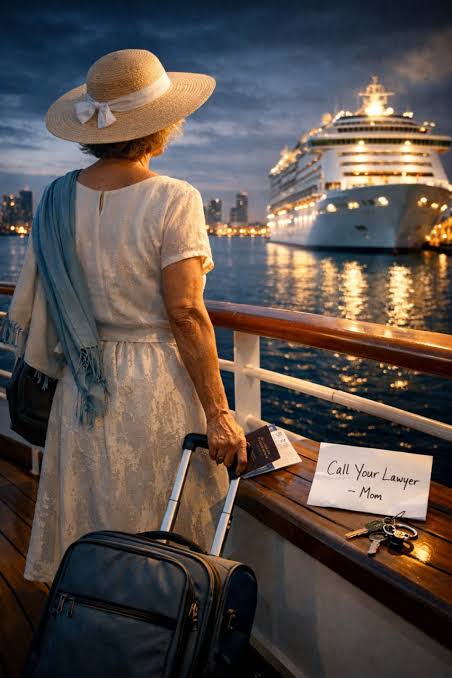
I slipped my phone into my purse.
A steward walked past and smiled.
“First day?”
“Yes.”
“Traveling alone?”
I looked at the endless water.
“Yes.”
He nodded as if that were perfectly normal.
To him, I was just another woman beginning an adventure.
He didn’t know that for forty years, I had been told that wanting an adventure was selfish.
He didn’t know that I had spent decades believing I needed permission to enjoy my own life.
And he certainly didn’t know that I had spent six months planning this exact moment.
The ship moved farther from shore.
Miami became smaller.
Then smaller still.
And eventually, it looked like a collection of tiny buildings beneath the morning haze.
I took a deep breath.
“Goodbye,” I whispered.
I wasn’t sure whether I was saying it to Miami, to my old life, or to the woman I had been.
My phone vibrated again.
This time I looked.
It was a message from Linda.
Linda: Eleanor, Ryan just called me. What’s going on?
I stared at her name.
Linda had been my best friend for thirty-one years.
I had almost told her.
Several times.
But every time I picked up the phone, I imagined her asking questions.
“Are you sure?”
“What about Arthur?”
“What will Ryan think?”
“What about your grandchildren?”
So I had kept quiet.
Not because I didn’t trust Linda.
Because I was afraid someone I loved would convince me to stay.
I finally typed:
Me: I’m on a ship.
The typing bubble appeared almost immediately.
Then disappeared.
Then appeared again.
Finally:
Linda: What ship?
I sent her a photograph of the ocean.
Then another of my cabin key.
Then:
Me: I’m taking a year for myself.
The phone rang.
Linda.
I answered.
“Hello?”
There was silence.
Then a breath.
“Eleanor.”
“Yes?”
“Please tell me you’re joking.”
I laughed.
“No.”
“You’re actually on a cruise?”
“Yes.”
“For how long?”
“One year.”
Linda didn’t speak.
I could practically hear her sitting down.
“A year?”
“That’s what I said.”
“You planned this?”
“For six months.”
“Without telling me?”
“I was afraid you’d talk me out of it.”
She laughed softly.
Then she began to cry.
“Oh, Eleanor.”
I closed my eyes.
“I didn’t want to die having only been someone’s wife and someone’s mother.”
“You should have told me.”
“I know.”
“You could have told me.”
“I know.”
“I would have gone with you.”
I smiled.
“That’s exactly why I didn’t.”
She laughed through her tears.
Then her voice changed.
“Ryan called me.”
“I figured.”
“He said you’ve abandoned him.”
I looked out at the ocean.
“Did he mention the dogs?”
Linda paused.
“No.”
“Of course not.”
“What happened?”
I told her everything.
The animals.
The list.
The demands.
The bedroom.
The granddaughter asking which room would be hers.
Linda was quiet.
Then she said something that I would remember for the rest of my life.
“Eleanor, you didn’t abandon your son.”
“No?”
“No. You finally stopped abandoning yourself.”
I looked down at my hands.
For the first time since Arthur died, I cried.
But these tears were different.
They weren’t tears of grief.
They were tears of relief.
Then Linda asked:
“What’s in the second envelope?”
I smiled.
“Something Ryan wasn’t supposed to open.”
“What is it?”
“I’ll tell you when he does.”
She laughed.
“You are terrifying me.”
“Good.”
And then we both laughed.
For the first time in months, maybe years, I laughed without checking whether someone needed me.
After we hung up, I walked onto the deck.
The wind pulled at my hair.
I closed my eyes.
I could still hear Ryan’s voice in my head.
We all have lives to live.
Yes.
We did.
And now I had decided to live mine.
Back at my house, Ryan stood beside my bed.
Chloe was behind him.
The blue envelope sat between them.
“Open it,” Chloe said.
Ryan hesitated.
“Mom said nothing about this.”
Chloe rolled her eyes.
“She’s not here.”
“Exactly.”
“So open it.”
Ryan picked it up.
There was no name on the front.
Only one sentence.
READ THIS BEFORE YOU MAKE ANY MORE DECISIONS ABOUT MY HOUSE.
Ryan swallowed.
He opened it.
Inside was a single sheet of paper.
He read the first line.
Then the second.
His face changed.
“What?” Chloe asked.
Ryan didn’t answer.
She snatched the paper from his hand.
Her eyes moved across the page.
Then widened.
“She can’t do that.”
Ryan finally spoke.
“Apparently, she can.”
Chloe read it again.
At the bottom was my signature.
And beneath it, the name of a law firm.
The letter stated that after Arthur’s death, the ownership documents of the house had been reviewed.
The house was mine.
Not Ryan’s.
Not Chloe’s.
Mine.
The mortgage had been paid off years earlier.
And more importantly, I had placed the property into a protected estate arrangement six months before Arthur died.
Ryan had no legal authority to sell it.
No legal authority to move anyone into it.
And no legal authority to treat it as an inheritance.
But that wasn’t the part that frightened him.
The final paragraph read:
My son has no permission to enter my home without my written consent while I am traveling. Any unauthorized entry will be treated as trespassing.
Chloe looked at Ryan.
“She wouldn’t.”
Ryan stared at the paper.
“She did.”
“And the pets?”
Ryan looked toward the hallway.
At that exact moment, one of the dogs barked.
The parrot screamed from downstairs.
“USELESS OLD LADY!”
Chloe shouted:
“That bird is driving me insane!”
Ryan rubbed his forehead.
“We need to leave.”
“What?”
“We can’t stay here.”
“But our flight is in an hour.”
“I know.”
“And the animals?”
“That’s your problem.”
Chloe stared at him.
“My problem?”
“You wanted them.”
“You said your mother would take care of them.”
“And she isn’t here.”
They looked at each other.
For the first time in their marriage, they had no one else to blame.
Then Ryan’s phone rang.
It was the airline.
Their flight had been delayed.
Chloe groaned.
“Perfect.”
Ryan ignored her.
His eyes remained fixed on the letter.
“There’s something else.”
“What?”
He turned the page over.
On the back was a handwritten note.
Only three lines.
Ryan,
You have spent years assuming I will always be available when you need something.
I want you to discover what happens when I’m not.
Chloe’s face went pale.
“She’s punishing us.”
Ryan shook his head.
“No.”
He folded the paper.
“She’s teaching us.”
Three days passed.
For the first time in Ryan’s adult life, he had to solve problems without calling his mother.
The dogs needed medication.
The cat refused to eat.
The parrot had somehow learned three new insults.
And the house smelled like wet fur.
Chloe began complaining.
“This is disgusting.”
Ryan snapped.
“You wanted pets.”
“I wanted your mother to watch them.”
“She’s gone.”
“I know she’s gone!”
“Then stop saying it!”
They stared at each other.
Their marriage had always been built around convenience.
When something went wrong, they called me.
When the children needed babysitting, they called me.
When Chloe wanted someone to stay with the kids while she went shopping, they called me.
When Ryan needed money, he called me.
When they needed someone to sign for packages, organize family dinners, watch pets, drive the children, cook meals, or listen to their complaints, they called me.
I had become the emergency service for a family that rarely asked whether I was tired.
Now their emergency service was on a ship.
And she wasn’t answering.
Meanwhile, I had discovered something extraordinary.
I liked being alone.
Not lonely.
Alone.
There was a difference.
I could wake up whenever I wanted.
I could eat breakfast at noon.
I could sit by the window for an hour and watch the ocean.
Nobody needed medication.
Nobody needed a sandwich.
Nobody wanted to know where I was going.
Nobody asked why I had bought a blue dress.
Nobody complained when I ordered dessert.
On the fourth evening, I sat at a table overlooking the sea.
A gray-haired gentleman approached.
“May I?”
I looked at the empty chair.
“Of course.”
He sat down.
“I’m Walter.”
“Eleanor.”
“Traveling alone?”
“Yes.”
He smiled.
“Same.”
We talked.
About the ship.
About books.
About our children.
About the strange experience of discovering that retirement wasn’t the end of life.
Walter was seventy.
He had been married for forty-five years.
His wife had died three years earlier.
“Everyone kept telling me I needed to find someone else,” he said.
“Did you?”
“No.”
“Why?”
He looked at the ocean.
“Because I finally realized I liked the man I became when nobody was telling me who I was supposed to be.”
I stared at him.
That sentence stayed with me.
Perhaps that was why I had booked the cruise.
Not to escape my family.
But to meet myself.
On the seventh day, Ryan called again.
This time I answered.
“Hello.”
There was silence.
Then:
“Mom.”
“Yes?”
“Can we talk?”
“We’re talking.”
“I mean really talk.”
I looked at the ocean.
“Go ahead.”
He sighed.
“The animals are difficult.”
“I imagine.”
“Mom.”
“What?”
“You know what I mean.”
“No. I don’t.”
“We need you.”
I closed my eyes.
There it was.
The sentence I’d heard my entire life.
We need you.
It had always sounded like love.
I finally understood that sometimes it was simply dependence.
“What do you need, Ryan?”
“We need you to come home.”
I almost laughed.
“I’m not coming home.”
“Mom, this is ridiculous.”
“No.”
“You left us with all this.”
“No, Ryan.”
I corrected him gently.
“I left you with what you gave me.”
He became quiet.
Then he said:
“What about the house?”
“What about it?”
“Are you really keeping it?”
“Yes.”
“But someday it’s going to be mine.”
“Someday, perhaps.”
“When?”
“When I decide.”
He sounded frustrated.
“You’ve changed.”
I smiled.
“I hope so.”
“You used to be different.”
“I know.”
“You used to care what we thought.”
“I still care.”
“Then why are you doing this?”
I looked at the water.
“Because caring about you doesn’t mean destroying myself for you.”
Silence.
Then, unexpectedly, Ryan’s voice softened.
“Mom…”
“Yes?”
“I’m sorry.”
Those two words hit me harder than I expected.
I sat down.
“For what?”
“For treating you like…”
He stopped.
“Like what?”
He exhaled.
“Like you were always going to be there.”
I didn’t answer.
“Mom?”
“I’m listening.”
“I didn’t realize.”
I swallowed.
“I know.”
“I thought…”
“What?”
“I thought you liked taking care of everyone.”
I looked toward the horizon.
“I did.”
“Then what’s wrong?”
I smiled sadly.
“There’s nothing wrong with taking care of people, Ryan.”
“Then?”
“I forgot to take care of myself.”
He didn’t respond.
For several seconds, all I heard was the static of the phone.
Then he said:
“I don’t want you to hate me.”
“I don’t hate you.”
“Do you love me?”
My heart tightened.
“Always.”
“Even now?”
“Especially now.”
He began to cry.
I had never heard my son cry like that.
Not when he failed his exams.
Not when his first marriage ended.
Not when Arthur died.
He had always been strong in front of me.
Now he sounded like the little boy who used to crawl into my bed during thunderstorms.
“Mom,” he whispered.
“Yes?”
“Come back.”
I closed my eyes.
“I will.”
His breathing steadied.
“Really?”
“Not yet.”
He went silent.
“I have somewhere to be first.”
“Where?”
I smiled.
“Everywhere.”
Then I hung up.
Two months passed.
The cruise became my new world.
I visited ports I had only seen in photographs.
I learned to dance.
Badly.
I took cooking classes.
I joined a book club.
I got sunburned.
I laughed at myself.
I bought earrings Arthur would have called unnecessary.
And every night, I wrote in a journal.
Sometimes I wrote about Arthur.
Sometimes about Ryan.
Sometimes about the woman I had been.
One night, I wrote:
Arthur,
I miss you.
But I don’t miss disappearing.
I closed the journal.
That was when I realized something.
I had loved my husband.
But I had also lost myself inside that marriage.
And now, perhaps, I could grieve him without grieving myself.
Then, on the ninety-third day of the cruise, everything changed.
I received an email from my attorney.
The subject line was:
URGENT — PROPERTY MATTER
I opened it.
There were several attachments.
My attorney explained that someone had attempted to obtain documents related to my house.
Someone had contacted a real estate agent.
Someone had claimed to be “a family representative.”
Someone had asked whether the property was available for sale.
My attorney had stopped everything.
But there was more.
The person had provided a copy of a document suggesting that Ryan had authority to act on my behalf.
A forged document.
My stomach dropped.
I immediately called my attorney.
“Who did it?”
“We don’t know yet.”
“Was Ryan involved?”
“We can’t say.”
“Could someone have forged his signature?”
“Possibly.”
I stared at the ocean through my cabin window.
The peaceful world I had built suddenly felt very far away.
Then another email arrived.
A photograph.
It showed a real estate contract.
My house.
My address.
A proposed sale price.
And at the bottom—
Ryan’s signature.
I stared at it.
I knew that signature.
I’d watched him sign birthday cards.
School forms.
Bank documents.
I knew the shape of every letter.
And this looked real.
My heart sank.
I called Ryan.
He didn’t answer.
I called again.
Nothing.
Then I called Chloe.
Nothing.
Finally, I sent one message.
Me: Ryan, I received the property documents. Call me immediately.
Three minutes later, my phone rang.
But it wasn’t Ryan.
It was my granddaughter.
Her voice was trembling.
“Grandma?”
“Sweetheart?”
“There’s something you need to know.”
I sat down.
“What happened?”
She whispered:
“Dad is in trouble.”
My heart began pounding.
“What kind of trouble?”
“He didn’t sell the house.”
“Then what?”
“He borrowed money.”
“From whom?”
Silence.
“Grandma…”
“Tell me.”
“He borrowed against the house.”
I felt cold.
“How?”
“He said you gave him permission.”
I closed my eyes.
The ship moved gently beneath me.
For months, I had believed my absence would teach my family how much they depended on me.
I had not expected it to expose something much darker.
My granddaughter began crying.
“Grandma, I’m scared.”
“Where are you?”
“At home.”
“Who is with you?”
“No one.”
“Lock the door.”
“What?”
“Lock every door.”
“Grandma, what’s happening?”
I stood.
My hands were shaking.
“I don’t know yet.”
Then I looked out at the endless ocean.
For the first time since I had boarded the ship, I wanted to go home.
Not because my family needed me.
Not because I was afraid of being alone.
But because someone had crossed a line that could not be uncrossed.
Someone had tried to steal the life I had worked forty years to build.
And suddenly, the blue envelope I had left behind didn’t feel like the end of my old life.
It felt like the beginning of a battle.
I picked up the phone.
“Sweetheart?”
“Yes, Grandma?”
“Listen carefully.”
“What?”
“I’m coming home.”
There was a pause.
Then my granddaughter whispered:
“Grandma…”
“Yes?”
“There’s one more thing.”
“What?”
She took a shaky breath.
“The person who gave Dad the documents…”
“Who?”
“I saw him.”
My heart stopped.
“Who was it?”
She whispered a name I hadn’t heard in thirty years.
A name I had hoped never to hear again.
“Grandma…”
“Who?”
“It was Uncle Michael.”
I froze.
Michael.
Arthur’s younger brother.
The man who disappeared from our lives after a family argument three decades ago.
The man Arthur had once accused of stealing money.
The man who had sworn he would never forgive us.
And according to my granddaughter…
He was back.
And he wasn’t working alone.
I slowly lowered the phone.
Outside my window, the ocean stretched endlessly toward the horizon.
I had spent my whole life believing I was running away from my family.
Now I understood.
I wasn’t running away.
I had finally stepped far enough back to see the truth.
And the truth was waiting for me at home.
PART 4
For the first time in ninety-three days, I wanted to leave the ship.
Not because I was afraid.
Because my granddaughter was afraid.
There is a difference.
I called the captain’s office and asked whether it was possible to disembark at the next major port and arrange transportation home.
The answer was yes.
But the next port was still four days away.
Four days.
Normally, four days at sea would have felt like a luxury.
Now they felt like an eternity.
I called my attorney again.
“Mr. Bennett, I need you to do something for me.”
“Anything.”
“Put a hold on every transaction involving my house.”
“Already done.”
“And I want someone physically at the property.”
There was a pause.
“I can arrange security.”
“Please do.”
“Mrs. Miller, there’s something else.”
“What?”
“The documents your son used are more serious than I first thought.”
I sat on the edge of my bed.
“Explain.”
“The loan application contains a power of attorney.”
“I never gave Ryan power of attorney.”
“I know.”
“Then it’s forged.”
“It appears so.”
My stomach tightened.
“How much?”
“Approximately four hundred thousand dollars.”
I stared at the wall.
Four hundred thousand.
“Why would he need that much?”
“I don’t know.”
“Did he use the house as collateral?”
“Yes.”
“And if he can’t pay?”
“The lender could attempt to enforce the security interest.”
I stood so quickly that the room spun.
“They can’t take my house.”
“Not without a legal process.”
“But he doesn’t own it.”
“I know.”
“Then stop it.”
“We’re doing everything possible.”
I walked toward the window.
The sea was dark.
There was no land in sight.
“Mr. Bennett?”
“Yes?”
“Find out exactly where that money went.”
He hesitated.
“I’ll try.”
“No.”
My voice became firmer.
“Don’t try.”
I looked at my reflection in the glass.
For forty years, I had been the woman who said, “I’ll see what I can do.”
Not anymore.
“Find out.”
He was silent for a moment.
Then he said:
“Yes, ma’am.”
I ended the call.
My granddaughter, Sophie, stayed on the phone with me every night.
She was twenty-one.
Old enough to understand what was happening.
Young enough to still be frightened by it.
“Grandma?”
“Yes?”
“Why did Dad do this?”
“I don’t know.”
“Did he lose money?”
“I don’t know.”
“Is he in trouble?”
“Probably.”
She was quiet.
Then:
“Is Uncle Michael really back?”
I closed my eyes.
“I don’t know.”
“But you know him.”
“Yes.”
“What happened?”
I sighed.
“That’s a long story.”
“I have time.”
I smiled sadly.
“Apparently, so do I.”
So I told her.
Thirty years earlier, Arthur and Michael had owned a small construction company together.
Arthur handled customers.
Michael handled finances.
Then nearly sixty thousand dollars disappeared from the company account.
Arthur accused Michael.
Michael denied stealing anything.
The brothers fought.
The company collapsed.
Michael left town.
Arthur never spoke about him again.
But I remembered something Arthur had once said.
A sentence I hadn’t understood at the time.
“Michael didn’t take the money. I know that now.”
I had asked him why he never apologized.
He said:
“Because by the time I discovered the truth, it was too late.”
I had forgotten about that conversation.
Until now.
“Sophie,” I whispered.
“Yes?”
“I need you to tell me something.”
“What?”
“Has your father been talking to Michael for long?”
She hesitated.
“Months.”
My heart sank.
“How many?”
“I don’t know. Maybe a year.”
“A year?”
“Yes.”
“And you knew?”
“I didn’t know what they were doing.”
“Did your mother know?”
“I think so.”
That was when another piece fell into place.
The pets.
The house.
The sudden trips.
The pressure to move me.
The questions about inheritance.
They weren’t random.
They had been preparing for something.
They had wanted me out of the house.
Not because it was too big for me.
Because they needed the house without me in it.
I whispered:
“They weren’t trying to help me.”
“No.”
“They were trying to get rid of me.”
Sophie began crying.
“Grandma, I’m sorry.”
“None of this is your fault.”
“But I should have told you.”
“You were protecting yourself.”
“I was scared.”
“I know.”
Then I said something I had never said to anyone in my family.
“You don’t owe your parents your silence.”
She stopped crying.
“What do you mean?”
“If something is wrong, you tell the truth.”
“Even if it hurts them?”
“Especially then.”
Four days later, the ship reached port.
I disembarked with one suitcase.
I could have continued the cruise.
My cabin was paid for.
My belongings were secure.
The world I had built was still waiting for me.
But sometimes leaving isn’t strength.
Sometimes strength is knowing when to return.
My attorney arranged a car.
By evening, I was back in my town.
The first thing I noticed was how small everything looked.
My street.
The grocery store.
The church.
The house.
I had spent so much of my life inside that house that I expected to feel relief when I saw it.
Instead, I felt anger.
Someone had tried to turn my home into a bargaining chip.
I parked outside.
Two security officers were waiting.
My attorney was beside them.
And across the street, behind the curtains of a neighbor’s house, someone was watching.
I recognized the silhouette.
Ryan.
I walked toward the front door.
He stepped out.
“Mom.”
I stopped.
He looked terrible.
His suit was wrinkled.
His face was thinner.
His eyes were red.
For a moment, I saw my little boy again.
Then I remembered the documents.
“Where is Chloe?”
“She’s gone.”
“Where?”
“I don’t know.”
“Where is Michael?”
Ryan looked away.
That was answer enough.
“You’ve been working with him.”
“I didn’t know what he was doing.”
“That’s not what I asked.”
Ryan’s eyes filled with tears.
“Yes.”
I nodded slowly.
“Why?”
“I was desperate.”
“For what?”
He swallowed.
“Money.”
“How much?”
“Three hundred and eighty thousand.”
“Where did you get that kind of debt?”
He didn’t answer.
I waited.
Finally he said:
“I invested in something.”
“What?”
“A business.”
“What business?”
“An online company.”
I almost laughed.
“You lost nearly four hundred thousand dollars on an online company?”
“It wasn’t supposed to happen.”
“Nothing ever is.”
He looked at me.
“Michael said he could help.”
“Michael has always said that.”
Ryan lowered his head.
“Mom, I thought I could fix it.”
“By taking my house?”
“I wasn’t going to take it.”
“You used it as collateral.”
“I thought I’d repay the loan.”
“With what?”
Silence.
I walked closer.
“Ryan, you didn’t make one mistake.”
He looked at me.
“You made a series of choices.”
“I know.”
“You lied.”
“I know.”
“You forged documents.”
“I didn’t forge them.”
I stopped.
“What?”
“I didn’t.”
“Then who did?”
Ryan looked toward the street.
“Michael.”
My heart hardened.
“Why?”
“I don’t know.”
“You’re lying.”
“I’m not.”
I stared at him.
Then he finally broke.
“He said you had dementia.”