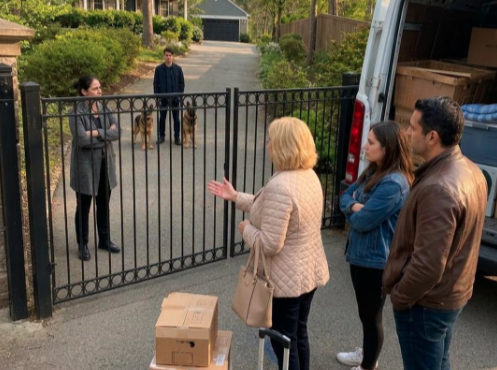
Why did I let my daughter Claire say “fine” so many times before I asked what she meant? I’ve asked myself that for years. I was close enough to see the little signs, and I kept treating them like weather. Bad for a day, sure to pass.
Claire and Aaron had been married three years. Aaron ran Prescott Global, a Boston company with more than five hundred employees. Claire had her own work and her own money, but she’d moved into his world, where dinners had seating charts and people remembered who wore which watch.
When I visited, I’d see her straighten his cuff links before he left. She knew which shirts needed starch and which ones made his neck itch. She’d set out a plate for him even if he hadn’t said what time he’d be home.
I thought it was kindness. Maybe some of it was. I didn’t see how much of her day she was arranging around the chance he might walk through the door.
The first clue was a dinner I’d made at their house in Marblehead. Aaron texted that he’d be late, so Claire kept the roast warm. At 10:40, she finally put it away. She said he’d been stuck with a client.
I asked if she believed that. She took the dish towel and wiped a clean patch of counter.
“He’s busy, Mom. It’s fine.”
I didn’t push. My own mother raised me to mind my business unless somebody asked for help. I still use that as an excuse more than I should.
The second clue came a few weeks later. I was in the passenger seat while Claire drove us to a farm stand. Her phone lit up in the cup holder. Aaron’s name appeared, then disappeared, then came back with a photo attached.
Claire glanced down at it and turned the phone over.
“Everything okay?” I asked.
“Jasmine sent him something for work.”
Jasmine Cole worked at Prescott Global. I knew the name because Claire had mentioned her after a company gala. She’d said Jasmine was always beside Aaron in photos, handling the schedule and making sure he had the right people around him.
I could’ve asked more. I didn’t. I bought a bag of apples and let the conversation move on.
Then came the empty chair at Thanksgiving. Aaron had said he’d be there by six. At seven, Claire put the turkey on the table.
At eight, she started eating. She kept checking the front window between bites.
He called once. She let it ring.
I remember the little cranberry sauce can sitting on the counter with one ridge of sauce still stuck inside. That’s what my mind kept, not the way my daughter’s face changed when she heard his message.
“He says he’s coming,” she told me.
“He said that before.”
She looked down at her plate. “I know.”
I should’ve stayed with it. Instead I told her the potatoes were getting cold. I gave her another job so I wouldn’t have to watch her hurt.
By the new year, she stopped telling me when Aaron was late. She’d say he had a dinner, a meeting, a work trip. The details got smaller. Her answers got quicker.
A few times she called me after midnight. Once she asked if I thought a marriage could be lonely even when two people lived in the same house.
I said yes. Then I said I wished she’d come stay with us. She thanked me but didn’t come.
I figured I was helping by keeping the door open. I didn’t understand that she was asking me to see what was already happening.
The fourth overnight absence was the one I knew about. Claire called at 8:12 the next morning. Her voice sounded ordinary, which worried me more than crying would have.
“Aaron didn’t come home,” she said.
“Do you know where he is?”
“No.”
“Do you want me to come?”
“I’m okay.”
I told her I’d call again later. I should’ve gotten in the car. I didn’t. I waited for her to ask twice, as if help had to be requested in the proper form.
Three weeks later, Aaron stayed out again.
At 3:17 in the morning, Claire sent me a message. She didn’t say where Aaron was. She said she’d found enough to know, and she was going to send one thing before she lost her nerve.
I sat up in bed and called her. She didn’t answer.
The next thing I saw was a screenshot from Prescott Global’s company-wide Slack channel. It showed a message from Claire, posted where over five hundred employees could read it. She thanked Jasmine for taking exceptional care of Aaron and said he no longer needed to come home.
I read it twice. Then I called Claire again.
She picked up this time. Her voice was steady, but I could hear the rough edge underneath.
“He’ll see it,” I said.
“I know.”
“Everybody at work will see it.”
“I know that too.”
I wanted to tell her it wasn’t the way I would’ve done it. That was true, and it was also the wrong thing to say. So I asked if she wanted me to come.
“Yes,” she said. “Please.”
Aaron’s calls were coming in by then. Claire showed me the count later: twenty-seven missed calls before seven that morning. She didn’t answer one.
I arrived at the house a little after six. Two suitcases stood in the hall, both packed with Aaron’s clothes. His suits were still in their covers. His shirts had been folded the way he liked them, with the cuffs tucked in so they wouldn’t crease.
I didn’t like seeing how carefully she’d packed for a man who hadn’t bothered to come home. I didn’t say that either.
“You don’t have to take all of it today,” I said.
“I want it gone.”
That was when I saw the envelope. It was sealed, with Aaron’s name written on the front. Claire had put it on top of the second suitcase.
She told me it was a proposed divorce settlement. The house, her accounts, and a list of the things she considered hers were all in it. She’d already spoken to Nathan Brooks, a lawyer she’d known since law school.
“You spoke to a lawyer before you called me?”
“I knew what you’d say.”
I didn’t like that. I wanted to believe she’d come to me first. But I understood why she hadn’t. I’d spent months listening without asking the one question she needed me to ask.
“What do you need from me?” I said.
“Come with me to the office.”
So I did.
At seven, the lobby at Prescott Global was filling up. I stood beside Claire while she handed the receptionist the sealed envelope and pointed out Aaron’s bags. The receptionist looked like she wanted to disappear behind the desk.
Claire said the clothes belonged to her husband. She asked that the envelope go to him for his attorney.
People had begun to gather near the elevator. I heard one woman whisper that the Slack post was real. Another said Jasmine had been with Aaron again the night before.
Claire heard them. She didn’t turn around.
Aaron came out of the elevator while Claire was still speaking to the receptionist. He saw the suitcases first. Then he saw Claire. He walked straight toward her and held out a hand.
“Claire, what are you doing?”
“Leaving.”
“You put that in the company channel.”
“I did.”
“You embarrassed me.”
Claire looked at him for a second. “I know.”
That answer seemed to bother him more than an argument would have. He reached for the envelope, but the receptionist had already set it behind the counter.
Aaron turned to me. I was so angry I couldn’t make my mouth work right away.
“Don’t,” I said.
He looked back at Claire. “Can we talk privately?”
“We’ve had three years.”
She took my arm, and we walked out together. I wasn’t brave or wise. I was just glad she’d asked me to come before I could find another reason to stay home.
Outside, her phone showed sixty-three messages. Aaron had kept calling. His mother had called. His sister had called. People from the company had sent notes that ranged from concern to gossip.
Claire called her father and told him she was divorcing Aaron. Then she called Nathan’s office. She had no things packed for herself, so her father and I went back to the house with her that afternoon.
Three weeks later.
The first week was mostly lawyers, boxes, and the kind of decisions that look small until you have to make them all at once. Claire moved into a rental near her old office. I helped carry dishes and a box of winter shoes. She kept her work clothes in two garment bags, the same ones she’d used when she first moved in with Aaron.
I kept expecting her to say she’d changed her mind. She didn’t.
Nathan met with Claire and me once, though he was careful to speak mostly to her. He explained the prenup and asked what she wanted. Claire said she wanted her own property, her own accounts, and nothing that belonged to Aaron.
Nathan stopped writing.
“You’re sure?”
“I’m sure.”
She told him about the place in Marblehead, which my husband and I had given her before the wedding. She showed him the account records that proved her investments hadn’t been mixed with marital money. Nathan said they had good paperwork.
Then Claire told him about her grandfather’s company.
Her grandfather had started a small investment firm called Redfern Partners. Before he died, he left Claire a stake in it. Aaron knew her grandfather had been a businessman, but he didn’t know what Claire had inherited or how Redfern was set up.
I knew even less. I’d heard the name at family dinners, then stopped asking when the talk turned to votes, shares, and lawyers. I’m not proud of that. I used to think money like that belonged to people who knew how to ask the right questions.
Nathan asked Claire whether the investment had been mixed with marital money.
“No,” she said. “Not once.”
“Does Aaron know about the voting rights?”
“No.”
I was sitting beside the window. I remember a coffee ring on the table because I kept looking at it while Nathan explained the paperwork. Claire’s grandfather had left her an interest in Redfern, along with voting shares tied to Redfern’s investment in Prescott Global.
The numbers were not simple. Claire didn’t own Prescott Global. She couldn’t decide the company’s future by herself. But Redfern held a meaningful block of company shares, and Claire’s inherited voting rights gave her a formal say in how that block was used.
That was the part Aaron had never bothered to ask about.
Nathan told her not to use the inheritance as a threat in the divorce. He also said the board deserved to know about a possible conflict if Aaron had been using company resources to support a relationship with an employee.
Claire sat quiet for a bit.
“I don’t want Jasmine blamed for Aaron’s choices,” she said.
“I’m not saying she should be,” Nathan told her. “I’m saying the company has to look at what happened.”
Claire had spent three years seeing Jasmine beside Aaron at dinners, galas, and work trips. She had also spent three years pretending that didn’t mean anything because she was afraid of what the answer would cost her. I watched her try to sort anger from what she could prove.
“I put that message in front of five hundred people,” she said. “I know I made it worse for her.”
Nathan said the post could be addressed separately. Claire asked if she could correct what she’d said without taking back the fact that Aaron had been unfaithful. Nathan said she could write a short note that stuck to what she knew.
That afternoon, Claire sent one. She said she regretted making a personal matter public in a company channel, and she wouldn’t discuss Jasmine’s role further. She didn’t apologize for asking for a divorce.
I was relieved. Then I felt ashamed of being relieved, as if the main thing I cared about was keeping Claire from looking bad.
A week after the lobby, Aaron’s chief operating officer contacted Nathan. He said Aaron wanted a private meeting with Claire. Nathan asked what the meeting was about.
The answer was that Aaron needed her to withdraw her request to contact Redfern’s board.
Claire sat at the kitchen table in her rental when Nathan told her. Her father had gone out for groceries. I’d brought a jar of soup and was standing near the sink, not sure whether to leave.
“Did Aaron know before now?” I asked.
“Maybe he knew Redfern had a stake,” Claire said. “I don’t think he knew I had the votes.”
“Why would he think he could ask you to withdraw it?”
She gave me a tired look. “Because he still thinks he can decide what I do.”
That was the first time she let herself sound angry with me. Not at me, exactly, but close enough.
“You knew I wasn’t doing well,” she said. “You kept telling me he was busy.”
I put the soup down. “You’re right.”
I had a dozen reasons ready. I hadn’t wanted to interfere. I thought she was an adult. I thought she’d tell me if she needed me. They were all just different ways of saying I’d chosen not to risk a hard conversation.
“I’m sorry,” I said.
Claire nodded, but she didn’t say it was fine.
The next day, she contacted Redfern’s managing partners and requested a review of Prescott Global’s conduct under Aaron’s leadership. She didn’t accuse Jasmine. She didn’t ask for Aaron’s job. She attached the records Nathan had helped her gather and disclosed that she was married to the CEO.
I sat with her while she wrote the email. She checked every date twice. I read it over, but I didn’t offer edits. It felt like watching somebody repair a fence one post at a time. Slow work, and no guarantee it would hold.
Aaron found out at 4:26 that afternoon. Claire learned the time from the company’s COO, who later gave a statement to the review team. He said he’d walked into Aaron’s office and told him Claire had contacted the board.
Aaron’s first response was to say Claire didn’t know the board members. The COO told him that wasn’t the point.
READ THE NEXT PART: 👇👇
PART 4 – I Watched My Daughter’s Husband Learn What Her Grandfather Left Her