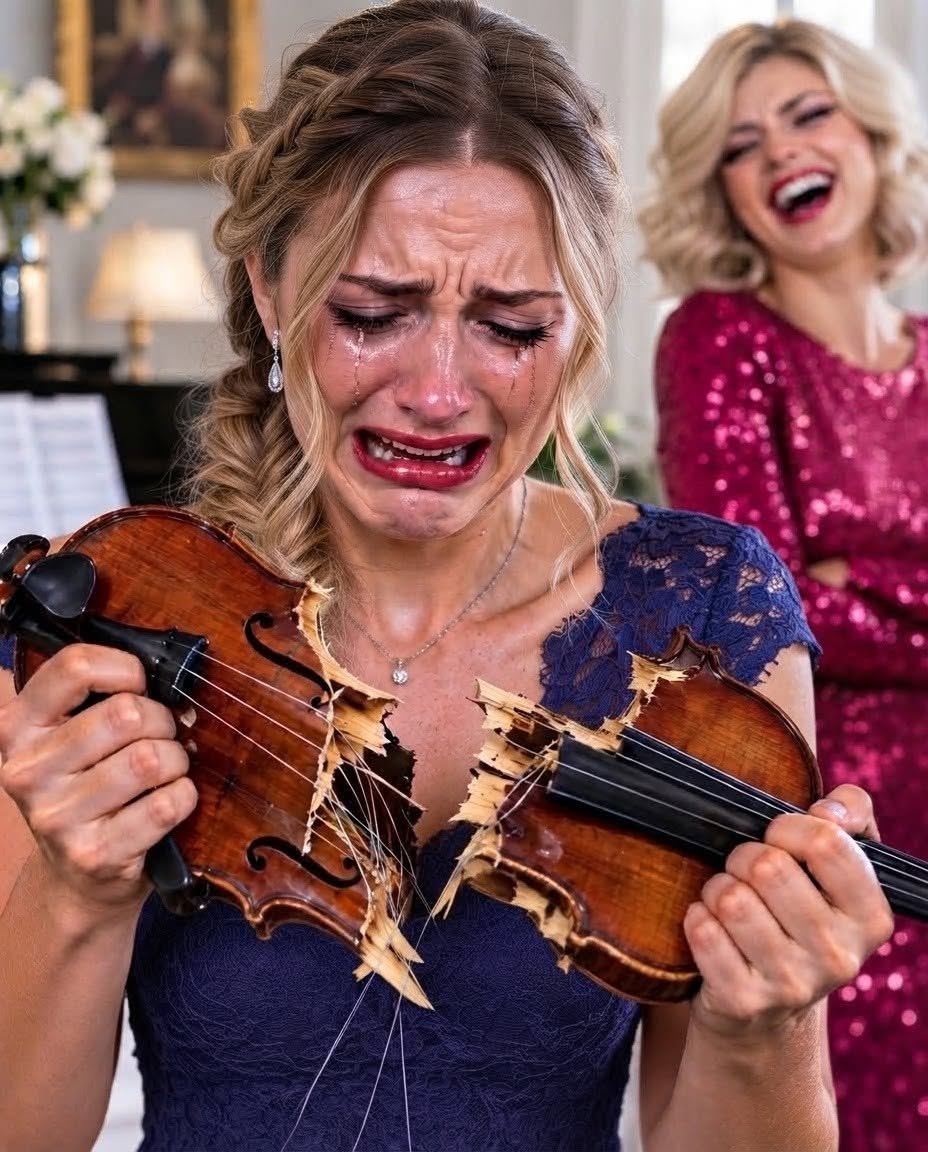
My sister broke my violin in half less than 20 minutes before the most important performance of my life all because I refused to give her my new dress. She looked at the broken pieces and said, “Guess your big night is over.”
“With what?”
Vanessa’s voice had changed.
The smugness was still there, but now there was something else underneath it.
Uncertainty.
I picked up my phone.
“With another violin.”
She laughed.
“Claire, you don’t have another violin.”
“No.”
I looked directly at her.
“But the orchestra does.”
Then I walked out.
For the first time that night, nobody followed me.
I moved through the backstage corridor carrying the closed case against my chest.
Inside it were the remains of the instrument my grandfather had protected for more than forty years.
Every step felt wrong.
The hallway was full of movement.
Stagehands carried music stands.
Two cellists hurried past discussing an entrance.
Someone tuned an oboe in the distance.
The entire building was moving toward the performance as though my world hadn’t just split open five minutes earlier.
Maybe that helped.
Music doesn’t stop because you’re hurting.
You either walk onto the stage or you don’t.
I found Maestro Adrian Cole near the wings.
He was speaking with our concertmaster, Lucas Grant.
Adrian saw my face immediately.
“What happened?”
I couldn’t say it at first.
I opened the case.
Both men went silent.
Lucas whispered, “Oh my God.”
Adrian slowly looked at me.
“Was there an accident?”
“My sister broke it.”
“What?”
“She did it deliberately.”
Lucas stared at the ruined instrument.
“Claire, that’s your grandfather’s violin.”
“Yes.”
Adrian’s expression hardened.
“Why?”
“Because I wouldn’t give her my dress.”
He actually closed his eyes for a moment.
Then he looked toward the stage clock.
Nineteen minutes.
“Can you play?”
“Yes.”
He studied me.
“I’m not asking if you want to prove something.”
“I know.”
“Can you physically play?”
“Yes.”
My hands were trembling, but not enough to matter.
He turned to Lucas.
“Where’s the Guarneri copy?”
Lucas blinked.
“In storage.”
“Get it.”
My heart stopped.
“Maestro—”
Adrian held up a hand.
The orchestra owned several high-quality instruments for visiting performers, competitions, and emergencies.
One of them was a modern violin modeled after a Guarneri del Gesù, built by a respected contemporary luthier.
I had played it once during a rehearsal demonstration.
It was worth more than my car.
“I can’t just take that onstage.”
“You’re not taking it,” Adrian said. “You’re borrowing it.”
“What if something happens?”
He looked at the broken case in my hands.
“Something already happened.”
Lucas disappeared down the hallway.
Adrian lowered his voice.
“You’ve practiced this concerto for eleven months.”
“Fourteen.”
“Exactly. The violin matters. Your grandfather’s violin matters. But the instrument is not the performer.”
My eyes burned.
“I was supposed to play his violin tonight.”
“I know.”
That almost broke me.
Adrian placed one hand on my shoulder.
“But if your grandfather taught you the way you’ve described, do you honestly think he would want you sitting backstage because somebody broke wood?”
I swallowed.
“No.”
“What would he say?”
I laughed once through my tears.
“He’d say my left hand gets lazy when I’m emotional.”
Adrian smiled.
“Then don’t let it.”
Lucas returned carrying a black hard-shell case.
He opened it.
The violin inside was dark amber, almost reddish beneath the backstage lights.
Beautiful.
Different from Grandpa’s.
Unfamiliar.
But alive.
I reached for it.
The first note I played was awful.
My hand was shaking too much.
I closed my eyes.
Again.
Open A.
Then D.
Then a scale.
Slowly.
The instrument responded differently from mine.
The neck was slightly thicker.
The balance felt more forward.
The G string was darker.
The E string brighter.
I adjusted.
Seven minutes later, my hands stopped shaking.
Adrian listened.
Then nodded.
“You’re going on.”
I didn’t know that Vanessa had followed us.
Not until she spoke.
“You’re seriously still doing this?”
I turned.
She was standing ten feet away in my green dress.
Mom stood behind her.
Vanessa looked from me to the replacement violin.
Her face had changed.
The satisfaction was gone.
“You can’t just use some random violin.”
Lucas laughed under his breath.
“This is not a random violin.”
Vanessa ignored him.
“You haven’t practiced with it.”
“No.”
“You’ll mess up.”
“Maybe.”
She stared at me.
For years, Vanessa had understood exactly how to hurt me.
She knew where the soft places were.
She knew I hated confrontation.
She knew I cared about being prepared.
She knew perfectionism could paralyze me.
That was why breaking the violin had seemed so effective.
She wasn’t trying only to destroy an object.
She was trying to destroy my confidence twenty minutes before I needed it most.
When I didn’t collapse the way she expected, she didn’t know what to do.
Mom stepped in.
“Claire, I still think performing right now is a bad idea.”
I looked at her.
“Of course you do.”
Her eyebrows rose.
“What is that supposed to mean?”
“It means Vanessa broke an eighty-thousand-dollar violin because she wanted my dress and your response was to tell me not to create a scene.”
“I was trying to keep everyone calm.”
“No.”
The word came easily now.
“You were trying to keep Vanessa comfortable.”
Mom’s face tightened.
“This is not the time.”
“It hasn’t been the time for fifteen years.”
Vanessa rolled her eyes.
“Oh my God.”
I looked at her.
“You’re right.”
She frowned.
“About what?”
“This isn’t the time.”
Then I turned away.
I had a concert to play.
The lights dimmed.
A stage manager motioned toward us.
My heart began pounding.
The orchestra filed onto the stage.
Applause rolled through Avery Fisher Hall.
I stood in the wings listening to it.
Then Adrian looked at me.
“You ready?”
“No.”
He smiled.
“Good. Means you’re paying attention.”
I almost laughed.
The announcement came.
My name.
The piece.
The final movement.
I stepped onto the stage.
The lights were brighter than I expected.
For one terrible second, the audience became a dark wall beyond them.
Hundreds of people.
Critics.
Donors.
Conservatory faculty.
Musicians.
People who could change my future.
Then I remembered Grandpa.
Not the broken violin.
Him.
He used to sit in an old wooden chair during my lessons.
He would tap a pencil against his knee whenever my tempo rushed.
“Don’t perform for the room,” he told me once.
“Perform for the phrase.”
I lifted the replacement violin.
The orchestra began.
And I stopped thinking about Vanessa.
The first entrance came.
My bow touched the string.
Everything else disappeared.
There are performances where you’re aware of every note.
Then there are performances where the music seems to happen before you can think about it.
That night became the second kind.
The violin was unfamiliar, but that forced me to listen harder.
Instead of relying on muscle memory, I responded to every sound.
The opening phrases felt dangerous.
Alive.
By the middle of the movement, I wasn’t thinking about the dress.
Or my mother.
Or the shattered instrument backstage.
I was thinking about Grandpa correcting my bow at eight years old.
About practicing scales when my friends were outside.
About audition rooms.
Rejected applications.
Blisters on my fingertips.
The first time I understood why Sibelius could sound like winter.
Every piece of my life was somehow inside those four strings.
Then came the final passage.
Fast.
Relentless.
The kind of passage where panic makes your fingers heavier.
I heard Grandpa in my head.
Don’t chase it.
Let it come to you.
I breathed.
And played.
The last chord hit.
Silence.
Maybe one second.
Maybe less.
Then the room exploded.
I had heard applause hundreds of times.
This was different.
People stood.
Not everyone.
Then more.
Then almost the entire center section.
Adrian turned toward me.
He was smiling.
Lucas lifted his bow against his music stand.
The string section joined him.
I lowered the violin.
And cried.
Not visibly at first.
Just enough that I had to blink before bowing.
Because my grandfather’s violin was broken.
Nothing could erase that.
But Vanessa had been wrong about one thing.
She had broken an instrument.
Not the years inside me.
Backstage was chaos afterward.
Musicians hugged me.
Someone handed me water.
The orchestra’s executive director wanted photographs.
A conservatory representative asked if I could speak after the reception.
One critic said the performance had an “unusual emotional rawness.”
If he had known why, he might have chosen another phrase.
Then Lucas approached me.
He wasn’t smiling anymore.
“Claire.”
Something in his tone changed the room.
“What?”
“You need to come with me.”
I followed him toward the dressing rooms.
Adrian came too.
At first, I thought something had happened with the replacement violin.
Then I heard shouting.
Vanessa.
“You can’t do this!”
Another voice answered.
Calm.
Male.
“I absolutely can.”
I turned the corner.
Three people stood outside my dressing room.
Vanessa.
My mother.
And Dr. Samuel Hargrove.
I knew him immediately.
Everyone in the New York classical music world did.
Hargrove was the chairman of the Ellison Conservatory board and one of the most influential private arts donors in the Northeast.
More importantly for Vanessa, he was also the founder of the Hargrove Arts Foundation.
The same foundation whose public-relations department Vanessa had been interviewing with for nearly two months.
Her final interview was scheduled for Monday.
She had talked about it constantly.
The salary.
The connections.
The benefits.
The parties.
According to Vanessa, getting hired there would “finally put her around serious people.”
Now Hargrove was standing outside my dressing room holding one of the broken pieces of Grandpa’s violin.
Vanessa looked like she was going to be sick.
My stomach dropped.
“What happened?”
Hargrove turned to me.
“Miss Bennett?”
“Yes.”
“Is this yours?”
He held the broken section carefully.
I nodded.
“It was.”
He looked toward Vanessa.
“And you’re sisters?”
“Yes.”
Vanessa interrupted.
“This is a private family issue.”
Hargrove’s expression barely changed.
“I was under the impression destruction of an insured instrument might be something other than a private family disagreement.”
Mom stepped forward.
“I’m sure everyone is upset, but this was an accident.”
I stared at her.
She had crossed from denial into lying without hesitation.
“No, it wasn’t.”
Vanessa snapped toward me.
“Claire.”
“No.”
Hargrove’s gaze shifted between us.
“What happened?”
My mother started.
“Mr. Hargrove—”
I spoke over her.
“My sister wanted my dress.”
Vanessa closed her eyes.
“She took my violin out of the case and broke it over her knee because I said no.”
Hargrove looked at Vanessa.
“Is that accurate?”
“It wasn’t like that.”
“How was it?”
Vanessa’s mouth opened.
Nothing came out.
Then Hargrove said the sentence that made her start crying.
“My office informed me this morning that you’re scheduled for a final interview with our foundation.”
Vanessa’s face drained.
“Yes.”
“I recognized your name when one of the staff mentioned it.”
She immediately stepped closer.
“Dr. Hargrove, please. This has nothing to do with work.”
His voice stayed calm.
“Our foundation entrusts employees with donor collections, historically significant instruments, private residences, artist estates and confidential materials.”
Vanessa went pale.
He looked at the broken wood in his hand.
“I think it has quite a lot to do with work.”
That’s when Vanessa started begging.
Not me.
Him.
“Please don’t cancel the interview.”
Hargrove didn’t answer.
“It was a stupid argument.”
Silence.
“I was angry.”
Still nothing.
“I’d never do anything like this professionally.”
Hargrove raised an eyebrow.
“Why should conduct become acceptable because it happened to your sister?”
Vanessa couldn’t answer.
Then she turned toward me.
And everything changed.
Five minutes earlier, she had been the sister who broke my violin and wore my dress.
Now she grabbed my hand.
“Claire.”
I pulled away.
She began crying harder.
“Please tell him I’m not like this.”
I looked at her.
Twenty minutes earlier, she had stared at the destroyed violin and said:
Guess your big night is over.
Now her future was suddenly in danger.
And she wanted me to save it.
“Claire, please.”
Mom moved beside her.
“Just tell him she made a mistake.”
“A mistake?”
“Yes.”
I looked at Mom.
“She picked up Grandpa’s violin and deliberately snapped it three times.”
“She was emotional.”
I actually laughed.
“So was I.”
No one spoke.
Then Hargrove handed the broken piece to Lucas.
“I think I have enough information.”
Vanessa panicked.
“No.”
He turned away.
She stepped after him.
“Dr. Hargrove, please.”
He stopped.
“I won’t discuss employment decisions in this hallway.”
Then he looked at me.
“Excellent performance, Miss Bennett.”
“Thank you.”
And walked away.
Vanessa stared after him.
Then slowly turned toward me.
“What did you just do?”
For a second, I couldn’t believe the question.
“What did I do?”
“You could have helped me.”
“You destroyed my violin.”
“It can be repaired!”
Lucas spoke from behind me.
“No.”
Everyone turned.
He was holding the case.
His face was grim.
“What?”
Lucas had worked part-time at a respected Manhattan violin shop before joining the orchestra.
He understood instrument construction better than almost anyone else there.
He opened the case.
“The top plate has multiple fractures. The ribs are destroyed here and here. Neck damage. Internal blocks may be compromised. Maybe an expert can reconstruct it.”
I held my breath.
“Will it sound the same?”
He looked at me.
“No one can promise that.”
Vanessa looked annoyed.
“It was insured.”
There it was.
Money.
As though an insurance check could recreate Grandpa’s hands.
I looked at her.
“Take off my dress.”
Her mouth fell open.
“What?”
“You heard me.”
“Claire—”
“Take. Off. My. Dress.”
Mom sighed.
“This is becoming childish.”
“No. It became childish when a thirty-year-old woman destroyed an antique violin because she couldn’t borrow clothes.”
Vanessa glared at me.
Then disappeared into the dressing room.
A few minutes later, she came out wearing the outfit she had arrived in.
She threw the green dress over the chair.
“Happy?”
“No.”
She walked past me.
Mom followed her.
Neither apologized.
I should have known the night wasn’t over.
After the reception, two orchestra administrators asked me to remain behind.
So did Adrian.
They brought us into a small office.
A woman named Marlene from venue security was waiting.
“Miss Bennett, do you want to make an incident report?”
I sat down.
“For the violin?”
“Yes.”
My mother had apparently assumed that because we were family, nothing official would happen.
But the dressing-room corridor had cameras.
Not inside the room.
Outside.
The footage showed Vanessa entering.
Then me running into the hallway minutes later with the broken instrument.
More importantly, two people had heard part of the argument.
A viola player in the room next door had heard me shout, “Put it down.”
A stage assistant heard the cracks.
Marlene explained that venue security documented any deliberate damage involving valuable property.
Then she asked whether the instrument was insured.
“Yes.”
“For how much?”
“Eighty thousand.”
The room became quieter.
“Do you have documentation?”
“Yes.”
Then Marlene asked the question I had avoided thinking about.
“Do you intend to make an insurance claim?”
I looked at Adrian.
He didn’t say anything.
Good.
It had to be my choice.
“Yes.”
Marlene nodded.
“Then your insurer may require a police report.”
My stomach tightened.
Police.
Against my sister.
I pictured Mom’s reaction.
Dad’s.
Every relative.
She’s your sister.
Don’t ruin her life.
It was just an instrument.
Family comes first.
All the sentences I’d heard in different forms since childhood.
Then I pictured Grandpa.
Not because I thought he’d want revenge.
He wouldn’t.
But Grandpa had believed in responsibility.
When I was eleven, I dropped a cheap student bow because I had been careless.
He didn’t yell.
He made me save allowance money toward the replacement.
“If your actions cost something,” he told me, “you don’t become a bad person by admitting the cost.”
Vanessa’s actions had a cost.
For once, it wasn’t going to be assigned to me.
“I’ll make the report.”
Mom called before I reached home.
I didn’t answer.
Then Dad.
Then Mom again.
Then seventeen messages arrived in the family group chat.
I didn’t read them.
I made tea.
Placed Grandpa’s broken violin case on my dining table.
And sat beside it until nearly three in the morning.
The adrenaline disappeared.
That’s when grief arrived.
I opened the case.
Carefully.
The familiar varnish caught the kitchen light.
I touched the small scratch near the chin rest.
That survived.
For some reason, that tiny detail destroyed me.
I cried harder than I had all night.
Not over the money.
Not even over the performance.
Because something Grandpa had touched thousands of times had been broken by somebody who knew exactly what it meant to me.
My phone buzzed again.
Vanessa.
PLEASE DON’T FILE THE CLAIM UNTIL WE TALK.
Then:
THIS COULD BECOME A FELONY IF YOU EXAGGERATE THE VALUE.
I stared at the message.
Exaggerate?
The violin had been professionally appraised.
She knew that because I had told the family when I updated the insurance.
Another message.
I SAID I’M SORRY.
She hadn’t.
Not once.
Then:
YOU’RE GOING TO DESTROY MY CAREER OVER A PIECE OF WOOD?
I took a screenshot.
Then I turned off my phone.
The next morning, I met the insurance adjuster.
Two days later, the violin went to a restoration specialist.
His name was Martin Weiss.
He examined every piece for almost an hour.
He said very little.
Finally, I couldn’t stand the silence.
“Can you repair it?”
“Repair isn’t the right word.”
My stomach sank.
“What is?”
“Restore.”
“Can you?”
He removed his glasses.
“I believe I can reconstruct the instrument.”
Hope surged.
Then he continued.
“But the damage is severe. The result may be structurally stable and playable. I cannot promise it will retain its previous tonal character.”
“How long?”
“Months.”
“How much?”
“Potentially tens of thousands.”
I nodded.
Insurance would handle much of it.
But money wasn’t the question.
“Do it.”
He smiled faintly.
“I thought you’d say that.”
Before I left, he asked about the instrument’s history.
I told him about Grandpa.
How he’d purchased it as a young musician after saving for years.
How he’d played community orchestras.
Church concerts.
Weddings.
How he taught me.
Martin listened.
Then said, “People sometimes think restoration is about making damage disappear.”
I looked at him.
“It isn’t?”
“No. On an instrument this old, damage never truly disappears. A good restoration makes it part of the instrument’s history without allowing it to end the instrument’s life.”
I stood there for a moment.
I would remember that sentence for years.
Vanessa’s interview was canceled.
She blamed me.
Naturally.
According to Mom, Dr. Hargrove’s foundation sent a short email saying they had decided not to move forward with her candidacy.
No explanation.
They didn’t need one.
Vanessa called me screaming.
“You destroyed the biggest opportunity I’ve ever had.”
I held the phone away from my ear.
“No. I didn’t.”
“You told him everything!”
“He saw the violin.”
“You could have said it was an accident.”
“That would have been a lie.”
“You’re my sister!”
“You remembered that quickly.”
Silence.
Then she said something quieter.
More dangerous.
“You’ve always been jealous of me.”
I almost laughed.
“Of what?”
“You hate that people like me.”
“There it is.”
“What?”
“The story where you’re still the victim.”
She cursed at me.
Then said, “Mom agrees with me.”
“I know.”
That didn’t hurt as much as it would have the day before.
Maybe something had changed.
Maybe hearing Mom defend Vanessa while Grandpa’s violin lay shattered on the floor had finally burned away the last bit of hope that she would someday choose fairness automatically.
I didn’t need her permission to know what happened.
“You’re really going through with the police report?”
“Yes.”
“Claire.”
“Yes.”
“You could get me arrested.”
“No. Your behavior could get you arrested.”
Then I hung up.
The police matter moved more quietly than my family predicted.
Vanessa wasn’t dragged away in handcuffs from our parents’ house.
There was an investigation.
Statements.
Documentation.
The appraisal.
The repair estimate.
Security footage.
Her messages.
Eventually, her lawyer advised her to cooperate.
My parents hired the lawyer.
Of course they did.
Dad called me several weeks later.
Unlike Mom, he wasn’t angry.
He sounded tired.
“Did she really do it because of a dress?”
“Yes.”
He was silent.
Dad traveled frequently for consulting work and hadn’t been at the concert.
Mom had apparently told him there had been “an argument and the violin got damaged.”
I sent him photographs.
He called back ten minutes later.
“I didn’t know.”
“You never asked me.”
Another silence.
“Your mother said—”
“I know what Mom said.”
He exhaled.
“Claire, I’m sorry.”
I waited.
“For which part?”
That question seemed to surprise him.
“For not calling you first.”
“Okay.”
“And for… more than that, probably.”
I didn’t help him finish.
He had to find the words himself.
“You’ve been expected to tolerate too much from Vanessa.”
My eyes filled unexpectedly.
Dad continued.
“I think I’ve been guilty of letting your mother handle it because confronting Vanessa is exhausting.”
“Yeah.”
“That isn’t a good excuse.”
“No.”
It was the first honest conversation we’d had about my sister in years.
The criminal case eventually ended with a negotiated resolution.
Vanessa avoided jail.
She had to pay restitution beyond the insurance portion, complete community service, and attend counseling.
There were legal consequences attached to her record that made the whole thing far more serious than she had ever imagined when she bent the violin over her knee.
Mom called it excessive.
Dad didn’t.
For the first time, they disagreed publicly about Vanessa.
That changed their marriage in ways I didn’t expect.
Mom had spent decades smoothing the path in front of her youngest daughter.
Dad had spent decades pretending not to notice.
Once he finally noticed, he couldn’t unsee it.
He started saying no too.
No to paying Vanessa’s rent when she lost her job.
No to replacing the car she couldn’t afford.
No to calling me and asking me to “make peace.”
Vanessa hated him for it.
Mom blamed me.
I let them.
Meanwhile, something strange happened with my career.
The performance that Vanessa tried to destroy became the one people remembered.
A review appeared two days later.
The critic praised the performance’s intensity and restraint.
He never knew the story.
Then Adrian called me into his office.
“Ellison wants you to audition.”
I stared at him.
“The conservatory?”
“Yes.”
“For graduate placement?”
“And fellowship consideration.”
I couldn’t speak.
“They heard you that night.”
I thought about Vanessa cracking Grandpa’s violin.
She believed that ending one performance would end my future.
Instead, I had walked onto the stage with an unfamiliar instrument and given the best performance of my life.
Not because adversity magically makes people stronger.
Sometimes adversity just hurts.
But because thousands of hours of preparation still existed even when the object I depended on disappeared.
I auditioned.
Three months later, I received the fellowship.
Fully funded.
I called Dad.
Then Adrian.
Then Martin, the restorer.
I almost called Mom.
I didn’t.
She still hadn’t apologized.
Eight months after the concert, Martin called.
“The violin is ready.”
I drove to his workshop that afternoon.
He placed the case on a worktable.
My hands shook before I opened it.
There it was.
Grandpa’s violin.
Whole again.
Not untouched.
If you knew where to look, you could see the fine lines of restoration.
The varnish had been carefully matched.
The neck reinforced.
The body reconstructed.
I touched the edge.
“Can I play it?”
Martin smiled.
“That’s why we’re here.”
I lifted it.
It felt familiar.
But not identical.
The first note came out darker than I remembered.
I played another.
Then a scale.
Then part of the piece Grandpa loved most.
The sound had changed.
Slightly.
Maybe someone else wouldn’t notice.
I did.
I began crying.
Martin waited.
“It’s different.”
“Yes.”
My heart sank.
Then he said, “Different doesn’t always mean ruined.”
I played again.
This time I listened to what the instrument was instead of what it had been.
The lower register had gained a roughness.
The upper register sounded slightly more open.
It wasn’t Grandpa’s violin exactly as I remembered it.
But it was still Grandpa’s violin.
And now part of its history belonged to me too.
I smiled.
“It’s alive.”
Martin nodded.
“Yes.”
A year after the night Vanessa broke it, I performed Sibelius again.
Different hall.
Different orchestra.
Same violin.
Grandpa’s violin.
Before walking onto the stage, I looked down at the restored lines in the wood.
Once, I would have wished they were invisible.
Now I didn’t.
They were evidence.
Not of Vanessa.
Of survival.
When I finished, Dad was in the third row.
Adrian sat two seats away.
Martin was there too.
Mom wasn’t.
Neither was Vanessa.
That was okay.
Not every story needs reconciliation.
Sometimes peace comes from accepting that certain people do not belong in every room of your future.
After the concert, a young violinist approached me backstage.
She was maybe twelve.
Nervous.
Holding a cheap student instrument.
“Miss Bennett?”
“Yes?”
“Can I ask you something?”
“Of course.”
“How do you stop being scared before you perform?”
I almost smiled.
“You don’t.”
Her eyes widened.
“You don’t?”
“No.”
I bent slightly so we were closer to eye level.
“You learn that being scared doesn’t get to decide whether you walk onto the stage.”
She thought about that.
Then nodded seriously.
“Okay.”…