A security officer called me. “Sir, your eight-year-old granddaughter has been in the elevator for two hours and refuses to step out.” Then he added, “She told me to give you one word… Lighthouse.” It was a private signal between my granddaughter and me.
My phone rang at 4:12 on a Thursday afternoon.
I was in my garage, trying to coax an old tabletop radio back to life. It had belonged to my wife, Maggie. The radio had a walnut cabinet, a cloth speaker grille, and a dial that glowed amber when it worked. Maggie used to keep it on the kitchen counter during Sunday mornings while she made coffee.
Four years after losing her, I still kept it around.
The number on my screen was unfamiliar.
“Hello?”
“Mr. Hail?” The man’s voice was steady, older, careful. “My name is Raymond Ortega. I’m head of security at Whitfield Tower downtown. Your granddaughter is here.”
For one second, I thought he meant Lily had gotten separated from her parents in the lobby or wandered away from a nanny. She was eight years old, curious by nature, and forever asking questions about anything with buttons.
“Is she hurt?” I asked.
“I don’t believe she has a serious physical injury,” he said. “But she won’t leave the elevator lobby. She asked for you specifically.”
I stood up from the workbench.
“Put her on the phone.”
“She doesn’t want to speak to anyone else. She told me to give you one word.”
My hand tightened around the phone.
“What word?”
There was a pause.
“Lighthouse.”
The screwdriver slipped from my other hand and hit the concrete floor.
For a few seconds I could not speak.
Nobody in the world knew why that word mattered except Lily and me.
“Mr. Hail?” Ortega said.
“I’m coming,” I told him. “Keep her where the cameras can see her. Do not let anyone take her anywhere. Not her father. Not anyone.”
“That is exactly what I’ve been doing,” he said quietly.
Then I grabbed my keys and left.
I am sixty-eight years old. Before I retired, I spent thirty-eight years working on elevators across the city: apartment buildings, hospitals, department stores, office towers, nursing homes. I worked nights, weekends, holidays, and more emergency calls than I could count.
Most people never think much about elevators. They step in, press a button, and expect the doors to open where they need them to.
That trust is built on a thousand small things going right.
Cables inspected. Brakes tested. Doors aligned. Sensors working. No one deciding that a shortcut is good enough.
My life was built around one rule: safety first. Every time.
Maggie used to make fun of me for it.
“Michael,” she would say, watching me check the front door lock for the third time, “we are going to dinner, not crossing the Arctic.”
“The fourth check is where the problem hides,” I would tell her.
She would shake her head and kiss my cheek anyway.
Maggie died after eleven months of treatment for ovarian cancer. I sat beside her through every round of it, right up to the end. Afterward, the house seemed to lose its sound. I still heard the refrigerator humming, the furnace kicking on, cars passing outside, but none of it reached me the same way.
Our daughter Emma was the reason I kept moving. Lily became the reason I got up in the mornings.
Every Sunday, Lily came to my house for blueberry pancakes. She liked too much syrup and hated when I tried to put fruit on the side “like it was a restaurant.” She had a gap between her front teeth, a laugh that made strangers turn around, and hair that escaped every ponytail Emma ever put it in.
She also loved elevators.
“Grandpa, why do some buildings skip thirteen?”
“Grandpa, what would happen if an elevator stopped?”
“Grandpa, do elevators get lonely if nobody rides them?”
I answered every question.
Then, when Lily was six, I taught her something I called the lighthouse rule.
Years earlier, I had been called to a hospital after a little boy wandered into an elevator car while looking for his mother. The doors closed before she could reach him, and the elevator stopped between floors. He was not badly injured, but he was terrified. By the time we got him out, he was shaking so hard he could barely stand.
I never forgot his face.
So one Sunday, with Lily sitting across from me at the kitchen table and blueberry syrup on her chin, I said, “If you are ever scared, especially if you cannot reach Mom or me, do not run somewhere hidden.”
She looked at me seriously.
“You go somewhere bright,” I said. “Somewhere people can see you. A front desk. A store counter. A school office. A lobby with cameras. You stay where other adults can see you, and you ask for help.”
“Like a lighthouse?” she asked.
“Exactly. A lighthouse does not chase ships. It stays where people can see it.”
She liked that.
We made it into a game after that. If I called out, “Lighthouse,” she would point to the safest visible place in whatever room we were in. In a grocery store, it was the customer-service counter. At the library, it was the circulation desk. At the mall, it was the information booth.
I thought I was teaching her a little safety lesson.
I never imagined she would need it.
Two Sundays before Ortega called, Lily was quieter than usual.
She sat at my kitchen table, moving one blueberry around her plate with the edge of her fork. Her backpack was tucked beside her chair. She had barely touched her pancakes.
“What’s going on, kiddo?” I asked.
She shrugged.
“School trouble?”
Another shrug.
Then she looked up at me, and I saw something in her face that I should have taken more seriously.
“Grandpa,” she said, “what do you do when the person who’s supposed to keep you safe doesn’t feel safe?”
I put down my fork.
“Has somebody scared you?”
Her eyes filled, but she shook her head quickly.
“Never mind. Can I have more syrup?”
I asked again, more gently. She would not say anything else.
That night, I called Emma. It went to voicemail.
I called the next morning. Voicemail again.
That afternoon, Grant texted me from Emma’s phone.
Emma isn’t feeling well. We need some family time this week. We’ll talk soon.
The words sounded wrong.
Emma used exclamation points. She sent pictures of Lily’s school projects. She always added something warm, even to a short message.
I told myself not to jump to conclusions.
I waited two more days, then called again.
No answer.
By Thursday, ten days had passed without a real conversation with my daughter.
That was when Raymond Ortega called.
The drive downtown took twenty-six minutes. I remember the red lights, the rain beginning to spit against the windshield, and the sound of Maggie’s radio sliding on the passenger seat every time I turned a corner.
I do not remember most of the traffic.
I remember saying Maggie’s name once.
I remember saying, “Please let me get there in time.”
Whitfield Tower was thirty-four stories of dark glass and polished stone. Grant’s gold W logo hung above the entrance. I had passed it for years. Grant’s company had developed the building, and he had always pointed it out with pride.
“Half the city is changing, Michael,” he once told me over dinner.
I had looked at the tower and said, “Buildings are easy. It’s the people inside them that make a place worth having.”
He smiled as if I had complimented him.
I parked at the curb and ran through the revolving doors.
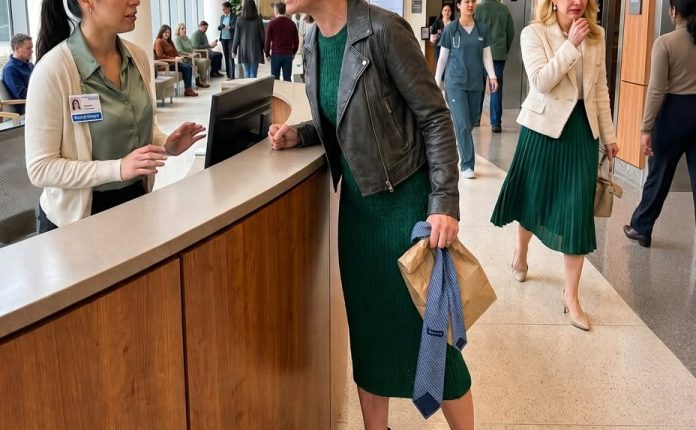
The lobby was bright, expensive, and almost unnaturally quiet. Marble floors. A reception desk. A flower arrangement taller than a child. A few residents stood near the mailboxes, speaking in low voices.
Raymond Ortega was waiting near the elevator bank. He was a broad man with a gray mustache, a navy security blazer, and the tired expression of someone who had already made a difficult decision.
“Mr. Hail,” he said. “Thank you for coming quickly.”
“Where is Lily?”
He pointed toward the far end of the lobby.
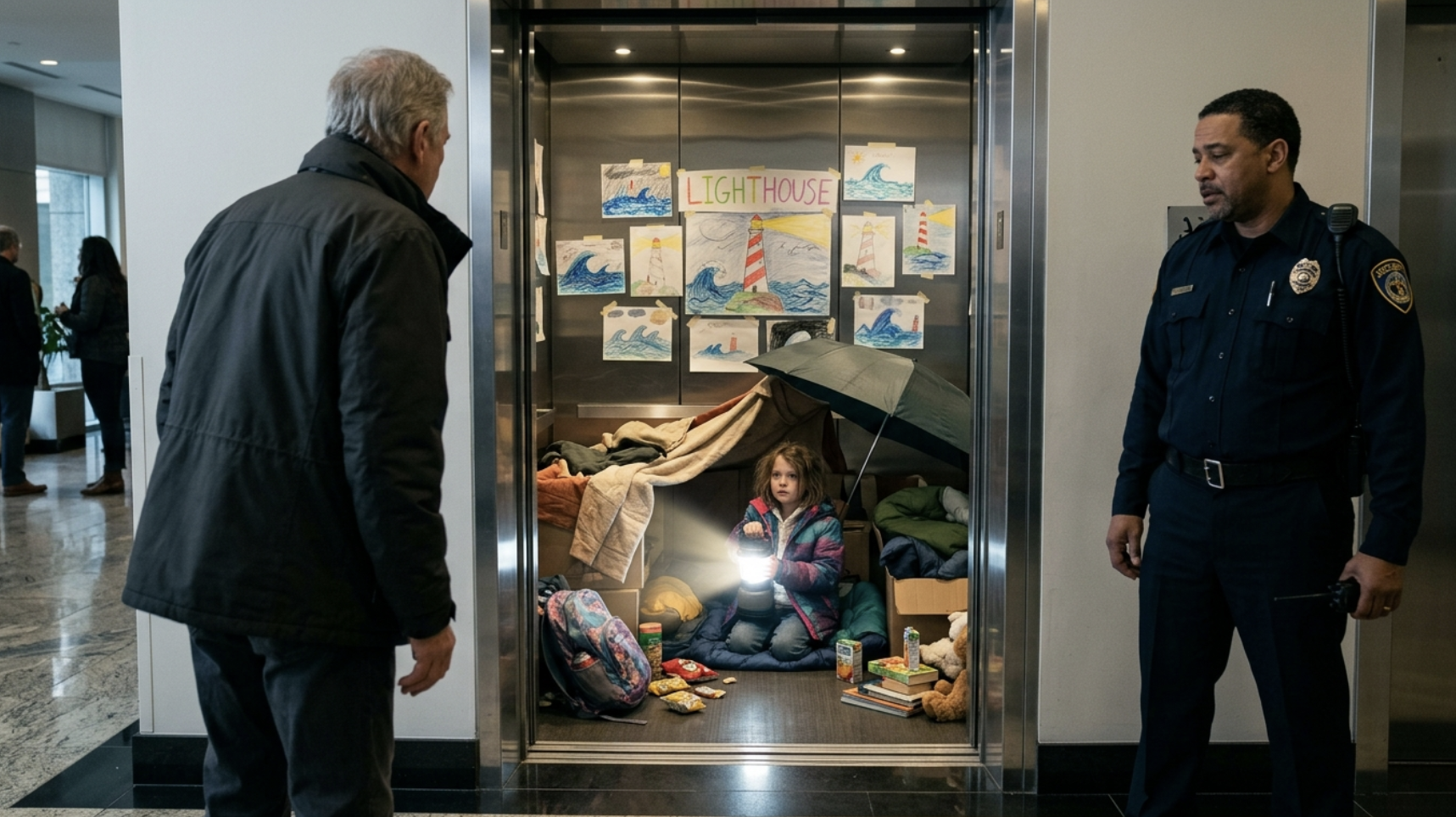
Elevator Three was open. A small orange safety cone stood in the doorway so the doors would not close automatically. Lily was sitting on the floor inside the car, pressed into the back corner with her knees drawn to her chest.
She still had her purple school backpack on.
Her hair was tangled. Her face was pale.
And there was a red mark on her left cheek.
Not a dramatic wound. Not blood. But a clear mark that should never have been there.
At her side sat Emma’s purse, her keys, and a phone with a cracked corner and a sunflower sticker.
Maggie had given Emma that sticker years ago.
I stopped walking.
“Lily,” I said.
She looked up at me.
Her eyes found mine, and she let out one long breath.
“Grandpa,” she whispered. “You came.”
I crouched at the elevator threshold, but I did not rush inside.
“Of course I came,” I said. “I will always come.”
She held up one small hand.
“Say the rule.”
My throat tightened.
“A lighthouse doesn’t chase the ships.”
“It stays where everybody can see it,” she said.
Then she crawled into my arms.
I held her carefully. She was trembling, though she was trying hard not to show it.
“Mommy didn’t go away,” she whispered against my shoulder. “Daddy said she did. He said she went to Arizona, but she’s still here. I heard her.”
I looked at Ortega.
His face changed.
I kept my voice low. “What do you mean, you heard her?”
“Daddy was talking downstairs,” Lily said. “He thought I was asleep. Mommy was crying, and he said she had to sign papers. I took Mommy’s phone when he left it on the table. I recorded him.”
She reached into the front pocket of her backpack and handed me Emma’s phone.
My hands were shaking so badly I almost dropped it.
Ortega stepped closer, but he did not touch Lily.
“I need to tell you something,” he said. “Two nights ago, I saw her on the thirty-first floor on camera. It was after three in the morning. She was barefoot in the hallway outside Mr. Whitfield’s private office suite. Mr. Whitfield came out, spoke to her, and took her back inside.”
“Did you report it?”
“I did. I reported it to our property-management office. I was told Mr. Whitfield said she had sleepwalking issues and that the family was handling it privately.”
“Who told you that?”
Ortega looked toward the reception desk.
“I do not have proof that anyone meant harm,” he said. “But I knew something was wrong. When Lily came down today, she told me not to send her back upstairs. She gave me your number from memory.”
Lily had memorized it when she was seven. I had made a game of that, too.
At the time, it had felt old-fashioned.
Now it felt like grace.
“Mr. Ortega,” I said, “please call 911.”
He already had his phone in his hand.
He made the call while I stood in the elevator doorway with Lily in my arms. I did not want her out of camera view until officers arrived. It was the only thing I could think to do.
A few minutes later, Grant appeared from the corridor leading to the executive offices.
He wore a charcoal suit, no tie, and the polished expression he used whenever he wanted a room to believe he was in control. Two employees from his company walked several steps behind him. I recognized neither man, but they had the stiff posture of people who had been told exactly where to stand.
“Michael,” Grant said, opening his hands. “Thank God. We have been looking everywhere.”
Lily gripped my shirt.
Grant’s eyes flicked to her, then to Emma’s purse on the elevator floor.
“Come to Dad, sweetheart,” he said. “You have frightened everyone.”
“Stay where you are,” I told him.
His smile stayed in place, but something behind it changed.
“Michael, she has been under a lot of stress,” he said. “Emma has gone away for a few days to rest. Lily misunderstood something.”
“Emma’s phone is here,” I said. “Her purse is here. Her keys are here. Her father has not heard her voice in ten days.”
“She left in a hurry.”
“Without her wallet? Without her phone? Without her passport?”
Grant gave a soft, patient laugh, as if I were making an unfortunate scene in a restaurant.
“She has been struggling lately. She gets overwhelmed. Lily is confused, and I do not want us frightening her further.”
“Then answer one question,” I said. “Where is my daughter?”
His eyes moved over my shoulder toward the camera mounted above Elevator Three.
“Michael,” he said, lowering his voice, “we are family. Let us take Lily upstairs and talk privately.”
“No.”
The word came out calm.
I had been afraid I would yell. Instead, I felt something settle inside me.
“No one is taking her anywhere.”
A woman near the mailboxes began recording with her phone. Another resident did the same. Grant noticed. He glanced at the building’s front doors just as two police officers entered the lobby.
Officer Elena Reyes was first through the door. She was in her forties, perhaps, with dark hair pulled back and a manner that made the room quiet without her having to raise her voice. Her partner, Officer Daniels, spoke with Ortega while Reyes came toward us.
“Who called?” she asked.
“I did,” Ortega said. “There is a child who reported being afraid to leave an elevator lobby, and there is concern about a missing adult.”
Grant stepped forward.
“Officer, I am Grant Whitfield. This is a family misunderstanding. My wife is resting out of state. My daughter has had an emotional episode.”
Reyes looked at Lily’s cheek, then at Emma’s belongings.
“Sir,” she said, “please stand over there for the moment.”
Grant’s jaw shifted.
“I own this building.”
“That does not change what I asked.”
I liked her immediately.
Reyes crouched at a respectful distance from Lily.
“Hi, Lily. My name is Elena. You are not in trouble. Can you tell me who made your cheek hurt?”
Lily looked at me.
I nodded once.
“Dad did,” she said.
Grant inhaled sharply.
“That is not what happened.”
Reyes did not look at him.
“Did you see your mother today?”
Lily nodded.
“I heard her. She was downstairs. Dad said she had to sign something. She said she wanted to call Grandpa.”
Reyes turned to me. “You said there is a recording?”
I unlocked Emma’s phone using the passcode Lily whispered to me: Maggie’s birthday.
There was a voice memo recorded two nights earlier.
Nineteen minutes.
The beginning was mostly muffled sounds: footsteps, a door shutting, Grant’s voice too low to make out clearly. Then the audio sharpened.
“She signs the refinance documents,” Grant said, “or she stays in that room until she is ready to cooperate.”
Another man asked, “What about Michael Hail’s house?”
Grant said, “Emma is on the deed. Once she signs, the house becomes collateral. The loan closes Friday.”
Then came Emma’s voice.
Weak. Frightened. Farther from the phone.
“Grant, please. I will not sign anything. Let me talk to Lily.”
The lobby became still in a way I will never forget.
Grant said, “That recording has been manipulated.”
Officer Reyes took the phone from my hand.
“Mr. Whitfield,” she said, “you are being detained while we investigate.”
That was when Grant stopped pretending.
He backed away fast, turned, and pushed through the door leading to the private parking garage.
One of the two men who had followed him stepped toward Ortega, but Officer Daniels moved between them before anything escalated. The man put his hands up and was kept in the lobby while another officer arrived.
Grant ran into the garage.
Reyes spoke into her radio. “Unit at Whitfield Tower. Adult male moving through the private garage toward the exit. Possible suspect in a missing-person investigation.”
Ortega pointed toward the security monitor at his desk.
“The garage exit has a gate,” he said. “It opens with a resident fob or a guard release. I have already locked the outbound gate.”
I watched the monitors while still holding Lily.
Grant’s black SUV stopped at the exit gate. He reached out the window with a key card. Nothing happened.
He backed up, got out, and moved toward a side pedestrian door.
Two officers entered the garage from the street side at that moment. Another appeared from the lobby stairwell.
Grant stopped.
For the first time in the nine years I had known him, he looked small.
He was not chased through a movie scene. There was no dramatic fight. No impossible stunt.
He simply looked around and realized there was nowhere left to go.
Officer Reyes reached the garage a minute later. Grant was placed in the back of a patrol vehicle while officers secured the scene.
But none of that mattered as much as Emma.
“Mommy is below the garage,” Lily whispered. “The place with pipes. Dad took her there through the service hallway.”
Ortega closed his eyes for a moment.
“There is an old records-storage suite on Sublevel Two,” he said. “It was supposed to be empty. Mr. Whitfield had maintenance work done there last month. He said it was for archived development files.”
Officer Reyes spoke to the building manager, who had just arrived from the property-management office. The manager used a master access card and led officers toward the service elevator.
I wanted to go with them.
Reyes looked at me.
“Mr. Hail, I need you to stay here with Lily. We have officers and paramedics going down now.”
“I know that building system,” I said. “I worked on those elevators before Whitfield’s company took over the management contract.”
“You can show my officer the floor plan,” she said. “But you do not enter any secured area. Understood?”
I nodded.
Lily held my hand until Officer Daniels sat with her at the security desk. Then I walked with Reyes, Ortega, the building manager, and two other officers to the service elevator.
The ride down was silent.
Sublevel Two smelled like concrete, old paper, and mechanical oil. Ortega led us past the boiler room and down a narrow service corridor. At the end was a gray metal door with a fresh electronic lock and a small camera above it.
The building manager held up his access card.
“It was not supposed to be programmed to this room,” he said.
The light turned red.
“No access,” the system said.
Reyes called for the facilities supervisor to remotely release the lock. He confirmed the door’s access history on his tablet: Grant’s executive card had opened it multiple times over the past ten days. One other card belonging to an assistant had been used twice.
The door clicked open.
Inside was not a secret dungeon. It was worse in a quieter way.
It was a storage room someone had tried to turn into a private holding space.
There was a folding cot, a water jug, a blanket, and a stack of cardboard file boxes against one wall. The overhead light was on. A small vent pushed out cold air.
Emma was sitting on the cot.
She wore the same sweater she had worn in the last photo she sent me almost two weeks earlier. Her hair was unwashed. Her face was drawn. When the door opened, she shielded her eyes from the hall light.
Then she saw me.
“Dad?”
I had not heard her call me Dad in years.
I crossed the room, dropped to my knees, and put my arms around her.
She felt lighter than she should have.
“I’m here,” I said. “Lily is safe. You are safe now.”
Her hands clutched the back of my jacket.
“Lily?” she asked.
“She found the way to get help.”
Emma began to cry then. Not loudly. Just enough for me to understand how long she had been trying not to.
The paramedics examined her in the hallway. She was dehydrated and exhausted. She had been denied normal access to her phone, her car, and the outside world. She had not been there every hour of those ten days; Grant had moved her between the executive suite, a vacant apartment he controlled, and that storage room while trying to force her to sign documents.
But she had been there long enough.
Long enough to be frightened.
Long enough to believe no one would find her.
At the hospital that night, Lily sat curled in a chair beside Emma’s bed, holding one of her mother’s fingers. I sat on the other side, watching the heart monitor rise and fall.
Around midnight, Emma woke for a few minutes.
“I’m sorry,” she said.
I leaned closer. “For what?”
“I should have told you sooner.”
“You have nothing to apologize for.”
She shook her head slowly.
“He took the money,” she whispered. “Your money. Mom’s money. I found records in his office. I found out he had used the one hundred forty thousand dollars you gave us as part of a fake investment pool. When I confronted him, he said he could lose everything if I talked.”
I did not interrupt.
“He wanted me to sign papers using your house,” she said. “He said I was already on the deed after Mom died, and that he could use my signature to secure a loan. I told him no. After that, he stopped letting me leave alone.”
“Why did you not call me?”
She looked at Lily.
“He told me he would make me look unstable. He said nobody would believe me over him. He said he would make sure Lily thought I abandoned her.”
I took Emma’s hand.
“He was wrong,” I said.
“About what?”
I looked at Lily, asleep in the chair with her backpack still at her feet.
“He forgot about the lighthouse.”
The investigation lasted far longer than the rescue.
That is the part people do not always understand. A terrible thing can happen in one afternoon. Proving every part of it takes time.
The police obtained security footage from the building. The footage showed Lily entering the elevator lobby, refusing to leave the camera’s view, and Grant trying to persuade her to come upstairs. It showed his access card opening the sublevel storage room.
Emma’s phone was examined by forensic specialists. The recording was authenticated. It had not been edited.
Financial investigators traced the money Grant had taken from me through several companies connected to his development business. They found similar contracts, similar promises, and similar missing funds. Other investors came forward. Some were retirees. Some were relatives. Some had believed they were helping finance short-term real-estate projects.
The assistant whose access card had opened the storage room cooperated with investigators after speaking with an attorney. He said Grant had ordered him to bring food downstairs and told him Emma was “resting after a breakdown.” He had believed enough of it to keep quiet until the police showed him the complete evidence.
Whitfield Residential collapsed over the following months. The company’s board removed Grant from all authority. Projects were audited. Some were sold. Some were completed under new management. The tower itself remained open, though the big gold W came down from the entrance.
Eighteen months after the day Lily called me through Raymond Ortega, Grant stood in court.
I sat beside Emma. Lily did not have to attend every hearing. A child advocate and the prosecutor made sure of that. When she did speak, it was in a recorded, child-friendly setting with Emma and a trained interviewer present, not in a crowded courtroom full of strangers.
Ray Ortega testified.
He explained why he had not forced Lily out of the elevator lobby before I arrived.
“She was afraid,” he said. “But she had chosen the one place she could be seen. She was asking for one person she trusted. I believed removing her by force would make her feel trapped again, and I had no reason to think her grandfather was a danger to her.”
The prosecutor asked, “What did you do instead?”
“I stayed with the cameras. I called her grandfather. Then I called the police.”
That was all.
No speech. No grand performance.
Just the truth.
Grant’s attorney tried to call it a family conflict. He suggested the recording lacked context and that Emma had misunderstood business discussions.
But the records did not misunderstand.
The building access logs did not misunderstand.
The surveillance footage did not misunderstand.
And neither did the loan documents Grant had tried to force Emma to sign.
Grant was eventually convicted on state charges connected to Emma’s unlawful confinement and Lily’s mistreatment, as well as financial crimes tied to the broader scheme. The federal fraud case was resolved afterward through a plea agreement.
His sentence was substantial. So was the restitution order, though I knew it would take years for victims to receive what they were owed.
I did not feel joy when the judge spoke.
I felt tired.
Relieved, maybe.
Mostly, I thought about how much damage one man had done because he believed charm could replace character.
A little more than a year after the conviction, I received a restitution check for the full amount I had given Grant: one hundred forty thousand dollars, plus a portion of the interest authorized by the court.
I held the envelope at my kitchen table for a long time.
That money had once felt like Maggie’s last gift to us. Then it had become a reminder of how badly I had failed to see what was happening to Emma.
In the end, I divided it three ways.
One part went into Lily’s education fund.
One part went to Emma, though she argued with me about taking it until I reminded her that rebuilding a life costs more than people admit.
The last part helped start a small community program with Ray Ortega.
We called it the Maggie Hail Lighthouse Project.
It was not a grand foundation with a gala dinner and people in tuxedos. It began with two folding tables at the public library, a few school counselors, and flyers printed at a local copy shop.
We taught children simple safety ideas: know a trusted adult’s phone number, move toward visible public places, ask employees for help, and keep talking until someone listens.
We taught parents how to hear the first quiet question instead of waiting for a child to say something perfect and clear.
Ray came to schools with us whenever his schedule allowed. He had turned down an offer to become head of security for the new ownership group at Whitfield Tower. Instead, he took a job with the city’s public-facilities department, where he could work regular hours.
“I’ve spent enough time protecting expensive buildings,” he told me once. “I’d rather protect people.”
Emma moved into my house while she recovered. At first, she slept in Maggie’s old sewing room because it was the room farthest from the front door and had the smallest windows. Therapy helped, but healing did not move in a straight line. There were nights she woke from dreams and checked that Lily was breathing. There were days she could not stand the sound of an elevator bell in a store.
But little by little, she came back to herself.
She found work with a nonprofit that helped older adults understand investment contracts before they signed them. She started wearing bright colors again. She laughed more often.
Every Sunday, the three of us made blueberry pancakes.
Lily turned ten.
She grew taller. Her front teeth came in straight. She joined the school robotics club and announced one afternoon that she wanted to become an engineer.
“What kind?” I asked.
“The kind who makes elevators safer,” she said.
“That sounds right.”
One Sunday after breakfast, I was washing dishes while Emma packed leftovers into containers. Lily came into the kitchen and tugged at my sleeve.
“Grandpa?”
“Yeah, kiddo?”
“When I was in the elevator lobby that day, I was scared. But not the whole time.”
I turned off the faucet.
“Why not?”
She looked up at me with the same serious face she had made at six, when we first talked about lighthouses.
“Because I knew you would come.”
My chest tightened.
“I did not even wonder if you would,” she said. “I just knew.”
I dried my hands on a dish towel and knelt beside her.
“I will always come if I can,” I said.
She nodded.
Then she put her arms around my neck.
Behind her, Emma stood at the kitchen counter with tears in her eyes. She did not hide them. She did not have to.
The world had not become perfect. It never does.
Maggie was still gone. Emma still had hard days. Lily still sometimes checked the locks before bed.
But there were pancakes on the table. There was sunlight across the kitchen floor. There were three people in that house who had learned, painfully, that being seen can be the beginning of being saved.
And every time I passed a lobby, a school office, a grocery-store counter, or an elevator with its camera blinking quietly in the corner, I thought of Lily.
A lighthouse does not chase ships.
It stays where someone can see it.
Disclaimer: This story is fictional and created for entertainment purposes only. Any names, characters, places, or events are fictitious or used fictitiously. No real person or organization is intended to be portrayed.