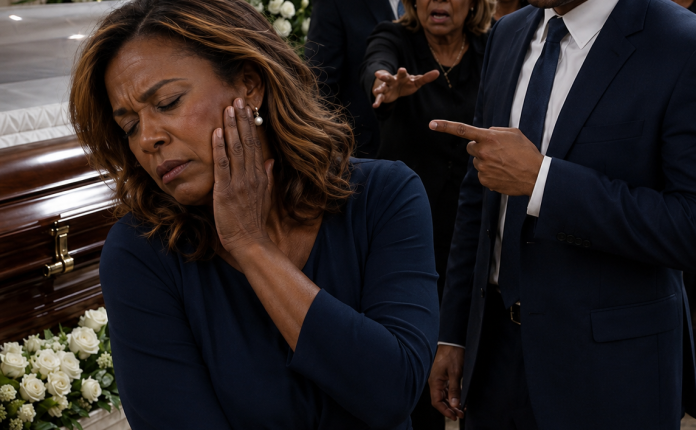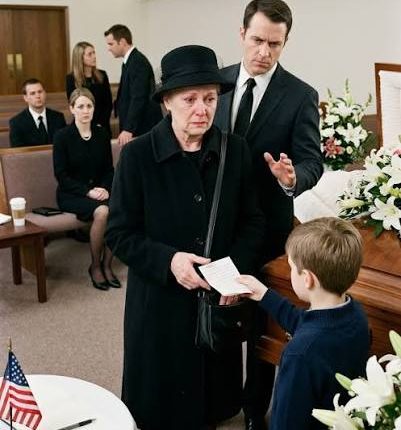
My daughter had been dead for ten years, yet somehow, this stranger had been carrying her final words all that time.
“Who are you?” I demanded again.
“My name is Patricia Vance.” The surname meant absolutely nothing to me. But when Leo started jogging back up the hill, card in hand, Patricia looked at him and covered her mouth to stifle a sob.
It wasn’t surprise at seeing a child. It was recognition.
“Who is his father?” I asked, my voice dangerously low.
Patricia whispered, “My son. Julian.”
The world narrowed to a pinprick. Ten years of protecting Leo from uncertainty had given me a fierce instinct to soften every blow, but this was too massive to cushion with a lie.
When Leo arrived, breathless, asking who the woman was, I told him the truth: she was someone who knew his mother.
Patricia managed to tell Leo a few harmless truths—that Sarah loved terrible horror movies and put hot sauce on her scrambled eggs. It bought us time. When Leo stepped away to place his card on the stone, I turned to Patricia.
“You’re coming home with us. You carried my daughter’s letter for a decade. You can sit at my kitchen table while I read it.”
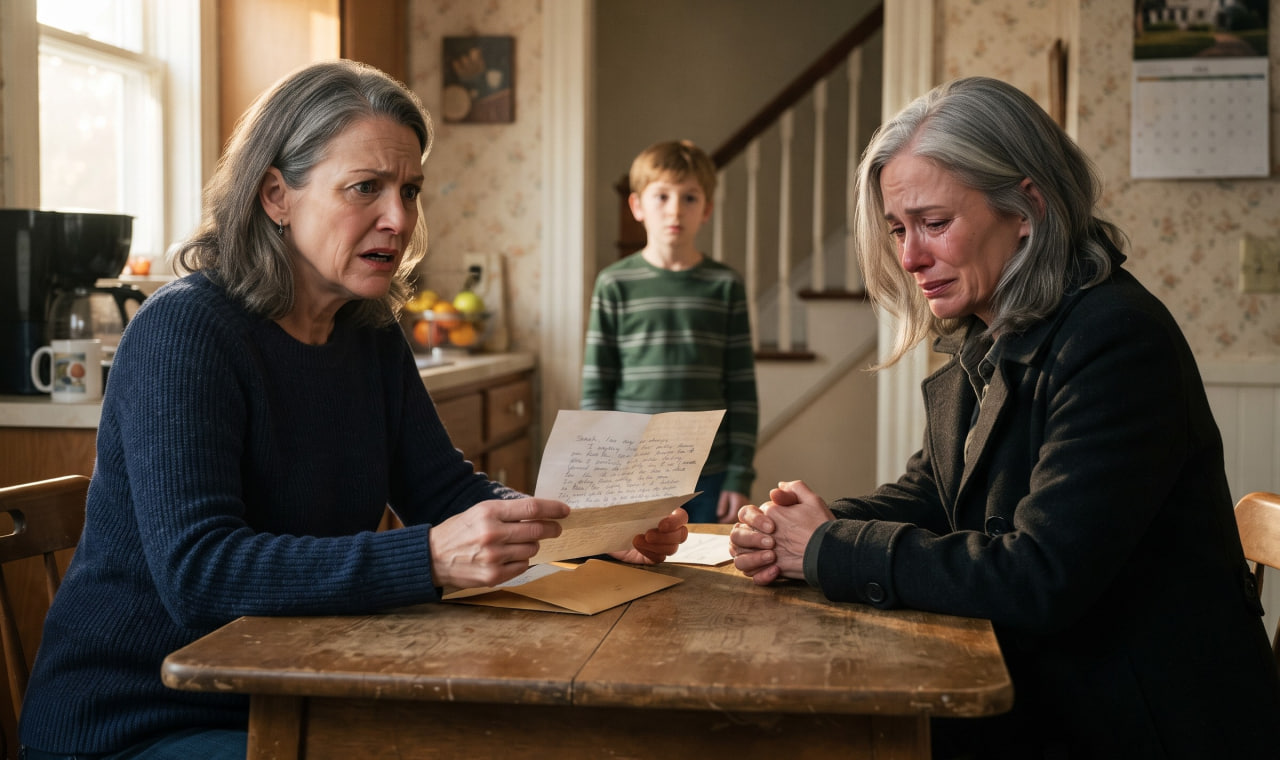
At home, after sending Leo upstairs, I sat across from Patricia. The envelope’s seal was brittle.
Inside were six pages. The first line stopped my heart: Mom, if Patricia is giving you this, then I either lost my nerve or something happened before I could tell you myself.
Leo’s father is Julian Vance. And you need to know why I kept his name from you.
The letter shattered every assumption I had made. I had spent ten years imagining an older, careless, or cruel man who had abandoned my daughter.
Instead, the letter painted a picture of two terrified nineteen-year-olds. Sarah had met Julian at a bookstore in Cambridge where she worked weekends.
They dated quietly for months, largely because Julian’s father, Arthur Vance—a wealthy, domineering real estate developer—controlled every aspect of his son’s life and despised Sarah for her working-class background.
When Sarah got pregnant, Julian wanted to do the right thing.
He told his parents first. And that was when everything fell apart.
According to the letter, Julian vanished. His phone was disconnected; his social media disappeared.
When Sarah went to the Vance estate, Arthur told her Julian had transferred schools and wanted nothing to do with her.
He even offered her twenty-five thousand dollars to sign a non-disclosure agreement and walk away.
Sarah refused.
Looking up from the pages, I demanded to know where Julian had actually been.
Patricia, weeping at my table, confessed the horrifying truth: Julian had suffered a severe psychological breakdown after a vicious argument with his father over the pregnancy.
He had attempted suicide and was placed in a long-term psychiatric facility in Vermont.
Arthur covered it up, lying to Sarah, and lying to Julian by telling him Sarah had ended the relationship.
Patricia had found Sarah’s ultrasound in Arthur’s desk months later.
She secretly met with my daughter, giving her Julian’s facility address.
They exchanged hidden letters. They even managed two phone calls before Sarah developed severe preeclampsia and was hospitalized.
“You knew before she died?” I asked, my voice vibrating with rage.
Patricia nodded. “Arthur stopped me from going to the hospital.
He threatened financial ruin. After she died, he told Julian the baby had died, too. I didn’t correct that lie until months later. I failed both of them.”
I wanted to throw her out. But then I thought of Leo upstairs. “Where is Julian now? Does he know he has a son?”
“He’s alive,” Patricia whispered. “And he’s known for nine years.”
That answer was somehow worse than the lies. Nine years. He had known, and he had never come.
Patricia showed me a recent photograph of Julian—tall, thin, with Sarah’s old woven bracelet still around his wrist.
She explained that his mental health recovery had been agonizingly slow, compounded by the grief of losing Sarah.
He had been terrified that I would blame him for her death, terrified that his history of depression would harm his son.
He had even driven to our town on multiple occasions, sitting in the bleachers at Leo’s Little League games, only to leave before approaching us.
“Why now?” I asked.
“Because Arthur died six months ago,” Patricia said. “And Julian told me if I didn’t give you the letter by Sarah’s birthday, he was going to knock on your door himself. He’s at a hotel three miles from here.”
I realized in that moment that I wasn’t responsible for deciding the next ten years in a single afternoon. I only had to choose the next safe step.
I told Patricia to leave. I demanded medical and psychiatric records to verify their timeline, a legal DNA test, and a meeting with Julian—without Leo present—in the office of Leo’s therapist, Dr. Elise Sterling.
The next few weeks were a blur of documentation and cautious maneuvering. I hired a sharp family lawyer named Rachel Thorne to help me navigate the incoming storm.
The medical records Patricia provided matched the timeline. The DNA test confirmed a 99.99% probability of paternity.
When I finally met Julian Vance at Dr. Sterling’s office, he was shaking. He didn’t offer excuses, which was the only reason I didn’t walk out.
When I asked him why he let Sarah go through her pregnancy alone, he showed me a letter Sarah had sent him at the facility: Julian, if you leave treatment because of me, I will be furious.
Get stable. I am safe. Mom is here even if she doesn’t know about you yet. We have time.
My daughter had believed they had time. That realization nearly broke me.
Julian didn’t ask for custody. He wanted a relationship, if Leo was willing. He submitted to every rule I laid out.
Telling Leo the truth was the hardest conversation of my life.
We sat in Dr. Sterling’s office, and I handed him the DNA results.
I watched his ten-year-old brain try to process that the father he thought had abandoned his mother was actually a man who had been shattered by illness and manipulated by a cruel grandfather.
“He knew for nine years?” Leo asked, his voice cracking. “Then why wasn’t I enough to make him come?”
I pulled him close. “You were always enough. Julian made choices because he was terrified and unwell. None of those things happened because there was anything wrong with you.”
Their relationship began with a single, cautious letter. Julian wrote about his terrible baseball skills, his love for building model bridges, and his hatred of black olives.
Leo wrote back: I like baseball. I hate olives too. I’m mad at you. Julian’s response was simple: You have every right to be.
When they finally met, there was no cinematic, tearful embrace. They sat awkwardly in the therapist’s office. Leo stared at Julian and finally muttered, “You do have my eyebrows.” Julian laughed, choked on a sob, and the ice slowly began to crack.
Building trust took years. It was forged in mundane moments—Julian showing up exactly on time for every scheduled visit, Julian sitting patiently while Leo gave him the silent treatment, Julian teaching Leo how to construct balsa-wood bridges.
It wasn’t just Julian who had to adjust; I had to learn how to share my grandson. I had to stop interrogating Leo after his weekend visits, treating Julian like a careless babysitter rather than a legally recognized father.
READ THE NEXT PART: 👇👇
PART 4 – My Daughter Died Giving Birth at 18—10 Years Later, a Stranger Brought Me Her Final Letter