At 2:15 every afternoon, my son’s wife waited for me to fall asleep and wrote the time on my calendar in red. So on Tuesday I lay down in the house my husband paid off in 2003 and never slept a wink.
At 2:40, I heard a woman I didn’t know whisper, “Is she out?”
“Like a light,” Jolene said.
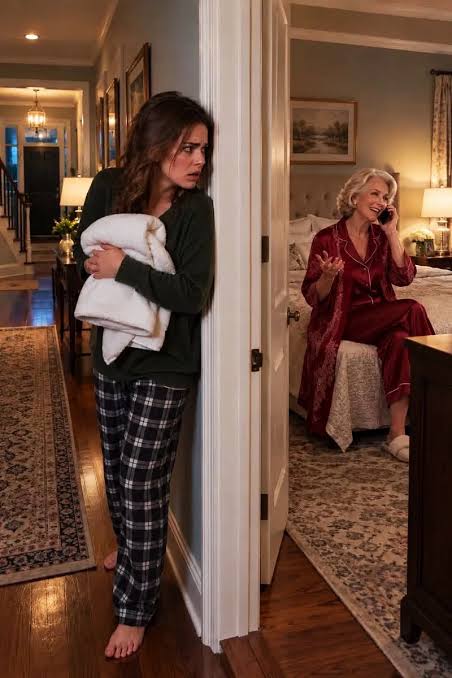
When I opened my eyes a slit, she was bent over my nightstand. She wasn’t after my pills. She was easing my reading glasses off their beaded chain, careful as you please.
I shut my eyes again and kept my breathing slow. I had been a nurse for thirty-one years at the hospital in Sparta. I knew what sleep looked like from the outside, and I knew how still I had to be to let someone think I was in it.
Six weeks earlier, I had gotten a new knee. My son, Dwayne, drove a propane truck all over White County, and his wife, Jolene, offered to stay with me on weekdays.
“Mama needs somebody,” Dwayne said. “And Jolene’s got the time.”
I was grateful. She made my coffee, drove me to therapy, and fixed a chicken casserole that wasn’t half bad. I liked having someone nearby while I was learning how much I could do on the new knee.
Every day, though, she asked, “What time do you lie down, Miss Joanne?”
The first time, I thought she was just trying to plan around my rest.
She asked again the next day, and again after that. Then I noticed 2:15 written in red on Tuesday’s square of my kitchen calendar. Nothing else was written there.
I asked her about it. She said it helped her keep track of when I usually rested. It was a reasonable answer, and I let it be one.
On Monday night, she set a brochure for Cumberland Manor by my coffee cup.
“Dwayne thinks it’s time you had help full-time,” she said. “He just can’t say it to you.”
She patted my hand. “They’ve got a garden, and bingo.”
I looked down at the brochure. “Did he tell you that?”
“Well, he worries,” she said. “He doesn’t want you trying to manage everything by yourself.”
“I manage my therapy.”
“That’s not what I mean. It’s just a lot for one person.”
I didn’t answer. I had spent years caring for people who needed help, and I knew help could be a kindness. I also knew what it felt like when someone started making choices on your behalf and called it kindness.
That night I lay awake looking at the ceiling Vance had painted twice because I didn’t like the first white.
“Leave it white,” he had said. “Nobody looks at a ceiling but you.”
The house and the fifty-eight acres behind it were all I had left of him. A developer out of Chattanooga had offered $740,000 for the land last spring. I told him no before he got out of his truck. Jolene had been standing on the porch when I did.
At two in the morning, my thoughts kept turning to Maisie and Hunter. If I crossed their mama, she could keep them from me. I could see them at Christmas, maybe, across a room. I almost let it go. I’m ashamed to say that fear had me nearly accepting the brochure as easier than a fight.
But Tuesday at 2:05, I made one phone call from my bedroom. Then I put my phone face-down under my Bible on the nightstand, lay down on top of the covers, and shut my eyes.
At 2:40, I heard my front door. Jolene came into my room with another woman. I recognized the second voice once she spoke again: Shelby Gann, Jolene’s cousin, a notary at the bank downtown.
“She can’t read a thing up close without these,” Jolene whispered.
That was true. I couldn’t.
They went back out to my kitchen table. I heard papers moving and the snap of a stamp case opening.
“It’s just a quitclaim,” Shelby said. “She signs, I stamp it, you file it Wednesday.”
“And the land goes in both our names,” Jolene said. “Mine and Dwayne’s.”
“Does Dwayne know?”
Jolene laughed. “Dwayne wouldn’t ask his mama for a dime if the bank was hauling off his truck.”
“Well, it about is,” Shelby said.
“Two months behind on the house note,” Jolene said. “And she’s sitting on three-quarters of a million dollars of weeds.”
Weeds. My husband’s hayfield.
I lay there with my fists balled under the quilt. Jolene said that when I woke up groggy, she would tell me the paper was a Medicare form for my knee. I would sign whatever she handed me.
Then I would go to Cumberland Manor, and they would sell the land to the Chattanooga people by Easter.
Shelby asked what Jolene would do if I fought it.
“Who’s gonna believe her?” Jolene said. “She’s sixty-eight, she’s on pain pills, and she can’t find her own glasses.”
Shelby giggled. I felt that giggle right in my chest.
I thought of Maisie’s gap-tooth grin. Maybe Jolene was right, and nobody would believe an old woman in a housecoat. Maybe I would lose my grandchildren over a hayfield. Then I pictured Vance on that tractor, sunburned, waving at me from the far fence.
I sat up. My new knee popped. The kitchen went quiet.
I found my slippers and walked down my own hallway slowly, one hand on the wall. Jolene was standing at my table with a pen in her hand. Shelby had the stamp open and a paper squared up in front of my chair.
Jolene’s face changed before she spoke.
“Miss Joanne,” she said. “You’re up early, hon. This is just the Medicare form.”
I held up my hand. “Before your cousin stamps anything, you ought to know who’s been listening since you came into my bedroom.”
Shelby put the stamp down. Jolene held the pen over the paper, then lowered it.
“You’re confused,” she said. “You were asleep.”
“I heard you say the paper was a quitclaim. I heard you say my land would go in your name and Dwayne’s.”
“It was just an idea,” Jolene said. “You need to sit down. Your knee, “
“Don’t tell me what I heard.”
Shelby glanced at Jolene. “I haven’t stamped anything.”
I looked at the page. It was a quitclaim deed, prepared to put the land in Jolene’s and Dwayne’s names. The signature line for me was blank.
“Is that what you brought into my room?” I asked.
Jolene’s voice softened again. “It was to make things simpler. You wouldn’t have to worry about the property.”
“Then why take my glasses?”
She didn’t answer. Shelby pressed the stamp case closed.
“Joanne, I can’t notarize a signature you haven’t made,” she said. “And you haven’t asked me to do this.”
Jolene snapped, “You said you’d help me.”
“I said I would notarize a signature. I didn’t say I would tell her it was a Medicare form.”
The fear that I would be alone against both of them had been wrong. But I didn’t want Shelby’s discomfort to become my proof. I needed Dwayne to hear what his wife had planned, from all three of us, while the paper was still on the table.
At 2:05 I had called him. I had told him to come home and listen before he decided I was confused. I had not told him the details. I wanted him to hear them himself.
Jolene looked at me. “You called Dwayne?”
“Yes.”
“You’ve put him in the middle of this.”
“He is named on that deed.”
She looked back at Shelby. “You don’t understand. We were trying to help.”
“I know what you said,” I replied. “You said you’d get me to sign by calling it a Medicare form.”
For a few seconds, she had no answer. Then she said, “The house note is behind. I was trying to keep us from losing everything.”
“By taking my land?”
“We could have paid it off. You have more land than you need.”
“That isn’t the same as asking me.”
She pushed the pen away. “You wouldn’t have listened.”
The admission was quiet. It was enough.
Dwayne came in while Shelby was still at the table. He looked first at me, then at Jolene, then at the paper.
“What is this?” he asked.
“Your wife was about to put my land in your names,” I said. “She planned to tell me it was a Medicare form.”
Jolene shook her head. “It wasn’t like that.”
Dwayne picked up the paper and read it. “You said she agreed to this?”
“I said we could talk to her.”
“You told Shelby I would sign whatever you put in front of me.”
“I thought it was the only way to get you to see the problem.”
He turned to his wife. “You told me this was about helping Mama recover.”
“It is. And the house note is two months behind. You know that.”
“I know we’re behind. I didn’t ask her for her land.”
“You didn’t have to. We could have handled it.”
Dwayne set the paper back down. “No. You can’t handle something that isn’t ours.”
Jolene’s mouth tightened. “So she’s just supposed to sit on all that land while we lose the house?”
“That’s not her decision to fix for us,” he said.
I looked at my son. The part of me that wanted to reach for him was still there. So was the part that had heard his wife laugh about my pills and my eyesight. I couldn’t make one part erase the other.
“Did you know she was taking me to Cumberland Manor?” I asked him.
“No,” he said. Then he looked at Jolene. “You said you were showing her a brochure.”
“I was trying to get her to consider help.”
“Not like this,” I said.
Jolene crossed her arms. “You make it sound like I was stealing from you.”
“You brought a deed into my house and planned to disguise it as a Medicare form.”
She stared down at the page. Shelby stood beside the table, her stamp case shut.
Dwayne pushed the deed toward Jolene. “You’re not filing this. You don’t have her signature, and you don’t have her permission.”
“I wasn’t going to file it without, “
“Stop,” he said. “You just told us why you took her glasses.”
Jolene looked at him, waiting for him to soften. He didn’t.
He told her she could no longer stay at my house to help me. Then he gathered the paper and handed it back to her.
“She can decide who helps her,” he said. “We can deal with our own house note ourselves.”
Jolene started to argue, but there was nowhere for the argument to go. Shelby had heard her plan. Dwayne had read the deed. I had heard the rest from the bed where she thought I was sleeping.
Shelby left without using her stamp. Jolene went with Dwayne. Before she walked out, she said I was making a mistake.
“Maybe,” I said. “But it will be mine.”
When the door shut, the land was still mine. The deed was unsigned and unfiled. My son knew why his wife had taken my glasses, and he had told her she could not use my home that way again.
I called it a day and kept the calendar where it was. I would decide when to lie down.