Robert’s voice came out of the recorder as if it were echoing from the bottom of a grave I had spent eleven years visiting. “I didn’t sell him. I just handed him over. The debt belonged to Lauren.”
Deputy Inspector Ramirez paused the audio before I could jump to my feet. I don’t know what expression was on my face, but the social worker slid a chair toward me as if she had seen countless parents break down in the exact same way.
“My wife didn’t have any debts,” I said. My voice sounded hoarse, detached.
Ramirez didn’t argue. She opened another file and placed copies of bank deposits, forged signatures, and loans under Lauren’s name on the table, along with a photo of Robert entering an underground casino in Orlando years before the trip.
“That’s what he’s trying to say to protect himself—that the debt belonged to your wife,” Ramirez said. “But the financial transactions are tied directly to him. He used her identification and forged her signature.”
I stared at Lauren’s name on papers she would have never signed. My wife, who saved grocery receipts in a little box and worried if we owed two hundred dollars on our electric bill, was listed as a debtor to people capable of stealing children. I felt a cold, deep rage settle in, far worse than any urge to scream.
“Does Matthew know?” I asked.
The social worker answered softly. “He knows his name is Matthew, even though they called him something else for years. He knows he was separated from his family. He doesn’t know all the details yet, and we highly recommend not pressuring him.”
I had found him alive, and yet I wasn’t allowed to hug him. That was a completely different kind of cruelty.
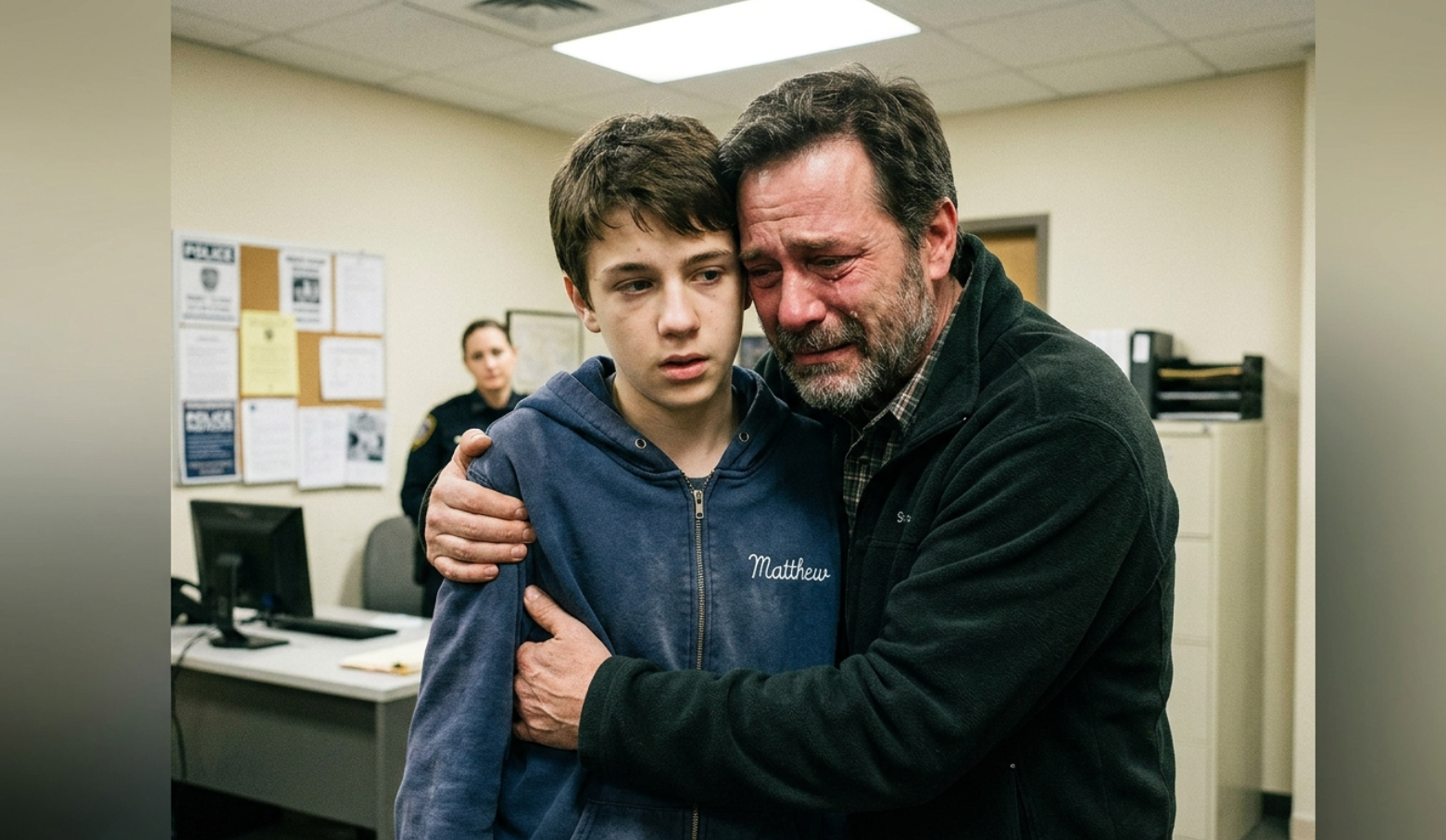
I watched him through the glass first. The boy was wearing the jacket even though the air in Miami was heavy and humid. He clutched it against his chest with both hands as if it were a shield. Ramirez explained that he went by Matty because that was how they registered him on the fake documents. But when one of the agents found the jacket and read the embroidery, he had whispered, “That’s the name a lady used to call me in my dreams.”
I had to close my eyes. Lauren hadn’t gone crazy. She had heard him because a part of her son was still calling out to her.
When they finally let me inside, I didn’t rush toward him. They had asked me not to beforehand. No sudden movements. No demanding “I’m your dad.” No touching him without permission. I walked in with my hands visible, the way you would approach a wounded animal.
He looked up. His eyes belonged to Lauren. It completely unraveled me.
“Hi,” I said. “I’m Daniel.”
He stayed quiet. He scanned my face, my hands, my shoes, looking for a lie.
“They told me you believe I’m your son.”
I swallowed hard. “I don’t want to force you to believe anything today. I just came because that jacket was embroidered by my wife. Your mom.”
His fingers tightened around the collar of the jacket. “I don’t have a mom. They told me I was abandoned.”
I felt something break behind my ribs. “No. We looked for you every single day. Your mom searched for you until her heart couldn’t take it anymore.”
He didn’t cry. He went rigid, as if crying were dangerous. “Did she die?”
I nodded. I couldn’t sugarcoat it. “A year after we lost you.”
Matthew—or Matty—looked down. “I used to dream about a woman telling me not to let go of the jacket. I thought it was because I was crazy.”
I sat across from him, leaving plenty of space between us. “You weren’t crazy. You were remembering love.”
The social worker looked away. I wanted to look away too, but I couldn’t. If I blinked for too long, I felt like he might disappear all over again.
The DNA test would take hours, maybe a day, but my body already knew. The scar on his eyebrow. The birthmark on his shoulder. The way he pressed his lips together when he tried not to shake. He was my son, and yet he wasn’t. He was the six-year-old boy who vanished in Miami and the seventeen-year-old youth who had survived on an isolated property where nobody called him by his real name. There was no clean way to bridge those two lives.
Ramirez shared what she could. The property outside Orlando was registered as an agricultural business. In reality, they had found minors and young adults with fake birth certificates—some used as forced labor, others moved between different facilities. Matthew had tried to escape twice. The second time, they beat him and took everything from him except the jacket, because he had buried it underground for weeks to hide it.
“Did Robert go there?” I asked.
Ramirez took a deep breath. “Yes. Not constantly, but there are records of payments. And there’s something else.”
She pulled out a grainy surveillance photo from the resort eleven years ago. In the image, Robert was walking hand-in-hand with Matthew toward a service corridor, not the kids’ club area. Walking right behind them was a man in a hotel uniform.
“The report about him drowning in the ocean was entirely fabricated afterward.”
I felt sick to my stomach. I remembered Robert crying on the beach, beating his chest, repeating, “He let go of my hand.” I remembered how Lauren embraced him even through her own blinding grief, telling him it wasn’t his fault. He let a grieving mother comfort the very man who had just handed her son over to strangers. It was monstrous. No words existed to describe it without setting my own mouth on fire.
I didn’t sleep that night. I stayed in a chair at the station with a cold cup of coffee, waiting for the DNA results. Matthew slept in a secured room. Before they closed the door, he asked me if he could keep the jacket.
READ THE NEXT PART: 👇👇
PART 4: They Said the Ocean Took My Son—11 Years Later, He Came Home