The next morning, I woke before the children. A narrow stripe of sunlight had crept through the motel curtains, illuminating dust floating above the carpet. My neck hurt from sleeping almost upright against the wooden headboard, and my eyes felt swollen and gritty.
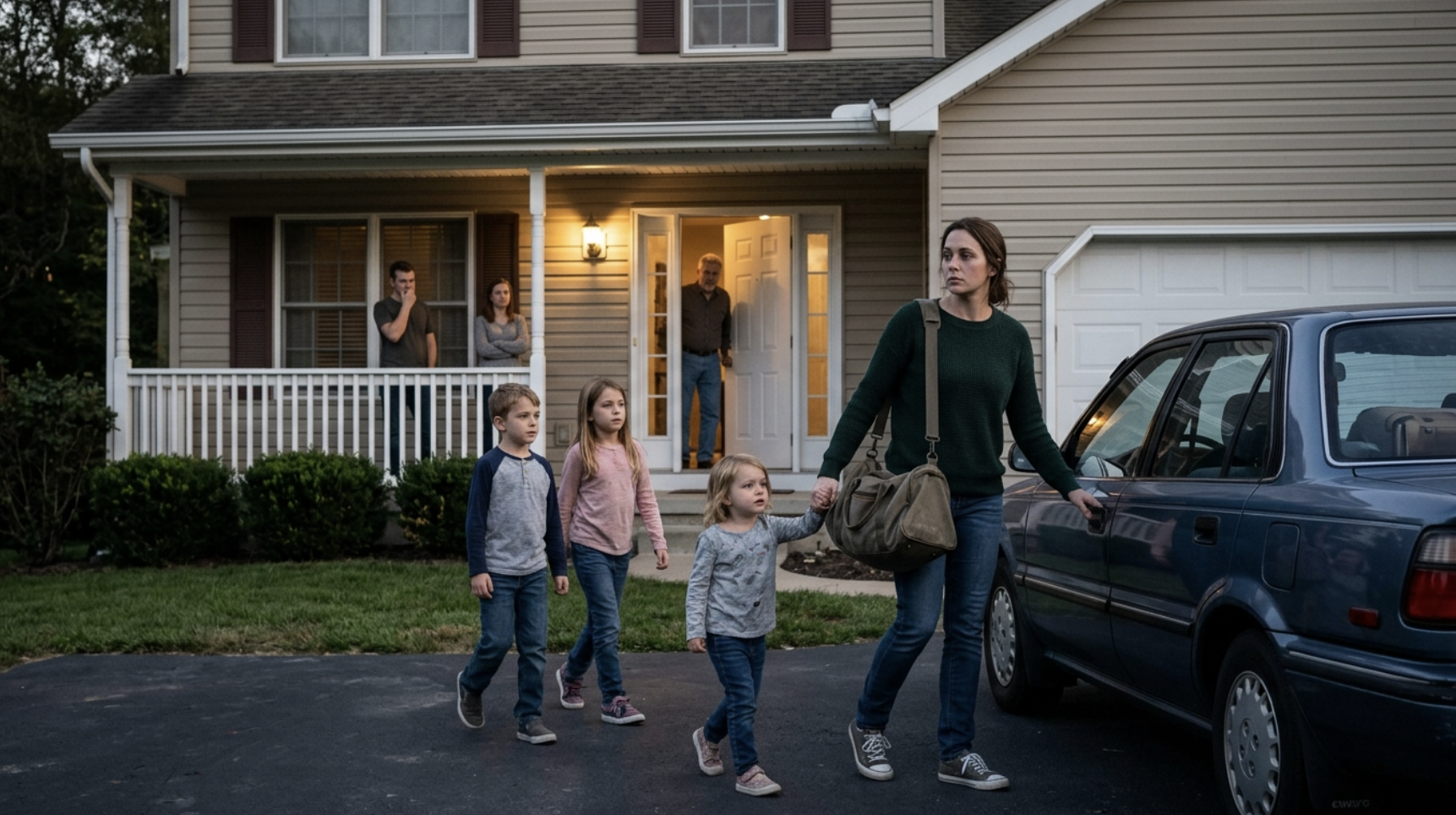
For a few seconds, I didn’t remember where I was. Then I saw the duffel bag beside the dresser and heard a toilet flush in the adjoining room. The memories came back in an instant: my father’s expression, Kevin’s laughter, Jessica’s accusation, and the soft, final click of the front door.
I reached for my phone.
The bank balance was still there. The transfer had gone through. No angry messages from Mark had arrived overnight, although his silence made me more nervous than I wanted to admit. I opened our joint account again and stared at the figures, trying to calculate how many days I could afford to stay in a motel.
There was enough for a little while. Not enough to begin a new life.
My phone rang at 7:16.
Mom.
I sat up so quickly that the blanket slipped to the floor. A small, hopeful thought rose in me before I could stop it. Maybe she had spent the night arguing with Dad. Maybe she had finally understood what it meant to send her daughter away with three children and nowhere to go.
I answered.
“Hello?”
“Where are you?”
Her voice was cautious, almost businesslike.
“At a motel.”
“Oh, Sarah.”
The disappointment in those two words made my stomach tighten. I waited for her to ask which motel, whether the children had slept well, or whether I needed anything.
Instead, she sighed.
“Your father was very upset last night.”
I closed my eyes.
“Mom, he wouldn’t let us stay.”
“He thought you should go home and settle things with Mark.”
“There were two empty bedrooms.”
“You know how your father feels about divorce.”
“I’m not divorced.”
“That’s not what I meant.”
I got out of bed and walked into the bathroom, shutting the door quietly. The children were still asleep. I didn’t want them hearing another conversation in which their need for a safe place became an inconvenience.
“Mark had an affair for almost a year,” I said. “He lied to me every day. He brought another woman into our marriage while I was raising his children.”
“I’m not defending what he did.”
I leaned against the sink. The faucet dripped at regular intervals, each tiny sound suddenly irritating.
“Then what are you defending?”
There was a pause.
“Marriage is difficult, Sarah. People make mistakes. You have three children. You can’t make decisions based only on how hurt you feel.”
I stared at my reflection. My hair was tangled, my face pale, and there was a faint crease on my cheek from the pillowcase.
“How hurt I feel?”
“You know what I mean.”
I thought about the previous evening. My father’s hand on the door, my brother’s laughter, my sister telling me to stop being selfish. I had arrived at that house hoping my family would understand the difference between a marital disagreement and the collapse of trust.
Apparently, that distinction mattered only to me.
“Did Dad ask you to call?”
Another pause.
“He thinks you should go back before things get even more complicated.”
“They became complicated when he closed the door.”
I heard my mother draw a breath, as if she were preparing another careful explanation. I didn’t wait.
“I have to go.”
“Sarah, don’t hang up on me.”
But I ended the call.
For a moment, I stood motionless in the bathroom. I wanted to cry. I wanted to call my mother back and make her listen until she finally understood. I wanted to ask why a daughter who had always answered their calls, attended every family gathering, and helped whenever someone needed something could suddenly become so easy to dismiss.
Instead, I washed my face with cold water and returned to the room.
Noah was sitting on the edge of the bed, rubbing his eyes.
“Are we going home today?”
I sat beside him.
“Not to the old house.”
He looked down at his socks. “Is Dad mad?”
“Your dad and I have things to work out.”
“Did Grandpa say we couldn’t stay?”
The question caught me off guard. I glanced toward Chloe, who had opened her eyes but was pretending to sleep.
“Yes,” I said after a moment. “He did.”
Noah absorbed that quietly. Then he asked whether there was cereal at the motel breakfast counter.
I told him there was.
It was an ordinary question, and I was grateful for it.
An hour later, we were eating toast and scrambled eggs beneath fluorescent lights in a breakfast area that smelled of burnt coffee. The children argued gently over the last orange juice carton. I watched them and tried to keep my face relaxed.
Chloe barely touched her food.
“What’s wrong, sweetheart?”
She shrugged.
“Nothing.”
“You can tell me.”
She pushed a piece of toast around her plate.
“Grandpa doesn’t like us anymore?”
My throat tightened.
“Of course he likes you.”
“Then why didn’t he let us stay?”
I looked at my daughter. She had inherited my habit of studying people’s faces before deciding whether to speak. It was a habit I wished she hadn’t needed to learn.
“Sometimes grown-ups make decisions that hurt people. That doesn’t mean you did anything wrong.”
She nodded, although I could tell she wasn’t convinced.
I reached across the table and covered her hand with mine.
“Listen to me. None of this is your fault. Not what happened with Dad, not what happened at Grandpa’s house, and not where we’re sleeping right now.”
Her fingers curled around mine.
“Okay.”
It was the first time that morning I felt able to breathe normally.
After breakfast, I called the dental office where I worked. My manager, Denise, answered on the third ring. She sounded surprised when I explained that I needed to rearrange my schedule for a few days.
“Is everything all right?”
“My marriage is ending,” I said.
The words sounded unfamiliar, even though I had been thinking them for weeks.
Denise went quiet.
“Oh, Sarah. I’m sorry.”
I explained the situation without mentioning the porch or my mother’s call. Denise listened, then offered to let me take a few days off if I needed them.
I declined the full break. I couldn’t afford to stop working.
“Then we’ll figure out the schedule,” she said. “You don’t have to explain every detail.”
That simple kindness nearly undid me.
By noon, I had found a furnished apartment above a laundromat on the edge of town. The landlord showed me two small bedrooms, a narrow kitchen, and a living room with a faded sofa. The windows rattled when a truck passed. The hallway smelled faintly of detergent and warm metal from the machines downstairs.
It wasn’t beautiful. It wasn’t what I had imagined for my children.
But it had a lock on the front door, and the landlord could hand me the keys that afternoon.
I signed a three-month lease.
When I carried the duffel bag upstairs, Liam insisted on holding one handle. Noah ran ahead to inspect the bedrooms. Chloe stood near the kitchen counter, looking at the bare walls.
“Which room do you want?” I asked.
She glanced at the boys.
“Can they have the bigger one?”
I looked at her. “You can choose your own room.”
“They’re going to fight if they have to share.”
“They might fight anyway.”
She gave a small smile.
We arranged the beds with borrowed blankets and unpacked the clothes. I bought inexpensive plates and cups from a secondhand shop, along with a small saucepan and a set of kitchen utensils. By evening, our new home contained the essentials, though the plastic bins still served as dressers.
That night, I sat on the edge of Chloe’s bed while she brushed her hair.
“Are we staying here forever?”
“No. Just until we figure out what’s next.”
She set down the brush.
“Do you think Dad will come get us?”
I took a breath.
“He’ll see you according to the arrangements we make. But nobody is going to make you choose between loving your parents.”
She looked at me in the mirror.
“Do you still love him?”
The question was so direct that I couldn’t hide behind a convenient answer.
“I don’t know what I feel about him yet.”
She considered that, then nodded.
After she fell asleep, I returned to the kitchen and opened my laptop. There were bills to review, work emails to answer, and a dozen small decisions waiting for me. I made a list on the back of an old grocery receipt.
Rent. Food. School. Attorney. Transportation.
The list seemed endless.
I placed the receipt beside my laptop and opened a blank spreadsheet. Numbers were familiar. They didn’t ask me to forgive someone. They didn’t tell me I was overreacting. They didn’t close doors.
For the first time since leaving Mark, I felt a small, practical sense of control.
I worked until midnight.
When I finally turned off the laptop, the laundromat machines below us were still humming. The vibration traveled through the floorboards, steady and low, like distant trains passing beneath the building.
I lay down beside my youngest son, who had wandered into my room after a nightmare, and listened to the sound.
The life I’d planned had disappeared.
The life I had now was small, uncertain, and held together by a three-month lease.
But it was ours.