PART 3
Dad’s expression hardened.
“That’s enough.”
“No,” I said quietly. “It isn’t.”
Tyler looked at me.
“He was standing in the kitchen when I pulled into the driveway. I saw him through the window. He opened the garage before I even got out of my truck.”
I nodded slowly.
“And he knew I was outside?”
Tyler didn’t answer immediately.
Then he looked at Dad.
“Yes.”
One word.
It landed harder than any argument I could have made.
Mom brought a trembling hand to her mouth.
“Robert,” she whispered.
Dad turned toward her. “Don’t start.”
“You knew she was out there?”
“I knew she was late.”
“That isn’t what I asked.”
For a moment, I thought Mom might finally say what I had wanted to hear for years.
I thought she might stand up, look my father in the eye, and tell him that no rule mattered more than her daughter’s safety.
Instead, she looked down at the kitchen floor.
Dad straightened his shirt.
“Tyler was coming home from a friend’s house. He had the garage code. That’s an entirely different situation.”
“Why?” I asked.
“Because he is a man.”
The answer came so quickly that even he seemed surprised by it.
Tyler’s head snapped up.
“Dad.”
“What?”
“I’m twenty-two. Kayla is a nurse. She was working at a hospital during a blizzard. What exactly do you think makes my situation more important than hers?”
Dad stared at him.
“You’re not helping yourself.”
Tyler let out a short, disbelieving laugh.
“Helping myself? That’s what this is about? You don’t want people to think you treated your daughter badly.”
“Watch your tone.”
“No. I’ve watched my tone my entire life because you get angry whenever somebody tells you something you don’t want to hear.”
My brother pushed his chair back.
I had never heard him speak to Dad like that.
Not once.
Then he turned toward me.
“I’m sorry, Kayla.”
The words caught me off guard.
“For what?”
“For what happened last night. And for pretending I didn’t know.”
He rubbed his face with both hands.
“I saw your car when I came home. I knew you were inside it. Dad told me not to get involved because you needed to learn a lesson.”
My stomach tightened.
“What lesson?”
Tyler looked at Dad.
“That rules matter more than excuses.”
For several seconds, nobody moved.
Then Tyler said something that changed the entire conversation.
“He also told me not to mention the garage because it would make him look bad.”
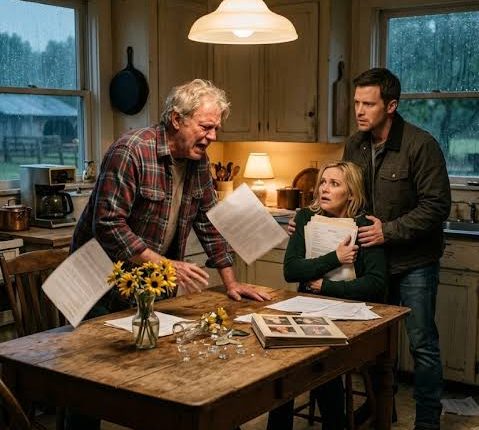
Dad slammed his hand against the island again.
“That’s enough!”
But the shouting no longer had the same effect.
It didn’t make Tyler stop talking.
It didn’t make Mom look away.
And it didn’t make me feel like a frightened teenager standing in front of a disappointed parent.
I was twenty-four years old.
I had spent the previous night trying to keep an elderly stranger alive in a snowstorm, and afterward, I had sat in a freezing car because the person who raised me believed that punishment mattered more than protection.
I wasn’t going to apologize for telling the truth.
Dad pointed toward the front door.
“If you’re determined to humiliate this family, you can leave.”
I looked at him.
“I heard you the first time.”
“Then you understand your situation.”
“Yes,” I replied. “I do.”
I went upstairs.
Behind me, I heard my mother whisper my name, but I kept walking.
I entered my bedroom and closed the door.
My room looked exactly as it had the previous evening. My folded scrubs lay over the chair. My nursing textbooks were stacked beside the desk. A small calendar hung above my dresser, with the date of my planned move-out circled in blue.
June.
I had been counting the months until June.
Now I wondered why I had been waiting at all.
I pulled my suitcase from beneath the bed and started packing.
My clothes went in first, followed by my documents, nursing license, laptop, and the few sentimental things I had kept since childhood.
I took the framed photograph of my grandmother, who had died when I was seventeen.
She had been the one person in the family who never made me feel as though love was something I had to earn.
I remembered sitting beside her hospital bed during her final week.
She had squeezed my hand and whispered, “Never confuse keeping the peace with doing the right thing, sweetheart.”
At seventeen, I hadn’t fully understood what she meant.
At twenty-four, standing in my childhood bedroom with a suitcase open on the floor, I finally did.
I wasn’t leaving because my father had ordered me to.
I was leaving because I had decided that I deserved better.
And for the first time in my life, the decision belonged entirely to me.
By noon, the story had spread far beyond our little town.
The Channel 7 segment had been shared thousands of times. People were commenting on the station’s website, discussing it at work, and reposting Dana’s original Facebook post.
Some praised me for helping Walt.
Others focused on the fact that my father was a school administrator who had reportedly locked his own daughter outside in dangerous weather.
The school district released a brief statement saying it was aware of the situation and would review the matter according to its policies.
Dad read the statement three times.
Then he called someone.
I was carrying a box downstairs when I heard him in the living room.
“No, I understand that. But you need to understand the context.”
A pause.
“She was late. I have rules in my household.”
Another pause.
“No, I did not know she was in danger.”
I stopped on the stairs.
He was lying again.
He knew I had been outside.
Tyler had confirmed it.
I continued down the stairs, and Dad glanced at me before turning his back.
“Of course,” he said into the phone. “I will cooperate fully.”
He hung up.
Then he faced me.
“You’ve made your point.”
I set the box down.
“Have I?”
“You’ve embarrassed your mother. You’ve upset your brother. You’ve put my job under scrutiny. What more do you want?”
I stared at him.
An apology would have been a start.
An acknowledgment that I could have frozen to death would have been another.
But I knew better than to expect either.
“I wanted you to open the door,” I said. “That’s all I wanted last night.”
He looked away.
“You could have called the police.”
“I was standing outside the house where I grew up. I thought my father would let me in.”
For the first time, he had no immediate response.
I picked up my box and carried it toward the front door.
“You’re making a mistake, Kayla.”
“Maybe.”
“You won’t last a week on your own. Rent is expensive. Cars break down. Bills come every month. You think because you have a nursing job, you know everything about being an adult?”
“No,” I replied. “But I know how to pay my bills, and I know how to take care of people.”
His expression darkened.
“Don’t expect this family to rescue you when you fail.”
I paused with my hand on the doorknob.
“I wasn’t expecting rescue last night, Dad. I was expecting a door to open.”
Then I walked out.
My first stop was the hospital.
I hadn’t planned to go there, but my charge nurse, Melissa, had called twice that morning. I needed to collect a few things from my locker, and I wanted to tell her I was safe.
When I arrived, the lobby smelled of disinfectant and fresh coffee.
The hospital was busy despite the storm, with patients being brought in from icy roads and staff members working extra hours.
Melissa spotted me near the nurses’ station.
“There you are.”
She pulled me into a hug before I could say anything.
“I saw the news.”
I lowered my eyes.
“I’m sorry it’s become such a mess.”
“Why are you apologizing?”
I opened my mouth, then closed it.
She shook her head.
“Kayla, you stayed late because we needed help. You stopped to help an injured man. You made sure he got medical attention. Then you spent the night in your car because your father refused to open a door.”
She looked at me carefully.
“Which part of that do you think you need to apologize for?”
I couldn’t answer.
Melissa squeezed my shoulder.
“You need somewhere safe to stay?”
“I’ll figure something out.”
“That wasn’t my question.”
I hesitated.
She continued, “My sister owns a small furnished apartment near the hospital. It’s normally rented to traveling nurses, but it’s empty this month. I’ll ask her whether you can stay there while you sort things out.”
Relief came so suddenly that I almost cried.
“Thank you.”
“Don’t thank me yet. I haven’t called her.”
She smiled.
“But I will.”
Later that afternoon, Melissa called back.
The apartment was available.
It wasn’t luxurious. It had a narrow kitchen, a small bedroom, a secondhand sofa, and a window overlooking a parking lot.
But it had a lock I controlled.
That evening, I moved the last of my belongings into the apartment.
I bought groceries, made my bed, and placed my grandmother’s photograph on the nightstand.
At 9:45 p.m., I sat by the window with a cup of tea.
No one asked where I was.
No one demanded my location.
No one told me I was breaking a rule.
For the first time in eighteen months, I could go to sleep without wondering whether a late shift might cost me a night in the cold.
My phone buzzed.
It was a message from Mom.
Your father is very upset. Please come home tomorrow so we can discuss this as a family.
I read it twice.
Then I typed a response.
I’m safe. I’ll talk when everyone is ready to discuss what happened honestly.
I sent it and put my phone facedown.
I didn’t know it then, but the next morning would bring a visitor who would change the direction of the entire story.
His name was Walter Bennett.
And he had no intention of letting my father decide what happened next.
At 8:10 the following morning, someone knocked on my apartment door.
I was still in my pajamas, halfway through a bowl of cereal, when I opened it.
Dana stood in the hallway.
Beside her was an elderly man wearing a navy winter coat and carrying a brown paper bag.
His left wrist was wrapped in a brace.
A healing cut crossed his forehead.
It took me a second to recognize him.
“Walt?”
He smiled.
“Morning, young lady.”
I stared at him.
“You shouldn’t be out walking around in this weather.”
“I’m not walking very far. Dana drove me.”
He lifted the paper bag.
“And I brought breakfast.”
I stepped aside, laughing despite myself.
“Please come in.”
Walt moved carefully toward the sofa. Dana placed the bag on the kitchen counter and looked around.
“This is nice.”
“It’s temporary.”
“Temporary can still be nice.”
Walt settled into the sofa and looked at me.
“I owe you a proper thank-you.”
“You don’t owe me anything.”
“That’s where you’re wrong.”
He pulled a folded envelope from his coat pocket.
“I’ve been thinking about that night.”
I sat in the chair opposite him.
“Please don’t tell me you came all the way here to pay me back for the coat.”
He laughed.
“No. Although your coat is worth more than the one I usually wear.”
Dana shook her head.
“Dad, get to the point.”
He gave her a look.
“I am getting to the point.”
Then he turned back to me.
“My daughter showed me the news story. I watched it last night, and then I watched it again this morning.”
I felt uncomfortable.
“I didn’t want any of this attention. I was just answering the reporter’s questions.”
“I know. That’s exactly why I wanted to talk to you.”
He rested his good hand on his knee.
“When I was younger, I worked for the county highway department. Thirty-one years behind a snowplow. You learn a few things doing that job.”
He paused, glancing toward the window.
“One of them is that the people you remember aren’t always the people who make the biggest noise. Sometimes they’re the ones who stop when everybody else keeps driving.”
I looked down.
“You were hurt. I couldn’t leave you there.”
“And you didn’t.”
He nodded.
“But I also learned something else. People reveal who they are when doing the right thing costs them something.”
I thought about my father.
Walt seemed to notice the change in my expression.
“I don’t know your father,” he continued. “I won’t pretend I understand your whole family. But I know what I saw on television. You didn’t call him names. You didn’t try to destroy him. You simply told the truth.”
He pushed the envelope toward me.
“There’s a letter in there.”
I opened it.
Inside was a handwritten note and a small business card.
The note read:
Kayla,
My daughter has told me that you are trying to find your feet after a difficult night. I spent most of my life working for the county, and I know a number of people who own rental properties in this area. If you need help finding affordable housing, please call the number on the card. I will gladly provide a reference for you based on what I witnessed.
You helped me when you had every reason to keep driving. I would like to help you if I can.
Walt Bennett.
I read the note twice.
Then I looked up.
“Thank you. Really.”
Walt waved a hand.
“There’s no obligation. I just wanted you to know that you have people in this world who appreciate what you did.”
Dana leaned against the kitchen counter.
“And Dad isn’t the only person who gets to decide whether you’re a good person.”
That sentence stayed with me long after they left.
Because somewhere along the way, I had allowed my father’s opinion to become the measurement I used for everything.
If he approved, I was good.
If he disapproved, I had failed.
I had spent years trying to earn a kind of respect that always seemed to move just beyond my reach.
Now, for the first time, I wondered whether the problem had ever been me.
On Monday morning, my father’s school district announced that it would conduct a formal review of the incident.
The district did not accuse him of any professional misconduct. The review concerned his public statements and whether his conduct aligned with the character and family-responsibility values he regularly promoted in school programs.
Dad had spent fifteen years working in education.
He was the kind of man who delivered speeches about responsibility, respect, and accountability. He volunteered at school events, helped organize food drives, and frequently spoke at assemblies about the importance of making good choices.
His reputation mattered to him.
Not just because he wanted to be respected.
Because he had built his identity around being the man who always knew what was right.
And now people were asking him questions he couldn’t answer with a prepared speech.
By Tuesday, the story had reached a regional newspaper.
A reporter contacted me and asked whether I would provide an interview.
I declined.
I wasn’t interested in making my father the center of my life anymore.
I wanted to work.
I wanted to pay my bills.
I wanted to sleep through the night without remembering the cold.
But the story continued to follow my family.
A former student posted a memory of Dad publicly humiliating him for arriving late to an after-school event.
Another person described being told that a personal emergency was no excuse for missing a mandatory meeting.
Someone else shared a photograph of a school presentation in which Dad stood beneath a banner reading, Character Is What You Do When No One Is Watching.
The comments were relentless.
Some were cruel.
Some were unfair.
A few people seemed more interested in punishing him than understanding what had happened.
I didn’t enjoy watching it.
Whatever my father had done to me, I didn’t want strangers threatening him or attacking my mother online.
So I posted a brief statement on my own social media account.
I shared what happened because I was asked a direct question, and I answered honestly. I don’t want anyone harassing my family. My goal was never to ruin someone’s life. I only wanted the truth to be acknowledged. Please respect our privacy while we work through this.
Then I turned off notifications.
I couldn’t control what the public thought of my father.
I couldn’t control what the school district decided.
And I couldn’t control whether my family would ever understand me.
I could only decide what kind of person I wanted to be.
For the next several days, I focused on my patients.
An elderly woman recovering from pneumonia asked me to help her call her daughter.
A young father whose baby had been admitted to the pediatric unit stood crying near the elevator, terrified because he didn’t understand what the doctor had told him.
A woman recovering from surgery needed someone to explain her discharge instructions slowly, because she was too embarrassed to admit she hadn’t understood them the first time.
I helped each of them.
Not because I wanted recognition.
Not because I expected anyone to write about it.
But because caring for people was the reason I had become a nurse.
And every time I walked into a patient’s room, I remembered something important.
My father’s approval was not what made me good at my job.
My willingness to show up, pay attention, and treat people with dignity did.
On Thursday evening, Tyler called me.
I almost didn’t answer.
We had exchanged a few messages since I moved out, but he hadn’t visited the apartment.
When I picked up, he sounded exhausted.
“Hey.”
“Hey.”
A long silence followed.
Then he asked, “Can I come over?”
I looked around my little apartment.
“Sure.”
He arrived twenty minutes later with a paper bag containing two sandwiches and a bottle of orange juice.
“I didn’t know what you had in the fridge.”
“Mostly leftovers and coffee.”
He nodded.
“Sounds like you.”
We sat at the small kitchen table.
For a while, we talked about ordinary things. His job. My shifts. The weather. The fact that our town’s roads still looked as though a giant had covered them in white cement.
Eventually, Tyler put down his sandwich.
“I need to tell you something.”
I waited.
“When I was eighteen, I came home at 2 a.m. after a party. Dad was furious. He told me I was irresponsible and threatened to kick me out.”
I remembered that night. I had been in my bedroom when Dad shouted at him.
“He made me write an apology,” Tyler continued. “He said if I ever embarrassed the family again, he would stop paying my college expenses.”
I didn’t understand where he was going with this.
“He didn’t lock you out,” I said.
“No. He didn’t.”
Tyler stared at his hands.
“Because Mom woke up and convinced him to let me in. She said it was too cold, and I was his son.”
The room became very quiet.
“He told me the next day that I owed him for the rest of my life because he had given me another chance.”
I felt something twist inside my chest.
Tyler continued.
“I thought that was normal. I thought all families worked like that. If Dad helped you, he got to use it against you later.”
I leaned back in my chair.
“Why are you telling me this now?”
“Because when I saw you sitting in your car, I remembered that night. And I knew exactly what Dad was doing.”
His eyes filled with tears.
“But I went inside anyway. I took off my coat, got a drink, and went to bed. I didn’t even ask whether you were okay.”
I didn’t know what to say.
“I should have helped you,” he whispered.
“Yes,” I said.
He looked up, startled by my honesty.
I took a breath.
“You should have.”
He nodded, and a tear rolled down his cheek.
“I know.”
For years, I had protected Tyler from Dad’s anger whenever I could. I had helped him with schoolwork, covered for him when he made mistakes, and lent him money when his account was empty.
I loved my brother.
But love didn’t mean I had to pretend he hadn’t hurt me.
“I forgive you for being afraid,” I told him. “But I need you to understand that being afraid doesn’t make what you did okay.”
He wiped his face.
“I understand.”
“And if something like that ever happens again, I need you to stand up for what’s right. Even if Dad gets angry.”
Tyler nodded.
“I will.”
I wanted to believe him.
But trust wasn’t something we could restore in one conversation.
It would take time.
As he stood to leave, he hesitated near the door.
“Kayla?”
“Yeah?”
“Do you think Dad will ever apologize?”
I looked at my grandmother’s photograph on the nightstand.
“I don’t know.”
Then I looked back at him.
“But I can’t spend my life waiting for him to become someone else.”
Tyler lowered his eyes.
For the first time, I think he understood that I wasn’t trying to punish our father.
I was trying to stop letting him decide how much my life was worth.
Friday arrived with another phone call from Dad.
I was between shifts when his name appeared on my screen.
I considered ignoring it.
Instead, I answered.
“Hello?”
“We need to talk.”
His voice sounded different from the previous week. Less angry. More controlled.
“About what?”
“The district wants to meet with me next week.”
“I see.”
“They’ve received complaints.”
“I know.”
He exhaled sharply.
“You could help clarify the situation.”
I closed my eyes.
“What do you want me to say?”
“That the situation was misunderstood.”
I waited.
“That I didn’t intend for you to spend the night outside.”
“But you knew I was outside.”
A pause.
“I didn’t think you would stay there all night.”
I felt a chill that had nothing to do with the weather.
“You knew the temperature was below zero.”
“I thought you would call someone.”
“I called you. I texted Mom. I waited outside the door.”
“You could have knocked harder.”
For a moment, I couldn’t speak.
There it was again.