I read Ryan’s message again. Whatever you do, don’t tell Mom I contacted you.
For seven years, I had known Ryan as the irresponsible younger brother who always seemed to be one disaster away from asking someone for money. He was charming when he needed something, apologetic when he was caught, and remarkably forgetful whenever it was time to repay a debt.
I had never hated him.
But I had never trusted him, either.
I showed my attorney the messages.
He read them carefully before looking at me.
“Don’t confront anyone just yet,” he advised. “We need to understand what this document is before making assumptions. Save every message, and don’t sign anything.”
I agreed.
That afternoon, Ryan met me at a small coffee shop two miles from our house. He looked nothing like the confident man who had once bragged about his latest investment at a family dinner.
His shirt was wrinkled. His eyes were bloodshot. He kept glancing toward the entrance.
When he saw me, he stood.
“Chloe, thank you for coming.”
“Tell me what happened.”
He sat down and pulled a thick envelope from his backpack.
“I found this in Mom’s house. She left it on her desk, and I recognized your name.”
He pushed the envelope toward me.
Inside were copies of emails, a draft loan agreement, and a document bearing my full legal name.
My stomach tightened.
The document claimed that I had agreed to guarantee a substantial portion of Ryan’s business debts using funds expected from my mother’s estate.
At the bottom was a signature that looked disturbingly similar to mine.
But I had never signed it.
“I didn’t authorize this,” I whispered.
Ryan nodded.
“I know.”
I looked up sharply.
“How?”
“Because I asked David whether you had signed it. He told me you had agreed to help, but he couldn’t show me the original. Then I asked him why your signature looked different from the one on our wedding documents.”
My hands went cold.
“What did he say?”
“He said the paperwork was being handled by Mom’s financial adviser.”
I stared at him.
“Your mother has a financial adviser?”
Ryan shook his head.
“Not one I know. I think she was talking about a man who helped her with some property investments years ago. I don’t know whether he’s involved in this.”
I looked back at the document.
There were too many questions and not enough answers.
“Why are you telling me now?” I asked. “You knew David was planning to give you eight hundred thousand dollars. Why didn’t you stop him?”
Ryan lowered his head.
“Because I was desperate.”
His answer came so quietly that I almost missed it.
For the first time, he didn’t try to defend himself.
He told me that his latest business had failed months earlier. He had borrowed money to keep it running, then taken out additional loans to cover the first ones. He had convinced himself that one successful investment would solve everything.
Instead, he had lost more money.
Some creditors had threatened legal action. Others had demanded immediate payment. He had hidden the full amount from Margaret because he knew she would panic.
When David offered to help, Ryan accepted.
“I thought he meant he would speak to you,” he admitted. “I never asked him to forge your signature. I never asked anyone to do that.”
“Did you know about the document before today?”
He hesitated.
“I saw a draft last week. I thought it was something David wanted to discuss with you. I didn’t know anyone was going to use it as if you had signed it.”
“Why didn’t you tell me then?”
His eyes filled with shame.
“Because I thought if you agreed to help, I could finally fix everything. And because I was selfish enough to hope I wouldn’t have to explain how bad things had become.”
It wasn’t a satisfying answer.
But at least it was honest.
I placed the papers back inside the envelope.
“Ryan, I’m not giving you my inheritance.”
He nodded.
“I understand.”
“No, I need you to understand something else. If someone has used my signature without permission, I’m going to have it investigated. I won’t lie to protect you, David, or your mother.”
He swallowed.
“I understand that, too.”
“Then tell me everything you know.”
For the next hour, Ryan described the conversations he had witnessed, the emails he had received, and the pressure he had placed on David.
Some details were confusing. Others were incomplete.
But one thing became clear.
Margaret had known about Ryan’s financial trouble long before I did. She had encouraged David to find a way to help him, and she had repeatedly told Ryan that my inheritance would solve the problem.
Whether she knew about the questionable document or had helped arrange it remained uncertain.
I wasn’t going to decide that based on suspicion alone.
My attorney would determine the next steps.
Before we parted, Ryan looked at me.
“I know I’ve caused a lot of problems. But I need you to believe me about one thing.”
“What?”
“I never wanted your mother to die. I never wanted you to lose her. And I never wanted this to happen.”
I looked at him for a long moment.
“I believe you didn’t want my mother to die, Ryan. But wanting something isn’t the same as taking responsibility for what you do afterward.”
He nodded slowly.
Then he left.
I remained at the coffee shop, watching people walk past the windows.
My mother had spent her entire life teaching me that kindness was important.
She had also taught me that kindness without judgment could leave a person vulnerable to those who mistook generosity for weakness.
That evening, I finally understood why she had written her letter so carefully.
She hadn’t known exactly what would happen after she died.
But she had known that one day I might need permission to say no.
And she had given me that permission before she was gone.
My attorney moved quickly.
He arranged for the disputed document to be reviewed, advised me on protecting my accounts, and instructed me to preserve all relevant communications.
He also explained that the legal consequences would depend on how the document had been created, whether it had been submitted anywhere, and who had been involved.
I was relieved to have someone guiding me through the process.
For the first time in weeks, I didn’t feel that I had to solve everything by myself.
David, however, was becoming increasingly anxious.
He called me repeatedly that evening.
I didn’t answer.
Eventually, he sent a message.
Chloe, please come home. We need to fix this before it gets out of hand.
I replied:
I will come home when I’m ready to discuss the situation calmly. Do not transfer, promise, or commit any of my funds.
He responded almost immediately.
I haven’t transferred anything.
That was the first useful thing he had told me all day.
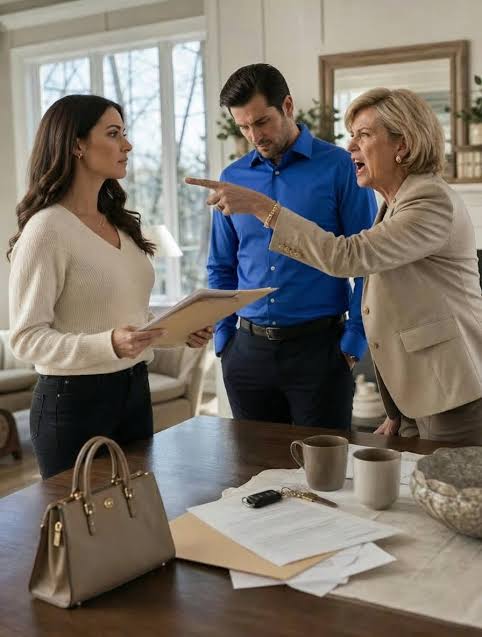
When I returned home the following morning, Margaret was waiting in the living room.
David stood beside the fireplace, his arms folded tightly across his chest.
Neither greeted me.
Margaret spoke first.
“Ryan tells me you’ve been asking questions.”
“Yes.”
“You’ve upset him terribly.”
I placed my bag on the chair.
“Ryan is not the person whose signature appears on this document.”
Her expression changed.
“What document?”
I watched her carefully.
“The one that claims I agreed to guarantee Ryan’s debts.”
For a fraction of a second, she looked genuinely confused.
Then her face hardened.
“David told me you were willing to help.”
“Did you see a signed agreement?”
“No.”
“Did you arrange for one to be prepared?”
“No!”
Her answer was immediate.
I couldn’t tell whether it was entirely truthful, but I didn’t press her without evidence.
Instead, I turned toward David.
“Did you submit this document to any lender or creditor?”
He stared at the floor.
“Not personally.”
“That wasn’t my question.”
He took a long breath.
“I emailed a copy to Ryan’s debt adviser. I thought it was just preliminary paperwork.”
My stomach dropped.
“You sent a document with my signature to someone who was dealing with Ryan’s debts?”
“I believed you were going to agree to help!”
“But I hadn’t agreed. You knew that.”
He opened his mouth, then closed it.
Margaret stepped between us.
“David was trying to save his brother. Surely you can understand that.”
I looked at her.
“Trying to save someone doesn’t give you permission to put another person at financial risk without their knowledge.”
She shook her head impatiently.
“All this over a piece of paper.”
“No. All this because the paper contains my name and a signature I did not authorize.”
For once, she had no immediate reply.
David approached me.
“Chloe, listen. I know I handled this badly. But I didn’t think anyone would actually use the document. I thought it was just a way to show Ryan’s creditors that the family was trying to arrange payment.”
“Then why didn’t you tell me?”
He looked at me helplessly.
“Because I knew you’d say no.”
That answer hurt more than any insult Margaret had thrown at me.
He had known me well enough to predict my refusal.
And instead of respecting it, he had decided to act without me.
I took a slow breath.
“That’s the problem, David. You knew my answer, so you tried to make the decision without me.”
His eyes filled with tears.
“I love you.”
“I wish love had been enough to stop you.”
I turned toward the door.
Margaret called after me.
“Where are you going now?”
“To my attorney.”
“You can’t just abandon your husband over a financial disagreement!”
I paused.
“This is no longer just a financial disagreement. Someone has used my name on a document I never signed, and my husband sent it to a third party without my consent. I need the truth before I can decide what happens to our marriage.”
Then I left.
Over the following days, the situation became more complicated.
My attorney contacted the appropriate parties to clarify that I had not authorized the disputed guarantee. The document was preserved for review, and the people who had received it were asked to explain how it had been obtained and whether anyone had relied on it.
David cooperated, though reluctantly.
He provided his emails and messages.
Margaret initially refused to answer questions, insisting that she had only been trying to help her son. Eventually, she admitted that she had encouraged David to seek financial assistance from me but denied preparing or signing anything on my behalf.
Ryan provided his own records.
The investigation did not immediately establish who had created the disputed signature or whether any person had deliberately attempted to deceive a creditor. Those questions required proper examination.
But one important fact was established quickly.
I had not agreed to guarantee Ryan’s debts.
The people involved were notified that the document could not be treated as my authorization.
My inheritance remained untouched.
For the first time since the apartment sale, I could breathe without feeling that someone was waiting for me to make a mistake.
But protecting the money was only one part of the problem.
The harder question was what I would do about David.
David moved into the guest room.
For the first few nights, he behaved as though the arrangement were temporary. He left coffee outside my bedroom door and sent messages asking whether I needed anything.
I appreciated the gestures, but I didn’t mistake them for change.
One evening, I found him sitting at the dining table with a stack of papers.
He looked exhausted.
“I’ve been going through our finances,” he said.
I remained standing.
“Why?”
“Because I realized something. I knew exactly how much you were inheriting, but I couldn’t tell you how much Ryan owed or what his actual repayment plan was.”
He rubbed his eyes.
“I never questioned whether helping him was sensible. I just assumed we would find a way to make it work.”
I sat across from him.
“And what have you discovered?”
“That I don’t know how to help him without risking my own finances. I’ve spent years believing that if I kept rescuing him, eventually he would become responsible.”
He looked down at his hands.
“Every time he failed, Mom told me he needed another chance. Every time I hesitated, she said I was abandoning my brother. I think I started confusing being a good son with paying for everyone’s mistakes.”
For the first time, I heard him describe the family pattern without blaming me for refusing to participate in it.
“Why didn’t you tell me any of this?” I asked.
“Because I was ashamed. And because I thought you would see how weak I’d been.”
I studied his face.
“David, I never expected you to solve every problem in your family. I expected you to be honest with me.”
He nodded.
“I know.”
“No, I don’t think you do. You made a decision that affected my future, then told me about it as if I had no choice. You allowed your mother to enter our home and demand money from me. And you let your brother believe he could count on funds that were never his.”
His eyes filled.
“I know I hurt you.”
“You hurt my trust.”
He was quiet for a long time.
Then he asked, “Can I fix it?”
I looked at the man I had married.
There had been good years. There had been kindness, laughter, holidays, and quiet evenings when we sat together without needing to say anything.
Those memories were real.
But so was what he had done.
“I don’t know,” I answered honestly. “And I won’t promise you that I can forgive everything just because you’re sorry now.”
He nodded.
“What do you need from me?”
“First, I need you to stop making decisions about my inheritance. Second, I need you to cooperate fully with the review of that document. Third, I need you to establish boundaries with your family. And finally, I need time to decide whether I can trust you again.”
“I’ll do all of it.”
I held his gaze.
“Don’t say that because you’re afraid of losing me. Do it because you finally understand why it matters.”
He didn’t answer immediately.
Then he said, “I will.”
For the next several weeks, David kept his word.
He cooperated with the legal process and did not attempt to access my inheritance. He stopped making promises to Ryan and told Margaret that any future financial decisions would have to be discussed honestly rather than imposed on me.
Margaret was furious.
She called me selfish. She accused me of destroying the family. She even told several relatives that I had become arrogant after inheriting money.
I stopped trying to correct every rumor.
People who wanted the truth could ask me.
People who wanted a villain would find one regardless of what I said.
Meanwhile, Ryan finally began confronting the consequences of his decisions.
Without my inheritance to rescue him, he had to negotiate directly with his creditors, obtain professional advice, and examine which assets he could sell. He abandoned the idea of launching another business and accepted a steady job while working through his financial obligations.
The process was painful.
There were months when he struggled.
But for the first time, he was no longer waiting for someone else to erase the consequences of his choices.
One afternoon, he called me.
“I wanted to thank you,” he said.
“For what?”
“For saying no.”
I was silent.
He continued.
“I hated hearing it at first. I thought you were letting me suffer when you could have helped. But if you had paid everything, I would probably have convinced myself that I could take another risk because someone would always save me.”
His voice broke.
“I’m sorry I became the kind of person who thought your money was the answer to my problems.”
I didn’t tell him everything was forgiven.
But I told him I was glad he was taking responsibility.
That was a beginning.
And sometimes, a beginning was all a person could honestly offer.
Three months after the morning Margaret burst into my house, I met David at the same restaurant where we had celebrated our seventh wedding anniversary.
I had chosen the place because it was quiet, familiar, and far enough from our home that neither of us would feel trapped.
David arrived early.
When I entered, he stood and pulled out my chair.
For a moment, the gesture reminded me of the man I had fallen in love with.
We ordered coffee.
Neither of us touched it immediately.
“I’ve been thinking about us,” he said.
“So have I.”
He took a breath.
“I know I can’t demand forgiveness. I know I can’t undo what happened. But I want to rebuild our marriage, if you’ll let me.”
I looked through the window at the passing cars.
“What would be different?”
He didn’t answer with promises about love.
Instead, he spoke about practical things.
He would no longer make financial commitments on my behalf. He would not allow his mother to dictate decisions in our home. He would be transparent about family requests and our shared finances. If we disagreed, he would discuss the disagreement with me rather than trying to arrange an outcome behind my back.
He also agreed that we should seek independent counseling to decide whether we could rebuild our relationship.
I listened carefully.
Then I asked, “And what happens when Margaret tells you that you’re a terrible son because you won’t give Ryan more money?”
He looked down at his coffee.
“I tell her that helping Ryan doesn’t mean paying for every mistake he makes.”
“And if she blames me?”
“I tell her that our marriage is not hers to manage.”
I watched him for a long moment.
Those were the words I had wanted to hear months earlier.
But words were easy.
The next year would reveal whether he meant them.
“I am willing to consider rebuilding our marriage,” I said. “But I won’t pretend nothing happened. Trust will have to be earned.”
He nodded.
“That’s fair.”
“And David?”
“Yes?”
“My inheritance will remain under my control. I will make my own decisions about it, and I will not use it to solve Ryan’s debts.”
He looked at me.
“I understand.”
That time, I believed he understood the boundary.
Whether he could respect it consistently remained something we would have to discover together.
We didn’t leave the restaurant with a magical promise that everything would be perfect.
We left with a decision to try.
Over the following months, counseling helped us discuss the things we had avoided for years. David began recognizing how often he had allowed guilt to dictate his choices. I began recognizing how often I had swallowed my own needs to avoid conflict.
We learned that reconciliation was not a return to the old marriage.
The old marriage had helped create the conditions that brought us to that restaurant.
If we were going to remain together, we would have to build something different.
Margaret took longer to accept the changes.
For a while, she barely spoke to me.