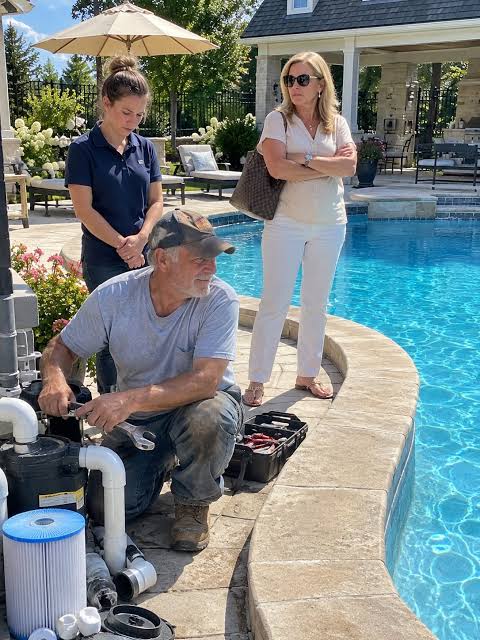
His Boss’s Wife Refused to Pay His Father the $7,800 She Owed for Nine Days of Pool Repairs, Acting Like She Could Get Away Without Paying—But When His Father Finally Revealed What He Had Documented, She Realized She Had Made a Costly Mistake.
Part 2 — What Was Under the Pool
The granite survey markers were buried eighteen inches below the concrete pool deck.
Dad found the first one on day five of the repair. He was excavating a trench along the eastern wall of the pool to access a cracked drainage pipe when his shovel struck something that was not pipe, not rock, and not the compacted fill material that typically surrounds a pool foundation.
It was a cut granite block, approximately twelve inches square, with a chiseled cross on the top face. A survey marker. The kind that property surveyors set into the ground decades before GPS existed, when the boundary of a parcel was defined by physical objects placed at measured intervals along the property line.
Dad knew what it was immediately. He had encountered survey markers on previous jobs. Most were unremarkable. Boundary stones that confirmed what modern records already showed.
This one was different.
This one was eighteen inches below a concrete deck that had been poured twelve years ago when Richard’s pool was installed. Which meant the marker had been buried, deliberately or carelessly, during construction. And burying a survey marker is not a minor oversight. It is the removal of a physical record that defines where one person’s property ends and another’s begins.
Dad did not remove the marker. He photographed it in place. He measured its position relative to the pool wall, the house foundation, and the property fence. He recorded the GPS coordinates using his phone. He noted the date and time.
Then he kept digging.
He found the second marker on day seven. Four feet from the first. Same granite. Same chiseled cross. Same depth. Buried beneath the same concrete.
Between the two markers, he found something else. The remnants of a stone foundation. Not a modern foundation. Old fieldstone, laid without mortar, the kind of construction used in rural Virginia in the early twentieth century for outbuildings, well houses, and property boundary walls.
The foundation ran in a straight line between the two markers. It was the physical manifestation of a property boundary that had existed long before Richard’s house, Richard’s pool, or Richard’s two-million-dollar mortgage.
Dad documented everything. Twenty-three photographs. A hand-drawn site map. Written descriptions of each marker’s condition, position, and surrounding soil composition. He placed the documentation in his work folder alongside the signed authorizations that proved Richard and Melissa had given him written permission to excavate in exactly the area where the markers were found.
That was why he had insisted they sign every page.
Not because he anticipated a payment dispute. Because a contractor who excavates on another person’s property without written authorization can be accused of trespassing, tampering, or fabricating evidence. A contractor who excavates with signed, itemized authorization from the property owner is performing permitted work and anything he discovers during that work is a legitimate finding.
Dad had learned this lesson years ago from a job where a homeowner accused him of damaging a buried utility line. The homeowner had not signed the work authorization. The dispute cost Dad $3,000 in legal fees. He told me afterward that he would never touch another person’s property without their signature on every page, and he had kept that promise for fifteen years.
Richard and Melissa’s signatures were on every page.
The markers were documented. The foundation was photographed. The evidence was organized.
And the woman whose family’s name appeared on the original deed was one phone call away.
Part 3 — Edith Calloway’s Thirty-Two-Year Wait
Edith Calloway had been waiting since 1994.
That was the year her family’s parcel, a half-acre section of land that had been in the Calloway name since 1923, was transferred to Richard’s father through a deed that the county recorder’s office flagged as irregular during routine processing.
The irregularity was specific. The transfer deed bore a signature attributed to Edith’s mother, Dorothy Calloway, authorizing the sale. But Dorothy Calloway had been in a care facility for three years at the time of the signature. She had been diagnosed with advanced dementia. She could not have signed a legal document with the understanding required for the signature to be valid.
Edith had challenged the transfer. She hired an attorney. The attorney filed a petition with the county. The county acknowledged the irregularity and placed a notation on the deed record.
Then nothing happened.
The notation sat in the county file. Edith’s attorney retired. The cost of pursuing the claim exceeded what Edith could afford. Richard’s father built a house on the combined parcel and the Calloway section was absorbed into the larger property as though it had always been there.
Edith told me later, sitting at my kitchen table with a cup of tea and the folder she had been carrying for three decades, that the hardest part was not losing the land. It was watching someone build on it. Watching the house go up. Watching the landscaping. Watching, twelve years ago, the construction crew pour concrete for an enormous pool over the exact area where her grandmother had built a well house in 1923.
The survey markers were part of that well house. Her grandmother had set them when the property boundary was first established. They were the physical proof that the Calloway parcel existed as a separate, defined piece of land.
And they had been buried under twelve inches of concrete and six inches of fill.
Edith told me she had assumed the markers were gone. Destroyed during construction. Removed by Richard’s father or the builders to eliminate any physical evidence of the boundary.
She was wrong. The markers were not removed. They were simply covered. Whether by negligence or intent, the construction crew had poured the pool deck directly over the Calloway boundary without excavating deep enough to encounter the granite.
Dad’s excavation for the drainage pipe went deeper than the original construction.
He found what they had buried.
Dad called Edith the evening Melissa refused to pay him. He had located her through the county recorder’s office, where the notation from 1994 still sat in the file, unresolved, beside a name and a last known address.
Edith answered the phone. She listened while Dad described what he had found. She asked him to describe the markers. He described the cut granite. The chiseled crosses. The position relative to the pool.
She told him those were her grandmother’s markers.
She told him she had been waiting thirty-two years for someone to find them.
She told him she would be there in the morning.
READ THE NEXT PART: 👇👇
PART 4 – His Boss’s Wife Refused to Pay His Father the $7,800 She Owed …