The shopping list had “twenty people” at the top, but the part that didn’t fit was the line under it: “Claire to stock the fridge.”
I was sitting in my car outside my apartment in Portland, still in my scrubs after a twelve-hour shift at St. Mercy Medical Center. I had a coffee stain on one sleeve and that hospital hand soap smell stuck to my skin. My phone kept lighting up in the cup holder.
Dad had sent the list to our family chat.
“Lake house this weekend,” he wrote. “Twenty guests. Claire, fill the fridge.”
Mom added, “It’s family. Don’t make this difficult.”
Kyle, my younger brother, put a row of laughing faces under that.
I read it twice. Then I wrote, “No.”
Mom answered before I had taken my hand off the phone.
“Do you really think you can stop us?”
I’m Claire. I was thirty-eight then, and I owned that little house near Devils Lake. I’d bought it with six years of overtime, double shifts, and a lot of meals eaten over the sink. It wasn’t a fancy place. Two bedrooms, a small deck, a kitchen drawer that stuck unless I lifted it. But it was mine.
I’d wanted somewhere quiet where I could sleep without hearing a call bell in my head. Somewhere I didn’t have to explain why I didn’t have kids, why I worked weekends, or why I didn’t call Mom every night.
I didn’t answer again. I went upstairs, took a shower, and called my neighbor, Mrs. Harper, who lived across the gravel road from the house.
“Margaret, if any cars show up this weekend, they don’t have permission to go inside.”
There was a pause.
“Your parents?”
“Yes.”
“Good. I’ll keep an eye out.”
I’d let them use the house the summer before. Dad had called it “our place” in front of the family, but I let that pass. He’d taken a spare key without asking and left beer cans by the hot tub. I told myself it was easier not to make a thing of it. I didn’t ask for the key back.
That was my bad call.
I changed every door code, shut off the garage keypad, changed the Wi-Fi password, and called the locksmith. By noon the next day, the old lock was gone. I emailed the sheriff’s office non-emergency line and told them no one had permission to enter the property.
I didn’t call my parents. I knew what they’d say. I also knew I’d end up apologizing for making them mad.
Then I slept. I’d been awake too long to have a good argument.
At 6:41 Friday morning, my phone started buzzing on the nightstand. I ignored it until it stopped. Then it started again.
By the time I sat up, I had forty missed calls from Dad.
I answered the forty-first.
“What did you do to the house?” he yelled.
His voice sounded windy. I heard Mom behind him.
“Tell her to stop this!”
I sat on the edge of the bed. “Good morning.”
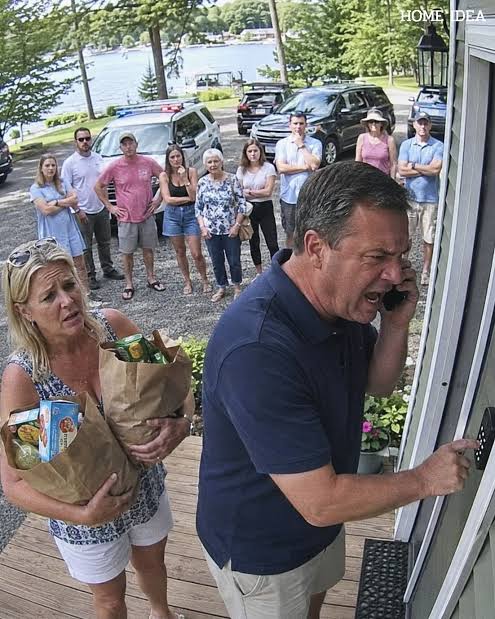
“The code doesn’t work. The garage is locked. There are cameras everywhere. Your mother has groceries sitting out here.”
“Then leave.”
“This is a family weekend.”
“No. You invited twenty people to my house after I said no.”
“They’re already here.”
“That’s not my problem.”
He lowered his voice, which was how I knew he was trying to sound reasonable.
“Open the door, Claire.”
I pulled up the security feed on my phone. Twenty people were gathered around the porch and driveway.
I recognized Kyle, Mom, Dad, two cousins, and an aunt. The rest were faces I’d seen at Christmas or maybe once at a wedding. Grocery bags sat along the porch rail.
Dad had his hand on the door handle.
Then a sheriff’s cruiser turned into the driveway.
I didn’t feel relieved. Not right away. I felt embarrassed, which wasn’t fair, but that was the first thing that came up. I could picture the guests watching my father get told to leave. I could picture Mom telling them I’d ruined the weekend.
Dad hadn’t noticed the cruiser yet. He was still tugging at the door.
“Sir,” I heard the deputy say through the camera speaker. “Step away from the door.”
Dad turned. Mom’s face changed. She went from angry to worried in a second.
I put on jeans and drove out.
It’s about two hours from Portland, depending on traffic. I don’t remember most of the drive. I remember a truck with a ladder rattling in the lane ahead of me, and I remember thinking I should’ve packed a granola bar. That’s the kind of thing my brain picked.
When I got there, the deputy was standing near the porch. Dad was talking fast. Mom had moved the grocery bags out of the sun. Nobody was screaming anymore, but the whole group had gone quiet.
The deputy looked at me. “You’re Claire?”
“Yes.”
“Is this your property?”
“Yes. I have the deed on my phone, and a copy in the house.”
Dad cut in. “It’s family property.”
“It’s mine,” I said.
He looked at me as if I’d made a rude joke.
“Claire,” Mom said, keeping her voice low, “don’t do this in front of everybody.”
I looked at the bags. The lettuce had started to wilt. There was a carton of eggs on top of one.
“I asked you not to come.”
“We thought you’d calm down,” she said.
That landed harder than I expected. Not because it was cruel. Because it was so normal. They thought my no was a mood. They thought they could wait it out.
The deputy asked Dad whether he had a key or written permission to enter. Dad said he’d had a key before. The new lock had changed that. He said I’d always let them use the house.
“Not this weekend,” I said.
He rubbed his forehead. “You’re making a scene over a family visit.”
I was tired enough to say something mean. I wanted to tell him the house had cost me more than he knew, and that my whole life had been one long shift of doing what he asked so he wouldn’t be disappointed. Instead I handed the deputy the printed deed.
He looked it over and gave it back.
“Mr. Mercer, you need to leave the property.”
Dad stared at the paper in my hand.
“I helped her buy it,” he said.
The deputy glanced at me. I didn’t say anything. Dad had helped me move a sofa once. He’d lent me a ladder. He had not helped me buy the house.
“I told everyone this was ours,” Dad said.
There it was.
Not a question. Not a mix-up. A plain sentence in front of twenty people, the deputy, and me.