His palm flattened across the doorframe just as the nurse and I started toward the exit.
He still had not touched either of us.
That almost made the gesture worse.
He stood there as if the doorway belonged to him, as if my body belonged to him, as if the simple fact that I had said I wanted to leave could be canceled by where he chose to put his hand.
The nurse’s arm was beneath mine, steady without pulling.
Her forgotten bag hung from her other hand and brushed lightly against my leg when she stopped.
My husband looked at her instead of me.
“You’ve done your job,” he told her.
His voice had gone quiet again.
That was the voice he used when he wanted something ugly to sound reasonable.
A few minutes earlier, everything had looked completely different.
The nurse had already finished checking me.
She had looked at the surgical dressing, made sure it was clean, and gone over the ordinary details that had taken over my life since surgery: pain, food, rest, nausea, movement, the small things my body could tolerate and the things it could not.
Cancer had reduced my days to measurements.
How many bites could I keep down?
Could I make it through a shower without getting dizzy?
Could I turn in bed without pulling at the surgical area?
Could I get from the chair to the bathroom without needing to stop?
I had learned not to think too far ahead.
The next meal was enough.
The next dose was enough.
The next hour was enough.
My husband had learned that too, but in a different way.
He understood exactly how tired I was.
He understood how slowly I moved.
He understood how badly I wanted every visit, every meal, every evening to end without another argument.
And over time, that exhaustion had become useful to him.
When the nurse was in the house, he could be attentive.
He asked the right questions.
He stayed close enough to look involved.
He could sound frustrated without sounding cruel, tired without sounding angry, worried without sounding controlling.
Then the nurse left.
The front door closed.
Her car was still in the driveway, though I did not notice that immediately.
Dinner had already gone wrong.
I could not keep it down.
The nausea came fast, and my husband reacted before I had even recovered from the first wave.
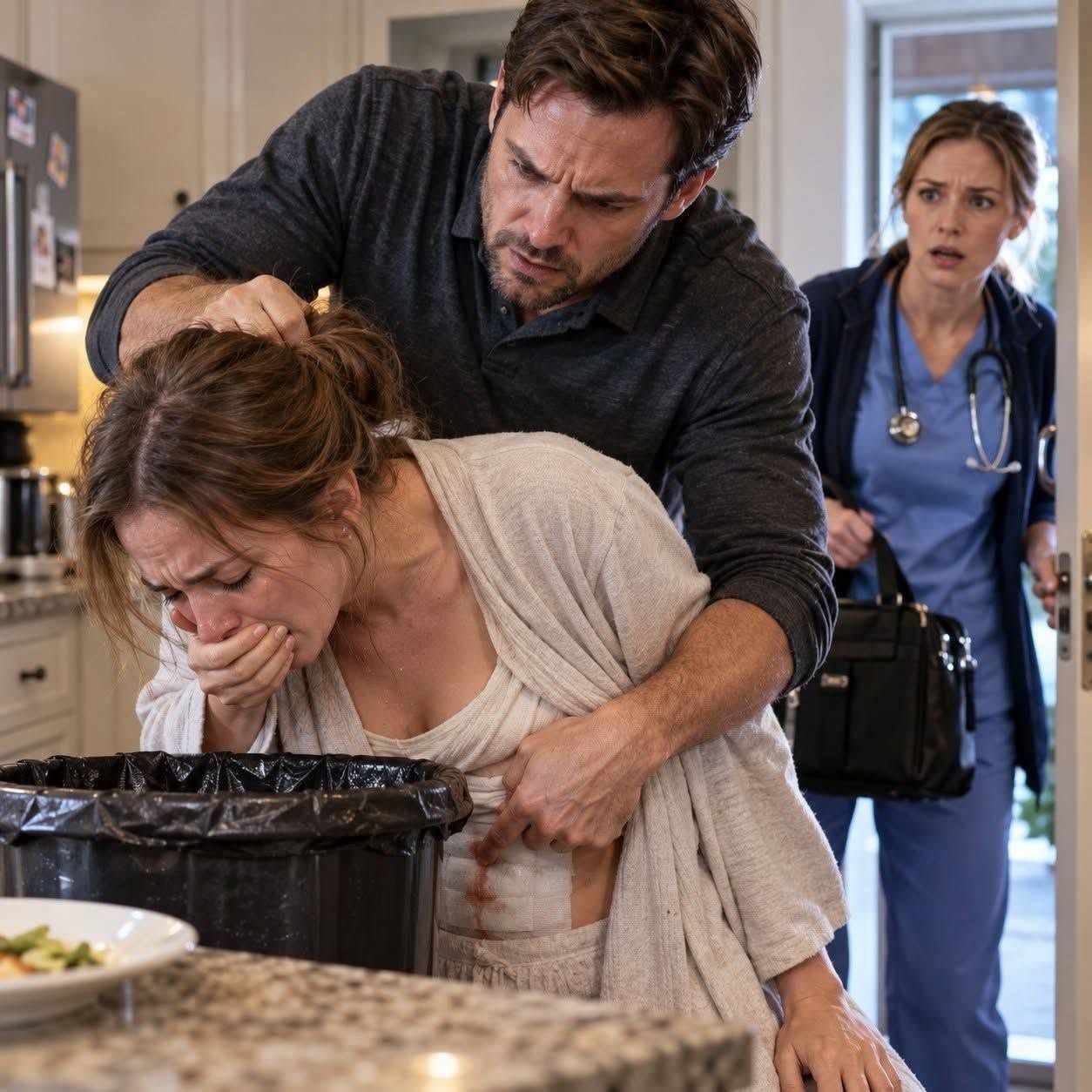
He shoved my head over the trash can.
The movement hurt more than the sickness did.
My body was still healing, and anything sudden made me feel as though the center of me had been pulled tight from the inside.
I tried to steady myself against the chair.
He did not stop.
Then his finger pressed into the tender surgical area.
Pain shot through me so sharply that I gasped.
The dressing, clean only minutes earlier, began to stain.
He watched my face.
“Tell the nurse cancer did it,” he said.
That sentence landed with a strange kind of clarity.
Not because it was the worst thing he had ever said.
Because it showed me that he was already preparing the explanation.
He was not confused.
He was not reacting without thinking.
He knew someone might notice.
He knew what he wanted me to say.
And until that moment, some part of me had still been working to protect the version of him other people saw.
I looked toward the clock.
Then I noticed something through the ordinary fog of pain and nausea.
The nurse’s car was still outside.
Before I could decide what that meant, the front doorknob moved.
My husband heard it too.
His finger lifted from the dressing immediately.
The expression on his face changed almost at once.
The hard look disappeared behind concern so quickly that it frightened me.
The nurse stepped back inside apologizing.
She had forgotten her bag.
It was near the doorway, exactly where she had left it.
Then she saw me.
I was still bent beside the trash can.
Her attention moved from my posture to the dressing.
The fresh stain was visible now.
She had checked that same dressing only minutes before.
“What happened?” she asked.
My husband answered first.
“She got sick again,” he said. “It’s the cancer.”
He said it smoothly.
He said it like an explanation that had already been agreed upon.
The nurse did not look at him.
She kept her eyes on me.
“I asked her.”
My husband remained beside my chair.
His leg pressed against the side of it.
He was not grabbing me.
He did not need to.
His closeness carried its own instruction.
I could still taste dinner in my mouth.
The adhesive around the dressing tugged every time I breathed.
My hands felt weak.
For one familiar second, I almost chose the answer that would make the room easier.
That had become one of my habits.
Make things easier.
Make things quieter.
Get through the next hour.
Do not make tonight harder than it already is.
Do not start something you are too tired to finish.
I looked at the nurse.
Then at the bag she had forgotten.
Then at my husband’s hand beside his thigh.
Then at the front door.
There are moments that look small while they are happening.
A person asks a question.
Another person gives an answer.
Nothing falls over.
No music swells.
The walls do not change.
But afterward, you can divide your life around that answer.
Before I said it.
After I said it.
“He pushed my head over the trash can,” I told her.
My voice was thin.
I kept going.
“And he pressed on the surgical area after you left.”
My husband laughed once.
Short.
Dismissive.
The kind of laugh meant to tell another person that the situation was too ridiculous to take seriously.
“She’s in pain,” he said. “She doesn’t know what she’s saying.”
I had heard versions of that argument before.
Not those exact words, maybe, but the structure was familiar.
If I was upset, I was emotional.
If I was exhausted, I was confused.
If I remembered something differently, I was stressed.
Now cancer itself could be used to make my own account of my body less believable.
The nurse did not debate him.
She did not turn the room into a courtroom.
She came closer to me instead.
She crouched enough to look carefully at the dressing without touching it.
“When I left,” she said, “this dressing was clean.”
That simple observation changed the room.
She was not guessing about our marriage.
She was not claiming to know what had happened during every minute she had been gone.
She was stating what she personally knew.
The dressing had been clean.
Now it was not.
My husband started explaining.
He talked about dinner.
He talked about the nausea.
He talked about how difficult the last few weeks had been for both of us.
He described exhaustion as if exhaustion itself had pressed his finger into the surgical area.
The nurse let him speak.
She did not interrupt him.
That seemed to make him talk more.
He kept reaching for the version of events in which he was a tired husband dealing with a sick wife and I was too overwhelmed to understand what had happened.
But he could not make the clean dressing disappear.
He could not make the timing disappear.
And he could not make the nurse stop asking me directly.
“Do you want me to stay?” she asked.
“Yes.”
One word.
My husband’s jaw tightened.
The nurse gave me another question, slower this time.
“Do you want to be alone with him right now?”
“No.”
Another word.
It felt bigger than the first.
My husband stepped closer.
“This is getting blown way out of proportion.”
The nurse straightened.
She still did not accuse him of anything beyond what she could observe.
She did something much more important for me in that moment.
She kept treating my answers as answers.
She moved her forgotten bag away from him and closer to me.
Then she asked whether I wanted to leave the room with her.
I looked at the doorway.
For weeks, pain had trained me to bargain with every movement.
Standing meant deciding whether the pain was worth standing.
Walking meant deciding whether I had enough strength to reach the next place.
Eating meant wondering whether my stomach would reject the effort.
Even sleep had become something I approached carefully.
My world had narrowed because healing demanded it.
Somewhere inside that narrow world, I had started treating every other decision the same way.
Could I survive the next argument?
Could I avoid upsetting him tonight?
Could I wait until tomorrow?
Could I say nothing now and figure it out later?
Small thinking had helped me manage pain.
But small decisions were still decisions.
“Yes,” I told her. “I want to go with you.”
My husband stared at me.
He looked genuinely offended.
Not surprised that I was hurting.
Not concerned about the dressing.
Offended that I had said what I wanted in front of someone else.
“You’re seriously doing this?” he asked.
The nurse reached for her bag.
“She answered the question.”
There was no speech after that.
No performance.
No dramatic promise that everything would suddenly become easy.
I still had to stand.
That was difficult enough.
I put one hand on the chair and pushed upward.
Pain caught beneath the dressing before I was fully upright.
My body stopped halfway.
The nurse offered me her arm.
She did not grab me.
She waited.
That detail mattered.
My husband had spent the last few minutes deciding what I felt, what I remembered, what I should say, and whether my pain made me reliable.
The nurse offered support and let me choose whether to use it.
I reached for her.
READ THE NEXT PART: 👇👇
PART 4 – The Nurse Came Back—and Saw What My Husband Blamed on Cancer