The Treasure Behind the Candy
“Grandma, look! Somebody left a treasure!”
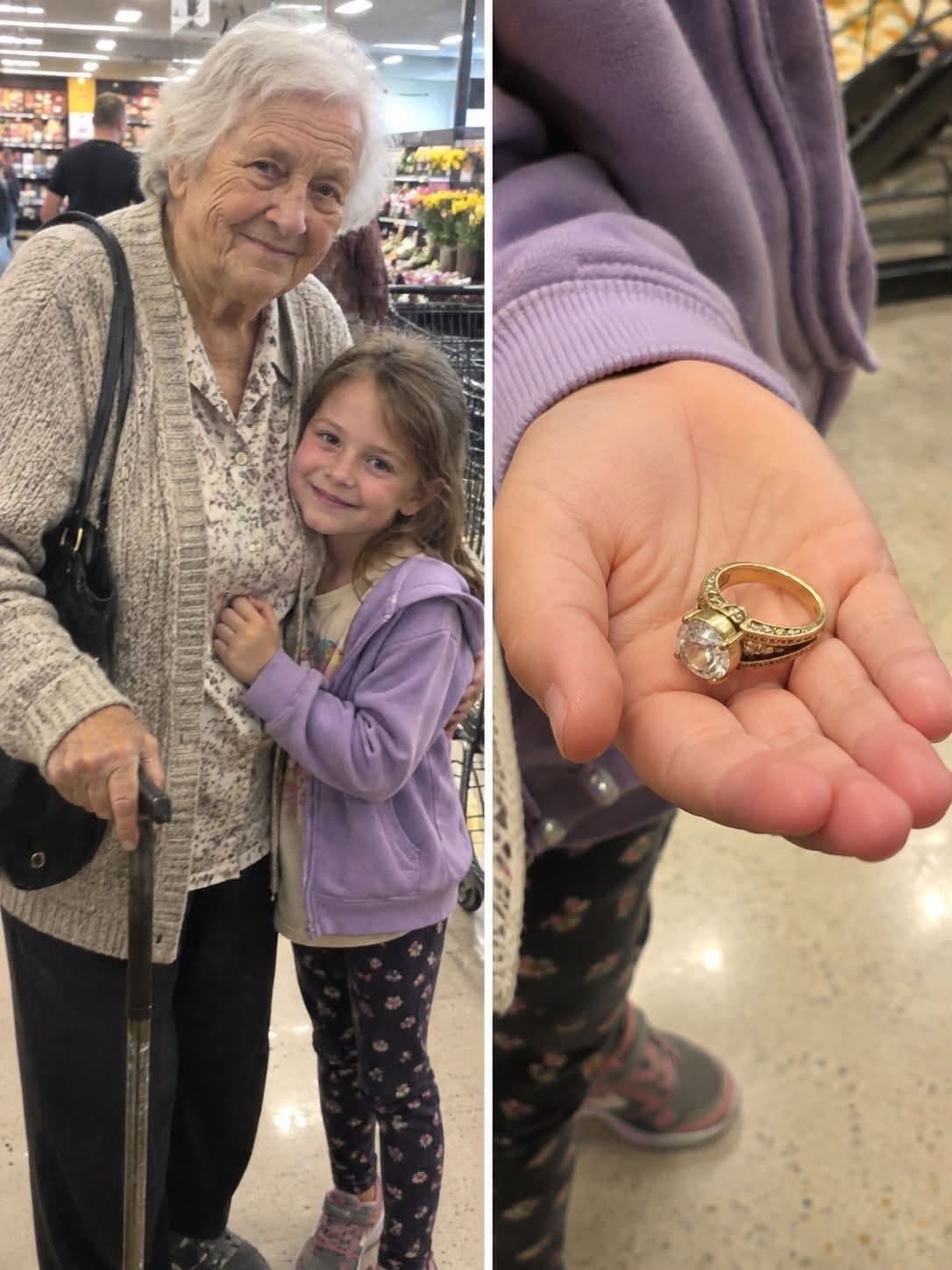
Ellie was holding her hand up to me in the candy aisle of the Walmart on Route 50. Her little palm was open. Her eyes were huge.
In the middle of her palm sat a ring.
Gold. Old-fashioned. With a diamond in the center so big it caught the fluorescent lights overhead and threw tiny rainbows across her fingers. Smaller diamonds all around it, like petals on a flower.
I’d never seen a diamond like that in real life. Only in magazines at the doctor’s office.
“Where did you find that?”
“Right there.” She pointed at the shelf. “Behind the box of Junior Mints. It was hiding.”
My heart started pounding.
I knew, the way you know things at seventy, that I was looking at more money than I’d held in my hand in a very long time. That ring could pay our bills for a year. Maybe two. It could fix the roof that leaked over Ellie’s bed every time it rained. It could pay for my blood pressure pills and my heart pills without me having to choose between them and her new shoes.
For one shameful second, I imagined keeping it.
Just one second. I saw it so clearly. Putting it in my coat pocket. Walking out to the parking lot. Driving to the pawn shop in Sedalia on Monday. A new roof. New shoes. A full refrigerator.
Nobody would ever know.
Then Ellie looked up at me with her serious brown eyes. Her mother’s eyes.
“Do you think somebody’s crying because they lost it?” she asked.
I swallowed hard.
“Let’s find out, sweetheart,” I said.
My name is Nora Whitfield.
I’m seventy years old. I’ve been raising my granddaughter, Ellie, by myself since we lost her parents three years ago.
My daughter, Lisa, and her husband, Tom, died on Interstate 70 on a Saturday night in October. A car accident, the police said. That’s what I tell people. That’s what it says in the obituary. Died in a car accident.
That’s all I’ve ever told anybody.
Ellie was four. She was in the back seat. She lived.
I don’t talk about that night. Not to anybody. Not to my pastor, not to my neighbors, not to the grief counselor the hospital made me see for six weeks. I put it in a box in my heart and I nailed the lid shut.
I’ll tell you why later.
We live in the old house on Pickett Street in Harlan, Missouri. The house where my husband, Hank, and I spent forty-one years of our married life. A little white two-story with green shutters and a front porch that sags in the middle like a tired horse.
Hank built that porch in 1979. He was always going to fix the sag. He died in 2019 before he got around to it. Heart attack, in the garden, pulling weeds. I found him lying between the tomato plants with his hat still on.
The house is too big for an old woman and a little girl. The furnace is older than I am. The roof leaks. There’s a blue plastic bucket in the corner of Ellie’s bedroom that catches the drips when it rains. She named the bucket Gerald. When it rains at night, she lies in bed and counts the drips. “Gerald’s thirsty tonight, Grandma.”
I live on Hank’s Social Security and a small pension from my thirty years as a school secretary. It isn’t much. It was enough for two old people. It isn’t enough for an old woman and a growing girl.
Some months, I have to choose between filling my prescriptions and buying Ellie new shoes.
I always buy the shoes.
I cut my heart pills in half to make them last. Dr. Patel would yell at me if she knew. She doesn’t know.
But that little girl has never once complained.
Not when her sneakers got so tight her toes curled. Not when we ate peanut butter sandwiches for dinner four nights in a row at the end of the month. Not when her friends all went to the water park for a birthday party and I couldn’t afford the twenty-dollar admission.
“That’s okay, Grandma,” she said. “I don’t really like water parks anyway.”
She loves water parks.
She is my sunshine. She’s the only reason I get out of bed some mornings.
Last Friday, we stopped at Walmart for milk and bread.
It was the twenty-eighth of the month. The worst time. Social Security doesn’t come till the third. I had eleven dollars and forty cents in my wallet and a list on the back of an envelope. Milk. Bread. Peanut butter. Bananas if cheap.
I was standing in the bread aisle comparing prices. The store brand was a dollar twenty-nine. The good kind, the soft kind Ellie likes, was two eighty-nine. I was doing the math in my head. If I got the store brand, I could get bananas.
That’s when Ellie tugged at my sleeve and pulled me around the corner into the candy aisle.
“Grandma, look! Somebody left a treasure!”
I held the ring up to the light.
There was something engraved on the inside of the band. Very small. Worn almost smooth.
R.M. to E.M. — Forever — 1951.
Old. Older than me, almost.
Somebody’s grandmother’s ring, maybe. Somebody’s whole life in a little gold circle.
Do you think somebody’s crying because they lost it?
I closed my hand around it.
“Come on, Ellie,” I said. “Let’s take it to customer service.”
She skipped ahead of me down the aisle. Her ponytail bounced. Her old pink sneakers squeaked on the floor. The left one had a hole in the toe. I’d glued it twice.
She had a little stuffed bunny clipped to her backpack. A gray one, worn and floppy, with one ear torn off and sewed back on crooked. His name is Mr. Hops. She’s had him since she was two. Her mother gave him to her.
She doesn’t go anywhere without Mr. Hops.
We were heading toward customer service when a woman rushed through the front entrance.
She came in so fast the automatic doors barely had time to open. She nearly knocked over a display of pumpkin spice coffee.
She was about forty. Pretty, in a tired way. Dark hair pulled back in a messy ponytail. She was wearing a nice blouse tucked into jeans, like she’d come from an office job. Mascara streaking down her cheeks in black lines. One of her shoes was untied, the lace flapping as she ran.
She ran straight to the customer service counter.
“Please!” she cried to the teenage cashier behind it. “Has anyone turned in a diamond ring? I was here twenty minutes ago! I was buying candy for my son! It must have slipped off! It’s gold, with a big diamond, it’s very old, please, please, has anyone—”
The cashier, a girl with purple hair and a nose ring, looked terrified. “I… no, ma’am. Nobody’s turned anything in.”
The woman made a sound I’ll never forget. Like all the air went out of her at once.
“Oh, God,” she whispered. “Oh, God, no.”
She put both hands flat on the counter. She bent over like she was going to be sick.
Ellie didn’t wait for me.
She ran straight toward her.
“Ma’am! Ma’am! Is this yours?”
The woman turned around.
I held out my hand. Opened it.
The ring was sitting in my palm.
The woman froze.
She stared at it. Her mouth opened. Nothing came out.
Then she grabbed the counter to steady herself.
“Oh my God,” she whispered. “Oh my God. Oh my God.”
She reached out with a trembling hand and picked up the ring. She held it up. She turned it over. She looked at the inside of the band. At the engraving.
And then she dropped to her knees.
Right there on the floor of the Walmart. In front of customer service. In front of the purple-haired cashier and an old man buying lottery tickets and a young mother with a cart full of diapers.
She dropped to her knees and burst into tears, clutching the ring to her chest.
“Thank you,” she sobbed. “Thank you. Thank you. You have no idea. You have no idea what you’ve saved me from.”
Ellie stood in front of her, a little scared. Holding onto the straps of her backpack.
“I found it behind the Junior Mints,” she said. “It was hiding.”
The woman looked up at her. Through her tears. She reached out and touched Ellie’s cheek.
“You found it,” she said. “You found it, and you gave it back.”
“Grandma says when you find something, you give it back,” Ellie said. “My mommy said it too.”
The woman closed her eyes.
I helped her to her feet. She was shaking all over. I held her elbow.
“Was it your wedding ring, dear?” I asked.
She shook her head.
“No,” she said. Her voice trembled. “It was my grandmother’s. It’s… it’s much more complicated than that.”
She pressed the ring against her heart.
“You really saved my life,” she said.
“It’s just a ring, honey,” I said. “Your life’s still right here.”
She looked at me. Something strange crossed her face. Like she wanted to say something and couldn’t.
“Not just my life,” she whispered.
Before I could ask what she meant, her phone rang.
She pulled it out of her back pocket. She glanced at the screen.
She went pale.
Not a little pale. White. All the blood drained out of her face like somebody had pulled a plug.
“I’m sorry,” she said. “I’m so sorry. I have to… I have to take this.”
She answered the phone. She put it to her ear. She listened.
Then she turned around and looked at us.
At Ellie.
At Ellie’s backpack. At the gray stuffed bunny with the crooked ear clipped to the zipper.
She stared at it for a long moment.
Then she turned away fast and hurried outside, through the automatic doors, into the parking lot. Talking into the phone in a low, fast voice.
She didn’t look back.
“That was weird,” Ellie said.
“People get upset when they lose things,” I said.
“She looked at Mr. Hops funny.”
“Maybe she likes bunnies.”
Ellie thought about that. “Maybe.”
We bought our milk and our bread. The store brand. And a bunch of bananas. Eleven dollars and six cents.
We walked home. It’s only six blocks from the Walmart to Pickett Street. I don’t drive much anymore. My eyes aren’t good at night, and the old Buick needs new brakes I can’t afford.
It was getting dark. The October air was cool and smelled like burning leaves. Ellie held my hand and swung our grocery bag between us.
“Grandma?”
“Yes, sweetheart?”
“Do you think the lady’s happy now?”
“I think so. She got her treasure back.”
Ellie was quiet for a few steps.
“I’m glad we gave it back,” she said.
“Me too.”
“Even though we could’ve bought a new roof.”
I stopped walking.
I looked down at her. Seven years old. In her glued-together pink sneakers. Holding a grocery bag with store-brand bread in it.
“How did you know we needed a new roof?”
She shrugged. “Gerald told me.”
I laughed. I couldn’t help it. Then I had to wipe my eyes.
“Come on,” I said. “Let’s go home.”
We walked home with our groceries, and I thought that was the end of it.
But I was so, so wrong.
At 7:15 the next morning, loud pounding shook our front door.
I was in the kitchen in my bathrobe making oatmeal. Ellie was still asleep upstairs. It was Saturday.
BAM. BAM. BAM.
I nearly dropped the pot.
Nobody comes to our door at seven in the morning. Nobody comes to our door much at all. The mailman. The Jehovah’s Witnesses once a month. Mrs. Abernathy from next door with zucchini bread in the summer.
BAM. BAM. BAM.
I tightened my robe. I went to the front window and pulled back the edge of the curtain.
A black SUV was parked at the curb in front of my house. Big and shiny. Tinted windows. The kind of car you see on TV when the government comes to take somebody away.
A tall man in a dark suit stood on my porch. He was holding a large manila envelope.
My stomach tightened.
I thought about the ring. About that one shameful second when I imagined keeping it. I thought maybe somebody had seen me hesitate. Maybe the woman thought I’d stolen something. Maybe the store had cameras.
I went to the door. I didn’t open it. I made sure the chain was on.
“Can I help you?” I said through the door.
“Mrs. Whitfield?” A man’s voice. Deep. Polite. A little out of breath.
“Who’s asking?”
“My name is David Reyes. I’m an attorney.” A pause. “Are you the woman whose granddaughter found a diamond ring yesterday? At the Walmart on Route 50?”
My stomach went cold.
“Yes,” I said. “Why?”
There was a long silence.
Through the gap in the curtain, I saw him glance back toward the black SUV. Then he turned back to the door. He leaned closer. He lowered his voice.
“Ma’am,” he said. “I need you to see something. Immediately.”
“What is it?”
“Please. Just let me show you.”
“I don’t open my door to strangers at seven in the morning.”
“I understand. I’m sorry for the hour.” He took a breath. “Ma’am, we’ve been looking for you for years.”
I stood there with my hand on the doorknob.
Looking for me for years.
For a crazy second, I thought it was about Hank. Some debt he’d left. Some mistake. Then I thought it was about the house. The bank. The back taxes I was eight months behind on.
Then I thought about Lisa.
I don’t know why. Something about the way he said years. Something in his voice.
“What do you mean?” I said. “Who’s been looking?”
“May I come in?”
“No.”
He nodded. Like he understood that. He held up the envelope so I could see it through the gap in the curtain.
“Then would you open the door just enough to take this?” he said. “And look at the first page. Just the first page. And then, if you want me to leave, I’ll leave.”
I looked at the envelope.
Then I looked at the SUV.
The back window rolled down a few inches. I could see a woman’s face in the gap. Dark hair. Tired eyes.
The woman from the Walmart.
And next to her, a teenage boy. Fifteen, maybe. Dark hair like hers. Staring at my house.
He had a scar on his face. On the left side. A big one. Shiny and pink. Running from his jaw down his neck and disappearing into the collar of his sweatshirt.
A burn scar.
I opened the door. Just as far as the chain would let it.
David Reyes handed me the envelope through the gap.
“The first page,” he said quietly. “Please.”
I opened it.
The first page was a newspaper article. A photocopy. From the Kansas City Star. Dated three years ago. October.
The headline said:
UNIDENTIFIED COUPLE KILLED AFTER PULLING BOY FROM BURNING CAR ON I-70
I couldn’t breathe.
I read the first paragraph. I didn’t want to. I couldn’t stop.
A man and woman who stopped to help at the scene of a single-car crash on Interstate 70 near Concordia late Saturday night were struck and killed by a passing tractor-trailer moments after pulling a 12-year-old boy from the burning vehicle, according to the Missouri State Highway Patrol.
The boy, who suffered serious burns, was transported to Children’s Mercy Hospital in Kansas City and is expected to survive. His mother, who was driving, was also injured.
A young child in the couple’s vehicle, which was parked on the shoulder, was unharmed.
The names of the deceased have not been released at the request of the family.
At the request of the family.
At my request.
My hands were shaking so hard the paper rattled.
“Ma’am?” David Reyes said through the door.
I didn’t answer.
I unhooked the chain.
I opened the door.
I don’t remember walking to the SUV.
I just remember being there. On the sidewalk. In my bathrobe and slippers. In the cold October morning with the newspaper article crumpled in my fist.
The back door of the SUV opened.
The woman from the Walmart got out. She was wearing the same blouse as yesterday. She hadn’t changed. She hadn’t slept. I could see it on her face.
She stood in front of me on the sidewalk.
“My name is Vanessa Cole,” she said. Her voice was shaking. “Three years ago, on October fourteenth, I was driving home from my mother’s house in Columbia with my son. It was raining. I was tired. I hit a deer. The car went off the road and rolled into the ditch and caught fire.”
I didn’t say anything.
“I was pinned,” she said. “My leg was broken. I couldn’t get out. And Danny was in the back seat, and he was trapped, and the car was burning, and I couldn’t reach him.” Her voice broke. “I could hear him screaming. I could hear my son screaming, and I couldn’t get to him.”
She pressed her hand against her mouth.
“And then a car pulled over,” she said. “A blue Honda. And a man and a woman jumped out and ran down into that ditch. Into the fire. The man broke the back window with a rock. The woman crawled in. She cut Danny’s seatbelt with a little knife on her keychain. She pulled him out. The man helped. They carried him up the hill to the shoulder. Away from the fire.”
Tears were running down her face.
“The woman put her jacket on him,” Vanessa said. “Her own jacket. She was holding him. She was telling him he was going to be okay. And the man went back down into the ditch for me. He was trying to get my door open.”
She stopped. She couldn’t go on.
The boy got out of the other side of the SUV. He came around. He stood next to his mother.
“That’s when the truck came,” he said quietly.
I looked at him.
Fifteen years old. Tall and skinny, the way boys are at fifteen. Dark hair falling in his eyes. A gray hoodie. The scar on his face and neck, shiny and pink.
He looked at me with steady brown eyes.
“The truck driver fell asleep,” the boy said. “He drifted onto the shoulder. He didn’t see them. He hit your daughter and the man while they were standing by the guardrail. Right next to me. I was lying on the ground in her jacket. And the truck hit them, and…”
He stopped. His jaw tightened.
“And I didn’t get hit,” he said. “I was lying down. It went right over where I was. Right past me. It hit them. And not me.”
I made a sound. I don’t know what kind.
“I’m Danny,” he said. “Your daughter saved my life. And then she died. And I’ve been trying to find you for three years to tell you I’m sorry.”
I sat down.
Right on my front steps. In my bathrobe. With the newspaper article crumpled in my lap.
My legs just stopped holding me up.
Vanessa sat down next to me. She didn’t touch me. She just sat there.
David Reyes stood on the sidewalk with his hands in his pockets. Danny stood next to him. Nobody said anything.
The street was quiet. A dog barked down the block. Mrs. Abernathy’s curtain moved next door.
“I knew,” I said finally. My voice didn’t sound like mine. “I knew they stopped. The police told me. They told me Lisa and Tom stopped to help at an accident and got hit by a truck. They told me Ellie was in the car, on the shoulder, and she was safe.”
“Did they tell you about Danny?” Vanessa asked softly.
“They told me there was a boy,” I said. “They told me he lived.”
I looked down at the newspaper article in my lap.
“And I didn’t want to know anything else,” I said.
That’s the box I nailed shut.
That’s the thing I never told anybody.
When the state trooper came to my door at two in the morning on October fifteenth, three years ago, and told me my daughter and her husband were dead, I asked him how.
He told me. They’d stopped to help at a crash. They’d pulled a boy out of a burning car. A truck had hit them on the shoulder.
“The boy survived,” he said. “Because of them.”
I remember standing in my doorway in my nightgown. Hank had only been gone a few years. I’d just started to learn how to live alone. And now this.
And I remember the first thing I felt.
Not grief. Not yet. Grief came later.
The first thing I felt was rage.
At the boy.
I didn’t even know his name. I didn’t know anything about him. But I hated him. I hated him so much I couldn’t breathe. Because Lisa and Tom were dead and he was alive. Because they’d stopped for him. Because if they’d just kept driving, just kept going, just been like everybody else on that highway who drove right past, they’d be alive. They’d be home. They’d be tucking Ellie into bed.
They died for a stranger.
And the stranger lived.
The newspapers called. The TV stations called. A reporter from Kansas City came to my door. They wanted pictures. They wanted names. They wanted to call Lisa and Tom heroes.
I didn’t want them to be heroes. I wanted them to be alive.
I told the Highway Patrol not to release their names. I told the newspapers no comment. I put died in a car accident in the obituary and nothing else.
And when the letters started coming, I didn’t open them.
They came through the Highway Patrol at first. Forwarded. Then through a lawyer’s office in Kansas City. Thick envelopes. Law Offices of David Reyes.
I wrote REFUSED — RETURN TO SENDER on every single one and put them back in the mailbox.
Eleven letters. Over three years.
I never opened one.
I thought they were lawsuits. Or ambulance chasers. Or reporters. Or worse, I thought they were from the boy’s family. Wanting to thank me. Wanting to tell me what a beautiful thing my daughter did.
I didn’t want their thanks.
I wanted my daughter back.
“I wrote you letters,” Danny said quietly.
I looked up at him.
He was standing on the sidewalk with his hands shoved into the pocket of his hoodie. He looked so young. Just a kid.
“Every year,” he said. “On October fourteenth. My uncle sent them.” He nodded at David Reyes. “They kept coming back. Refused. I thought… I thought maybe you hated me.”
I couldn’t answer.
“It’s okay if you do,” Danny said. His voice cracked. “I would. If I were you. I’d hate me too.”
David Reyes cleared his throat.
“Mrs. Whitfield,” he said gently. “There’s more in the envelope. If you’re ready.”
I looked down at it. I’d forgotten I was still holding it.
I took out the next page.
It was a photograph. A color snapshot, printed on regular paper.
A highway shoulder at night. Emergency lights. Fire trucks. A blue Honda Civic parked on the shoulder with its hazard lights on.
And in the back seat of the Honda, visible through the open door, a little girl in a car seat. Four years old. Brown hair in pigtails. Crying.
And sitting on the edge of the seat next to her, a skinny twelve-year-old boy wrapped in a woman’s green jacket. His face and neck and arm were bandaged. He was holding the little girl’s hand.
And the little girl was holding a gray stuffed bunny.
With one ear torn off and sewed back on crooked.
“A paramedic took that,” David Reyes said. “For the accident report. We got a copy through a records request.”
I stared at the picture.
“I don’t remember much,” Danny said. “From that night. Just pieces. The fire. The screaming. My mom. The truck.” He swallowed. “But I remember her.”
He pointed at the photograph. At the little girl in the car seat.
“After the truck,” he said, “the paramedics were working on your daughter. And the man. And my mom was still trapped. And everybody was running around and yelling. And nobody was watching the little girl. She was all alone in the back seat. Screaming for her mommy.”
His voice shook.
“So I got up,” he said. “I don’t know how. My arm was burned so bad I couldn’t feel it. But I got up and I walked over to the car. And I sat down next to her. And I held her hand.”
He was crying now. Not hiding it.
“And she stopped screaming,” he said. “She looked at me. And she held up her bunny. And she said, ‘This is Mr. Hops. He’s scared too.’ And I said, ‘It’s okay, Mr. Hops. I’ve got you.’”
I put my hand over my mouth.
“And then she started singing,” Danny said. “To the bunny. ‘You Are My Sunshine.’ Over and over. She sang it to Mr. Hops until the ambulance came to take her. And I held her hand the whole time.”
I couldn’t breathe.
You Are My Sunshine.
That’s what Lisa sang to Ellie every night. Every single night. From the day she was born. I sing it to her now. Every night.
And Ellie used to talk about the fire boy.
For a whole year after the accident, she’d wake up screaming in the night. And when I’d come into her room, she’d say, “Where’s the fire boy, Grandma? Is the fire boy okay?”
I thought it was a nightmare. I thought she was making it up. I thought it was her little four-year-old brain trying to make sense of something terrible. The grief counselor said it was normal. A coping mechanism. An imaginary helper.
She drew pictures of him. A boy with bandages on his face. Holding hands with a girl and a bunny. She drew him over and over.
I threw the pictures away. I couldn’t stand to look at them.
I thought the fire boy was a nightmare.
He wasn’t.
He was real.
He was standing on my sidewalk.
“Grandma?”
I turned around.
Ellie was standing in the front doorway in her pajamas. Purple pajamas with yellow stars on them. Her hair was a mess. She was holding Mr. Hops by his crooked ear.
She was looking past me.
At Danny.
At his face. At the scar on his face and neck. Shiny and pink.
She stared at him for a long time.
Danny stared back at her.
Then Ellie’s face changed.
She dropped Mr. Hops on the porch.
“Fire boy?” she whispered.
Danny made a sound like he’d been hit.
He took a step forward. Then he stopped. Like he wasn’t sure he was allowed.
Ellie came down the porch steps. Barefoot. In her starry pajamas. Past me, sitting on the step. Down the walk.
She stopped in front of him.
She tipped her head back to look up at his face. At the scar.
“You got bigger,” she said.
Danny laughed. It came out wet and broken. He knelt down on the sidewalk so he was eye level with her.
“So did you,” he said.
“You had bandages.”
“I did.”
“You held my hand.”
“I did.”
“I sang to Mr. Hops.”
“You did.” Danny wiped his eyes. “‘You Are My Sunshine.’ I still remember all the words.”
Ellie looked at him for a long moment. Very serious.
Then she reached up and put her small hand on his cheek. On the scar.
“Does it still hurt?” she asked.
Danny closed his eyes.
“Not right now,” he said.
And my granddaughter put her arms around the boy her mother died saving.
And held on.
I sat on my front steps in my bathrobe and watched them.
And the box I’d nailed shut three years ago came open.
All at once.
I cried like I hadn’t cried since the night the trooper came to my door. Big, ugly, gasping sobs. Sitting on the front steps of the house Hank built, in front of a lawyer and a stranger and the whole of Pickett Street.
Vanessa put her arm around me.
I let her.
We went inside eventually.
All of us. Me and Ellie and Vanessa and Danny and David Reyes. I put on a pot of coffee. I made more oatmeal. Ellie insisted on sitting next to Danny at the kitchen table. She kept staring at him like he might disappear.
The kitchen was small and shabby. The linoleum was peeling by the sink. There was a water stain on the ceiling over the stove from the roof leak. Gerald, the blue bucket, was sitting in the corner by the back door, half full from last week’s rain.
Nobody said anything about any of it.
Vanessa held her coffee cup with both hands.
“Can I tell you the rest?” she asked. “About the ring?”
I nodded.
“It was my grandmother’s,” Vanessa said. “Rose Martinez. My grandfather gave it to her in 1951. R.M. to E.M. Rosa to Eduardo. No, other way. Eduardo to Rosa.” She laughed a little. “I always get it mixed up. Forever.”
She turned the ring on her finger.
“Danny’s had six surgeries since the accident,” she said. “Skin grafts. On his face and his neck and his arm. The burns were third degree. The doctors did an amazing job. But there’s one more surgery. The last one. On his neck. The scar tissue is pulling. It’s starting to limit how he can turn his head.”
Danny looked down at the table.
“Insurance denied it,” Vanessa said. “They said it’s cosmetic. It’s not cosmetic. If he doesn’t have it, it’ll get worse. He won’t be able to turn his head all the way. The doctor wrote letters. We appealed. They denied it again.”
“How much?” I asked quietly.
“Thirty-eight thousand dollars.”
I didn’t say anything.
“I’m a dental hygienist,” Vanessa said. “I’m a single mom. Danny’s dad left when he was two. I’ve already taken out a second mortgage. I’ve already maxed out every credit card I have. I’ve done GoFundMe twice.” She looked at the ring. “This was the last thing I had. My grandmother left it to me. It’s appraised at forty-two thousand.”
“You were going to sell it,” I said.
“Yesterday,” Vanessa said. “I was on my way to a jeweler in Kansas City who was going to buy it. I stopped at Walmart because Danny wanted candy for the drive. I took it off to put lotion on my hands in the car, and I put it in my coat pocket, and there must have been a hole…” She shook her head. “I didn’t notice it was gone until we were back on the highway. Twenty minutes later. I turned around and drove back like a crazy person. I thought it was gone forever. I thought Danny was never going to have his surgery.”
She looked at Ellie.
“And then a little girl came running up to me,” she said. “Holding it in her hand.”
“And the phone call,” I said. “At the Walmart. You went white.”
Vanessa looked at Danny.
“That was me,” Danny said quietly. “I was waiting in the car. In the parking lot. And I saw you come out with your groceries. And I saw her.”
He looked at Ellie.
“I saw Mr. Hops,” he said. “Clipped to her backpack. The crooked ear. And I knew. I knew right away. I’ve been looking at that picture for three years. The one from the accident report. I’d know that bunny anywhere.”
“So you called your mom,” I said.
“I called her and said, ‘Mom. Mom, it’s her. The little girl from the car. With the bunny. She’s right there.’” Danny swallowed. “And Mom came running out to the car. And we watched you walk home. We followed you. Real slow. In the car. I’m sorry. I know that’s creepy. We just needed to know where you lived. We’d been looking for so long.”
“We didn’t want to scare you,” Vanessa said. “Not yesterday. Not after everything. So I called my brother. David. He’s the one who’s been handling everything. And he drove down from Kansas City last night.”
David Reyes set down his coffee cup.
“Mrs. Whitfield,” he said. “There’s one more thing in the envelope.”
He reached across the table. He pulled out the last few pages. He laid them in front of me.
It was a bank statement. On fancy letterhead. Missouri Community Trust.
At the top, it said: The Good Samaritan Fund — For the Family of the Unidentified Rescuers, I-70, October 14.
I looked at the number at the bottom.
I looked again.
Current Balance: $418,632.17
I couldn’t speak.
“After the accident,” David said quietly, “the story went everywhere. Newspapers. TV. It went viral online. A couple who ran into a burning car to save a stranger’s child. And died doing it. And nobody knew their names.”
He tapped the paper.
“People wanted to help,” he said. “So many people. From all over the country. A woman in Kansas City started a fundraiser. Then the Missouri Truckers Association matched it. Then a church in Springfield. Then a high school in Topeka held a car wash. Then a man in Texas who’d lost his own daughter in a highway crash sent fifty thousand dollars.” He shook his head. “It just kept growing.”
“And nobody could find you,” Vanessa said.
“The Highway Patrol wouldn’t release the names,” David said. “At your request. Which was your right. Completely. So I set up a trust. In 2023. I’ve been managing it for free. Trying to reach you. Through the Highway Patrol. Through every channel we could find.”
“The letters,” I whispered.
“The letters,” he said gently. “Eleven of them. Explaining the fund. Asking how to get it to you.”
“I wrote refused on every one.”
“I know,” David said. “I have them all. I kept them. In case.”
I put my hands flat on the table.
Four hundred and eighteen thousand dollars.
I thought about Gerald, the bucket in the corner. I thought about my heart pills, cut in half. I thought about Ellie’s pink sneakers, glued together twice. Peanut butter sandwiches four nights in a row. The water park she said she didn’t like.
I thought about the eleven letters I’d written REFUSED on in my shaky handwriting and put back in my mailbox.
All that time. All that time, this money had been sitting in a bank in Kansas City. Waiting. For us.
And I’d refused it. Because I was too angry to open an envelope.
“I’m so sorry,” I said. My voice broke. “I’m so sorry. I thought you were lawyers. I thought you were reporters. I thought you wanted to call them heroes, and I didn’t want them to be heroes. I just wanted them to be home.”
“You don’t have to be sorry,” Vanessa said.
“I hated your son,” I said.
The kitchen went quiet.
I made myself look at Danny. Across my kitchen table. With his scarred face and his gentle brown eyes and Ellie leaning against his arm.
“I hated you,” I said to him. “For three years. I didn’t even know your name. I hated you because they died and you lived. Because they stopped for you. Because if they’d just kept driving, they’d still be here.”
Danny didn’t look away. He took it. Every word.
“I know,” he said quietly.
“I’m so sorry,” I said. “I’m so sorry, Danny. You were twelve. You were a child. You were burning. And I hated you.”
He was quiet for a long moment.
“I hated me too,” he said.
I stared at him.
“For a long time,” he said. “Every single day. I’d look in the mirror at my face and I’d think, two people are dead because of me. A little girl doesn’t have a mom because of me. Why did I get to live? Why me?” He swallowed. “I stopped eating for a while. I stopped going to school. I didn’t want to be alive. It felt like stealing.”
Vanessa reached over and took his hand.
“He was in the hospital,” she said softly. “Not for the burns. The other kind of hospital. For two months. When he was thirteen.”
I closed my eyes.
“A counselor there asked me something,” Danny said. “She asked me what I thought your daughter would want. If she could see me. Starving myself. Hating myself. And I said I didn’t know. Because I never met her. Not really. I only knew her for about four minutes.”
He looked down at the table.
“So the counselor said, ‘Well, what did she do in those four minutes?’ And I said, ‘She ran into a fire to save a kid she didn’t know.’ And the counselor said, ‘Then I think she wanted that kid to live. Really live. Not just survive.’”
He looked up at me.
“That’s when I started writing you letters,” he said. “I wanted to tell you I was trying. I wanted to tell you I’m going to make it count. Whatever I do with my life. I’m going to make it count for her.” He wiped his eyes. “I’m going to be a firefighter. Like the ones who came that night. I’ve already signed up for the junior program at the fire station in Lee’s Summit.”