The elderly man lowered his head. Joel continued.
“I asked him if he needed help. He said he was fine, but he was shaking so much that he dropped his bag.”
I looked at the groceries.
“Where did all this food come from?”
“My lunchbox,” Joel whispered. “I gave him my sandwich first. Then I used the money in my backpack.” My eyes widened.
“You used your allowance?”
He nodded.
“I had twelve dollars.”
I stared at him.
Twelve dollars was the money he had been saving for weeks to buy a remote-control car he had seen in a toy store. He had talked about that car almost every day.
“You spent all of it?”
Joel looked down at his shoes.
“He said he hadn’t eaten since yesterday.”
The elderly man finally spoke.
“Your son is a very good boy, ma’am.”
His voice was weak and unsteady.
“I told him not to buy me anything. I told him to go home. But he wouldn’t leave me sitting here alone.”
I felt a strange mixture of relief, confusion, and pride.
But then I noticed something else.
The old man’s left hand was pressed against his chest. His breathing seemed shallow, and his face had an unnatural grayish color.
I immediately pulled out my phone.
“I’m calling an ambulance.”
He shook his head.
“No, please. I don’t want to cause trouble.”
“You’re not causing trouble,” I replied firmly. “You need help.”
While I spoke to the emergency dispatcher, Ivy stepped closer to me.
She was still crying.
I glanced at her.
“Ivy, why are you so upset? What happened before I arrived?”
She pressed a hand over her mouth.
Then she pointed toward Joel.
“Because your son did something I haven’t seen another child do in years.”
I looked at her, waiting.
She took a shaky breath.
“When I came outside, he was kneeling beside that man, holding his hand. He was telling him that he wasn’t alone and that somebody would come to help him.”
My throat tightened.
Ivy wiped her cheeks.
“And when I asked Joel why he didn’t just go home and tell you, he said something that broke my heart.”
I turned toward my son.
“What did you say, sweetheart?”
Joel’s eyes moved to the old man.
Then he whispered, “I told her that if Grandma were still alive, I would hope someone would help her, too.”
For a moment, the entire street seemed to fall silent.
My mother had died three years earlier.
Joel had been eight.
He still remembered how she used to sit on our front porch, handing sandwiches to delivery workers and leaving containers of soup outside for an elderly neighbor who lived alone.
She had taught him that kindness wasn’t about how much money you had.
It was about noticing when someone else needed help.
I had thought he was too young to understand the lesson.
Apparently, I had been wrong.
But the story wasn’t over.
Not even close.
Because when the ambulance arrived, the elderly man suddenly grabbed Joel’s wrist.
His eyes filled with tears.
“What’s your name, son?”
“Joel.”
The old man repeated it quietly.
“Joel…”
Then he looked at me.
“Ma’am, there’s something you need to know about what happened today.”
My heart tightened again.
“What is it?”
He hesitated, looking down at the photograph in his trembling hand.
Then he turned it toward me.
The picture showed a young woman standing beside a little boy in front of a red-brick house.
I recognized the house immediately.
It was the house at the end of our street.
The one that had been empty for nearly two years.
The elderly man looked at Joel again.
“I came here looking for someone,” he said. “But I never expected to find him.”
Before I could ask what he meant, the paramedics arrived and began examining him.
They asked questions about his symptoms, checked his vital signs, and prepared to take him to the hospital.
As they helped him onto the stretcher, he reached for my hand.
“Please,” he said. “When you have a moment, come to the hospital. I need to explain everything.”
Then he looked directly at Joel.
“And there’s something your son deserves to know.”
The ambulance doors closed.
The siren sounded.
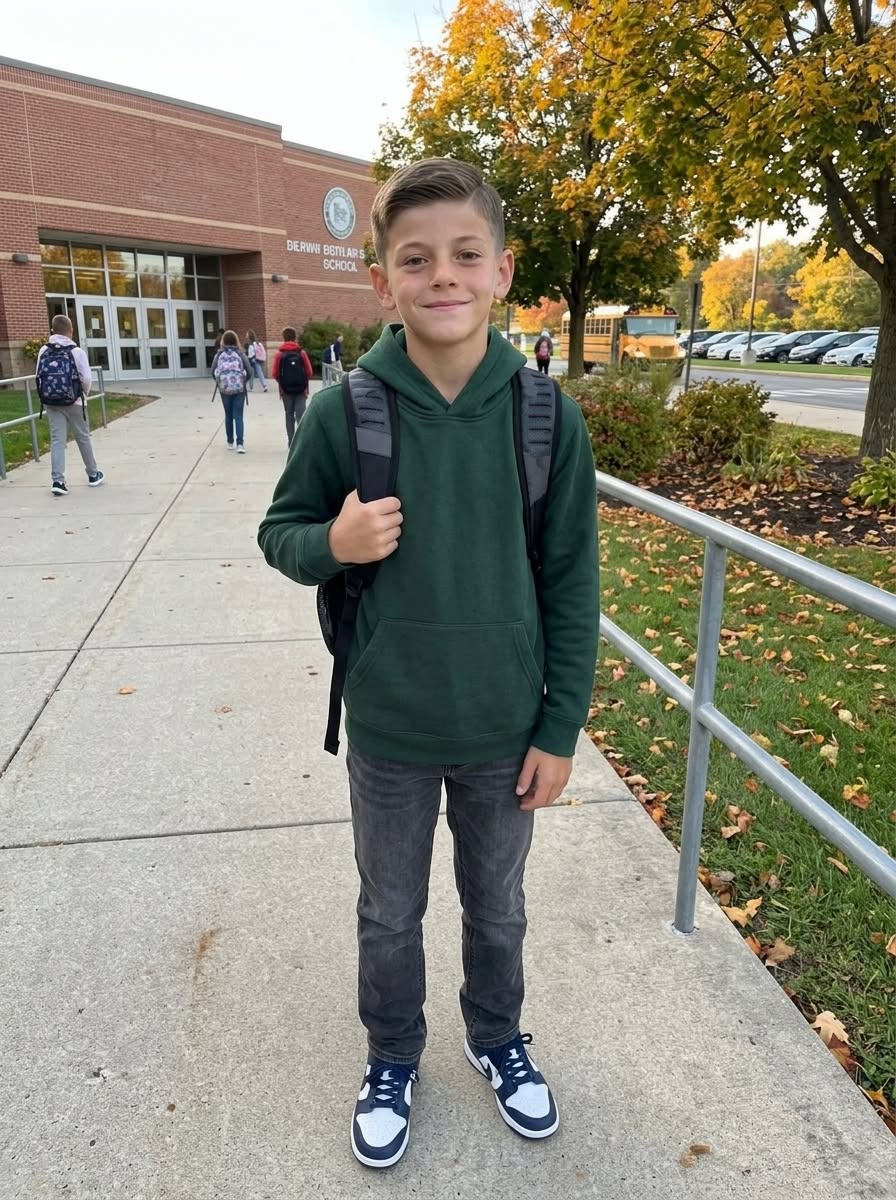
And just like that, the quiet Friday afternoon that had begun with my eleven-year-old asking for a little independence became something I could never have imagined.
I wrapped my arms around Joel.
He buried his face against my shoulder.
“Am I in trouble, Mom?”
I pulled back and looked at him.
“No, sweetheart.”
His eyes searched mine.
“Even though I stopped on the way home?”
I kissed his forehead.
“We’ll talk about the rules later. Right now, I’m proud of you for caring about someone who needed help.”
He let out a breath he seemed to have been holding for a long time.
Then he asked the question that made my heart ache.
“Mom, do you think Grandma would be proud of me?”
I hugged him tighter.
“I know she would.”
But as I watched the ambulance disappear around the corner, I couldn’t stop thinking about the photograph.
The old man had recognized something about Joel.
Something that seemed to connect him to the empty house at the end of our street.
And I had a feeling that our lives were about to change.