“Tell Cody his hunters left my gate open again.”
That was how I found out. Not a letter. Not a phone call. Don said it to me across a pallet of water softener salt at the co-op in Albion on a Thursday afternoon, two days before rifle season opened. He said it the same way he might have told me it looked like rain.
I had a forty-pound bag of sunflower seed on my hip. I set it down on the pallet.
“His hunters?” I said.
Don has farmed across the road from our eighty since before I married into it. He hays the twenty acres of grass on the north end for me on shares, and he runs heifers on his side of the county road. He is not a man who carries tales. Not ever. In all the years I have known him I have never once heard him say a bad word about a neighbor.
He took his seed corn cap off, looked down into it like the answer might be in there, and put it back on.
“Marlene,” he said. “I figured you knew.”
“Knew what, Don?”
“I had eleven heifers out on the road Sunday before last. Your gate was standing wide open and so was mine, because whoever went through yours turned around in my drive. I caught a fella loading a bow into a pickup with Douglas County plates, and I asked him what he thought he was doing.”
He rubbed the back of his neck.
“He was polite about it. Said he was sorry about the gate. Said he was hunting with permission. Said he pays Cody a hundred and fifty dollars a day.”
I did not say anything. I could feel my heart going in my ears.
“I said, pays Cody for what. And he said for the hunting. He said the place came to Cody from his uncle.”
His uncle was Wes.
Wes was my husband for thirty-six years. He had been gone twenty months that week. He went out to the shop on a Tuesday in March to sharpen mower blades, and an hour later I found him sitting on an overturned bucket with his glasses still on his face, like he had only stopped for a minute to think something over.
He never got up.
The eighty was his father’s before it was his. His dad bought it in 1961. Sixty acres of timber and creek bottom along Beaver Creek, and twenty acres of grass, seven miles out of town. It never made anybody a dime to speak of. It was not that kind of land. It was where the men in that family went to be quiet.
Wes ran a road grader for the county for thirty-one years. He spent his whole working life fixing roads other people drove on, and fixing machines that broke every winter, and fixing whatever went wrong in our house on the weekends. That eighty was the only thing he ever owned that he did not have to fix.
It came to me when he died. I paid the taxes on it in April, the same as I had the April before, out of the same checking account I pay the light bill from.
“Don,” I said. “Are you sure he said Cody?”
“He showed me the number in his phone.” Don looked sorry clear down to his boots. “I should have come to the house. I kept thinking it wasn’t my business. And then I kept thinking Wes would’ve wanted me to say.”
“You said it,” I told him. “Thank you.”
I need to tell you who Cody is, or none of the rest of this will make sense.
Cody is my sister Janet’s boy. He was twenty-seven that fall. His own father left when he was nine. Drove off to a job in Texas and never sent for them. Never sent much of anything, not even birthday cards after the first two years.
It was Wes who took that boy. Wes put a fishing pole in his hand the first summer, and showed him how to bait a hook without crying over the worm. Later it was a .22, and later still a deer rifle. Wes taught him to shoot out of the stand above the creek crossing on the eighty.
That stand was built for one man. Wes made it that way on purpose. But the fall Cody turned eleven, Wes tore the old bench out and built it back wide enough for two.
He never said a word about why. He just did it.
Cody stood next to me at the funeral. He carried the casket. I remember his hand on my elbow at the graveside, steadying me, and I remember thinking, at least I still have this boy.
I sat in the co-op parking lot with the engine off for a long time after Don told me. The bag of sunflower seed was still sitting on that pallet inside. I never did go back for it.
I want to be plain about what I could have done, because I know how it sounds that I didn’t.
I could have called the game warden. Hunting somebody’s land without the owner’s permission is against the law in Nebraska, sign on the fence or not. And taking money from people for it, under a lie, is something worse than that. I could have called Deputy Schmitt, who stood up at our wedding and has known Cody since he was in diapers. Either one of them would have been at that gate Saturday morning in a marked truck with the lights going.
I did not send them. Not yet.
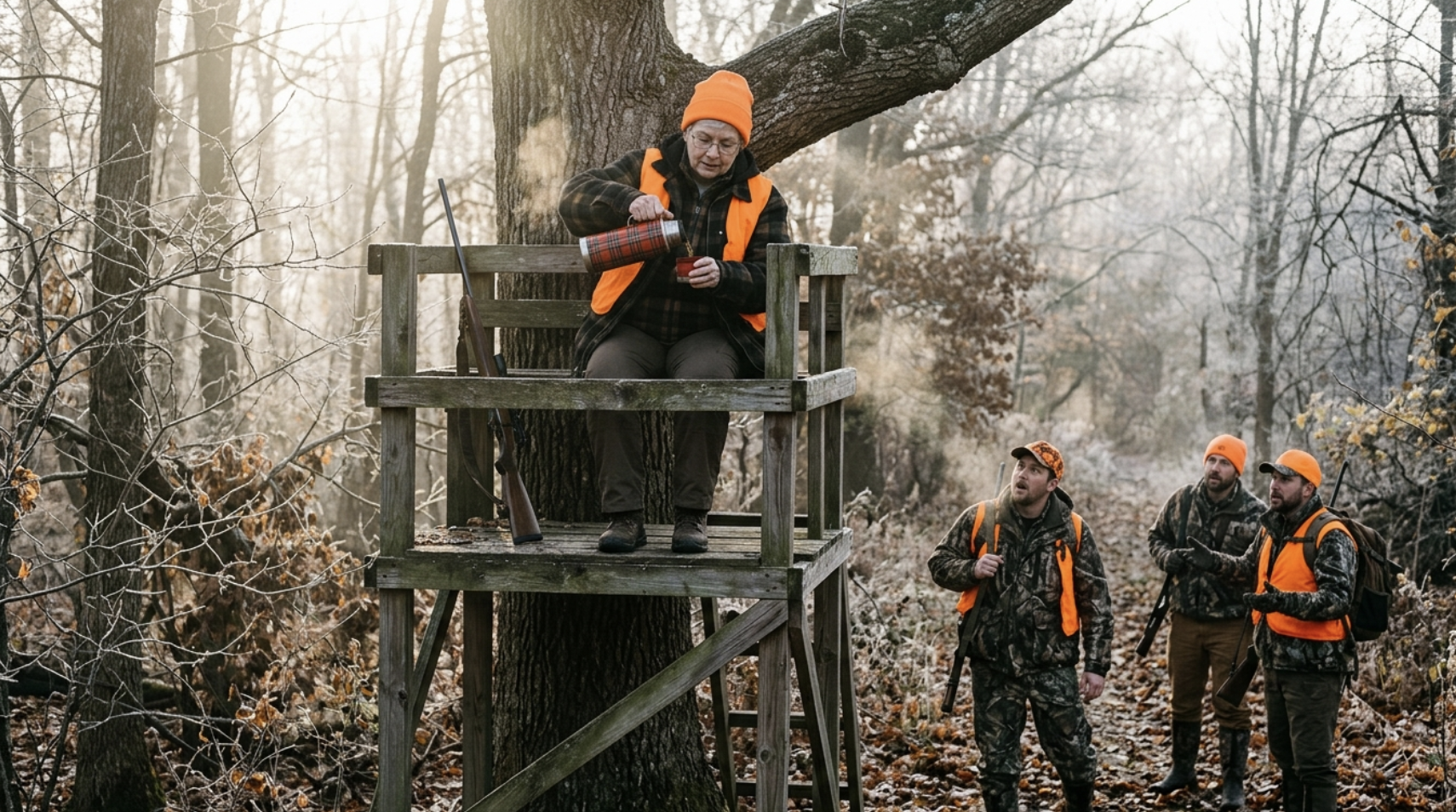
What I did do was call Schmitt at home Friday at noon. I did not give him Cody’s name. I told him I had reason to think strangers were hunting the eighty. I told him I would be sitting in Wes’s stand before daylight on opening morning to see who they were, and that he would hear my voice on his telephone by nine o’clock.
“And if I don’t?” he said.
“Then you come. And you come quick.”
He was quiet on the line. “I could just be there, Marlene.”
“I know you could. I want to look at them myself first. Let me have that.”
He did not like it. I could hear it in his breathing. But he said he would be parked at the corner a mile north with his radio on, and I did not argue with him about that.
I could have called Cody too. That was the one I thought about hardest. I sat at my kitchen table Thursday night with the phone in my hand and his name right there on the screen.
But I have known that boy his whole life. If I called him, he would have a story ready before I hung up. And a better story by the time he got to my kitchen. He would call his hunters off, and he would cry, and I would never know how long it had been going on or how many people he had taken money from.
And there was something else.
Strangers had been walking Wes’s ground for I did not know how long. Sitting on his bench. Looking at his creek. I wanted to see them with my own eyes. I wanted to know what kind of men they were before I decided what kind of trouble this was.
So instead of calling anybody, I drove out there.
It was four o’clock in the afternoon and the light was already going long and yellow across the stubble fields.
The gate was shut. The chain was looped around the post the way it should be, and the padlock was snapped. It was the same padlock that had always been on that gate. Wes kept three keys to it. One was on my ring. One hung on a nail in the shop. And one he had given to Cody on his sixteenth birthday, tucked inside a card.
I had not been out to the eighty four times since the funeral. I will own that. I would drive as far as the gate and see the two-track going down into the trees, and my hands would start shaking on the steering wheel, and I would turn the pickup around and go home.
This time I got out and unlocked the gate and drove down.
The first thing I saw was the sign.
It was a square of plywood wired to the big cottonwood where the two-track forks. Painted white, with black letters done carefully with a brush. Somebody had taken time on those letters.
PRIVATE GROUND. HUNTING BY RESERVATION ONLY. CALL CODY.
And under that, his telephone number.
I stood and read it three times. Then I walked the creek.
Down at the bend there was a new metal ladder stand strapped to an ash tree. The store tag was still zip-tied to the rail. There were truck tracks cut deep into the soft ground along the bottom. Deeper than anything Wes ever left. Wes walked in. He always walked in.
Then I went to Wes’s stand.
It sits eight feet up in a bur oak above the crossing, where the deer come down off the hill to water. He built it out of treated lumber in 1998, and he replaced the boards every few years whether they needed it or not. The ladder is two-by-fours. The bench is a single plank. The rail across the front is a two-by-six he ran his hand along so many seasons that the top of it has gone smooth and dark, like the arm of an old church pew.
I climbed up.
Under the bench somebody had left a hand warmer packet and a candy wrapper.
I sat down where he used to sit. And I looked at the rail.
Wes kept his tally there, cut in with his pocketknife. A notch for every deer that stand ever gave him. Twenty-some of them, small and neat and even, the way he did everything.
And then, next to the notches, a bigger cut. Deeper. In a boy’s uneven letters.
CODY. AGE 12.
And next to that, small, in Wes’s hand:
PROUD OF YOU.
I had never seen it. In thirty-six years of marriage, I had never once climbed that ladder. I had always figured it was his place, his and the boy’s, and I left them to it.
I put my hand on those letters.
I did my crying up there, where nobody was looking. Then I climbed down and drove home, and I did not sleep that night.