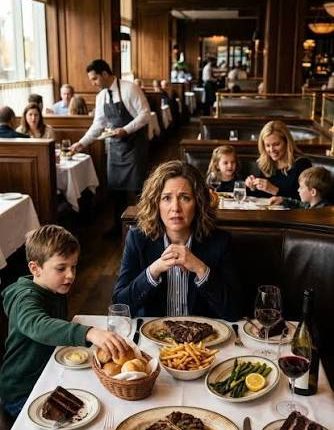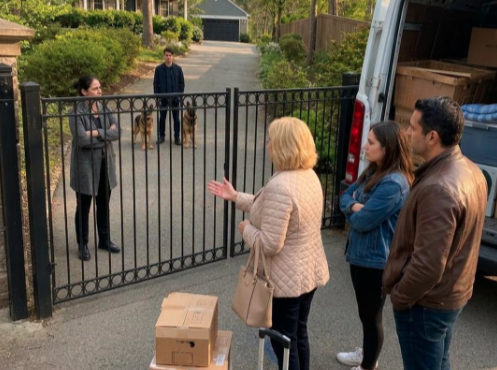
My name is Paige Whitaker. I was thirty-one years old when my mother showed up outside my gate with a rented moving truck, my twin sister, her husband, three children, and enough taped cardboard boxes to cover half my driveway.
The very first words out of Diane Whitaker’s mouth were not a greeting. “Open the gate. We’ve been driving for three hours, and the kids are exhausted.”
She spoke right into the intercom as if I had already agreed to this arrangement, as though my consent had been settled miles back on the highway without my knowledge or input.
Standing behind her was my twin sister, Mallerie, alongside her husband, Grant Keller. Their three children shifted restlessly near the vehicle, gripping backpacks and tablets. One of them had already dropped a small suitcase onto the gravel by the gate, assuming the outcome was already settled for everyone involved.
Mallerie gestured through the iron bars toward my house. “The downstairs suite will suit us wonderfully,” she announced. “The stairs at our current place are becoming far too much to handle.”
Grant peered past her toward my detached workshop. “Is the garage heated?”
My mother glanced nervously toward the neighboring property, dropping her voice as though suddenly fearful of being overheard. “Paige, please don’t make a scene in front of the neighbors.”
I looked down at the keypad beside the gate, then up at the security cameras mounted overhead, silently recording every movement.
Twelve years earlier, these exact people had watched me walk away carrying two garbage bags and no destination for the night. They had called it building independence.
Now that I owned a brick home, a workshop, multiple company vans, and enough acreage to easily swallow their moving truck, they called it family.
For the first time in my life, they were the ones stuck standing outside a closed door.
And that gate remained locked.
My mother’s version of our family history had always been remarkably uncomplicated. She claimed she simply did the absolute best she could after our father walked out when Mallerie and I were eight years old.
That was her go-to line whenever anyone dared question the stark contrast in how her two daughters were treated. She never once acknowledged loving Mallerie more.
Instead, she insisted Mallerie simply needed extra attention. She never admitted I was expected to fade into the background whenever my presence became an inconvenience. She labeled me calm, capable, strong, and self-sufficient, as if those descriptors were high praise rather than symptoms of neglect.
Mallerie was older by seven minutes, but Diane treated those seven minutes like a royal crown placed upon her head in the delivery room, never to be removed.
Mallerie claimed the bedroom beside the window; I slept right next to the door. Mallerie received a brand-new winter coat every single year, while I inherited the previous year’s jacket with its eternally jammed zipper. Mallerie took dance lessons because she was expressive and social.
I was given a library card because I allegedly preferred solitude—as though my quietness had ever been a genuine preference instead of a survival tactic.
On our birthdays, Mallerie picked the cake, the venue, the film, and the guest list. My mother told me how lucky I was to be spared the stress of planning.
Whenever relatives came to visit, Mallerie would sit next to Diane and spin tales casting me as the eccentric twin, the serious one, the difficult girl who somehow made life heavier than necessary.
I learned early on that cruelty doesn’t always arrive screaming. Sometimes it wears the mask of humor. Sometimes it comes wrapped in a gentle hand on your shoulder and a soft reassurance: “You understand, Paige. Your sister simply needs a little more from us than you do.”
We grew up in Ridge Hollow, a sleepy town in central Pennsylvania where everyone knew whose porch needed painting and whose teenager got into trouble before his parents even clocked out of work. Diane worked at a medical billing office.
She paid her rent on time, kept the refrigerator stocked, and made certain the outside world had zero reason to poke around our domestic life. That was her special talent: constructing a home that looked perfectly normal from the street while operating on a rigid hierarchy inside.
I was never starved. No one ever struck me. I had school supplies, a winter coat, and a mother who signed every permission slip punctually. Yet every single day taught me that life went much smoother when I required less.
The sole person who ever called out this imbalance was my grandmother, Elaine Morris—Diane’s mother.
She wore her silver hair in a loose bun and possessed a warm laugh that drew strangers in. She also had a way of looking at my mother that could shut down an argument without a single raised voice.
On Saturday mornings, she took me along to estate sales. “Old objects tell the truth better than people do,” she told me once while inspecting a refinished table. “Pay attention to where the cracks were mended. That’s where the pressure actually was.”
At the time, I thought she was just giving me furniture-restoration tips. Years later, I realized she was teaching me how to read human nature.
Grandma noticed when Mallerie spent my birthday money and Diane instructed me not to be petty.
She noticed when I helped Mallerie study, only to watch Diane heap praise on my sister while dismissing my own strong grades as effortless—treating effort as a virtue only when Mallerie displayed it.
She noticed when Mallerie wept her way out of household chores and I was handed the workload because I was the dependable twin.
Grandma Elaine never made grandiose promises about saving me from my situation. She simply carved out a safe space for me at her kitchen table. She allowed me to speak without correcting my emotions. She let me feel anger without demanding I earn the right to feel it.
During my senior year of high school, she fell ill. It happened faster than any of us could process. One week she was arguing with a pharmacist over pill prices, just as sharp and stubborn as ever; the next, she lacked the strength to sit upright for a single cup of tea.
When she passed away, the fragile balance in our house collapsed overnight. Mallerie stopped pretending she needed to walk on eggshells around me. Diane stopped pretending she intended to treat us fairly.
At the funeral, Mallerie wept into our mother’s chest as though she had been the granddaughter who spent every Saturday morning at that kitchen table. Diane rubbed her back, telling everyone how deeply sensitive her poor girl was.
I stood two steps away without shedding a tear, because my grief had retreated somewhere too deep for crying. My mother looked at my dry face as if my silence were just another personal failing.
That was when I learned a vital lesson that ultimately saved me years later: some families don’t forget how they mistreated you; they simply wait until they need a favor, rewrite history to fit their needs, and expect you to play along.
Following high school, I assumed I had several months to prepare for independence. I had been accepted into a community college drafting program.
I didn’t have some master career plan; I simply loved measuring rooms, reading blueprints, and understanding how physical structures hold together beneath the surface.
Grandma Elaine had left me nine hundred dollars in cash tucked inside an old cookbook’s binding, knowing Diane would never look there. I tucked that money into a worn purse, working mornings at a grocery store and evenings cleaning middle school classrooms. My plan was simple: save enough to rent a room before fall classes started.
Then Mallerie announced she was pregnant.
Diane wept happy tears for two full days, calling every relative on her contact list and marching through our duplex with a notebook like a reality TV home renovator. She decided the baby required a tranquil setting. She decided Mallerie needed constant care. She decided Grant—Mallerie’s boyfriend at the time—should move in so a young father could be involved from day one.
Grant arrived hauling a black pickup truck, two laundry baskets of clothes, a massive television, and the brazen confidence of a man who had never paid for a roof over his head.
He was twenty-one, loud, charming whenever an audience was present, and entirely incapable of holding down a job for more than a few months.
Within forty-her hours, his boots blocked the hallway, his dirty dishes filled the sink, and his opinions dominated every family discussion.
Then Diane dropped the bomb: my bedroom was the only one spacious enough for a crib.
“Where am I supposed to sleep?” I asked.
My mother didn’t look remotely apologetic. In fact, she looked relieved, as though she finally got to voice a script she’d rehearsed in private.
“You’re nineteen, Paige. At some point, you need to stop making yourself my burden.”
I asked if I could take the couch until I found a room to rent. Grant chimed in that his back locked up if he slept poorly, so the living room had to remain free for him.
I suggested the basement. Mallerie claimed the damp air would ruin the baby’s future items. I reminded everyone that college started in six weeks. Diane sighed as though I had personally insulted her.
“Your sister is building a family,” she stated. “You’re just building excuses.”
Mallerie stood behind our mother, hand resting on her belly, a smug smile tugging at her lips. “You always acted like you didn’t need us anyway. This should be a breeze for you.”
I packed my things while they watched television in the next room. No one offered assistance. No one asked me to reconsider. Before I walked out the door, Diane handed me a plastic grocery bag containing a few cans of soup and some crackers.
“Don’t go telling people we kicked you out,” she warned. “Just say you moved. It sounds more mature.”
For the first week, I slept on friends’ floors and lied about why I was crashing there. Pride is a stubborn companion when you’re young; it keeps you upright, but it also blocks you from asking for life-saving help. I didn’t want pity.
I didn’t want school counselors calling Diane. Above all, I didn’t want Mallerie learning I had cried alone in a bathroom at midnight, terrified and pretending otherwise.
By week two, those couches were no longer available. Parents started asking awkward questions. My friends had their own family rules and limitations.
That’s how I ended up living behind a seasonal roadside flea market outside Ridge Hollow, equipped with a discount tent, a flashlight, two bags of clothing, and less than two hundred dollars of Grandma Elaine’s money left. The market only operated Thursday through Sunday.
The rest of the week, the back field sat mostly empty. I pitched my tent behind a row of dark red storage sheds and prayed nobody would notice.
I washed my face and brushed my teeth in gas station restrooms before heading to work. My one decent shirt stayed sealed inside a plastic bag so it wouldn’t absorb the smell of damp grass.
At night, I slept with my shoes right beside my pillow because I once read that you should always be ready to run. Every rustle became a question: raccoon or person? Wind or footsteps? Rain or something brushing against the thin nylon inches from my face?
I learned how biting the ground could get past midnight, even in July. I learned how hunger changes when every single dollar must be hoarded for tomorrow rather than spent today. And I learned that the phrase “family helps family” is usually spoken by people who have quietly decided which relatives are actually worthy of assistance.
The most agonizing part wasn’t the tent itself. It was knowing Diane knew. One rainy afternoon, while rounding up shopping carts in a grocery store lot, I spotted her car pull in. She stared right at me through the windshield.
Mallerie sat in the front passenger seat, laughing at her phone. Diane didn’t park. She didn’t roll down her window. She simply drove past slowly, treating me like an unpleasant memory she chose to ignore that day.
That evening, I nearly dialed her number. I held my prepaid phone until the screen faded to black. Then I remembered Grandma Elaine teaching me to spot repaired cracks in old wood.
Sitting in the wet grass, I made myself a promise: if I survived this, I would build a life anchored by secure walls, locking doors, and absolutely no room set aside for people who only remembered me when they wanted something.
The job that completely altered my trajectory began with water damage at a funeral home. I was twenty-one by then, renting a tiny room above a laundromat and chipping away at college courses one at a time.
A pipe had burst in the viewing room during a January deep freeze. The cleanup crew I worked for was sent in to rip up soggy carpets, wipe down woodwork, and haul ruined ceiling tiles out to a dumpster.
Most of the crew rushed to finish as fast as possible. I, however, kept studying the room. Fine cracks webbed across the plaster. The floorboards buckled near the front row of chairs. The crown molding was waterlogged but salvageable.
A man named Arthur Bell owned the restoration firm hired to handle the actual repairs after our cleanup phase. Arthur was in his late fifties, dressed in flannel and heavy work vests, with the calmest demeanor I’d ever encountered on a job site. He caught me examining the baseboards.
“Do you know what you’re looking at?” he asked.
“Not yet.”
He chuckled. “That’s a much better answer than pretending you do.”
Arthur’s company specialized in reviving older homes and commercial spaces following floods, fires, storms, and years of neglect. He didn’t believe in gutting everything by default.
Instead, he preserved what could be saved, replaced what couldn’t, documented everything meticulously for insurance adjusters, and taught clients the true difference between surface damage and structural decay.
I started helping out on his crew over weekends. Before long, I was taking evening shifts too. When my school cleaning contract ended, Arthur brought me on full-time.
He trained me in moisture mapping, plaster repair, floor sanding, historic window weight preservation, lead-safe practices, and how to draft accurate estimates without preying on frightened homeowners.
I fell in love with the work. Damaged buildings made sense to me in a way my upbringing never had. A ruined room didn’t offer excuses; it demanded an honest assessment. Rotten materials had to be excised before healthy ones could be restored. Boundaries mattered. Documentation mattered.
Arthur noticed I had a gift for handling nervous clients. I understood the subtle pitch of panic in someone’s voice when they were trying to stay polite. I knew how to stand in a wrecked kitchen and say, “We can handle this step-by-step without pretending the situation is smaller than it is.”
For years, I labored until my hands cracked open against Pennsylvania winters. At night, I studied construction management, bookkeeping, and small-business law. I learned to scrutinize contracts because I already knew what happened when people relied on promises rather than paperwork.
Every locked storage trailer required an inventory log. Every project required a signature. Every claim required proof.
By twenty-six, Arthur offered to sell me one of his older work vans and pass along smaller jobs he no longer wanted. I named my business Whitaker Restoration and Finish. I wanted my surname to stand for something entirely apart from Diane’s house.
My first headquarters was a desk shoved into the corner of a rented garage. My first hire was Luis Ramirez, a retired painter who could match stain colors purely by sight. He reviewed my early pricing estimates and simply shook his head.
“You charge too little,” he told me, “because you still feel like you have to apologize for existing.” He was right. My second hire was Jenna Cole, a bookkeeper in bright pink glasses who dug up three overdue invoices buried in my email during her first week.
“Paige, these clients aren’t confused,” she said bluntly. “They’re betting you’re too polite to collect what they owe.” She was right too.
The business expanded steadily. Then, after a severe spring hailstorm slammed the Harrisburg suburbs, our phones stopped ringing quiet. For months, we repaired porch columns, flooded floors, and smashed trim.
A local insurance adjuster began recommending us specifically because our paperwork was airtight. Real estate agents called when historical properties needed delicate prep work prior to listing. Churches contacted us regarding storm windows.
Families hired us after losing an elder, needing an old house made safe before selling.
By age thirty, I managed a team of twelve. We operated four vans and maintained a warehouse stocked with reclaimed flooring, doors, and hardware. We had also built a reputation for brutal honesty—even when telling the truth meant losing a lucrative contract.
The following year, I purchased a property just outside Harrisburg featuring a modest brick house, a detached workshop, a gravel yard for the vans, and an old carriage house converted into material storage.
The previous owner had installed a security fence for equipment storage. I upgraded the gates, lighting, cameras, and intercoms. I wasn’t paranoid; I simply understood the value of a boundary that didn’t rely on someone else choosing to respect it.
A professional security service monitored the commercial yard at night, occasionally bringing trained dogs since the site held expensive tools and rare architectural salvage.
These animals were calm, leashed, and expertly trained. They weren’t there to attack; they existed to provide a clear deterrent before someone made a reckless choice.
I moved in with two mattresses, a coffee maker, and Grandma Elaine’s old cookbook—the very one that once hid nine hundred dollars in its binding.
On my first evening there, I wandered from room to room flicking lights on and off just because I could. No one accused me of running up the electric bill. No one claimed a space belonged to someone else. No one stood in my doorway making me feel like a stranger in my own home.
I slept eight straight hours. That was when I realized peace can feel unnerving when you’re raised in chaos.
Still, I settled in. I painted the kitchen green, planted rosemary by the back steps, and programmed the gate code myself. Every inch of that property had been earned by the exact hands Diane once dismissed as useful only when serving others.
Two weeks after moving in, my mother tracked down the address. I was reviewing invoices for a church project when movement flashed on my security monitor. A silver SUV pulled up outside the front gate.
Diane stepped out wearing oversized sunglasses and carrying a purse far too large for a casual visit. She scanned my house with an expression that instantly knotted my stomach—not pride, but calculated maternal manipulation.
Mallerie emerged from the passenger side, looking a bit weathered compared to her online photos, softer around the jaw but harder around the mouth. Grant parked the rented moving truck so carelessly that a rear tire rested squarely in my driveway’s grass.
Their three kids climbed out burdened with backpacks and tablets, wearing the weary daze of children dragged into adult schemes.
Diane pressed the intercom button and smiled at the camera. “Paige, honey, open the gate. We need to talk.”
I replied through the speaker. “You can talk from right there.”