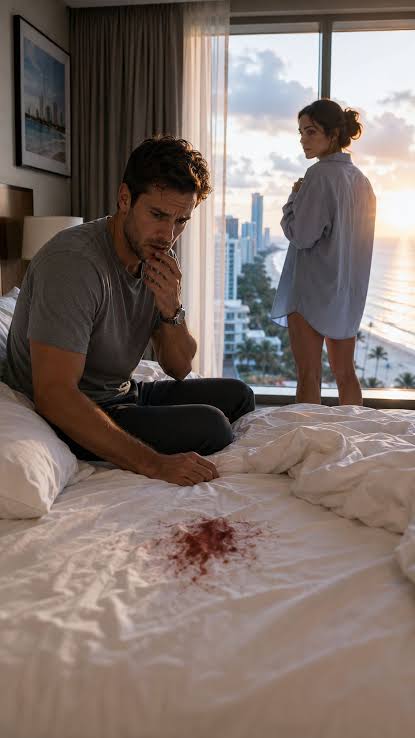
The blood spot on the hotel sheet was about the size of a quarter. Sarah was already pulling the sheet off the bed before I could ask why.
I was standing there in my socks, blinking at it, while she kept her back to me. It was early, though I couldn’t tell you the exact time. The hotel clock had been unplugged, and I remember being annoyed about that before I noticed the blood.
“Sarah, what happened?”
“Nothing. Don’t make a thing of it.”
She said it too fast. Then she took the sheet and went into the bathroom.
That was the first clue. I had plenty more before the month was over, but that morning I let her leave without giving me an answer.
I was in Miami for two nights to look at a piece of land for the construction company I worked for. I was 46, divorced for almost three years, and tired enough that I was counting the days until I could get back to my own bed in Chicago. I grew up on a farm outside Decatur, and when something went wrong, my first instinct was to keep doing the next chore. That habit didn’t always help.
Sarah had moved to Florida after we divorced. She worked in hospitality, somewhere near Miami, and mutual friends said she was doing well. I didn’t ask for details. I told myself that was respectful. It was also easier than hearing she was happier without me.
Our marriage hadn’t ended with a big affair or one terrible fight.
It wore down. I took work calls during dinner. Sarah stopped asking me to put my phone away. We fought over small things, then kept score of the small things. In the last year, we could sit across from each other and barely speak.
When we signed the papers, Sarah brought a red folder with the forms in it. I remember that because she had folded one corner back and kept smoothing it with her thumb while the clerk talked. We shook hands in the parking lot. It was a stupid way to end a marriage, but neither of us knew what else to do.
I didn’t see her again until the Miami trip.
I had checked into the hotel and gone out for a beer because I couldn’t sit in the room with my laptop any longer. I walked into a little bar, ordered, and looked up. Sarah was at the far end of the counter.
I knew her before she turned around. She still tucked her hair behind her ear when she was thinking. I nearly walked back out. Then she turned and saw me.
“Charles?”
“Hey, Sarah.”
We sat at a table after that. We talked carefully at first, like we were crossing a frozen pond and neither one wanted to test the ice. She asked about the company. I asked about her job. We laughed about the time we drove to Wisconsin and got lost because I refused to stop for directions.
“You still do that?” she asked.
“Get lost? Sure.”
“Refuse to ask.”
“That too.”
It was easy in a way I hadn’t expected. That’s the part I don’t like admitting. I had spent years saying we were done, but one hour with her and I was back to making her laugh and listening for what she wasn’t saying.
Around midnight, she said she knew the hotel where I was staying.
She suggested a walk by the water. I told myself it was harmless. I was still telling myself that when she came back to my room with me.
We didn’t talk about what it meant. We didn’t talk about the morning. I said something about how strange it was to be together again, and she said, “Don’t turn it into a big thing.”
So I didn’t.
At dawn, she stood by the window in one of my shirts. For a second I felt comfortable, which was more dangerous than anything else that happened. Then I saw the blood on the sheet.
Sarah wouldn’t explain it. She washed her hands, found her clothes, and left before I could finish getting dressed.
“I have work,” she said.
“Can you just tell me if you’re okay?”
“I’m fine.”
“Sarah.”
“Please, Charles. Not today.”
She left me standing beside the bed with the sheet half pulled back. I had meetings to get to, so I got dressed and went. I texted her after the first one. No answer. I called after lunch. No answer. That night, I saw she’d read my message.
I went back to Chicago the next day. I decided not to press her. I said she was an adult and I was an ex-husband. Both were true. Neither stopped me from checking my phone all week.
That was clue number two: she had left in a hurry, but she’d made sure to take the sheet with her.
I know how that sounds. It could have been laundry. It could have been embarrassment. At the time I pictured a dozen ordinary explanations because ordinary was easier.
Four weeks later, I got a call while I was leaving the office. A woman said my full name and asked whether I was Charles Miller.
“Yes.”
“Mrs. Sarah Sanders listed you as her emergency contact. She’s at Jackson Memorial Hospital. We need you to call us right away.”
I was on the sidewalk, with people going around me, and couldn’t make myself take a step.
“What happened?”
“She was found unconscious near her apartment building. She was brought in early this morning.”
“Was there an accident?”
“We believe she fell. The doctor can explain more.”
I called the number back from the curb. Then I called my boss and told him I had a family emergency. He asked if I needed a ride. I said no, because it was easier than explaining that my ex-wife was in Miami and I was going to find out why she’d written my name on a hospital form.
I booked the first flight I could get. At the airport I kept thinking about the blood spot. Then I told myself I was being ridiculous. I had a few hours to come up with reasons that didn’t scare me.
At Jackson, a nurse led me to a small room and asked how I knew Sarah.
“We were married.”
“How long ago?”
“Almost three years.”
She glanced at her screen. “I see.”
That “I see” stayed with me. It sounded like she had already guessed there was more to it, which was probably just me hearing things.
Sarah was awake by the time I saw her. She had a bruise near her hairline and a hospital band around her wrist. Her hair looked flat against the pillow. She stared at me like she’d been expecting anyone but me.
“You came.”
“They called.”
“I know.”
I pulled a chair close to the bed. My hands felt clumsy, so I put them on my knees.
“What happened?”
“I fell.”
“Why?”
“I got dizzy.”
“Why were you dizzy?”
She looked at the wall instead of me. I thought of the hotel, her leaving with the sheet, those unanswered messages. All the small things lined up in my head, but I still didn’t know what they meant.
“Sarah, what was the blood?”
She closed her eyes.
The doctor came in before she answered. He introduced himself, asked me to step into the hall, and said Sarah had acute myeloid leukemia. He said her blood counts were low, and the fall had caused a head injury. They were watching it closely. Her condition was serious, but she was stable.
I asked him to repeat the name.
“Acute myeloid leukemia.”
I knew enough to hear that it was cancer. I didn’t know enough to ask the right questions, so I asked the same ones twice. He told me she had been diagnosed before she saw me in Miami. She’d already started treatment.
The red spot hadn’t been from a cut or a period. Her blood wasn’t clotting the way it should. Sex had started a nosebleed, and she hadn’t wanted me to see.
I sat down in the hall. The nurse asked if I needed water. I said I was fine. That was a lie, but it was the only answer I had ready.
When I went back in, Sarah had her eyes open.
“You knew before Miami?”
“Yes.”
“How long?”
“Six weeks.”
“And you didn’t tell me.”
“No.”
I tried to think of a good reason she should have. There wasn’t one. We were divorced. She didn’t owe me a medical report. Still, I felt something ugly in me, like I had been kept outside a door I thought I could still open.
“Why did you list me?”
She turned her face toward me. “I didn’t, at first.”
The nurse had left a folder on the counter. Sarah nodded toward it.
“Check the date.”
I picked up the intake form. Her name was printed at the top. Under emergency contact, someone had typed mine. The date beside it was the morning after we spent the night together.
I looked at her.
“I added it before I went to the clinic,” she said. “I thought maybe you’d answer if something happened.”
That landed harder than the diagnosis. She had been afraid enough to put my number down, then afraid enough to hide why.
“You could have called me.”
“I didn’t want you coming back because I was sick.”
“I came because you were in the hospital.”
“I know.”
Neither of us said anything for a while. I could hear a cart rolling over a seam in the hallway floor. It made the same little clunk every few seconds.
Then Sarah said, “I didn’t know how to tell you.”
“Did you think I’d pity you?”
“I thought you’d try to fix it. And then you’d get mad when I didn’t want you to.”
That was close enough to true that I didn’t argue. I liked being needed. I also liked pretending I was only helping. When Sarah was well, she had never needed me in quite the way I wanted.
I could have told her none of that mattered now. I didn’t. I was too aware that I had left her alone in that hotel room after seeing blood.
“I should’ve stayed that morning,” I said.
“Maybe.”
It wasn’t forgiveness. I didn’t ask for it.
A social worker came in and explained that Sarah had listed a local friend as a backup contact, but the woman was out of town. I asked if Sarah had anyone else. Sarah named her older sister, who lived in Arizona, and a coworker who couldn’t leave work that day.
“Can I stay on the form?” I asked.
Sarah looked at me for a long second. “For now.”
So I stayed.
The next few days were mostly phone calls, forms, and waiting. Her head injury didn’t get worse, and the doctors adjusted the treatment plan. Sarah had already been going to appointments on her own. She had kept working as long as she could, partly because she needed the insurance and partly because sitting at home scared her more.
I learned that from her, not from the doctors. We had a lot of short talks between visits.
“You don’t have to sit here all day,” she told me.
“I know.”
“Your job?”
“They can survive without me for three days.”
“You hate being away from the job.”
“I hate being away from the job when I’m choosing to be.”
She gave me a tired half smile. “That sounds like you.”
I started making calls about her apartment and her leave from work. I asked before I did anything. That was new for me. I had spent most of our marriage deciding that taking over was the same as helping.
When her sister called from Arizona, I gave her the doctor’s number and explained what I knew. Sarah listened from the bed. Afterward, she said, “Thanks for not making it sound worse than it is.”
“I don’t know how bad it is.”
“Neither do I.”
There was the truth, plain and small. The doctors could talk about treatment and odds. Nobody could tell either of us what would happen.
On the fourth day, Sarah asked me to bring the red folder from her apartment. She said it was in the bottom drawer of her desk, behind the tax papers. I knew the folder. It was the one she’d carried when we signed our divorce papers, though I hadn’t seen it since.
I brought it in a grocery bag with her phone charger and a pair of clean socks. She took out the folder and set it on the bed.
“You kept that?” I asked.
“I keep too much.”