PART 3
Her face reddened. “You make it sound as though we have been exploiting you.” I could have listed everything.
The early mornings. The late dinners. The school pickups. The laundry. The deliveries. The errands that always seemed to become emergencies the moment I said I wanted an afternoon to myself.
I could have shown her the little blue notebook.
I could have read aloud every assignment that had quietly appeared under my name.
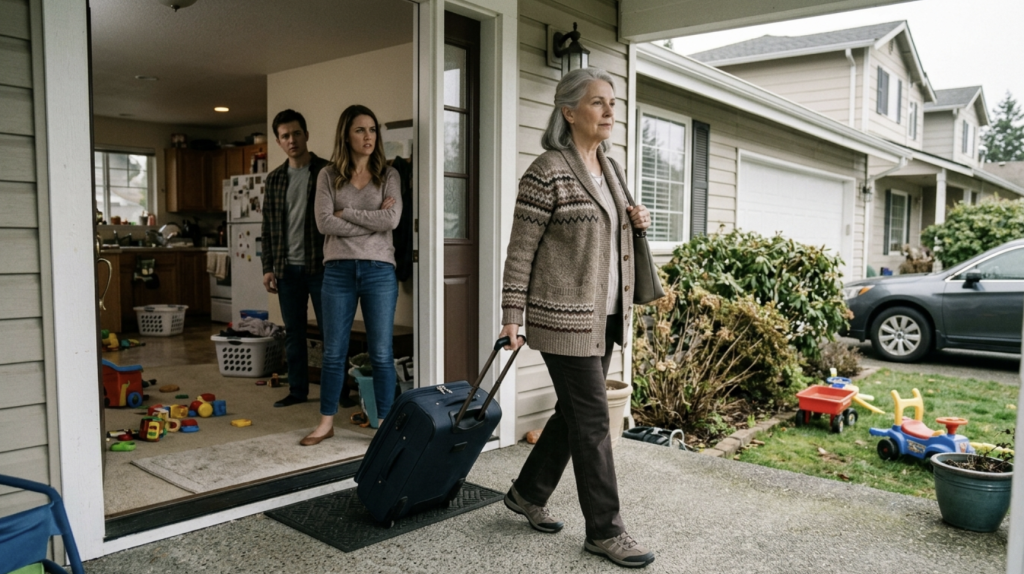
Instead, I zipped my suitcase.
“I don’t need to make it sound like anything,” I said. “I only need to stop doing what I never agreed to do.”
Callum followed me toward the front door.
“Mom, please. Can we talk about this privately?”
“We already talked privately.”
“I know, but—”
“You knew I might say no, Callum. You told me that yourself.”
He looked down.
“I made a mistake.”
“Yes,” I said. “You did.”
His eyes lifted, perhaps surprised that I had not immediately comforted him.
For most of his life, I had been the person who softened difficult truths so that he could bear hearing them.
When he failed an exam, I reminded him that one bad grade did not define him.
When his first serious relationship ended, I sat beside him until he stopped blaming himself.
When his father died, I held him while he cried, even though I was barely able to stand beneath the weight of my own grief.
I had spent decades teaching my son that he could come home when life became difficult.
Somewhere along the way, I had forgotten to teach him that coming home did not mean handing someone else the burden of his life.
“Can you at least stay until we find someone?” he asked.
“When will that be?”
“A few days. Maybe a week.”
“And if you cannot find anyone in a week?”
He hesitated.
“We’ll figure something out.”
I nodded.
“Then figure it out now.”
I opened the door.
The autumn air was cold against my face.
Behind me, Tessa said, “I hope you understand what you’re doing to this family.”
I turned around one last time.
“I understand exactly what I’m doing, Tessa. I’m going home.”
Then I left.
I did not slam the door.
I did not cry on the front steps.
I placed my suitcase in the trunk of my car, adjusted the rearview mirror, and drove away.
For the first twenty minutes, I felt as though I had committed some terrible offense.
I kept imagining June looking for me after school. I imagined Micah asking where Grandma had gone. I imagined Callum standing in the kitchen, overwhelmed by all the things I had previously done without anyone needing to ask.
Then I reached the highway.
The sky was pale blue, the trees along the road had begun turning gold, and for the first time in weeks, nobody was calling my name.
I stopped at a small roadside café.
I ordered a grilled cheese sandwich, a bowl of tomato soup, and a cup of coffee.
The waitress asked whether anyone would be joining me.
“No,” I said.
Then, after a moment, I smiled.
“Just me today.”
I sat by the window and ate slowly.
It was a small thing.
But sometimes the first sign that your life belongs to you again is being able to finish a meal while it is still warm.
When I finally arrived at my little brick ranch, the sun was beginning to set.
The house looked exactly as I had left it.
The porch light was off. The curtains were closed. A few leaves had gathered beside the front steps.
I unlocked the door and carried my suitcase inside.
The silence greeted me.
For weeks, I had been too busy to notice how much I missed it.
I put my suitcase in the bedroom, changed into comfortable clothes, and made myself a cup of tea.
Then I took out my blue notebook.
I opened it to the last page.
For several minutes, I stared at the lists of errands and responsibilities.
I had written down every pickup, every delivery, every dinner, every unexpected appointment.
I had not written down a single hour I had spent resting.
Not one.
I turned to a fresh page.
At the top, I wrote:
Things I Am Allowed to Do Without Asking Permission.
I stared at the words, feeling slightly foolish.
Then I began.
Read a book.
Visit Ruth.
Sleep until eight.
Eat dinner whenever I want.
Go to the garden center.
Spend money on flowers.
Say no without explaining myself.
I stopped there.
Then I added one more.
Love my family without making myself indispensable to them.
I closed the notebook.
For the first time in six weeks, I slept through the night.
The next morning, my phone rang at 6:42.
Callum.
I watched it vibrate on the bedside table.
It rang until it stopped.
A moment later, a message appeared.
Mom, did you leave the school emergency folder?
I had.
It was in the kitchen drawer, exactly where I had told him it would be.
I replied:
Top drawer beside the refrigerator. The school phone numbers are inside.
Three minutes later, another message arrived.
Can you call the school and explain that you’re no longer doing pickup?
I stared at the screen.
I had already removed myself from the regular pickup list the previous afternoon. Callum and Tessa were now responsible for providing the school with their own arrangements.
I typed:
You and Tessa will need to contact the school yourselves. They will be happy to update your arrangements.
Then I put my phone down.
At 7:15, it rang again.
This time, it was Tessa.
I answered.
“Lenora, the children are getting ready, and we have a problem.”
“What’s the problem?”
“Callum has to be at work by eight, and I have a meeting with the bakery’s suppliers. Neither of us can take them.”
“I’m sorry to hear that.”
There was a pause.
“Could you just take them today? We can discuss everything else later.”
I looked out the window at my quiet garden.
“Tessa, I’m two hours away.”
“I know, but—”
“And even if I were next door, I wouldn’t have agreed to take them today.”
She exhaled sharply.
“So you’re really doing this.”
“Doing what?”
“Refusing to help.”
I let the silence settle between us.
Then I said, “I helped for six weeks. Now I’m going home to live my own life.”
“You make everything sound transactional.”
“No. I make it sound voluntary.”
She said nothing.
I continued, “I love June and Micah. That hasn’t changed. But loving them doesn’t mean I am automatically responsible for every gap in your schedule.”
“We’re under enormous pressure right now.”
“I understand that.”
“Then why can’t you be more understanding?”
“Because understanding your pressure doesn’t make it disappear when you hand it to me.”
For the first time since I had known her, Tessa seemed unable to find an immediate response.
Finally, she said, “Callum is going to be devastated when he realizes you won’t come back.”
My heart tightened.
That was the sentence she had chosen.
Not that the children would miss me.
Not that she regretted what she had said.
She was reminding me of my son’s feelings, trusting that I would once again sacrifice my own comfort to protect him from disappointment.
“Tessa,” I said quietly, “Callum is a grown man. He can be upset with me and still be responsible for his family.”
I ended the call.
Then I made breakfast.
Not for six people.
Not while checking permission slips or looking for missing shoes.
Just eggs, toast, and a cup of coffee.
I ate at the kitchen table, where I had eaten alone so many times after Ray died.
But that morning, the silence felt different.
It no longer sounded like something I had lost.
It sounded like something I had reclaimed.
By Saturday morning, I had begun to settle into my own routine.
I watered the plants on the porch. I went to the grocery store. I called my friend Ruth and told her I was finally back.
She invited me to lunch.
We met at a little restaurant near the library, the kind of place with paper napkins and homemade pies displayed beneath glass.
Ruth looked at me for a long moment after I sat down.
“You look tired,” she said.
“I am.”
“No. I mean the kind of tired that comes from carrying something for too long.”
I laughed softly.
“Is it that obvious?”
“To me? Yes.”
I told her everything.
The calendar assignments. The budget. The consulting fees. The argument in the kitchen.
When I finished, Ruth put down her fork.
“Lenora, do you know what bothers me most?”
“What?”
“You’re telling this story as if you abandoned them.”
I looked at her.
“But I did leave.”
“You left a house where two capable adults had quietly decided your time belonged to them. Those are not the same thing.”
I looked down at my hands.
“I should have spoken up earlier.”
“Perhaps. But they should have asked earlier, too.”
For a moment, I could not answer.
Then Ruth reached across the table and squeezed my hand.
“You can be a wonderful mother and grandmother without being available every minute of every day.”
I swallowed the lump in my throat.
“I know that in my head.”
“And what does your heart say?”
I looked toward the window.
“My heart says June will wonder why I left. Micah will think he did something wrong. Callum will think I chose myself over him.”
Ruth’s expression softened.
“Then tell the children the truth when you speak to them. Don’t let guilt do the talking for you.”
That afternoon, June called.
I answered on the second ring.
“Grandma?”
“Hello, sweetheart.”
“Are you coming home?”
I closed my eyes briefly.
“I’m already home, darling. I’m at my own house.”
There was a pause.
“Did we do something bad?”
My heart broke a little.
“Oh, June. No. Absolutely not.”
“Then why did you leave?”
I took a breath.
“Sometimes grown-ups need to remember how to take care of themselves, too. Grandma loves you and Micah more than you can imagine. But I needed to go back to my house for a while.”
“Are you mad at Mom?”
“I love your mom. And I’m not asking you to take sides in anything.”
“Are you mad at Dad?”
“No, sweetheart.”
“Are you coming for my school concert?”
That question caught me off guard.
“When is it?”
“Next Thursday. I told my teacher you would come because you always come.”
I felt tears sting my eyes.
For six weeks, I had been so busy taking care of everyone else’s responsibilities that I had barely thought about the things I wanted to do with my grandchildren.
I had planned to attend that concert.
Then a bakery delivery had appeared on my calendar.
“I would love to come,” I told her. “If your parents are able to arrange it, I’ll be there.”
“Okay.”
Her voice brightened.
“Can I tell Micah you said hello?”
“Of course.”
A few seconds later, I heard his small voice shouting in the background.
“GRANDMA! I LOST MY BLUE DINOSAUR!”
I laughed through my tears.
“Look under your bed, sweetheart!”
“I ALREADY DID!”
“Then look under your pillow!”
There was a loud rustling sound.
Then a triumphant scream.
“FOUND IT!”
June came back to the phone.
“He says he loves you.”
“Tell him I love him, too.”
When the call ended, I sat quietly for several minutes.
Leaving the household had been necessary.
But leaving the children emotionally stranded was never what I wanted.
I could hold my boundary and still remain their grandmother.
Those two things did not have to compete.
By Monday, the bakery was open.
I knew because Tessa posted photographs online.
Juniper and Rye looked beautiful.
The oak display cases were filled with croissants, cinnamon rolls, fruit tarts, and loaves of sourdough. Flowers stood beside the register. A chalkboard announced the day’s specials.
The photographs showed Tessa smiling beside the counter, Maris standing near the espresso machine, and Callum holding a box of pastries.
The caption read:
After months of hard work, our dream is finally open. Thank you to everyone who helped make Juniper and Rye possible.
I read it twice.
Then I put my phone away.
I did not expect my name to be mentioned.
I had not helped them because I wanted public recognition.
But I wondered whether anyone looking at those photographs understood what it had taken to get the bakery to opening day.
Who had watched the children while the inspections happened?
Who had prepared dinners when both parents stayed late?
Who had driven across town for missing supplies?
Who had returned defective packaging and waited for deliveries?
Who had made it possible for the people in those photographs to stand smiling in front of their dream?
The answer did not need to be written beneath a photograph.
I knew it.
And for the first time, knowing it was enough.
On Tuesday, Callum called during lunch.
I was reading a novel in the garden when his name appeared on the screen.
“Hi, Mom.”
“Hello, sweetheart.”
He sounded exhausted.
“How are you?”
“I’m fine. How are you?”
A short laugh escaped him.
“Honestly?”
“Honestly.”
“Terrible.”
I closed my book.
“What happened?”
“Everything is harder than I thought.”
He told me that the school pickup arrangements had fallen apart twice. Tessa had missed a supplier meeting because Micah had developed a fever. He had left work early, and the bakery had been short-staffed during the afternoon rush.
Their original childcare plan had depended on my being there.
Without me, the gaps were suddenly visible.
“We’ve hired someone to help in the afternoons,” he said. “But she can’t start until next week.”
“I’m glad you’ve found someone.”
He hesitated.
“Mom, I know you must be angry.”
“I’m not trying to punish you, Callum.”
“Then what are you doing?”
I looked at the sunlight falling across my book.
“Learning how to be your mother without becoming the solution to every problem in your life.”
He went quiet.
I continued.
“When your father was alive, we worked hard to make sure you could stand on your own feet. I don’t want you to need me less because I love you less. I want you to need me differently because you’re capable of doing more yourself.”
He breathed out slowly.
“I didn’t realize how much you were doing.”
“You didn’t ask.”
“I know.”
“And I didn’t tell you when I became overwhelmed. That’s something I should have done.”
“Mom, you shouldn’t have had to.”
I closed my eyes.
That was the first time anyone in that household had said those words.
For six weeks, I had heard that they were busy, stressed, exhausted, and under pressure.
I had understood all of it.
But understanding had rarely traveled in the other direction.
“Thank you,” I said.
He cleared his throat.
“Can I ask you something?”
“Of course.”
“Did you really mean it when you said you were going home for good?”
I considered the question.
“I meant that I wasn’t going to stay in your house under the arrangement we had.”
“So you’re not saying you won’t ever stay with us again?”
“No. I’m saying that if I visit, it will be because we’ve agreed on the visit together. Not because someone has decided my time is available.”
He was quiet for a moment.
“That sounds fair.”
“It is fair.”
Before we hung up, he said something I had been waiting to hear.
“I’m sorry, Mom.”
Not I’m sorry things got difficult.
Not I’m sorry you felt unappreciated.
Just a simple apology.
“I appreciate that,” I told him.
And I did.
But an apology was only the beginning.
The real change would come when he had to choose what to do the next time he needed help.
The first unexpected bill arrived on Wednesday.
I learned about it through a text message from Callum.
The after-school program costs more than we expected. We need to cover three afternoons this week, plus the registration fee.
A second message followed.
The emergency babysitter charged $180 for yesterday because we needed someone on short notice.
I read both messages.
Then I put my phone down.
I did not know what response he expected.
Perhaps he wanted sympathy.
Perhaps he wanted me to offer to drive over and take over again.
I couldn’t be sure.
So I answered honestly.
That sounds expensive. I hope you can find a regular arrangement that works for your family.
He did not respond.
That evening, Tessa sent me a longer message.
Lenora, I know things became tense before you left. But we are facing some serious financial pressure now. We have paid for childcare, delivery help, and extra household support. The costs are adding up quickly. I really wish you had given us more notice.
I read it slowly.
More notice.
I had told them I was leaving the previous evening. I had explained that I was returning home. I had removed my name from the pickup list and left the information they needed.
They had simply expected me to change my mind.
I wrote a reply, deleted it, and started again.
I understand the pressure is real, Tessa. I hope you and Callum find a sustainable solution. I agreed to help for six weeks. I did not agree to stay until December, and I did not agree to become the bakery’s unpaid delivery service or your permanent childcare plan. I love the children, and I love my family. But I need my time and my home to be respected, too.
I sent the message.
Tessa read it.
She did not reply.
I thought that might be the end of the conversation.
I was wrong.
The next morning, Callum called again.
“Mom, can we talk about the costs?”
I was standing in the kitchen, preparing to make soup.
“Of course.”
He sounded embarrassed.
“We’ve had to pay for several things we weren’t expecting.”
“What things?”
“Childcare. A delivery driver. Prepared dinners a few nights. And we had to pay someone to stay with the kids while Tessa dealt with a problem at the bakery.”
I stirred the soup.
“How much?”
He hesitated.
“About eighteen hundred and fifty dollars so far.”
I stopped stirring.
Not because I was surprised that childcare and household help cost money.
But because I suddenly understood the number that had been hiding inside all those little favors.
Nearly $1,850 in just two weeks.
And that did not include the cost of all the hours I had given them during the six weeks before I left.
“That’s a lot of money,” I said.
“It is.”
He sounded tired.
“I’m not telling you this to make you feel bad.”
I waited.
He continued.
“It’s just that we never realized how much we were relying on you until you weren’t here.”
I leaned against the counter.
“Callum, I think you knew you were relying on me. I don’t think you understood what that reliance meant.”
He was silent.
“Every time you needed someone to collect the children, I was there. Every time a delivery was late, I went. Every time dinner needed to be made, I made it. Because I loved you, I stopped noticing how much of my own life I was giving away.”
“I’m sorry.”
“I believe you.”
He sighed.
“Can I tell you what happened yesterday?”
“Go ahead.”
“Tessa had to leave the bakery early because the sitter called in sick. I stayed home with the kids. We had a catering order that needed to be delivered, and I couldn’t leave them alone, obviously.”
“Of course.”
“So we paid a courier service to take the order. Then the customer called because one of the boxes was damaged. Tessa had to arrange a replacement.”
I listened.
“Then June needed her school project finished. Micah couldn’t find his library book. The kitchen was a mess, and neither of us had bought groceries.”
He laughed, but there was no humor in it.
“By nine o’clock, we were both exhausted.”
I felt a familiar instinct rise inside me.
I could have offered to come over for a weekend.
I could have suggested preparing several meals in advance.
I could have driven to their house and helped them organize a better system.
The solutions were already lining up in my mind.
For years, that was what motherhood had meant to me: seeing a problem before anyone else did and quietly making it disappear.
But I had learned something during the past few days.
If I rushed to solve every problem, they would never have to learn how to solve their own.
So I asked a different question.
“What are you going to change?”
He was quiet.
“What do you mean?”
“What are you going to do differently so this doesn’t keep happening?”
He took a long breath.
“We’re making a schedule.”
“Good.”
“We’ve also decided that Maris can help with the children on Fridays when she isn’t working.”
I remembered the packaging call that had once been too important for her to interrupt.
“That sounds useful.”
“And we’re going to hire a regular driver for bakery deliveries instead of asking whoever happens to be available.”
“That sounds sensible.”
He paused.
“Mom?”
“Yes?”
“I think I owe you more than an apology.”
I said nothing.
“I don’t mean money. I know you weren’t asking to be paid.”
“That’s true.”
“I mean I owe you an honest acknowledgment of what you did.”
My throat tightened.
For six weeks, I had wanted someone to notice.
Not the money.
Not the recognition.
Just the truth.
“You can start by remembering that helping you was my choice,” I said. “And that choice should have remained mine.”
“I understand.”
“I hope you do.”
We ended the call gently.
I returned to my soup.
Outside, the afternoon sun settled across the garden, and the first few leaves drifted onto the porch.
For the first time since leaving their house, I felt that something important had begun to change.
Not because the bills were expensive.
Not because the household was struggling.
But because my son was finally beginning to see the difference between having help and having someone who had quietly been carrying his responsibilities for him.
And I had a feeling that the real conversation was still ahead.