Chapter 1
My mother promised my brother three bedrooms in my new house without asking me. “Family doesn’t ask permission,” she said—then my husband and daughters walked through the door she thought I lived behind alone. I handed her an envelope with my father’s instructions, and suddenly she wasn’t deciding who belonged in my home…
The first thing my mother did when she walked into my new house was admire the kitchen. The second thing she did was give away three bedrooms.
“This kitchen is gorgeous,” she said, running her fingertips along the white quartz island. Then she glanced toward the hallway and added, “With three spare bedrooms, your brother’s family will finally have room to breathe. Ryan already gave his landlord notice.”
She had been inside less than four minutes. Apparently, the tour included a complimentary transfer of ownership.
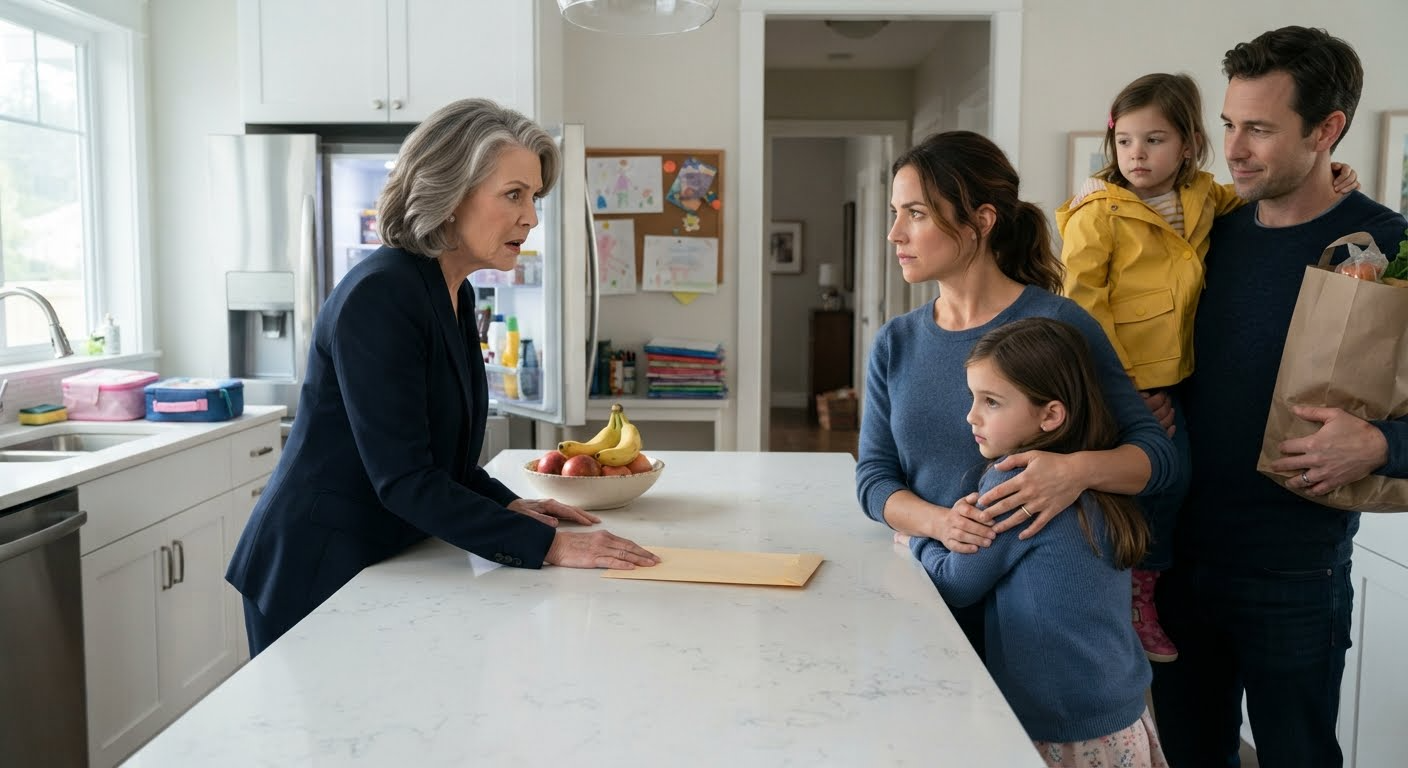
I stood across the island watching Diane Whitmore make arrangements for rooms she had never entered. Beside the fruit bowl sat a cream envelope, the reason I had invited her, but she hadn’t noticed it yet.
For most of my life, my mother had treated my objections as symptoms of an unfortunate personality. I was sensitive when I wanted something returned, dramatic when I questioned a decision, and selfish when my paycheck developed plans of its own.
My name is Mara Whitmore. At twenty, I lent my brother my first car, and he drove it into a mailbox; I paid the deductible while Mom explained how terrible he felt.
When he lost his job at a plumbing supply company, I covered groceries for four months. Mom reminded me that he had children, as though I had misplaced that information somewhere between the milk and the electric bill.
Later, Ryan and his wife, Kelsey, enrolled their twin daughters in a private elementary school they couldn’t comfortably afford. Mom called me before they called the school.
“You’ve always been responsible,” she said. “And you don’t have children. You can help.”
When I declined, she stopped speaking to me for six weeks. I spent those weeks wondering whether I had been cruel, which was how her silences usually worked.
Then Dad died, and the familiar requests became something I couldn’t explain away.
Thomas Whitmore had built modest but solid wealth: investments, savings, retirement accounts, and part ownership of a commercial property. He liked to say he wanted both his children to have “a soft place to land.”
At his funeral, neighbors were still carrying casseroles into the church basement when Mom hugged me. I leaned against her, grateful for the comfort, until she whispered, “Don’t make this about money. Your brother needs stability.”
I hadn’t asked about money. I was trying to get through the afternoon without crying into somebody’s potato salad.
Three weeks later, she explained that Dad had changed his plans. Ryan’s landscaping company needed help, and protecting the grandchildren meant directing much of the available money into the business.
“What about my share?” I asked.
“You have a career,” she said. When I asked what that had to do with it, she answered, “Ryan has a family.”
Documents appeared in front of me, thick with account summaries and language I struggled to follow while grieving. I signed one acknowledgment and refused another; Mom cried, and Ryan called me greedy.
Money I had understood would be divided between us went into his company. Eleven months later, the company failed, with Ryan blaming equipment costs and Mom blaming his business partner.
I ended up in a studio above a laundromat. At eleven every night, the dryers vibrated beneath my floor, an appliance orchestra with absolutely no interest in requests.
One evening, unable to sleep, I opened Facebook and saw Ryan’s family in Florida. Matching shirts, a resort pool, and Mom’s comment underneath: “So happy my babies can finally relax.”
I stared at it for a long time. Then I blocked them.
For four years, my mother knew almost nothing about my life. She could keep imagining the daughter upstairs from the dryers, because I no longer called to correct her.
I worked, earned a promotion, saved, and invested. Eventually I bought a little blue house and rented it out, checking the numbers myself instead of trusting somebody who told me numbers were unkind.
I also met Ethan Brooks in an urgent care waiting room, eighteen months after Dad died. I had a sprained wrist; his daughter Lily had introduced a bead to her nose, an ambitious craft project nobody had approved.
He made me laugh when I didn’t think I had much laughter left. Our relationship grew, and later he introduced me properly to Lily and her younger sister, Grace.
Their mother had died when Grace was a toddler. I never tried to take her place; I learned how to show up in my own.
There were school plays, dentist appointments, science projects, and pancakes that should have been removed from the stove several minutes sooner. There were ordinary evenings when somebody needed a clean shirt or someone to sit beside her until a nightmare loosened its grip.
The first time Grace accidentally called me “Mom,” she cried because she thought she had done something wrong. I knelt beside her and held her while she wrapped both arms around my neck.
.
“You didn’t do anything wrong,” I told her. I meant every word.
Ethan and I married near Lake Michigan, with Lily carrying yellow flowers and Grace dropping the rings twice. I didn’t invite my mother; I wanted one important day she couldn’t rearrange around Ryan.
Later, we bought this house together. Four bedrooms, a garden, a breakfast nook Lily claimed for homework, and a kitchen spacious enough for Ethan to dirty every pot while attempting French food.
We argued over the pendant lights for three weeks. Grace labeled the pantry with crooked stickers, and somehow those stickers made it feel more like home than anything the real estate agent had pointed out.
Three months after we moved in, an unfamiliar number called. I almost ignored it, but the woman introduced herself as Nora Caldwell, who had worked for Dad’s estate attorney.
“I think we need to meet,” she said.
That conversation led to the envelope beside the fruit bowl. Mom believed my invitation meant reconciliation; I had invited her because I needed to see what she would say when I showed her what had been found.
Instead, she was assigning bedrooms.
“Ryan and Kelsey should take the room facing the garden,” she continued. “The twins can share the one near the upstairs bathroom. Kelsey wants them close.”
“You discussed my bedrooms with Kelsey?”
“I sent her the listing.” Mom gave a little wave, as though that cleared everything up. “Mara, don’t turn this into a thing.”
“You told them they could move in without asking me?”
“Family doesn’t ask permission.”
She opened the refrigerator and frowned at its contents. We would need a second one in the garage, she decided, because Ryan’s girls drank so much milk.
I looked from her hand on my refrigerator door to the cream envelope. She hadn’t asked how I had been, who used the breakfast nook, or why two lunch boxes stood beside the sink.
.
“This is my house, Mom.”
“You have more space than you need. Their rent went up. This solves everyone’s problem.” She shut the refrigerator. “You won’t be rattling around by yourself, and maybe you’ll finally feel part of the family again.”
Before I answered, the front door opened. Lily came into the kitchen in her yellow raincoat, calling, “Mommy!”
She stopped when she saw my mother. “Grandma’s here?”
Eight-year-old Grace followed, holding the edge of Ethan’s jacket. He carried two grocery bags, and when our eyes met, I knew he remembered our conversation the night before: let me speak for myself.
Mom looked at the girls, then at Ethan’s wedding ring, then finally at mine. For someone who had inspected the refrigerator so carefully, she had missed a surprising number of details.
“You’re married?”
“Yes.” I rested a hand on Grace’s shoulder. “These are my stepdaughters. Daughters in every way that matters.”
“You didn’t tell me?” Mom asked, then immediately added, “What does Ryan know about this?”
“Whatever you told him.”
She recovered enough to say Ethan should understand why Ryan needed help. A few months, perhaps a year; surely we could make room.
“No one is moving in,” I said. “Ryan needs to call his landlord.”
Mom looked toward Ethan for support. He stayed beside the girls while I slid the envelope across the island.
She opened it and read Dad’s trust document. Beneath his signature was an attached instruction: I was not to be Ryan’s financial backstop, and advances to him or his businesses were to come solely from his share.
Her fingers tightened on the page. Then she noticed Nora Caldwell’s name, and for the first time since entering my kitchen, she stopped making plans.