PART 3
She removed her sunglasses.
Her eyes were cold.
“My name is Marlene.”
“Last name?”
She hesitated.
“Marlene Foster.”
I looked at Sophie.
“Is that true?”
Sophie shook her head.
The woman’s jaw tightened.
“She’s confused.”
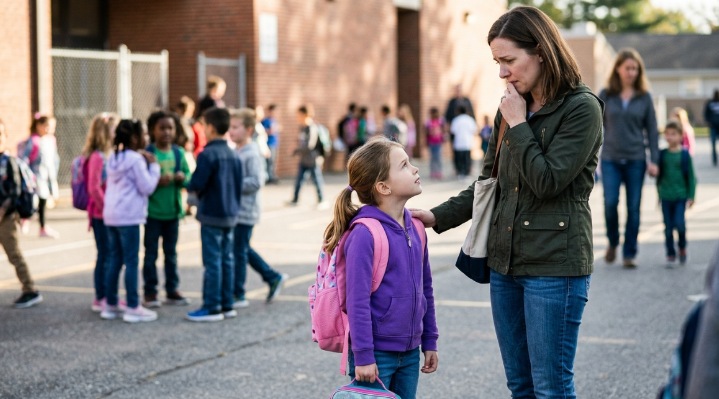
Sophie immediately stepped behind me.
Chloe moved with her.
Ms. Henderson finally spoke.
“Laura, perhaps we should take this inside.”
“No.”
The answer came from me before I even thought about it.
“Not until someone explains why this child is afraid of the person who supposedly came to pick her up.”
Marlene laughed.
“She isn’t afraid of me. She’s embarrassed because she’s dirty.”
That sentence changed everything.
I looked at the stained shirt in Chloe’s hand.
Then at the bruise beneath Sophie’s sleeve.
Then at the woman standing in front of us.
“What happened to her arm?”
“She falls.”
Sophie shook her head.
“She doesn’t.”
Marlene snapped her head toward her.
“Sophie.”
The little girl flinched.
That was enough.
I took out my phone.
“I’m calling the police.”
Marlene’s expression changed instantly.
“You have no right.”
“I have every right to report what I’m seeing.”
“You’re making a serious accusation.”
“No,” I said quietly. “I’m reporting what I can see.”
She stepped closer.
“You don’t know this family.”
“No.”
“And you don’t know me.”
“No.”
“Then stay out of it.”
I looked at Sophie.
“That’s exactly what adults said before.”
Marlene’s face hardened.
“What does that mean?”
I glanced at Ms. Henderson.
“Apparently the school has already been contacted about Sophie.”
The teacher’s face went pale.
Marlene noticed.
“What did you tell her?”
Ms. Henderson didn’t answer.
Marlene turned back to me.
“Give me the backpack.”
“No.”
“It’s not yours.”
“It isn’t yours either.”
Her eyes narrowed.
“Where is her mother?”
Sophie began crying again.
“She told me Mommy was sick,” Chloe said.
Marlene looked at her.
“Children imagine things.”
“My daughter doesn’t imagine smells.”
I opened the plastic bag again.
The smell was unmistakable.
It wasn’t merely dirty clothing.
There was something biological about it.
Something that reminded me of spoiled meat and damp walls.
I suddenly remembered what Chloe had said.
It smells like when food dies.
I felt sick.
Then Sophie spoke.
“My mom is in the basement.”
Everyone went silent.
Marlene grabbed her arm.
“Stop.”
Sophie cried out.
I slapped Marlene’s hand away.
“Don’t touch her.”
Marlene stepped back.
“You’re interfering in something you don’t understand.”
Sophie whispered:
“She locked Mommy downstairs.”
I felt my stomach drop.
Ms. Henderson covered her mouth.
“What?”
Sophie stared at the ground.
“She said Mommy was sick.”
“Where?”
“At home.”
“What home?”
Sophie gave an address.
Marlene immediately interrupted.
“She is lying.”
I looked at her.
“Then why are you so afraid of that address?”
She didn’t answer.
I called 911.
This time, Marlene didn’t try to stop me.
She ran.
Security guards at the school gate intercepted her before she reached the parking lot.
She screamed at them.
“Get your hands off me!”
Within minutes, police officers arrived.
Everything changed after that.
The officers separated us.
Sophie was taken inside with a female officer.
Chloe stayed with me.
Marlene was questioned near the school entrance.
I could hear fragments of the conversation.
“She’s my niece.”
“No, I’m not her legal guardian.”
“Yes, her mother is…”
“I don’t know where she is.”
The officer looked at her.
“You just said she was sick.”
Marlene became quiet.
Then she said:
“I don’t know.”
The female officer came toward me.
“Mrs. Carter?”
“Yes.”
“Your daughter needs to stay with you, but we’d like to speak with you privately.”
I followed her inside.
She closed the door.
“Tell me everything.”
I did.
Every detail.
The smell.
The bruising.
The shirt.
The backpack.
The woman’s behavior.
Most importantly, what Sophie had said.
When I finished, the officer leaned back.
“Do you know if anyone has contacted child protective services before?”
“Ms. Henderson said the family had already been spoken to.”
The officer looked toward the teacher.
“Who spoke with them?”
Ms. Henderson entered the room.
Her hands were trembling.
“I did.”
“With whom?”
“The woman.”
“Marlene?”
“I thought she was the aunt.”
“Did you report the bruises?”
Ms. Henderson swallowed.
“No.”
“Why not?”
“I didn’t know they were serious.”
The officer stared at her.
“What did you think they were?”
The teacher’s eyes filled with tears.
“I thought the girl was being neglected.”
“Neglect is serious.”
“I know.”
“Did you document it?”
A pause.
“Yes.”
“Where?”
“Her student file.”
The officer looked at me.
“Can we access it?”
Ms. Henderson nodded.
The file was brought from the administration office.
Inside were months of notes.
Sophie frequently arrived late.
She sometimes fell asleep during class.
She rarely ate lunch.
She had asked teachers several times whether she could take leftover food home.
There were three reports of unexplained bruises.
One note said:
Student becomes visibly frightened when approached from behind.
Another:
Student asked if she could sleep at school.
And another:
Student repeatedly states she doesn’t want to go home.
I stared at the pages.
“How could nobody report this?”
Ms. Henderson began crying.
“I thought the aunt was handling it.”
The officer looked at her.
“That’s not an answer.”
“I know.”
“Did Sophie ever say anything directly?”
Ms. Henderson nodded.
“Once.”
“What did she say?”
“She told me her mother was sleeping.”
“For how long?”
“Three days.”
The room became silent.
“Why didn’t you report it?”
Ms. Henderson covered her face.
“I thought the mother had a medical condition.”
The officer stood.
“Get me the principal.”
Two hours later, we were driving to the address Sophie had given.
I was not supposed to go.
But Sophie refused to leave the school unless Chloe came with her.
And Chloe refused to leave Sophie.
So the police allowed me to follow behind.
The house was in a neighborhood I had passed hundreds of times without noticing.
Small homes.
Low fences.
Overgrown lawns.
Nothing about it looked dangerous.
That was what frightened me.
Danger rarely announces itself.
The officers approached the front door.
Marlene had already been detained.
The house was locked.
One officer knocked.
No response.
They tried again.
Nothing.
Then they heard something.
A faint sound.
From inside.
A woman’s voice.
“Help.”
My entire body went cold.
The officers forced the door.
I stayed outside.
Then I heard shouting.
“Police!”
A minute later, one officer emerged.
“Ma’am, stay here.”
“Is she alive?”
He looked at me.
“Yes.”
I covered my mouth.
“She needs medical attention.”
An ambulance arrived.
Then another.
I watched as paramedics carried a woman out on a stretcher.
She looked painfully thin.
Her hair was tangled.
Her skin was pale.
Her wrists had red marks around them.
And then Sophie saw her.
“Mommy!”
The little girl ran.
The paramedic tried to stop her.
But the woman lifted her arms.
“Sophie.”
Her voice was weak.
Sophie climbed carefully onto the side of the stretcher.
“I told them.”
Her mother started crying.
“I knew you would.”
Chloe stood beside me.
She was crying too.
“Mom,” she whispered.
“Yes?”
“That’s why Sophie smelled.”
I nodded.
I didn’t trust myself to speak.
Because suddenly I understood.
The smell wasn’t coming from Sophie.
It was coming from the clothes she had been wearing while spending time in that basement.
The rotting smell.
The dampness.
The smell of spoiled food.
The smell of a place where someone had been trapped.
And the little shirt in the plastic bag wasn’t just dirty.
It was evidence.
Sophie’s mother was taken to the hospital.
The police searched the house.
They found the basement.
The door had been locked from the outside.
Inside were blankets.
Empty water bottles.
Food containers.
A mattress.
A bucket.
And photographs.
Dozens of them.
Some showed Sophie.
Some showed her mother.
Some showed bruises.
There were dates written on the backs.
The investigation became much larger than any of us had imagined.
Marlene was arrested.
But she wasn’t the person who had started the whole thing.
That came two days later.
The police discovered that Marlene had been receiving money from Sophie’s mother’s employer.
The payments had been disguised as cleaning expenses.
But they weren’t cleaning expenses.
They were hush money.
Sophie’s mother, Rebecca, had worked as a bookkeeper for a small medical company.
She had discovered financial irregularities.
Millions of dollars were missing.
When Rebecca threatened to report them, someone threatened her daughter.
She refused to stay silent.
Then she disappeared.
Everyone assumed she had abandoned Sophie.
She hadn’t.
Marlene had been hired to keep Sophie away from her mother.
But when Rebecca refused to cooperate, Marlene locked her in the basement.
She planned to force her to sign documents transferring control of the accounts.
Sophie had been told her mother was sick.
The girl knew something was wrong.
But she didn’t know how to explain it.
She only knew that her mother’s clothes smelled like the basement.
She knew her mother wasn’t allowed upstairs.
She knew Marlene became angry whenever she asked questions.
And she knew that every adult she tried to tell seemed too busy to listen.
Except Chloe.
Chloe listened.
Three weeks later, Sophie returned to school.
The schoolyard looked different.
Not because anything had changed.
Because we had.
Children gathered around her.
Some apologized.
Others simply stood near her.
Nobody called her dirty anymore.
Chloe walked beside her.
The two girls carried their lunchboxes together.
I watched from the gate.
Sophie saw me.
She smiled.
It was the first real smile I had seen from her.
She ran toward me.
“Ms. Laura!”
I crouched down.
“How are you?”
“Good.”
“Your mom?”
“She’s getting stronger.”
I smiled.
“That makes me happy.”
Sophie looked at Chloe.
“Can I ask you something?”
Chloe nodded.
“Why did you say I smelled funny?”
Chloe thought for a second.
“Because I wanted people to notice.”
Sophie looked confused.
“But everyone already noticed.”
Chloe shook her head.
“They noticed you.”
She pointed toward the school.
“I wanted them to notice what was happening to you.”
Sophie hugged her.
I looked away for a moment.
My eyes were burning.
Because my daughter had taught me something I should have known as an adult.
Sometimes children don’t have the vocabulary for danger.
They don’t say:
I think someone is being abused.
They say:
She smells funny.
They don’t say:
I think something is wrong at home.
They say:
She doesn’t want to go home.
And sometimes the difference between tragedy and rescue is simply whether one adult is willing to listen.
Six months later, the school held another spring fair.
This time, Sophie was there.
She wore a bright yellow dress.
Her shoes were new.
Her hair was neatly braided.
But what struck me wasn’t how clean she looked.
It was how loudly she laughed.
She and Chloe ran between the booths.
They shared cotton candy.
They argued over a game.
They chased each other across the grass.
I stood with Rebecca near the lemonade table.
She had recovered physically, though she still had difficult days.
“I don’t know how to thank you,” she said.
“You don’t owe me anything.”
“I owe Chloe.”
“You owe her friendship.”
Rebecca smiled.
“I can do that.”
Then she looked toward the girls.
“You know what Sophie tells everyone?”
“What?”
“She says Chloe saved her life.”
I shook my head.
“Chloe didn’t save her.”
Rebecca frowned.
“Then who did?”
“Sophie did.”
Rebecca looked surprised.
I continued.
“She knew something was wrong. She kept trying to tell people. She didn’t give up.”
Rebecca’s eyes filled with tears.
“And Chloe listened.”
We watched the girls laugh.
Then Rebecca said something I’ll never forget.
“She smelled like death because she was surrounded by it.”
I nodded.
“But she never stopped looking for life.”
That night, after the fair, Chloe and I sat on our porch.
She leaned against me.
“Mom?”
“Yes?”
“Were you mad at me that day?”
I looked at her.
“At first.”
“Because I said Sophie smelled?”
“Yes.”
She looked down.
“I thought I did something bad.”
I wrapped my arm around her.
“You didn’t.”
“But I said something mean.”
“You said something that sounded mean.”
She looked at me.
“What’s the difference?”
“Sometimes the words sound wrong even when the heart behind them is trying to help.”
She thought about that.
“Like when I said she smelled like dead food.”
I laughed softly.
“Yes.”
She smiled.
“Do you think I should’ve said something different?”
“Maybe.”
“What?”
I looked at her.
“Maybe next time, tell me exactly what you notice.”
She nodded.
“Okay.”
Then she leaned against me again.
“Mom?”
“Yes?”
“Will you listen next time?”
The question hurt more than anything else.
Because I remembered how she had tried to tell me earlier that week.
Sophie doesn’t want to sit with me anymore.
And I had called her dramatic.
I kissed the top of her head.
“Yes.”
“Even if you’re busy?”
“Especially if I’m busy.”
She smiled.
“Promise?”
“Promise.”
We sat quietly.
The neighborhood was peaceful.
Cars passed in the distance.
A dog barked somewhere down the street.
The world looked ordinary.
But I knew better now.
Ordinary moments could hide extraordinary warnings.
A child refusing to go home.
A bruise beneath a sleeve.
A strange smell.
A frightened look.
A sentence that sounded rude.
A backpack held too tightly.
None of them should automatically be treated as proof of something terrible.
But none of them should automatically be dismissed either.
Sometimes a child is simply being a child.
And sometimes a child is trying desperately to tell you something they don’t yet have the words to explain.
That day in the schoolyard, I thought my daughter had embarrassed me.
I thought she needed to learn manners.
Instead, she taught me something far more important.
She taught me to listen before judging.
She taught me that children notice things adults overlook.
And she taught me that sometimes the strangest sentence can carry the most important message.
Years later, people would still ask me how we discovered what happened to Sophie.
They expected some dramatic detective story.
They expected hidden cameras.
Secret documents.
A brilliant investigation.
The truth was much simpler.
An eight-year-old girl noticed something was wrong.
Another eight-year-old girl refused to stay quiet.
And one mother finally stopped being embarrassed long enough to listen.
That’s how Sophie was found.
That’s how Rebecca was rescued.
And that’s how two little girls changed all of us.
I still think about that afternoon sometimes.
The spring banners.
The lemonade.
The laughter.
The woman in the sunglasses.
The little plastic bag.
And my daughter’s small hand tightening around mine.
If I could go back, I wouldn’t erase that embarrassing moment.
I would thank her for it.
Because what I thought was a rude comment was actually a warning.
What I thought was childish cruelty was courage.
And what I thought was the smell of something dead…
was a little girl’s desperate way of telling us that someone she loved was still alive.