The room went silent.
Not courtroom silent, where everyone was waiting for someone powerful to speak.
This silence felt older.
Personal.
The kind that came when a secret had finally grown too heavy for the people carrying it.
I stared at the photograph in my father’s hand.
Marcus Reed stood on the left, younger by nearly twenty years but unmistakable. His hair was darker, his shoulders narrower, yet he wore the same expression I had seen at law firm dinners—a pleasant smile that never quite reached his eyes.
Sylvia stood on the right.
She looked almost exactly as she did now, except softer. Her hair fell to her shoulders. She wore a pale blue dress and a small silver cross at her throat.
And between them stood my mother.
Elizabeth Bennett.
The woman I remembered in fragments.
A yellow scarf.
Warm hands braiding my hair.
A voice singing beside my bed when thunderstorms frightened me.
A woman I had mourned since I was six years old.
My fingers tightened around the hospital blanket.
“Where did you get that?” I asked.
Dad did not answer immediately.
He sat beside my bed, looking suddenly less like the Chief Justice of the Supreme Court and more like a tired father who had spent twenty-nine years hoping he would never have to explain something.
“I kept it,” he finally said.
“Why?”
His eyes lowered to the handwriting on the back.
ANNA MUST NEVER KNOW WHO SYLVIA REALLY IS.
“Dad.”
He looked at me.
“What does that mean?”
Across the room, my attorney, Rachel Kim, quietly closed the door.
David was no longer there. Police had escorted him from the hospital after investigators questioned him. Sylvia had left separately with an attorney.
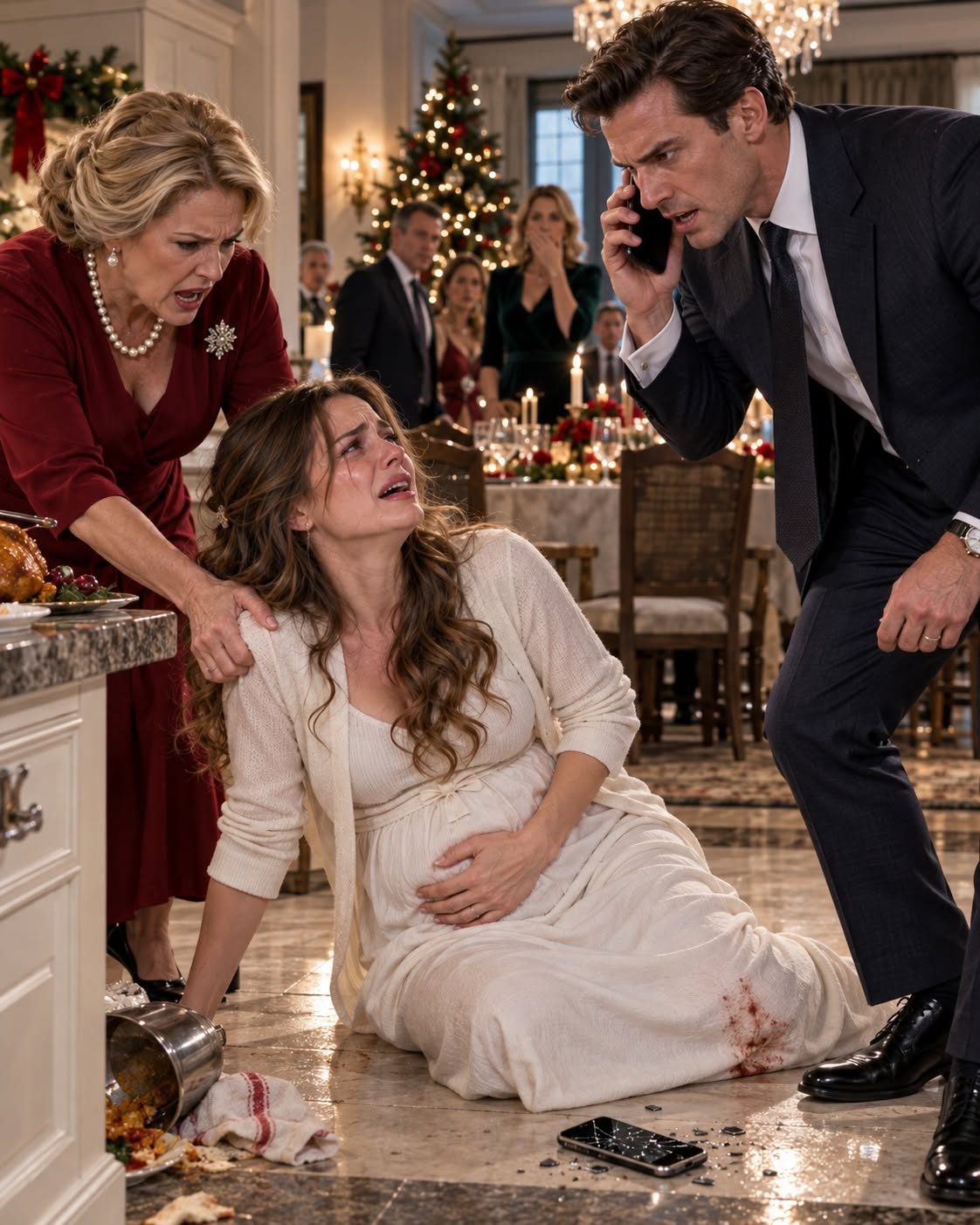
For the first time since Christmas dinner, I was surrounded only by people who were trying to protect me.
Yet somehow I felt more frightened than when I had been lying on that kitchen floor.
Dad rubbed one thumb over the corner of the photograph.
“Sylvia’s maiden name wasn’t Mercer,” he said.
I waited.
“It was Vale.”
The name meant nothing to me.
Apparently my expression showed it.
“Your mother’s maiden name,” Dad continued, “was also Vale.”
The air seemed to change.
I looked from him to Rachel.
Rachel’s face had gone still.
“No,” I whispered.
Dad nodded once.
“Sylvia is your mother’s older half-sister.”
I actually laughed.
Not because it was funny.
Because sometimes a truth is so impossible that your body rejects it before your mind can.
“That’s ridiculous.”
“I wish it were.”
“She’s David’s mother.”
“Yes.”
“So David is…”
“Not your blood relative,” Dad said quickly. “Sylvia became David’s stepmother when he was four. She legally adopted him two years later.”
I stared at him.
Every family gathering rearranged itself in my memory.
Sylvia’s strange interest in where I grew up.
The way she had once asked whether I remembered a lake house.
The way she had watched me when I said my mother died young.
The way she sometimes looked at me with something deeper than dislike.
Recognition.
“You knew?”
Dad swallowed.
“I knew who Sylvia was.”
“And you let me marry into her family?”
Pain passed over his face.
“No.”
My voice sharpened.
“You attended my wedding.”
“I attended your wedding because you were my daughter and you asked me to stay in the background.”
“I asked you to stay in the background because David thought my father was a retired government attorney from Virginia.”
“I know.”
“You could have stopped me.”
“I tried.”
I remembered.
Phone calls I had refused to return.
A letter I had left unopened for two weeks because I thought Dad was judging my engagement.
One dinner where he had asked too many questions about David’s family and I had accused him of interrogating everyone in my life.
My anger weakened, but it did not disappear.
“You could have told me the truth.”
“Yes,” he said.
Two words.
No excuse.
That hurt more.
Dad had always been measured. Even when I was a teenager shouting at him, he had chosen every sentence carefully.
Now he sounded like a man who had run out of legal arguments.
“I should have told you.”
I turned toward the window.
Outside, the city was beginning to wake. Christmas morning light spread pale gold across the hospital buildings. A few snowflakes drifted between the towers.
Somewhere down the hall, a newborn cried.
I instinctively placed my hand over my stomach.
My baby moved.
Just once.
A small pressure beneath my palm.
I closed my eyes.
For hours, every conversation had been about crimes, evidence, witnesses, law firms, sealed records.
That tiny movement brought me back to what mattered.
My child was still here.
I was still here.
Dad noticed.
His entire face softened.
“The doctors are optimistic,” he said quietly.
“I know.”
“They want to keep you under observation.”
“I know.”
He hesitated.
“May I?”
I looked at him.
His hand hovered near mine.
For all his titles, all his authority, my father was asking permission to touch his daughter’s hand.
I turned my palm upward.
He held it.
And for several minutes neither of us said anything.
Then I asked the question that had waited almost thirty years.
“How did Mom really die?”
His fingers tightened.
Rachel shifted near the door.
Dad stared at the photograph again.
“That,” he said, “is where the story becomes complicated.”
—
My mother, Elizabeth Vale, had grown up in a family that looked wealthy from the outside and broken from within.
Her father, Charles Vale, owned a regional insurance company and several commercial properties. He married twice.
Sylvia came from the first marriage.
Elizabeth came from the second.
“They were eight years apart,” Dad explained.
“Were they close?”
“Sometimes.”
That answer told me more than yes or no could have.
Dad stood and walked toward the window.
“Your grandfather was controlling. He believed loyalty meant obedience. Sylvia learned early how to survive him. Your mother learned how to resist him.”
That sounded like the woman I remembered.
Even my faint memories carried movement.
Mom dancing in the kitchen.
Mom laughing too loudly in museums.
Mom driving with the windows down in winter because she said cold air woke up the soul.
“Sylvia stayed close to their father,” Dad continued. “Elizabeth left home at eighteen.”
“And met you?”
“Several years later.”
A tiny smile appeared.
“For someone who eventually became a judge, I had very little money and terrible furniture.”
I almost smiled too.
“What did Mom see in you?”
“She said I listened before answering.”
“That sounds like Mom.”
“It was also not always true.”
For a second, he looked younger.
Then the smile faded.
“When your grandfather died, the family estate became difficult. There were trusts, business holdings, disputed property. Sylvia expected to control most of it.”
“But Mom inherited something.”
“Yes.”
“What?”
Dad looked at Rachel.
Rachel stepped closer.
“Your grandmother’s trust,” she said.
“The thirty-eight million?”
“That is what it is worth now,” Dad replied. “It was considerably smaller then.”
I tried to absorb that.
“My grandmother left it to Mom?”
“Originally.”
“But Mom died.”
“Her share transferred to you.”
I frowned.
“Why didn’t I know?”
“Because of the terms.”
Rachel opened a folder.
“The trust was designed to remain sealed until you turned thirty-five, unless certain conditions were met earlier.”
“What conditions?”
“Marriage dissolution. Financial exploitation. Incapacity. A credible threat to your safety.”
A chill moved through me.
David’s petition.
The documents claiming I was unstable.
His effort to control my finances.
“He was trying to trigger the trust.”
Rachel nodded.
“Or trigger access to it.”
“But how did he know?”
“That,” Dad said, “is what investigators are trying to determine.”
I stared at the photograph.
Marcus.
Sylvia.
My mother.
“Marcus knew my mother.”
“Yes.”
“Was he her lawyer?”
“No.”
Dad turned from the window.
“He was her fiancé.”
I stopped breathing for a second.
“What?”
“Before your mother met me.”
Rachel slowly lowered the folder.
Even she had not known that.
Dad continued.
“Elizabeth and Marcus were engaged for five months.”
“Did Sylvia know him first?”
“That has never been clear.”
I looked back at the photograph.
Suddenly Marcus standing beside my mother did not look casual.
His hand rested near her waist.
Not touching.
Almost.
“What happened?”
“Elizabeth ended the engagement.”
“Why?”
“She never fully told me.”
“You married a woman who had once been engaged to Marcus Reed, and twenty years later he introduced her daughter to his employee?”
Dad closed his eyes briefly.
“I did not know Marcus introduced you to David.”
That was true.
David had told me we met because Marcus thought we would have similar interests.
I had never mentioned that detail to my father.
Not because it was secret.
Because it seemed unimportant.
Now nothing seemed unimportant.
“What did Marcus want from Mom?”
“I don’t know.”
“Money?”
“Possibly.”
“Connections?”
“Possibly.”
I hated those answers.
Possibly.
Maybe.
We’ll investigate.
My entire life suddenly felt filled with locked doors.
“Why does the note say I must never know who Sylvia really is?”
Dad looked down.
“Because Elizabeth wrote it.”
That landed harder than everything else.
“My mother wrote that?”
“Yes.”
“When?”
“A few weeks before she disappeared.”
The word took a second to reach me.
Not died.
Disappeared.
I stared at him.
“What did you just say?”
Dad went completely still.
I could hear the hospital monitor beside me.
My own heartbeat.
The soft mechanical hum of heat beneath the window.
“Dad.”
He looked at me.
“You said disappeared.”
His face answered before his mouth did.
I pulled my hand away from him.
“You told me she died.”
“Anna—”
“You told me my mother died.”
“I believed she had.”
“That is not what you just said.”
Rachel quietly stepped toward the door.
“I’ll give you privacy.”
“No,” I said.
She stopped.
“If there are going to be any more secrets, I want a witness.”
Dad flinched.
I had never seen a sentence physically wound him before.
But I did not take it back.
He sat again.
“When you were six,” he said slowly, “your mother left the house one evening.”
I remembered rain.
A coat.
Maybe that was real.
Maybe memory had manufactured it.
“She said she was meeting someone,” Dad continued. “She wouldn’t tell me who. We argued.”
“About what?”
“Whether she was in danger.”
My mouth went dry.
“She had been frightened for several weeks. She received calls she wouldn’t discuss. She changed the locks twice. She stopped taking you to the same playground.”
I remembered that.
A park with red swings.
Then suddenly another park farther away.
I had cried because I missed a girl named Sophie.
“What happened that night?”
“She left at 8:40.”
Dad’s voice became unnaturally precise.
The voice of a man who had replayed one night thousands of times.
“She wore a gray coat. She carried a blue umbrella. She kissed you while you were sleeping.”
My eyes filled.
“At 11:15, I called her.”
No answer.
“At midnight, I called again.”
Nothing.
“By morning, I contacted the police.”
“And?”
“Her car was found two days later near the river.”
I knew this part.
At least I thought I did.
“They found her body.”
Dad shook his head.
The room tipped.
“No.”
“Then why did you tell me—”
“A body was recovered several weeks later.”
He stopped.
“It was badly damaged by water. Identification standards were different then. Dental records appeared to match.”
“Appeared?”
“I accepted the identification.”
His voice broke.
“I wanted something to bury.”
That sentence silenced my anger for one second.
I saw him as he must have been.
Young.
Widowed.
Holding a six-year-old who kept asking when her mother was coming home.
“I buried an empty certainty,” he whispered. “And I told you your mother was dead because I believed the alternative—that she had left us—would hurt you more.”
I wiped my face angrily.
“What changed?”
“Three years later, a detective contacted me.”
Dad reached inside his jacket.
He removed an envelope that looked old enough to crumble.
“The dental identification was questioned during an unrelated investigation.”
I knew before he said it.
“The body wasn’t Mom.”
“No.”
I turned away.
Everything inside me wanted somewhere to go.
Anger had nowhere.
Grief had nowhere.
Hope was somehow the worst of them.
“Is she alive?”
“We don’t know.”
“You never found her?”
“No.”
“Did you look?”
Dad stared at me.
For the first time that morning, something fierce entered his expression.
“Every day.”
Those two words changed the room.
Not enough to erase the secret.
But enough to show me what it had cost him.
“I hired investigators,” he continued. “I contacted agencies. I followed sightings from California to Quebec. I spent years believing every unknown number might be her.”
His voice lowered.
“And every time I began to think she was truly gone, something happened.”
“What?”
“A bank withdrawal.”
Rachel turned.
“What kind of withdrawal?”
“Small amounts. From an account no one else knew existed.”
Dad looked at me.
“Elizabeth had opened it before we married.”
“Someone was using it?”
“Three withdrawals over twelve years.”
“Where?”
“Boston. Savannah. Portland, Maine.”
My mind raced.
“Did cameras catch anything?”
“The first was before widespread surveillance. The second camera malfunctioned. The third showed only a woman in a hood.”
“Convenient.”
“Yes.”
“Why didn’t you tell me?”
“Because every trail disappeared.”
His shoulders dropped.
“And because by then you were seventeen. You had finally stopped waking from nightmares asking whether your mother was cold.”
My anger broke around that memory.
I remembered those nights.
I remembered Dad sitting at the foot of my bed.
I remembered asking whether heaven had blankets.
I covered my mouth.
For a while, neither of us spoke.
Then Rachel asked, “What does Sylvia have to do with Elizabeth’s disappearance?”
Dad turned the photograph over again.
“This arrived in the mail six months after Elizabeth vanished.”
“No return address?”
“No.”
“Did police test it?”
“Yes. Nothing useful.”
I stared at the sentence.
ANNA MUST NEVER KNOW WHO SYLVIA REALLY IS.
“Maybe Mom didn’t mean Sylvia was her sister,” I said.
Dad nodded slowly.
“That possibility has bothered me for years.”
“What else could she mean?”
“We may finally be able to ask Sylvia.”
—
Sylvia was questioned that afternoon.
Not by my father.
He refused to enter the room.
That decision surprised me.
“You could probably make her confess to stealing the moon,” I said.
Dad almost smiled.
“That is precisely why I’m staying out.”
He had changed out of his suit jacket. Without it, with his tie loosened and his reading glasses in one hand, he looked less intimidating.
“The investigation must survive scrutiny,” he said. “Everything involving me will be examined. Every decision questioned. The safest thing I can do for you is not interfere.”
I studied him.
A few hours earlier, I had wanted him to storm through every institution in the country and punish David.
Now I understood the restraint.
Power was not always the ability to crush someone.
Sometimes it was having the authority to interfere and choosing not to.
“What happens to David?”
“That depends on evidence, prosecutors, professional disciplinary authorities, and the courts.”
“And Sylvia?”
“The same.”
“And Marcus?”
Dad’s expression changed.
“Marcus may be the most important piece.”
Rachel entered before I could ask why.
She carried a laptop and two cups of coffee.
“I found something.”
Dad stood.
“What?”
Rachel set the laptop on the hospital table.
“Marcus Reed visited Sylvia last night.”
I stared at her.
“After I was taken away?”
“Twenty-three minutes after.”
“How do you know?”
“The neighbor across the street has a doorbell camera.”
She turned the screen.
The image was grainy but clear enough.
Marcus stood outside Sylvia’s house.
No coat despite the snow.
He kept looking toward the street.
Then Sylvia opened the door and pulled him inside.
“How long did he stay?” Dad asked.
“Eleven minutes.”
“And after?”
Rachel clicked.
Another image appeared.
Marcus returning to his car carrying a rectangular metal box.
Dad leaned toward the screen.
“Can you enlarge that?”
Rachel did.
The image blurred.
Still, I could see a faded sticker on the corner.
A small sailboat.
Something stirred in my memory.
I leaned forward.
“No.”
Dad looked at me.
“What?”
“I know that box.”
His face changed.
“Anna?”
“My mother kept letters in it.”
Nobody spoke.
I could see it.
A blue metal box beneath her desk.
I remembered sitting cross-legged on the carpet while she wrote Christmas cards.
The little sailboat sticker had been mine.
I had stuck it on the lid.
Dad stared at the screen.
“That box disappeared the night Elizabeth did.”
A knock sounded at the door.
Everyone turned.
A hospital security officer stepped inside.
“Ms. Bennett?”
“Yes?”
“There’s a woman downstairs insisting she knows you.”
My stomach tightened.
“Who?”
“She won’t provide identification.”
Dad immediately moved closer to the bed.
“What does she want?”
The officer looked uncertain.
“She says she has something that belongs to Anna’s mother.”
—
The woman’s name was Eleanor Price.
At least, that was the name she finally gave security.
She was in her late sixties, with silver hair pinned loosely behind her head and a wool coat that looked as though she had slept in it.
She carried no handbag.
Only a paperback book.
When she entered my room, she stopped.
Her eyes found mine.
Then she began to cry.
Not dramatically.
Quietly.
As if she had been holding those tears for years.
“You have Elizabeth’s eyes,” she said.
Dad stiffened beside me.
“Who are you?”
Eleanor looked at him.
For a moment, she seemed afraid.
Then something softened.
“You’re Jonathan.”
He did not respond.
“I knew your wife.”
Dad took one slow step forward.
“Where?”
Eleanor looked toward the security officer.
Rachel understood first.
“Can we have the room?”
Dad shook his head.
“One officer stays outside.”
The door closed.
Eleanor held the paperback book against her chest.
“I worked at St. Matthew’s Women’s Center.”
Dad frowned.
“That was a shelter.”
“Yes.”
“When?”
“Twenty-seven years ago.”
My heart accelerated.
Two years after Mom disappeared.
Eleanor looked at me.
“Your mother stayed there.”
Dad gripped the back of the chair.
I could almost see his mind rejecting the words.
“That isn’t possible.”
“It is.”
“You are saying my wife was alive two years after her disappearance?”
“Yes.”
“Why didn’t anyone contact me?”
“Because she begged us not to.”
Dad’s face emptied.
I watched the sentence enter him like cold.
“She left us?”
Eleanor shook her head.
“No.”
“Then explain it.”
“I can only tell you what she told me.”
Eleanor sat.
“She arrived using another name. She had cut her hair. She had no identification. For almost a week she barely slept.”
“What name?”
“Mary Ellis.”
I whispered it.
It sounded ordinary.
Designed to disappear.
“She said someone had threatened her daughter.”
My hand moved to my belly again.
Dad stared at Eleanor.
“Who?”
“She never said.”
“Sylvia?”
“No.”
“Marcus?”
Eleanor hesitated.
“She mentioned a man named M.”
Dad and Rachel exchanged a look.
“What did she say about him?” Rachel asked.
“That he was patient.”
Eleanor’s fingers tightened around the book.
“She said patient men frightened her more than angry ones.”
I thought of Marcus.
Never loud.
Never rushed.
Always waiting.
“What happened to Mom?” I asked.
Eleanor looked at me.
“She stayed almost four months. Then one morning she was gone.”
My heart sank.
“Did she leave anything?”
Eleanor held out the paperback.
I recognized the title.
The Secret Garden.
Mom used to read it to me.
My breath caught.
“She gave me this,” Eleanor said. “She told me that if anything ever happened and I saw your name in the news, I should find you.”
“Why now?”
“Because I saw the report this morning.”
Of course.
The incident had not remained private.
My husband’s arrest, my father’s identity, the allegations surrounding the firm—it had already become national news.
Eleanor opened the book.
Inside the front cover was handwriting.
I recognized it immediately.
Even after nearly thirty years.
Mom.
For Anna—
Gardens survive winter because roots remember spring.
Never believe silence means absence.
Love,
Mom
I stopped breathing.
Dad turned away.
His hand covered his mouth.
For the first time in my life, I watched my father cry.
Not the controlled tears he had wiped away at graduations.
Not proud emotion.
Grief.
Old, unfinished grief.
I reached for him.
He crossed the room immediately.
I took his hand.
“I’m sorry,” he whispered.
I knew he was not only apologizing for keeping secrets.
He was apologizing for not finding her.
For telling me the wrong story because it was the only story he had.
For every bedtime when he had said heaven because he could not say I don’t know.
“You were alone too,” I said.
His eyes closed.
That was the moment something between us repaired.
Not perfectly.
Maybe never perfectly.
But enough.
For years I had thought my father’s silence meant distance.
Now I understood that sometimes silence was where frightened people hid the things they did not know how to survive aloud.
I squeezed his hand.
“No more secrets.”
He nodded.
“No more.”
Eleanor watched us.
Then she said, “There’s something else.”
Rachel looked up.
“What?”
“Elizabeth visited the shelter twice.”
The room stilled.
“You said she stayed four months.”
“The first time.”
“When was the second?”
Eleanor swallowed.
“Eleven years later.”
Dad’s head snapped toward her.
“That would have been…”
“When Anna was nineteen.”
I stared at Eleanor.
I had been a freshman in college.
My mother had been alive while I was in college.
“How long did she stay?”
“One night.”
“Why?”
“She wanted to know whether anyone had ever asked about her.”
“Had they?”
Eleanor nodded.
“Two people.”
“Who?”
“One was a private investigator hired by Jonathan.”
Dad nodded.
“And the other?”
“A woman.”
“What woman?”
“She called herself Sylvia Mercer.”
—
By evening, the case had changed.
What had begun as an investigation into what happened to me at Christmas dinner now touched decades of missing-person records, financial trusts, sealed court files, professional misconduct, and a woman who might have been alive long after everyone believed her dead.
I should have felt overwhelmed.
Instead I felt strangely clear.
Maybe because survival simplified things.
For years, David had trained me to second-guess myself.
Was I overreacting?
Was I too emotional?
Had Sylvia really insulted me, or was I being sensitive?
Had David really embarrassed me, or had I misunderstood his joke?
He had turned uncertainty into a cage.
Now there were too many facts for doubt to live comfortably.
He broke my phone.
He prevented me from calling for help.
He had prepared documents portraying me as unstable.
Someone at his firm had accessed a sealed file connected to my inheritance.
Marcus had removed my mother’s missing metal box from Sylvia’s house.
Those things were real.
And for the first time in years, I trusted my own eyes.
Around seven, a nurse entered to check the baby.
The small monitor filled the room with a rapid heartbeat.
Steady.
Strong.
I started crying before I realized I was.
The nurse smiled.
“That sound gets people every time.”
Dad stood near the window pretending to study his phone.
His shoulders were shaking.
“Dad.”
He looked over.
“Come here.”
He approached the bed.
The nurse adjusted the monitor.
“That’s your grandchild.”
Dad listened.
Something in his face changed.
All day he had been Chief Justice Bennett.
Widower.
Investigator.
Father carrying an old failure.
Now he was simply going to be a grandfather.
“Strong heartbeat,” the nurse said.
Dad touched the rail of the bed.
“Very strong.”
I smiled through tears.
“Stubborn.”
“Runs in the family.”
“You mean me.”
“I absolutely mean you.”
For the first time since Christmas morning, I laughed.
A real laugh.
It hurt a little.
I did it anyway.
—
David called at 8:17 p.m.
Not me.
My father.
Dad stared at the screen.
Rachel was still in the room.
“So much for legal counsel telling him not to contact anyone,” she said.
Dad silenced the phone.
It rang again.
Then again.
On the fourth call, Rachel said, “Answer it.”
Dad looked at her.
“Why?”
“Because I want to hear what he says.”
He accepted the call and placed it on speaker.
“David.”
There was breathing.
Then my husband’s voice.
“Sir.”
I almost laughed at the difference.
Yesterday, David spoke about my father as though he were some powerless old man.
Now he sounded like a nervous law student.
“I need to speak with Anna.”
“No.”
“Please.”
I looked at Dad.
“I’ll speak to him.”
His jaw tightened.
“Anna—”
“No more people deciding for me.”
He nodded immediately.
That mattered.
I took the phone.
“David.”
Silence.
Then, “Anna, this has gone too far.”
The old me might have apologized.
I heard that woman somewhere inside myself.
The woman who had spent years managing his moods.
She felt very far away.
“You broke my phone while I was asking for an ambulance.”
“You’re twisting what happened.”
“There were witnesses.”
“My mother panicked.”
“You stopped me from calling for help.”
“I was trying to protect our reputation.”
“Whose?”
He said nothing.
I continued.
“Yours?”
“Anna, listen. Marcus told me your family had money. I didn’t know who your father was.”
There it was.
Not remorse.
Calculation.
“You knew about the trust.”
Another silence.
“Not everything.”
“How much?”
“Enough.”
My throat tightened, but my voice remained steady.
“Did you marry me because of it?”
“No.”
Too fast.
“David.”
“I loved you.”
Past tense.
Maybe neither of us noticed until it was already between us.
I looked at the baby monitor.
“I loved you too.”
His breathing changed.
I meant it.
That was important.
Because admitting I had loved him did not mean what he did was acceptable.
It only meant I did not have to rewrite myself to escape him.
I had loved someone who had slowly revealed who he was.
That did not make me weak.
It made leaving necessary.
“I’m filing for divorce,” I said.
“Anna—”
“My attorney will contact yours.”
“Don’t do this.”
“You already did.”
He lowered his voice.
“You think your father can destroy me.”
Dad looked away.
I answered for myself.
“This isn’t about my father.”
“You think I’m afraid of him?”
“No.”
I surprised myself with the calm in my voice.
“You’re afraid of me finally believing myself.”
David stopped talking.
That silence was the first honest thing he had given me in years.
I ended the call.
My hands shook afterward.
Rachel quietly took the phone.
Dad stood beside me.
“You all right?”
“No.”
He nodded.
“Good answer.”
I looked at him.
He sat.
“You don’t have to be all right immediately just because you made the right decision.”
I let out a breath.
“Was that father advice or judge advice?”
“Father.”
“Better.”
“I’ll note your ruling.”
I leaned back against the pillow.
Outside, snow had begun falling heavily.
Inside, for the first time, the future frightened me less than the past.
—
At 10:03 p.m., investigators found Marcus Reed’s car.
It was parked at Reagan National Airport.
The metal box was gone.
Marcus was gone too.
“He boarded a flight?” I asked.
Rachel shook her head.
“No ticket under his name.”
“Security cameras?”
“Investigators are reviewing them.”
Dad stood over the laptop.
“His passport?”
“Still at his home.”
“Second passport?”
“They’re checking.”
I stared at the picture of the empty vehicle.
“Would he run?”
Dad’s answer came quietly.
“A patient man doesn’t run without a reason.”
My phone rang.
A replacement Rachel had arranged.
Unknown number.
Everyone froze.
I answered.
“Hello?”
Nothing.
Then a woman breathed.
Not spoke.
Breathed.
My pulse jumped.
“Who is this?”
The line crackled.
Then came three words.
“Check the garden.”
The call ended.
Dad was already moving.
“Trace it.”
Rachel grabbed her phone.
But I sat perfectly still.
Check the garden.
A memory rose.
Gardens survive winter because roots remember spring.
Mom’s inscription.
I picked up The Secret Garden.
My fingers ran over the front cover.
“Wait.”
Dad turned.
“What?”
I opened the book again.
The inscription looked exactly the same.
But now I noticed something.
The word garden was darker.
Not much.
Just enough.
I held the page toward the lamp.
There.
Tiny indentations.
Someone had written on another sheet placed over this one.
“Pencil,” I said.
Rachel understood immediately.
She found one in her bag.
Very lightly, she rubbed the side of the graphite across the blank page behind the inscription.
Faint letters appeared.
Dad leaned over us.
A sentence emerged.
JONATHAN KNOWS THE PLACE.
We looked at him.
His face drained of color.
“What place?” I asked.
For several seconds he did not move.
Then he whispered, “The lake house.”
The same lake house Sylvia had once asked whether I remembered.
I sat upright.
“What lake house?”
“Your mother’s family owned one near Charlottesville.”
“Does Sylvia still own it?”
“No. It was sold years ago.”
“Then why—”
Dad was already searching on his phone.
“What was the address?” Rachel asked.
He gave it.
She typed.
Seconds later, property records filled the screen.
The house had changed hands four times.
Then Rachel stopped.
“What?”
She looked up.
“The current owner bought it through a limited liability company.”
“Whose company?”
“I’m checking.”
Her fingers moved across the keyboard.
My heart pounded.
The unknown caller.
Check the garden.
JONATHAN KNOWS THE PLACE.
Rachel’s eyes widened.
“Oh my God.”
Dad leaned closer.
“What?”
“The LLC’s registered agent is Marcus Reed.”
The room seemed to shrink.
“When did he buy it?” I asked.
Rachel scrolled.
“Eleven years ago.”
The same year my mother returned to the shelter.
Dad grabbed his coat.
“I’m going.”
“No.”
He looked at me.
I pushed myself higher against the pillows.
“We just agreed. No more deciding things alone.”
“Anna, you’re staying in the hospital.”
“Yes.”
“And I’m not letting you anywhere near that house.”
“I didn’t say I was going.”
I held up the book.
“But neither are you.”
His expression hardened.
“Anna.”
“You’re the Chief Justice.”
“That is irrelevant.”
“It is absolutely relevant. If Marcus is involved in anything criminal and you walk onto property connected to him, every future defense attorney will make the investigation about you.”
Rachel nodded.
“She’s right.”
Dad looked betrayed.
“You too?”
“Especially me.”
He paced once across the room.
I understood his frustration.
For twenty-nine years, he had chased shadows.
Now there was an address.
A real place.
A door he could physically open.
And everyone was telling him not to touch it.
I reached for his hand.
“Dad.”
He stopped.
“If Mom is connected to that house, we’ll find out.”
He looked at me.
“Legally.”
A tired smile appeared.
“You really are my daughter.”
“I’ve been told.”
—
Police obtained authorization to search the property shortly after midnight.
Dad and I remained at the hospital.
That was one of the hardest things either of us had ever done.
We waited.
Rachel slept in the chair for twenty minutes, woke, answered three calls, and fell asleep again.
Dad walked the same stretch of floor until I finally pointed at the couch.
“If you pace one more time, I’m filing a complaint.”
“With whom?”
“Your supervisor.”
He stared at me.
“I do not have one.”
“Exactly. Sit down.”
He sat.
At 1:46 a.m., Rachel’s phone rang.
She answered immediately.
“Yes?”
Her expression sharpened.
“We’re listening.”
She placed it on speaker.
Detective Alvarez spoke from the other end.
“We entered the property twelve minutes ago. No occupants.”
Dad leaned forward.
“Any sign Reed was recently there?”
“Possibly. Kitchen supplies. Fresh tire tracks. Heat was on.”
My skin prickled.
“What about the garden?” I asked.
“We checked the grounds.”
“And?”
“There’s a greenhouse behind the house.”
I closed my eyes.
Of course there was.
“What did you find?”
A pause.
“Mrs. Mercer’s metal box.”
Dad stood.
“Contents?”
“Letters. Photographs. Several financial records. We haven’t catalogued everything.”
My heartbeat accelerated.
“Anything from Elizabeth Bennett?” Dad asked.
Another pause.
“Yes.”
He grabbed the back of the chair.
“How recent?”
The detective’s answer changed everything.
“Some appear to be from twenty-seven years ago.”
Dad exhaled.
“And?”
“One letter is dated eleven years ago.”
The room went quiet.
Mom had been alive.
At least then.
I closed my eyes.
Nineteen-year-old me flashed through my mind.
Walking across campus.
Complaining about exams.
Calling Dad because I had locked myself out of my dorm.
Somewhere, my mother had been alive.
Writing.
“What does it say?” I whispered.
“We’re preserving evidence. I don’t want to handle it more than necessary.”
“Please.”
The detective hesitated.
“There is one line visible without unfolding the page.”
I waited.
“It says, ‘Anna can never know until Marcus tells the truth about Sylvia.’”
The old mystery returned.
Who Sylvia really was.
Not merely Mom’s sister.
Something else.
Something Marcus knew.
Something my mother believed could not be revealed without danger.
Dad sat slowly.
Rachel rubbed her forehead.
“Anything else?” she asked.
“Yes.”
The detective’s voice had changed.
“There’s a locked room beneath the greenhouse.”
My stomach tightened.
“What kind of room?” Dad asked.
“We don’t know yet. We’re waiting for the technical team.”
“Why?”
“Because the lock is electronic.”
Rachel frowned.
“That house is old.”
“Exactly.”
Dad looked at me.
A terrible certainty passed between us.
Someone had modernized that room.
Recently.
The detective continued.
“And there’s something written above the door.”
“What?”
He paused.
“Anna’s name.”
—
I did not sleep.
Neither did Dad.
At 3:15 a.m., the doctor came in and reminded both of us that stress was not helping me or the baby.
Dad immediately turned off every phone in the room.
I almost laughed.
“You just cut off a federal investigation because my doctor frowned at you.”
“She outranks me in this room.”
“Good to know someone does.”
The doctor smiled.
“Try to rest.”
After she left, Dad pulled the chair beside my bed.
“Sleep.”
“You first.”
“I’m not the patient.”
“You look worse than I do.”
“That is extremely rude.”
“I learned from Mom.”
The words escaped before I could stop them.
We both went quiet.
Then Dad smiled.
“She would have said worse.”
I studied him.
“Tell me something good about her.”
His eyes softened.
“What?”
“Not about disappearing. Not about Sylvia or Marcus or the trust.”
I shifted under the blanket.
“Tell me something ordinary.”
Dad thought for a moment.
“She cheated at Scrabble.”
I blinked.
“No.”
“Constantly.”
“Mom?”
“Your mother invented words with absolute confidence.”
I started laughing.
“She’d put down something like ‘flinter’ and stare at me as though I was uneducated.”
“What is a flinter?”
“I still don’t know.”
“Maybe it’s a word.”
“It is not.”
“You became Chief Justice and you still sound bitter.”
“I lost seventy-four points on flinter.”
I laughed harder.
Dad smiled.
“She burned pancakes.”
“I remember that.”
“She sang beautifully.”
“I remember that too.”
“She hated olives.”
“So do I.”
“She loved thunderstorms.”
I closed my eyes.
“I remember.”
Dad’s voice became quieter.
“When you were born, she refused to let the nurses take you from the room unless absolutely necessary.”
I opened my eyes.
“She said you had waited nine months to meet her and she wasn’t giving up her appointment.”
Tears returned.
This time they felt different.
Not only grief.
Connection.
Dad continued.
“Whatever happened after she disappeared, Anna, one thing was never uncertain.”
“What?”
“She loved you.”
I looked at the book on the table.
Gardens survive winter because roots remember spring.
For nearly three decades, I had believed my mother’s story ended when I was six.
Now the ending was gone.
It terrified me.
But it also gave something back.
Possibility.
I rested my hand on my stomach.
“I’m going to do things differently.”
Dad looked at me.
“With the baby.”
“How?”
“No secrets disguised as protection.”
He nodded.
“No teaching them that family means accepting mistreatment.”
Another nod.
“And no pretending everything is fine because appearances matter.”
Dad looked toward the window.
“Your mother would approve.”
“What about you?”
He looked back.
“I already do.”
For the first time that day, peace entered the room.
Not certainty.
Not answers.
Peace.
I finally slept.
—
I woke just after sunrise.
Dad was asleep in the chair beside me, head tilted awkwardly, one hand still resting near the rail of my bed.
The snow had stopped.
Morning light made the entire room look new.
My baby moved beneath my palm.
Strong.
Steady.
I smiled.
For one quiet minute, there was no David.
No Sylvia.
No Marcus.
No Chief Justice.
No thirty-eight-million-dollar trust.
Just me.
My child.
My father.
And the strange, fragile beginning of a family becoming honest again.
Then Dad’s phone vibrated.
He woke instantly.
Rachel, asleep on the couch, sat up.
The screen showed Detective Alvarez.
Dad answered.
“Tell me.”
The detective sounded exhausted.
“We opened the room.”
I pushed myself upright.
“And?”
“There are filing cabinets. Audio tapes. Photographs. Records going back more than thirty years.”
Rachel was already standing.
“What kind of records?”
“We’re still determining that.”
Dad’s grip tightened around the phone.
“What about Elizabeth?”
Silence.
“Detective?”
“We found evidence she was there.”
“When?”
“Recently.”
The word hit the room like thunder.
I forgot to breathe.
“What do you mean recently?” I asked.
“Medication bottles.”
Dad stood.
“What dates?”
“Filled six months ago.”
My heart slammed against my ribs.
Mom had been alive six months ago.
Maybe.
Unless someone wanted us to believe that.
“What medication?” Rachel asked.
“I’d rather not discuss identifying medical information until confirmed.”
“Anything else?”
“Yes.”
He hesitated.
“There’s a recording.”
My mouth went dry.
“Of my mother?”
“We believe so.”
“Can you play it?”
“Not over the phone.”
Dad was already reaching for his coat.
The detective stopped him.
“Chief Justice, there is another problem.”
Dad froze.
“What?”
“We found a hidden compartment behind one of the cabinets.”
“And?”
“Inside was a birth certificate.”
I frowned.
“Whose?”
The detective did not answer immediately.
Then he said my name.
“Anna.”
My entire body went cold.
Dad gripped the phone.
“What does it say?”
“It lists Elizabeth Vale as the mother.”
“That is correct.”
“Yes.”
The detective paused.
“But it does not list Jonathan Bennett as the father.”
Nobody moved.
I looked at Dad.
His face had gone completely still.
I could hear the baby’s monitor.
The heating vent.
My own breathing.
“Who does it list?” Rachel asked.
The detective answered.
“Marcus Reed.”
Dad stared at me.
I stared back.
For twenty-nine years, I had believed I knew exactly who my father was.
Across the room, morning sunlight touched the old photograph lying faceup on the table.
Marcus.
Sylvia.
My mother.
And suddenly the space between the three of them looked nothing like it had before.
Dad slowly lowered the phone.
“No,” he whispered.
Not angrily.
Not defensively.
Like a man who had just discovered that the mystery he had spent half his life chasing had been living inside his own family all along.
Then the detective spoke again through the speaker.
“There’s more.”
Dad raised the phone.
“What?”
“We found a second birth certificate.”
My heartbeat seemed to stop.
The detective took a breath.
“This one is for David Mercer.”
I stared at the phone.
“And who does it list as his mother?”
The answer came quietly.