Marcus was still completely unaware that this story was only just beginning.
The taxi moved through downtown Chicago while the city slipped past in ribbons of white headlights and red brake lights.
I sat in the back seat with my laptop open on my knees.
The driver glanced at me once through the rearview mirror.
“Late flight?”
“Yes.”
“Business?”
I looked out the window.
“In a way.”
He nodded and returned his attention to the road.
My phone was still off.
That was deliberate.
Marcus would be landing from Honolulu sometime after midnight.
According to the itinerary he had sent me three days earlier, he had gone there for a “regional operations summit.”
He had complained about it before leaving.
Long meetings.
Unreasonable executives.
Barely any free time.
He had kissed me on the forehead at the airport and said, “I wish you were coming with me.”
Apparently Chloe had been available.
I had spent the entire week working late because Marcus told me the Honolulu trip was critical to a restructuring project we were both involved in.
That was the beautiful part.
While I stayed in Chicago finishing the projections his department needed, he had been walking barefoot on a beach with his secretary.
And Chloe had been kind enough to send me proof.
I opened the photograph again.
Not because I wanted to torture myself.
Because I was looking at details.
The image had been taken at sunset.
Chloe was wearing a red swimsuit under a white cover-up.
Marcus wore linen shorts and a navy shirt I had packed for him.
I recognized the shirt because I had ironed it the night before his flight.
That detail hurt more than it should have.
In the background, behind them, was the logo of the hotel.
The Halcyon Waikiki.
Not the business hotel listed on Marcus’s travel reimbursement request.
Interesting.
I saved the image in three places.
My laptop.
Cloud storage.
An external folder tied to a personal account Marcus could not access.
Then I took screenshots of Chloe’s messages.
Every line.
Every timestamp.
Every time she wrote that Marcus had told her he was trapped in our marriage.
Every time she mocked me for working.
Every time she implied she knew details about my personal life that could only have come from my husband.
I created a folder.
HONOLULU.
Then I opened our company expense system.
I had access because my role involved financial planning and project controls.
Not unrestricted access.
Enough.
I searched Marcus’s trip.
Airfare.
Hotel.
Meals.
Transportation.
Two business-class tickets.
I stared at the screen.
Two.
One for Marcus Thorne.
One for Chloe Davis.
That part was not unusual on its own.
She was his assistant.
Assistants sometimes traveled with executives.
Then I opened the itinerary.
Official meetings were scheduled Tuesday through Thursday.
Marcus and Chloe had flown Saturday.
Three extra days.
The return flight was Monday.
Four extra days on the back end.
Nine nights total.
Company-funded.
I scrolled through hotel charges.
Two rooms had been booked.
Then one room was canceled after check-in.
A single upgraded ocean-view suite remained.
My breathing slowed.
I had assumed adultery.
Now I was looking at potential misuse of company funds.
That changed everything.
The marriage belonged to Marcus and me.
The money did not.
I opened my email.
Started a new message.
To: myself.
CC: no one.
Subject: Personal Record.
I attached everything.
Then I closed the laptop.
The taxi pulled up to O’Hare.
I paid, walked inside, and went to the departures board.
I was not flying anywhere.
I had lied to the taxi driver because explaining the truth would have sounded insane.
I was at the airport because my sister, Rebecca, was waiting at a hotel nearby.
She had flown in that afternoon for a medical conference.
Two months earlier, she had begged me to spend one night with her.
I had said no because Marcus needed me to work late.
That seemed funny now.
I called her from the terminal.
She answered sleepily.
“Liv?”
“I need somewhere to stay.”
She became awake instantly.
“What happened?”
“Marcus is having an affair.”
Silence.
Then:
“Where are you?”
“O’Hare.”
“Come here.”
No questions.
No theories.
No I told you so.
Just come here.
That was what love sounded like.
Twenty minutes later, Rebecca opened her hotel-room door wearing pajama pants and one sock.
She looked at my face.
Then at the laptop bag.
Then at my purse.
“You left him.”
“I left the office.”
“Where is he?”
“Probably somewhere over the Pacific.”
“With her?”
“Yes.”
Rebecca closed her eyes.
“Oh, Olivia.”
That was when I almost cried.
Not when I saw the picture.
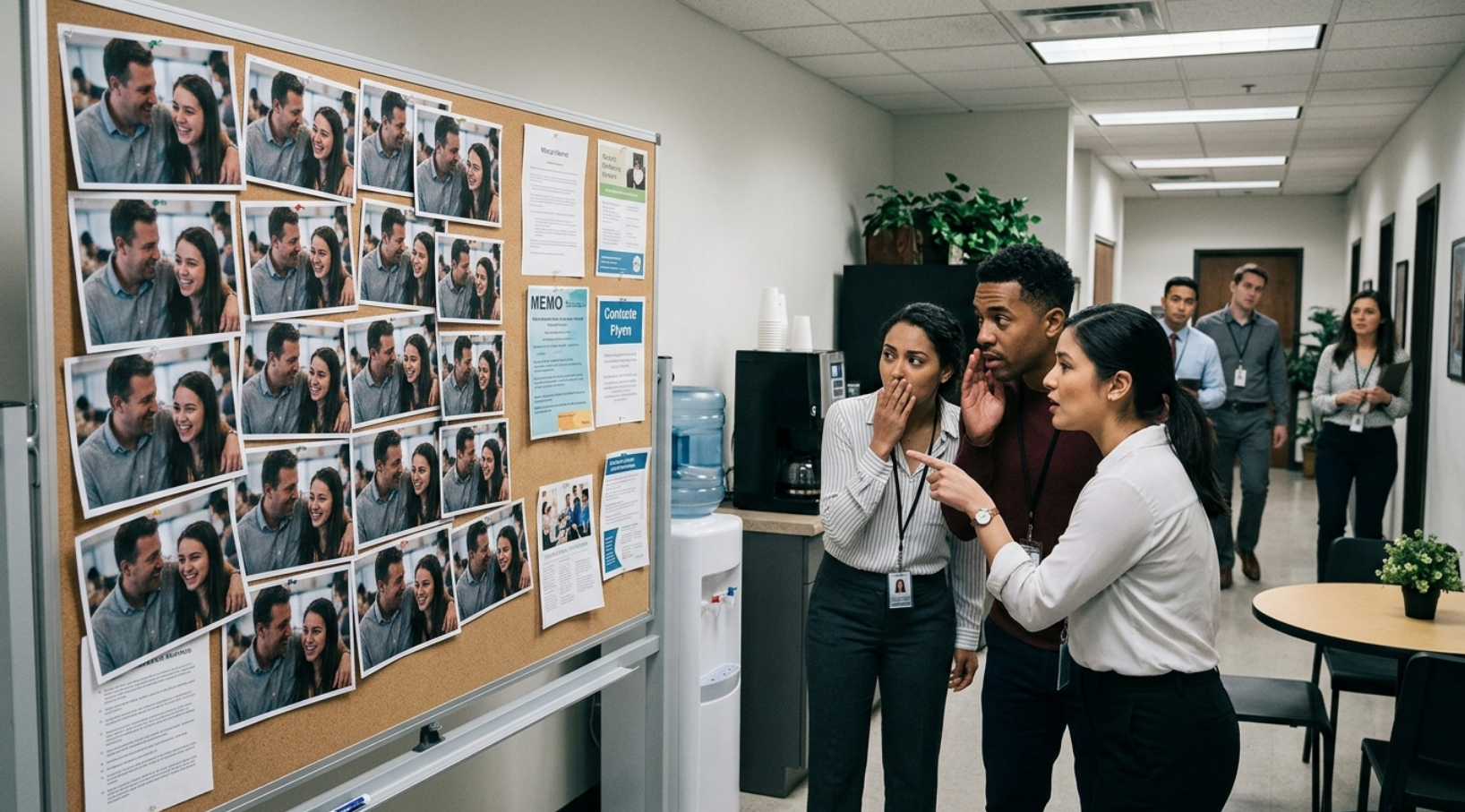
Not when I printed a hundred copies.
Not when I pinned them beside Marcus’s office.
When my sister said my name.
I put my bag down.
“I need you not to hug me.”
She stopped.
“Okay.”
“If you hug me, I will fall apart.”
“Okay.”
“I can’t fall apart yet.”
Rebecca nodded.
“Then we make tea.”
“Wine.”
“It’s midnight.”
“Wine.”
She opened the minibar.
I sat on the edge of the bed and turned on my phone.
It exploded.
Thirty-seven missed calls.
Seventy-four text messages.
Most were from coworkers.
Then Marcus.
Call me.
What did you do?
Olivia, answer your phone.
This is not funny.
Did you put those photos up?
CALL ME.
Then Chloe.
You are completely insane.
You had no right to distribute a private photo.
You are going to regret this.
I showed Rebecca.
She stared at the screen.
“She sent you the photograph.”
“Yes.”
“And is now angry you shared it?”
“Yes.”
Rebecca looked impressed.
“That is almost artistic.”
I laughed.
It came out sharper than I intended.
Then another message appeared.
Marcus.
You have created a serious HR problem.
I stared at it.
Rebecca read over my shoulder.
“He cheated on you with his subordinate and you created the HR problem?”
“Apparently.”
“What exactly did you put up?”
I showed her the picture.
Rebecca’s mouth opened.
“You printed a hundred?”
“Yes.”
“Olivia.”
“I know.”
“No.”
She started laughing.
“I mean one hundred?”
“Eleven by seventeen.”
She sat down.
“Oh, you were angry.”
“I was calm.”
“That is worse.”
Probably.
I took the wine.
“I’m not proud of it.”
“Yes, you are.”
“Maybe a little.”
Her expression softened.
“Are you okay?”
“No.”
“Good.”
I looked at her.
She shrugged.
“If you said yes, I’d worry.”
I took a drink.
Then I told her everything.
The late nights.
The canceled dinners.
The phone turned face down.
The Honolulu trip.
The photograph.
Chloe’s messages.
The hotel reimbursement.
The canceled room.
Rebecca listened.
When I mentioned company expenses, she sat straighter.
“Stop.”
“What?”
“Marcus used company money?”
“It looks that way.”
“For a romantic vacation?”
“I don’t know yet.”
“He extended a business trip by a week.”
“With his secretary.”
“Yes.”
“Stayed in the same suite.”
“Yes.”
“And charged the company?”
“At least some of it.”
Rebecca was a physician.
Not a lawyer.
But even she understood the shift.
“This is not only divorce material.”
“I know.”
“You need counsel.”
“I know.”
“Before you go back to the office.”
“I know.”
“Before you talk to Marcus.”
“I know.”
She narrowed her eyes.
“You already thought about this.”
“On the way here.”
“Who are you?”
“I don’t know.”
That was true.
At forty-two, I thought I knew who I was.
Senior Director of Strategic Planning at Halden Systems.
Wife.
Daughter.
Sister.
Reliable person.
The one who remembered anniversaries.
The one who fixed mistakes before executives noticed.
The one who never made scenes.
That version of Olivia would not have printed a hundred photographs.
Maybe she had been waiting a long time to do something exactly that reckless.
At 1:14 a.m., another email arrived.
From corporate security.
Ms. Bennett,
Please contact me as soon as possible regarding materials displayed on the 17th floor tonight.
I read it.
Then deleted nothing.
Rebecca watched me.
“What are you going to do?”
“Sleep.”
“You?”
“Yes.”
“How?”
“I haven’t decided.”
“You’re scaring me.”
“Good.”
At 6:30 the next morning, Rebecca woke me.
“Liv.”
I opened my eyes.
“What?”
“You have company.”
“What?”
She held up her phone.
“There are news vans outside your building.”
I sat up.
“What building?”
“Halden.”
My stomach dropped.
“How?”
She turned the screen toward me.
A local business gossip account had posted one of the photographs.
WHO PLASTERED HALDEN SYSTEMS HQ WITH PHOTOS OF OPERATIONS DIRECTOR MARCUS THORNE VACATIONING WITH HIS ASSISTANT?
It already had thousands of shares.
Someone at the office had photographed my photographs.
Of course.
Rebecca said carefully, “This is bigger now.”
I took the phone.
Another post.
Employees say dozens of large prints appeared overnight across the executive floor.
Another.
Sources identify woman in photo as Thorne’s personal assistant Chloe Davis.
Another.
Questions emerging about whether Honolulu travel was company-sponsored.
I went cold.
That last one had not come from me.
Someone else knew about the trip.
Or guessed.
My own phone rang.
Our CEO.
Thomas Hale.
I stared at the name.
Rebecca said, “You’re not answering that without a lawyer.”
She was right.
I let it ring.
Then I called one.
Rebecca knew someone from her hospital board whose wife handled complex employment and executive disputes.
Her name was Naomi Carter.
She answered at seven-thirteen.
By seven-forty, she had seen the photograph, the messages, the expense records, and the corporate security email.
At seven-forty-five, she said:
“You need to understand that putting the photographs around the workplace was risky.”
“I know.”
“It could be characterized as harassment, disruption, or misuse of company space.”
“I know.”
“You may face discipline.”
“I know.”
“Do you regret it?”
I thought.
“As a professional decision?”
“Yes.”
“Yes.”
“As a human decision?”
She waited.
“Ask me next week.”
Naomi almost smiled.
“Fair.”
Then her expression changed.
“Now, the more important issue.”
“Marcus.”
“Marcus and Chloe, if their relationship involved a reporting-line conflict or company resources.”
I nodded.
“Do you know your company’s policy?”
“Yes.”
I had helped revise part of it two years earlier.
Managers could not engage in undisclosed romantic relationships with direct reports.
Any relationship involving a power imbalance had to be disclosed to HR.
Failure to disclose could lead to discipline up to termination.
Expense misuse was separate.
Falsifying company travel records was grounds for termination.
Naomi said, “Do not make accusations you can’t prove.”
“I won’t.”
“Do not access anything you are not authorized to access.”
“I haven’t.”
“Preserve what you already lawfully obtained.”
“I have.”
“And do not delete your own conduct either.”
“The photos.”
“Yes.”
“I’m not planning to.”
“Good.”
She leaned closer to the camera.
“They may investigate you too.”
“I know.”
“Let them.”
That surprised me.
“You’re not telling me to deny it?”
“No.”
“You did it.”
“Yes.”
“Own what you did. It makes the rest stronger.”
That became the best advice anyone gave me.
At eight-twenty, I returned Thomas Hale’s call with Naomi listening.
Thomas answered immediately.
“Olivia.”
“Good morning.”
“I need you in the office.”
“I can be there at ten with counsel.”
A pause.
“Counsel?”
“Yes.”
“That sounds unnecessary.”
“Then you won’t mind if she comes.”
Another pause.
Thomas had been CEO for nineteen years.
He was not used to employees answering him that way.
“Fine.”
“Thank you.”
“Olivia.”
“Yes?”
“Did you put those photographs up?”
Naomi raised one finger.
I answered.
“Yes.”
Thomas exhaled.
“Why?”
“I’ll explain at ten.”
He hung up.
Rebecca drove me downtown.
I had changed into the only professional clothes she had with her that fit me reasonably well.
Black pants.
White blouse.
A navy blazer one size too large.
“You look like you’re borrowing someone’s life,” she said.
“I am.”
When we approached the corporate building, reporters were standing outside.
I wanted to disappear.
Rebecca said, “Parking garage.”
We entered through the lower level.
Naomi met us by the elevators.
“Do not speak to media.”
“I wasn’t planning to.”
“Good.”
“Where’s Marcus?”
“According to what HR told me, still in transit.”
I checked the time.
His flight had landed twenty minutes earlier.
“He’ll be here.”
“Yes.”
“What about Chloe?”
Naomi looked at me.
“She landed with him.”
Of course.
The elevator doors opened on seventeen.
The hallway looked completely different.
Every photograph was gone.
Bulletin boards empty.
Walls blank.
My coworkers pretended not to stare.
They failed.
One woman from finance caught my eye.
She gave the smallest nod.
Not approval.
Recognition.
That helped.
HR had commandeered a conference room.
Thomas sat at the head of the table.
Beside him were General Counsel Daniel Mercer, HR Vice President Lorraine Kim, and two people from corporate compliance.
Naomi sat beside me.
Thomas began.
“This is an extraordinary situation.”
I said nothing.
“Olivia, we need a straightforward account of what happened last night.”
I gave them one.
I told them about Chloe’s message.
I handed over printed screenshots.
I admitted immediately that I had ordered one hundred photographs.
“How many did you display?” Lorraine asked.
“Twenty-six.”
Thomas stared.
“Twenty-six?”
“Yes.”
“What happened to the others?”
“In my car.”
Naomi glanced at me.
I had forgotten to mention that.
Thomas rubbed his forehead.
“Why?”
I knew what he meant.
Why twenty-six?
Why one hundred?
Why any?
“I was humiliated.”
“That doesn’t justify disrupting the workplace.”
“No.”
My answer surprised him.
“I agree.”
The room shifted.
“I should not have used company common areas to expose a private marital issue.”
Thomas relaxed slightly.
Then I continued.
“But it stopped being entirely private when I discovered the Honolulu travel may have involved company-funded expenses and a relationship between an executive and his direct subordinate.”
Nobody moved.
I placed the travel records on the table.
Daniel Mercer picked them up.
He read.
Then read again.
Lorraine asked, “How did you access this?”
“Through the project-cost system I am authorized to use.”
“Why were you reviewing Marcus’s travel?”
“Because I was checking whether the photograph could have been taken during the business trip.”
Daniel interrupted.
“Stop.”
He looked at Thomas.
“We need a formal compliance hold.”
Thomas frowned.
“Based on this?”
“Based on the possibility.”
Lorraine looked at me.
“Did you know Chloe traveled with Marcus?”
“I knew his assistant attended the summit.”
“Did you know they extended the trip?”
“No.”
“Did you authorize expenses?”
“No.”
“Did anyone in your department?”
“Not that I know of.”
Daniel placed the page down.
“Who approves Marcus’s travel?”
Thomas answered.
“I do at the budget level. Finance handles reconciliation.”
“Who approved the hotel?”
“No idea.”
Thomas looked irritated now.
Not at me anymore.
That mattered.
Lorraine asked me to leave the room.
Naomi and I went into a smaller office.
My hands started shaking.
“There it is,” she said.
“What?”
“The adrenaline crash.”
“I hate this.”
“I know.”
“Am I getting fired?”
“Maybe.”
I stared.
“You could lie.”
“I could.”
“Would you?”
“No.”
“Good.”
“That wasn’t comforting.”
“It wasn’t meant to be.”
Twenty minutes later, the door opened.
Not Lorraine.
Marcus.
He stopped when he saw me.
For half a second, his face showed something I had never seen before.
Fear.
Then anger covered it.
“What the hell have you done?”
Naomi stood.
“Do not speak to my client that way.”
Marcus stared at her.
“Who are you?”
“Naomi Carter.”
“I was asking my wife.”
“I heard you.”
He looked back at me.
“Olivia.”
I stayed seated.
His tan was fresh.
That detail enraged me.
There I was wearing my sister’s blazer after sleeping four hours in a hotel, and Marcus looked rested from Hawaii.
“You humiliated me in front of the entire company.”
I almost smiled.
“You seem to have survived.”
“This is not funny.”
“No.”
“You put private photographs everywhere.”
“Chloe sent me the photograph.”
His jaw tightened.
“She had no right.”
Interesting.
Not I didn’t do it.
Not It’s misleading.
Chloe had no right.
“So the photograph is real.”
“Obviously it’s real.”
“And your relationship?”
He looked toward Naomi.
“I’m not discussing my marriage in front of a stranger.”
Naomi answered.
“You may discuss it with your own attorney.”
Marcus laughed bitterly.
“Unbelievable.”
He turned toward me.
“What were you thinking?”
I looked at him.
“I was thinking about how many nights I stayed in that office finishing work you told me was urgent while you were on a beach with your secretary.”
His face changed.
“Nothing happened until recently.”
That sentence was almost impressive.
Naomi closed her eyes briefly.
Even she understood.
“You should probably stop talking,” I said.
Marcus realized too late.
He straightened.
“This is between us.”
“No.”
I shook my head.
“The marriage is between us.”
I pointed toward the conference room.
“The company expenses are not.”
For the first time, Marcus went pale.
“What expenses?”
I watched him.
There.
That was enough.
“You know.”
His eyes moved toward the closed door.
“What did you give them?”
“Everything I was authorized to see.”
“You had no right to pull my travel records.”
“I use that system every day.”
“For projects. Not to spy on me.”
Naomi stepped closer.
“Mr. Thorne, this conversation is over.”
“No.”
He pointed at me.
“She is destroying my career because she’s angry about our marriage.”
I stood.
“I didn’t book two business-class tickets for a nine-night trip built around a three-day conference.”
Marcus froze.
“I didn’t cancel one hotel room after check-in.”
Silence.
“I didn’t submit extended meals and transportation to the company.”
His mouth opened.
“No.”
I picked up my purse.
“You did.”
He lowered his voice.
“You have no idea what you’re doing.”
“I’ve heard that before.”
“What is that supposed to mean?”
“It means men say that to women when the women stop doing what the men expect.”
His face twisted.
“You think this is empowerment?”
“No.”
I looked at him.
“I think it’s evidence.”
Lorraine opened the conference-room door.
“Marcus.”
He turned.
“We need you inside.”
He looked back at me.
“We are not finished.”
I met his eyes.
“As husband and wife?”
A pause.
“No.”
I picked up my bag.
“We probably are.”
The compliance review lasted six weeks.
I was placed on paid administrative leave for the first ten days because of the photographs.
That was fair.
I hated it.
But it was fair.
I had disrupted the workplace.
I had dragged coworkers into something they had not chosen.
A few employees complained that the display made them uncomfortable.
They were right.
A few thought it was hilarious.
That did not make it professional.
I gave HR a written acknowledgment.
No excuses.
No claim that pain made me innocent.
I wrote:
I displayed the images intentionally. I understand that workplace common areas were not an appropriate forum for a marital conflict, and I accept responsibility for that decision.
Naomi approved the wording.
Then I added one sentence she had not suggested.
I do not, however, regret preserving evidence that subsequently raised legitimate compliance concerns.
She read it.
“Keep that.”
I did.
I received a formal written warning.
Not termination.
Partly because my record over seven years was excellent.
Partly because I admitted the conduct immediately.
And, I suspect, partly because firing the wife who exposed an executive’s undisclosed affair and expense problems would have created a public-relations nightmare.
Marcus did not have the same outcome.
Neither did Chloe.
Compliance reviewed thousands of records.
Emails.
Expense reports.
Travel itineraries.
Messages on company devices.
Access logs.
It turned out Honolulu was not the beginning.
The affair had started four months earlier.
At least physically.
The emotional relationship began before that.
Marcus had used company-funded travel to create opportunities for them to spend time together in Dallas, Phoenix, and finally Honolulu.
Sometimes the business purposes were legitimate.
Sometimes the extensions were not.
He had approved reimbursements for Chloe.
She had altered calendar records to make personal time appear connected to meetings.
Nothing amounted to millions.
That almost made it worse.
Marcus risked his marriage and career for hotel upgrades, meals, flights, and a few thousand dollars of travel expenses he could easily have paid himself.
But the financial misuse was only part of it.
The undisclosed relationship violated policy.
Chloe reported directly to him.
Marcus approved her salary adjustment.
Her bonus.
Her travel.
Her performance reviews.
And three weeks before Hawaii, he had recommended her for promotion.
Another employee, Melissa Grant, had also applied for that position.
Melissa had more experience.
She did not get it.
The investigation could not conclusively prove that Chloe’s relationship caused Marcus’s recommendation.
It did not need to.
The conflict should have been disclosed.
It was not.
Marcus was terminated for failure to disclose a prohibited reporting relationship, misuse of corporate travel, inaccurate expense submissions, and violations of management conduct policy.
Chloe was also terminated.
Her role in expense documentation mattered.
So did messages found on her company account.
One message to a friend read:
Once Marcus moves me into the strategy role, I won’t have to be anybody’s secretary anymore.
Another:
Olivia is never around because she thinks working late makes her important. Works for me.
That message reached me through the investigation because it was relevant to motive.
I wish I had never read it.
It did not make me feel victorious.
It made me feel foolish.
Because Chloe was not entirely wrong about one thing.
I had spent years believing work would protect me.
If I was valuable enough professionally, organized enough personally, understanding enough as a wife, maybe nothing would fall apart.
That is not how life works.
You can be excellent and still be betrayed.
You can do everything “right” and someone else can still choose badly.
Their choice is not always an evaluation of your worth.
It is often an evaluation of theirs.
Marcus’s termination happened on a Monday.
He called me that evening.
I had returned to our house two weeks earlier, but only when I knew he would not be there.
He was staying with a friend.
I had already retained a divorce attorney.
His name was Aaron Feld.
Thirty-one years practicing family law.
Zero tolerance for melodrama.
When I first told him about the photographs, he stared at me.
“You did what?”
“One hundred copies.”
He took off his glasses.
“Why is everyone in this case trying to make my job harder?”
I liked him immediately.
By the time Marcus called after his termination, Aaron had already filed the divorce petition.
I answered because I knew the call would come.
Marcus did not say hello.
“They fired me.”
“I heard.”
“Of course you did.”
I waited.
“You’re happy.”
“No.”
“Don’t lie.”
“I’m not happy.”
“You destroyed my career.”
I closed my eyes.
There it was.
“You were a director with twenty-two years of professional experience.”
“What does that mean?”
“It means you knew company policy.”
“This would have been handled privately if you hadn’t turned it into a circus.”
“No.”
“It would.”
“You had an undisclosed relationship with your direct subordinate.”
“We could have disclosed it.”
“You didn’t.”
“Because I was trying to figure out what I wanted.”
I laughed quietly.
“You figured out what you wanted on an ocean-view balcony.”
Silence.
“That photograph was private.”
“Not after Chloe sent it to me.”
“Why would she do that?”
For the first time, he sounded genuinely confused.
I almost felt sorry for him.
“She wanted me to know you chose her.”
“She had no right.”
“You keep saying that.”
“Because it’s true.”
“Do you hear yourself?”
“What?”
“You are angrier at her for telling me than at yourself for giving her something to tell.”
Marcus went quiet.
Then he said, “Our marriage was already broken.”
That sentence hurt.
Because partly, it was true.
We had become distant.
We talked about calendars more than feelings.
Sex had become occasional.
We canceled more plans than we kept.
I worked late.
He traveled.
There were problems.
But problems are not permission.
“Yes,” I said.
“We were struggling.”
“You never wanted to talk about it.”
“I asked you for counseling last year.”
“You brought it up once.”
“Three times.”
“I was under enormous pressure.”
“So was I.”
“You always chose work.”
I almost laughed.
“So your response was to sleep with your secretary during a work trip?”
“I did not say it was justified.”
“You are currently justifying it.”
“No.”
He exhaled.
“I’m explaining.”
That word.
Explaining.
People love explanations when apologies feel too vulnerable.
“Did you love her?”
I asked.
Marcus was silent.
It was the first time I had asked.
Eventually, he said, “I thought I did.”
Thought.
Past tense.
Interesting.
“What happened?”
“She blames me for getting fired.”
I stared at the wall.
Of course.
“She says I promised I could protect her.”
“Did you?”
“I said I would take care of things.”
There was Marcus in one sentence.
Take care of things.
He had spent our marriage believing competence could erase consequences.
“I’m sorry,” he said.
My eyes closed.
There it was.
I had imagined wanting that apology.
Now it sounded small.
“What are you sorry for?”
“All of it.”
“Name something.”
He breathed out.
“For humiliating you.”
I waited.
“For lying.”
I waited.
“For Honolulu.”
“Okay.”
“For making you feel like your work was why we were distant when I was already involved with her.”
That one hurt.
Because he knew.
He had watched me blame myself.
“I should have ended our marriage before I started something else.”
“Yes.”
“I was a coward.”
Yes.
But I did not say it.
Marcus continued.
“I don’t expect you to forgive me.”
“Good.”
“I want to explain something.”
I almost laughed.
“You’ve explained a lot.”
“This matters.”
“Go ahead.”
“The picture.”
My stomach tightened.
“What about it?”
“The day it was taken, Chloe asked someone at the hotel to photograph us.”
“I assumed.”
“I didn’t know she planned to send it to you.”
“Obviously.”
“She had been pushing me to tell you.”
“And you wouldn’t.”
“No.”
“Why?”
“I didn’t know how.”
That sentence might once have moved me.
Now it made me tired.
“You’re forty-six years old, Marcus.”
“I know.”
“You’ve fired employees.”
“I know.”
“You’ve closed facilities.”
“Yes.”
“You’ve stood in rooms and told hundreds of people their jobs were disappearing.”
His voice lowered.
“Yes.”
“But telling your wife the truth was too difficult.”
He did not answer.
“That was not inability.”
I spoke quietly.
“That was convenience.”
He said my name.
I ended the call.
Divorce was not fast.
Nothing involving two people, a house, retirement accounts, stock options, and ten years of joint finances is fast.
Marcus had not hidden marital assets.
That was one small mercy.
The company expense misconduct affected his severance but did not magically give me everything.
Despite what revenge stories like to pretend, courts do not award houses because husbands behave badly.
We negotiated.
Argued.
Appraised.
Signed disclosures.
Separated accounts.
Sold the house.
That was my choice.
Marcus wanted to keep it.
I could have fought.
I did not want the walls.
I wanted distance.
The house sold five months after we separated.
On the final day, I walked through empty rooms.
Our dining table was gone.
The photographs removed.
The closet empty.
I stood in the kitchen where Marcus once surprised me with a cake for my thirty-eighth birthday.
I remembered laughing as he dropped frosting on the floor.
Then another memory.
The night he told me his Honolulu trip was going to be “brutal.”
Human beings contain contradictions.
Marcus had loved me.
He had also betrayed me.
Both things were true.
Pretending the first never existed would not make the second easier.
I touched the kitchen counter one last time.
Then left the key.
At work, things became more complicated.
I returned after administrative leave.
Some people admired me.
I did not want admiration.
Some avoided me.
I understood.
Some treated me like a celebrity.
I hated that.
Someone had put a small printed copy of the Honolulu photograph inside a frame in the breakroom with the caption:
CHECK YOUR EXPENSE REPORTS.
HR removed it within an hour.
I laughed anyway.
Then felt guilty.
Melissa Grant eventually received the promotion Chloe had been seeking.
Not automatically.
The company reopened the process with an independent panel.
Melissa won.
One afternoon, she came to my office.
“Do you have a minute?”
“Sure.”
She closed the door.
“I wanted to thank you.”
“For what?”
“The investigation.”
“I didn’t run it.”
“You started it.”
“That wasn’t why.”
“I know.”
She sat.
“I thought I was losing my mind.”
I understood instantly.
“What happened?”
“Marcus kept telling me I wasn’t ready.”
She laughed without humor.
“I have twelve years of experience.”
I said nothing.
“He said Chloe had better executive instincts.”
My jaw tightened.
“Maybe he believed that.”
“Maybe.”
Melissa looked toward the window.
“But when someone’s sleeping with the boss, it becomes very hard to tell what feedback is real.”
That was the hidden damage of conflicts of interest.
Not only unfair rewards.
Corrupted reality.
Everybody else began questioning their own performance because the system was secretly tilted.
“I’m sorry,” I said.
She shrugged.
“I almost quit.”
“But you didn’t.”
“No.”
“Why?”
She smiled.
“Spite.”
I laughed.
“I understand.”
She stood.
At the door, she turned.
“For what it’s worth, you were always the reason those projects stayed on track.”
I frowned.
“What?”
“Marcus got the credit for operations.”
“That was his job.”
“Yes.”
“And?”
“And people noticed who stayed until eleven fixing everything.”
That sentence did something to me.
For years, I had resented those late nights after discovering the affair.
They had become evidence that I was the fool working while Marcus enjoyed himself.
Melissa reminded me of something else.
The work had still been mine.
His betrayal did not erase my competence.
I stopped giving him ownership of my effort.
That changed my recovery more than the divorce did.
Three months later, Thomas Hale asked me to lunch.
I assumed it involved company restructuring.
I was right.
Partly.
We met at an Italian restaurant near the river.
Thomas ordered coffee.
No alcohol.
That meant seriousness.
“Olivia, Marcus’s position is being redesigned.”
I nodded.
“Operations is splitting.”
“Okay.”
“One part will remain traditional operations.”
“And the other?”
“Strategic execution.”
I waited.
“We want you to lead it.”
I stared at him.
“As what?”
“Executive Vice President.”
For a second, I genuinely thought he was joking.
“Thomas.”
“I’m serious.”
“I’m a planning director.”
“You’ve been functioning above that level for years.”
“Why now?”
He knew what I was asking.
Is this guilt?
Public relations?
Compensation because my husband cheated with an employee?
“No,” he said.
“You didn’t let me finish.”
“I know the question.”
“Then answer it.”
He folded his hands.
“The board reviewed leadership succession during the compliance investigation.”
“That sounds ominous.”
“It was.”
He almost smiled.
“They discovered several people whose formal titles did not match their actual organizational influence.”
“Me.”
“You.”
I looked away.
Thomas continued.
“Marcus often presented project recoveries as operations wins.”
My chest tightened.
“I knew he did that sometimes.”
“More than sometimes.”
“What are you saying?”
“I’m saying your work was undervalued.”
That hurt in a completely different way.
“Did Marcus do that intentionally?”
“I can’t answer motive.”
Good corporate answer.
“I can tell you reporting history.”
He slid a folder toward me.
Performance summaries.
Project completion reports.
Executive presentations.
I recognized work I had built.
Some slides still contained metadata from my team.
But in board summaries, Marcus had often become the visible owner.
My husband had not stolen my job.
Nothing that dramatic.
He had simply benefited from an arrangement where I worked quietly and he presented confidently.
At home and in the office.
A pattern.
“You knew?” I asked.
“Not enough.”
“That means yes.”
Thomas sighed.
“We knew you were essential.”
“But not essential enough to promote.”
“That criticism is fair.”
I appreciated that he did not argue.
“Why should I trust this company now?”
“You shouldn’t automatically.”
That surprised me.
“Then why stay?”
“I’m not telling you to.”
He looked at me.
“I’m offering the role. You can negotiate. You can decline. You can leave.”
That was the first job offer I had ever received that treated leaving as a legitimate form of power.
I asked for three days.
Naomi reviewed the employment terms.
Rebecca reviewed them too despite having no business qualifications.
Her conclusion:
“Ask for more money.”
I did.
A lot more.
Thomas said yes.
I asked for a stronger bonus structure.
He negotiated.
I asked for executive coaching budget.
Yes.
I asked for authority to build my own team.
Yes.
Then I asked for something that mattered more than all of it.
A company-wide rule requiring disclosure and independent review of all romantic relationships involving direct or indirect reporting authority.
Thomas stared.
“We already have policy.”
“Your policy failed.”
“Fair.”
“And a protected reporting channel outside the management chain.”
“HR already—”
“No.”
I shook my head.
“Employees need a route they trust when the person they’re reporting is powerful.”
He thought.
“I can take that to the board.”
“Then take it.”
I accepted the position two weeks later.
The internet loved that.
CHEATED WIFE TAKES HUSBAND’S EXECUTIVE TURF.
I hated the headline.
The role was not Marcus’s.
It was newly created.
But truth is slower than a catchy sentence.
For several months, strangers sent me messages.
Queen.
Icon.
Revenge goals.
Teach me your ways.
I had printed photographs in a moment of shock.
Somehow people turned me into a strategist.
That was dangerous.
So when a business podcast asked me to appear, I initially refused.
Then the producer said the topic would not be adultery.
It would be workplace power.
I agreed.
The host asked one question I remember.
“Do you recommend what you did?”
“The photographs?”
“Yes.”
“No.”
She looked surprised.
“Really?”
“Yes.”
“Why?”
“Because humiliation is unpredictable.”
I thought about my coworkers.
Melissa.
The employees dragged into gossip.
The company receptionist answering reporter calls.
People who had nothing to do with my marriage.
“I was hurt. I did something dramatic.”
“Understandable.”
“Understandable is not the same as wise.”
“So you regret it?”
I smiled.
“Parts.”
“What would you do differently?”
“I would preserve the evidence and go directly to counsel, HR, and compliance.”
“That’s much less entertaining.”
“Yes.”
She laughed.
“But probably better.”
“Definitely.”
Then she asked, “Do you regret exposing them?”
“No.”
That answer was immediate.
“I regret the method.”
Not the truth.
That distinction became important.
Chloe disappeared from my life.
For almost a year.
Then she emailed me.
I nearly deleted it.
Subject:
I owe you an apology.
I opened it.
Olivia,
I don’t expect a response.
I was cruel to you because I wanted to believe Marcus choosing me meant I had won something.
I sent you the photo because I wanted you to feel defeated.
I thought if you knew he preferred me, you would quietly leave.
I did not understand how much of what he told me about your marriage was self-serving.
That sentence angered me.
Not because it was false.
Because it was familiar.
Men having affairs often tell the new woman the wife has become cold.
Distant.
Obsessed with work.
The marriage is already dead.
They sleep in separate rooms.
They are only together for appearances.
Maybe sometimes it is true.
Maybe sometimes it is partly true.
But the story almost always makes adultery sound like the final step in a process nobody chose.
Chloe continued.
Marcus told me you cared more about your career than him.
He said you barely spoke.
He said you had agreed your marriage was essentially over but had not discussed divorce because of finances.
That was a lie.
We had never agreed that.
Not once.
She wrote:
I should have known that if a man is still married, the wife deserves to hear from him, not from me.
I was arrogant.
I also believed he would protect my career.
When we were both fired, I blamed him, then you, then the company.
Eventually I had to admit that I knew the relationship violated policy and helped hide it.
I am sorry.
I do not expect forgiveness.
Chloe
I sat with the email open for a long time.
She was twenty-six when the affair happened.
Old enough to know better.
Young enough to make spectacularly bad decisions and believe desire was destiny.
I did not absolve her.
But I no longer needed to hate her.
I replied with three sentences.
Chloe,
I received your message.
What you did hurt me deeply, but I appreciate that you took responsibility without asking me to make you feel better.
I hope you make different choices going forward.
Olivia
She never contacted me again.
Marcus did.
More than once.
Not romantically at first.
Practical matters.
Tax forms.
Insurance.
Final property transfers.
Then, after the divorce became final, silence.
Nine months passed.
Then he asked if I would meet for coffee.
I almost said no.
Then I said yes.
We met at a café where no one knew us.
Marcus looked different.
Not ruined.
The internet had imagined he would become unemployable.
He did not.
People with twenty years of experience do not evaporate because one company fires them.
But consequences existed.
He had taken a lower-level operations role at a manufacturing company in Wisconsin.
Less money.
Less prestige.
No executive title.
He had moved into a condominium.
He looked older.
So did I, probably.
“Thank you for coming,” he said.
“You said you wanted to talk.”
“I do.”
We ordered coffee.
Then sat awkwardly.
Finally, Marcus said, “I went to therapy.”
I nearly smiled.
“Everyone keeps doing that after hurting me.”
He laughed.
A little.
Then became serious.
“I deserved that.”
I waited.
“I spent a long time believing the affair happened because our marriage was empty.”
“What do you believe now?”
“That I made it emptier.”
That was a good start.
“I was lonely.”
“So was I.”
“I know.”
“You handled it differently.”
“Yes.”
He looked down.
“I made you responsible for my unhappiness because that let me avoid asking what I was doing.”
I said nothing.
He continued.
“I liked being admired.”
That was honest.
“Chloe admired me.”
“I know.”
“You knew?”
“Marcus.”
“Right.”
He smiled sadly.
“At home, you knew everything about me.”
“Yes.”
“My weaknesses.”
“Yes.”
“My bad habits.”
“Many.”
He almost laughed.
“With Chloe, I got to be the successful director.”
I understood.
Not approved.
Understood.
“She saw the version of me I wanted to see.”
“And I saw the version you actually were.”
“Yes.”
“That sounds uncomfortable.”
“It was.”
He looked directly at me.
“That is not your fault.”
I had waited years to hear him understand that.
It arrived too late to save anything.
But not too late to matter.
“I’m sorry I made you think working harder would fix us.”
My throat tightened.
“That was cruel.”
“I know.”
“I canceled a trip with Rebecca because you said the Honolulu planning was behind schedule.”
His face broke.
“I know.”
“You were already there with Chloe.”
“Yes.”
“I worked until midnight three times that week.”
He closed his eyes.
“I know.”
“That is the part I had trouble forgiving.”
“Not the sex?”
“That too.”
I smiled without humor.
“But I hated that you used my reliability against me.”
He nodded.
“I’m sorry.”
This time, I believed him.
I did not want him back.
That was how I knew believing him was safe.
“Thank you.”
We sat quietly.
Then Marcus said something unexpected.
“I was angry when you got promoted.”
I raised an eyebrow.
“Honest.”
“I know.”
“I told myself the company rewarded you because they felt guilty.”
“Did you believe that?”
“At first.”
“And now?”
He shook his head.
“I saw the announcement about the Phoenix acquisition.”
I had led it.
One of the hardest projects of my career.
“You did that without me.”
“Yes.”
He smiled sadly.
“I think I needed to believe you were successful because of us.”
That sentence explained more of our marriage than he knew.
“I think I needed to believe the same thing,” I said.
He looked surprised.
“For years.”
“Why?”
“Because if we were a team, then my sacrifices had meaning.”
We sat with that.
Finally, Marcus asked, “Are you happy?”
I thought.
“Yes.”
“Really?”
“Yes.”
He nodded.
“Good.”
“And you?”
“Some days.”
Fair.
Before we left, he said, “I saw one of the pictures once.”
“What pictures?”
“The office ones.”
I laughed.
“Someone sent me a photo of the hallway.”
“Oh.”
“You put one directly outside my office.”
“Yes.”
“Perfectly centered.”
“I used a ruler.”
He stared.
“Of course you did.”
We both laughed.
It was the first time the photograph became funny.
Not the affair.
Not the humiliation.
The absurdity.
One hundred eleven-by-seventeen color prints.
That was excessive.
I could finally admit it.
Three years after the affair, Halden Systems held its annual leadership conference.
I stood onstage in front of nearly six hundred employees.
Executive Vice President.
My department had grown from twelve people to seventy.
We had implemented a new reporting system for ethics concerns.
Not perfect.
Nothing is.
But people used it.
Several conflicts of interest had been disclosed before becoming problems.
One manager stepped away from a promotion decision involving someone he was dating.
Another transferred reporting lines voluntarily.
Boring.
Healthy.
Exactly what good policy should produce.
Thomas introduced me for the closing keynote.
He had asked me to speak about “organizational trust.”
I hated the phrase.
But I accepted.
I told the audience something I had learned the hard way.
“Trust is not believing that good people never make bad decisions.”
The room became quiet.
“Trust is knowing the system does not depend on everyone being good.”
I talked about disclosures.
Checks.
Independent review.
Clear reporting.
No names.
No Honolulu.
Everyone knew anyway.
At the end, an employee asked:
“How do you rebuild trust after it’s broken?”
I almost gave a corporate answer.
Transparency.
Consistency.
Accountability.
Instead, I told the truth.
“Slowly.”
People laughed.
I smiled.
“I wish there were a better answer.”
There wasn’t.
“An apology can happen in five minutes.”
I thought of Marcus.
Chloe.
“Trust takes repeated evidence.”
That was true in companies.
And marriages.
And friendships.
And self-trust.
Especially self-trust.
After the affair, the person I distrusted most was myself.
How did I not see it?
Why did I believe him?
Why did I work so late?
Why did I accept the cancellations?
Why did I not confront him when his phone behavior changed?
Those questions tortured me.
Therapy helped.
Yes.
I joined the trend.
My therapist, Dr. Ramirez, asked me one day:
“If your best friend told you her husband lied convincingly, would you blame her for believing her husband?”
“No.”
“Why do you blame yourself?”
“Because I should have known.”
“Based on what?”
“The signs.”
“What signs did you have before you already knew what they meant?”
I stopped.
That was the trap.
Once you know the ending, the beginning looks obvious.
At the time, a late meeting was a late meeting.
A guarded phone was stress.
Canceled dinner was work.
Distance was marriage going through a hard season.
I had not been stupid.
I had been trusting.
Those are different things.
The lesson was not never trust again.
It was trust evidence when it changes.
That took me years.
I dated eventually.
Very slowly.
My first date after divorce lasted forty-seven minutes.
His name was Peter.
He spent thirty of those minutes talking about cryptocurrency.
I went home grateful to be divorced.
The second man asked whether I was “the woman with the posters.”
I left before appetizers.
Then I stopped dating for six months.
Eventually, I met Jonathan.
Not through work.
Not through an app.
At a bookstore.
Which sounds fake even to me.
He reached for the same copy of a biography I wanted.
We argued over whether the author was overrated.
Coffee followed.
Then dinner.
He was divorced.
Two adult daughters.
Civil engineer.
Terrible taste in movies.
Excellent cook.
On our fourth date, I told him about Marcus.
He already knew some of it.
The story had been public.
But he let me tell it.
When I finished, he asked:
“Do you still have any of the prints?”
I stared at him.
“That is your question?”
“I’m curious.”
“Yes.”
“How many?”
“Seventy-four.”
He almost choked.
“You kept seventy-four?”
“I paid for them.”
That was the moment I knew I liked him.
He did not ask me to trust him.
He behaved in ways that made trust possible.
There is a difference.
He did not guard his phone.
Not because I demanded access.
Because normal people sometimes leave phones on tables.
He did not narrate every minute of his day.
I did not need him to.
He told me when he was unhappy.
That sounds small.
It was enormous.
One evening, about a year into our relationship, he said:
“I feel like your job gets the best part of you this month.”
My body tensed.
Old memory.
Marcus saying I cared more about work.
Jonathan noticed.
“That sounded loaded.”
“A little.”
“I’m not accusing you of anything.”
“Then what are you saying?”
“I miss you.”
That was it.
No affair.
No secret resentment.
No punishment.
“I miss you.”
So we changed plans.
I delegated two meetings.
We went away for a weekend.
Healthy relationships can be astonishingly undramatic.
I had no idea.
Five years after Honolulu, Halden Systems opened a new regional headquarters.
At the opening reception, I saw a familiar man near the entrance.
Mr. Henderson.
The print-shop manager.
Older.
Same glasses.
I laughed instantly.
He recognized me too.
“Mrs. Thorne.”
I smiled.
“Ms. Bennett.”
“Right.”
He looked embarrassed.
“Sorry.”
“It’s fine.”
“I heard about the divorce.”
“I assumed.”
He glanced around.
“You work pretty high up now.”
“So they tell me.”
He smiled.
Then said, “I still remember that order.”
“I’m sure you do.”
“One hundred copies.”
“I know.”
“Urgent.”
“I know.”
“Eleven by seventeen.”
I covered my face.
“Please stop.”
He laughed.
“You looked so calm.”
“I was not.”
“You looked calm.”
“That’s different.”
He nodded.
“Can I tell you something?”
“Sure.”
“I almost asked what they were for.”
“Why didn’t you?”
“Twenty-four-hour print shop.”
He shrugged.
“We learn not to ask.”
Fair.
Then his smile faded slightly.
“The next morning, corporate security came down and asked if we had records.”
My stomach tightened.
“I’m sorry.”
“For what?”
“I dragged you into it.”
“No.”
He shook his head.
“They asked whether you ordered them.”
“What did you say?”
“I said yes.”
I laughed.
“Helpful.”
“I wasn’t going to lie.”
“Good.”
He looked toward the reception crowd.
“You know, the girl came down too.”
I froze.
“Chloe?”
“The next afternoon.”
I had never heard this.
“What did she want?”
“To know whether we still had the original digital file.”
“Why?”
“She wanted us to delete it.”
I stared.
“What did you do?”
“Nothing.”
He smiled.
“You emailed it. We don’t keep client files beyond job retention unless required.”
“So?”
“I told her the person she needed to ask was the person who sent the file.”
Me.
“She wasn’t happy.”
“I imagine not.”
Mr. Henderson shook his head.
“People are strange.”
“Yes.”
“That job was better than most.”
“You mean the prints?”
“Yes.”
“How?”
“Usually people print tax forms.”
I laughed.
We shook hands.
As he walked away, I thought about that night.
The elevator.
The empty hallway.
The first photograph pinned to the bulletin board.
At the time, I believed I was ending something.
I thought I was ending Marcus’s secret.
Ending Chloe’s advantage.
Maybe ending my marriage.
I did not understand I was beginning something too.
Not a revenge story.
At least not the one strangers wanted.
People wanted Chloe humiliated.
Marcus ruined.
Me elevated.
Justice in three acts.
Reality was messier.
I behaved badly in one moment.
Marcus behaved badly for months.
Chloe behaved cruelly and helped hide an affair and policy violations.
The company failed to notice.
Then everybody paid different prices.
Some deserved.
Some incidental.
Some temporary.
Marcus lost a job but rebuilt a career.
Chloe lost a job and, I hope, learned something.
I lost a marriage.
Then built a life.
There was no single winner.
That used to disappoint people when I told the story.
They wanted me to say Marcus regretted everything forever.
I don’t know if he did.
They wanted Chloe to remain miserable.
I hope she didn’t.
They wanted me to marry a billionaire and buy the company.
I did neither.
I became good at my own job.
That turned out to be enough.
More than enough.
Seven years after the photograph, I received a package at my office.
Inside was a framed image.
At first, I did not understand.
Then I laughed so loudly my assistant came in.
“What?”
I turned it around.
It was the Honolulu photograph.
But someone had edited it.
Marcus and Chloe were gone.
In their place was a large blank white rectangle.
Underneath:
RESERVED FOR BETTER DECISIONS.
No sender.
Then I saw the note.
From Melissa.
Happy anniversary of the most chaotic compliance investigation in company history.
I called her.
“You’re insane.”
“You laughed.”
“I did.”
“Then it worked.”
“Why do you remember the date?”
“Because my promotion became official the same week.”
“Of course.”
I put the framed joke in a drawer.
Not on the wall.
I had grown.
Mostly.
That evening, Jonathan and I had dinner.
I told him about the package.
He laughed.
Then asked, “Do you ever wonder what would’ve happened if Chloe had never sent the picture?”
That question stopped me.
Yes.
I had wondered.
Maybe Marcus would have ended the affair himself.
Maybe not.
Maybe he would have left me months later.
Maybe I would have discovered a message.
A receipt.
A lie.
Maybe the relationship would have continued for years.
Maybe Marcus would have promoted Chloe.
Maybe Melissa would have quit.
Maybe company money would keep subsidizing the secret.
Or maybe everything would have burned out quietly.
There was no way to know.
“I think I would have found out eventually.”
“Would you still be married?”
I looked at him.
“No.”
“You sure?”
“Yes.”
The photograph did not destroy my marriage.
It revealed where it already was.
That distinction had taken years to accept.
Jonathan reached across the table.
“You okay?”
“Yes.”
“Really?”
I smiled.
“Yes.”
That was the beautiful thing.
I was.
Years earlier, Chloe had written:
It’s a pity seeing you working while we enjoy this trip.
At the time, she believed she had sent me evidence that she had won.
She thought Marcus’s attention was the prize.
She thought my late nights made me pathetic.
I thought so too for a while.
Then my life kept moving.
The work she mocked helped build the career that supported me when the marriage ended.
The coworkers who watched the photographs spread became the people who later trusted me to lead them.
The projects Marcus sometimes overshadowed became proof of what I could do alone.
The woman Chloe pitied became someone I finally learned to respect.
Myself.
That was the ending none of us predicted.
Not a ruined man.
Not a humiliated mistress.
Not a giant revenge check.
Just a woman who stopped measuring her life by whether her husband chose her.
A year after that conversation with Jonathan, I found the remaining photographs in a storage box.
Seventy-three now.
I had apparently lost one.
They were still wrapped in brown paper from Mr. Henderson’s shop.
I sat on the floor and opened them.
There they were.
Marcus.
Chloe.
Honolulu.
For the first time, I felt almost nothing.
No stabbing pain.
No rage.
No urge to examine Marcus’s smile.
It was simply an old photograph of two people who had made choices that changed my life.
Jonathan sat beside me.
“What are you going to do with them?”
“I don’t know.”
“Bonfire?”
“Dramatic.”
“Shredder?”
“Time-consuming.”
“Sell them as limited-edition art?”
I laughed.
Then I knew.
The next morning, I took them to a secure document-destruction service.
The clerk looked at the stack.
“Sensitive records?”
“Very.”
He wheeled them away.
That was it.
No ceremony.
No flames.
No speech.
I walked outside holding nothing.
And it felt better than displaying them ever had.
Because revenge needs the other person.
Freedom does not.
That evening, I called Rebecca.
“I destroyed the photos.”
“All of them?”
“Yes.”
“Even the originals?”
“Digital copies too.”
She was quiet.
“Wow.”
“What?”
“I thought you would keep one.”
“Why?”
“I don’t know. Evidence.”
“The divorce is done.”
“History.”
“I remember.”
“Insurance?”
“Against what?”
She laughed.
“Good point.”
I stood on my balcony.
Chicago glittered below.
“I don’t need them anymore.”
Rebecca understood.
“Good.”
We talked about her kids.
Her hospital.
Normal life.
After we hung up, I stayed outside.
The city had changed in seven years.
So had I.
People sometimes think betrayal destroys trust in others.
For me, the harder damage was trust in myself.
I questioned my judgment.
My instincts.
My memories.
I replayed conversations looking for clues.
I wondered whether every happy moment had been fake.
Therapy eventually taught me not to turn one deception into a rewrite of my entire life.
Marcus lied during the affair.
That did not mean he lied every day for five years.
Our wedding vows were sincere when we made them.
Our vacations had been real.
Our laughter had been real.
The love had been real.
And then something changed.
He handled that change dishonestly.
That was enough.
I did not need to convert him into a lifelong villain to justify leaving him.
I only needed to accept that the marriage I deserved could not be built with the person he had chosen to be at that time.
Maybe that was maturity.
Or exhaustion.
Either way, it brought peace.
The following Monday, I walked into Halden headquarters before seven.
Early.
Old habit.
The seventeenth floor was quiet.
Our offices had been renovated years earlier.
The old bulletin board was gone.
Marcus’s former office was now a collaboration room.
Chloe’s desk had disappeared during the redesign.
My office was on nineteen now.
But I stepped off at seventeen anyway.
I walked past the place where I had pinned the first photograph.
No trace.
Of course.
Buildings do not remember drama the way people do.
A new employee hurried past me carrying coffee.
“Morning, Ms. Bennett.”
“Morning.”
She disappeared around the corner.
I stood there another moment.
Then smiled.
Seven years earlier, I had believed the story started with a photograph.
It didn’t.
It started much earlier.
With little silences.
Delayed conversations.
Work used as an excuse.
A marriage that stopped asking difficult questions.
A manager who let personal desire cross professional boundaries.
An assistant who believed being chosen made her powerful.
A wife who believed being indispensable at work could compensate for being lonely at home.
The photograph only turned on the light.
And yes, I printed it.
One hundred copies.
That will probably follow me forever.
I can live with that.
Because the person who pinned those photographs to the wall was hurt, furious, and impulsive.
But she was also finished pretending.
I do not admire every choice she made that night.
I understand her.
I forgive her.
Most importantly, I became her advocate instead of her critic.
That may have been the real lesson.
We are often kinder to the people who hurt us than we are to the version of ourselves who allowed the hurt to happen.
I stopped doing that.
At nine, I led an executive meeting.
At noon, I reviewed an acquisition plan.
At three, I called Jonathan.
At six, I went home.
Not to work more.
Home.
We cooked pasta.
Badly.
He chose a terrible movie.
I complained.
He ignored me.
My phone stayed on the kitchen counter.
No secrets.
No surveillance.
No need to check.
Before bed, I received an email from a young manager at work.
She had attended my leadership conference years earlier.
She wrote:
Olivia,
I disclosed a relationship with someone in another department today because I remembered what you said about trust not depending on everyone making perfect decisions.
HR adjusted our reporting lines.
Nobody got fired.
Nothing exploded.
It was awkward for twenty minutes.
Then it was fine.
I thought you might like to know.
I read it twice.
Then smiled.
That was the ending.
Not the photographs.
Not Marcus losing his title.
Not Chloe apologizing.
Not my promotion.
The ending was a younger employee telling the truth before the truth became a weapon.
Something painful had become useful.
That was enough for me.
I replied:
Thank you for handling it early and honestly.
Then I closed my laptop.
Jonathan looked over.
“Work?”
“Something good.”
“Rare.”
“Very funny.”
I turned off the light.
Years ago, Chloe sent me a photograph because she wanted me to know my husband had chosen her.
She believed the picture would break me.
For one night, maybe it did.
Then I printed a hundred copies because I wanted everyone else to see what I had been forced to see.
I thought exposure would make the pain easier.
It didn’t.
Truth made it easier.
Consequences made it clearer.
Time made it smaller.
And eventually, rebuilding made it mine.
If I could go back to that night at 10:47 p.m., I would tell the woman staring at her phone something simple.
Do not beg.
Do not compete.
Do not ask why she was enough when you were not.
That is the wrong question.
Do not mistake another person’s dishonesty for evidence about your value.
Save the messages.
Call a lawyer.
Call your sister.
Go somewhere safe.
Sleep before you make decisions involving a commercial printer.
Especially that last one.
I smile when I think about it now.
Because I know what happened next.
Marcus thought the worst thing that morning was seeing his affair displayed outside his office.
Chloe thought the worst thing was losing control of the secret.
I thought the worst thing was losing my marriage.
All three of us were wrong.
The worst thing would have been continuing exactly as we were.
Marcus living two lives.
Chloe building a career inside a conflict she refused to acknowledge.
Me staying late every night trying to earn security from people who were not being honest with me.
The photograph ended that.
Messily.
Publicly.
Painfully.
But it ended it.
Years later, when someone at work once joked that I was “the woman who knows how to make an announcement,” I laughed.
Then I said:
“I prefer email now.”
Everyone laughed.
They thought I was making a joke.
I was.
Mostly.
Because these days, when something is wrong, I speak earlier.
Before resentment becomes theater.
Before silence becomes permission.
Before one hundred glossy prints become emotionally necessary.
That is growth.
Not becoming a person who never gets angry.
Becoming a person who no longer needs anger to be heard.
And that is how the photograph that was supposed to humiliate me became the last secret Marcus and Chloe ever controlled.
They chose the picture.
I chose what happened afterward.