My Father Asked Me for $1,000 and My Wife Told Him to Get Another Job. Three Days Later, a Hospital Handed Me an Envelope He Said I Must Not Open With Her.
My father stood in my kitchen asking to borrow a thousand dollars, and I had never seen him look so ashamed.
Arthur Hayes had spent more than thirty years in construction. He had worked through rain, summer heat, layoffs, a torn rotator cuff, and the kind of back pain that made him brace one hand against the counter every time he stood up.
He had also spent most of his life giving things away without announcing that he was doing it.
When I was eighteen, Dad sold the motorcycle he had restored in our garage because my first semester of college cost more than we had expected.
He told me he was tired of riding.
I believed him until years later, when one of his friends mentioned how much Dad had loved that bike.
When Jessica and I bought our house, Dad sold a small piece of land he had inherited from his father and quietly covered most of our down payment.
He called it an early gift.
When I tried to repay him, he laughed.
“Put it toward the mortgage, Ethan.”
That was my father.
He would loan you his truck, give you the last steak off the grill, spend an entire Saturday fixing your fence, then act offended if you tried to pay him for gas.
In forty-one years, he had never once asked me for money.
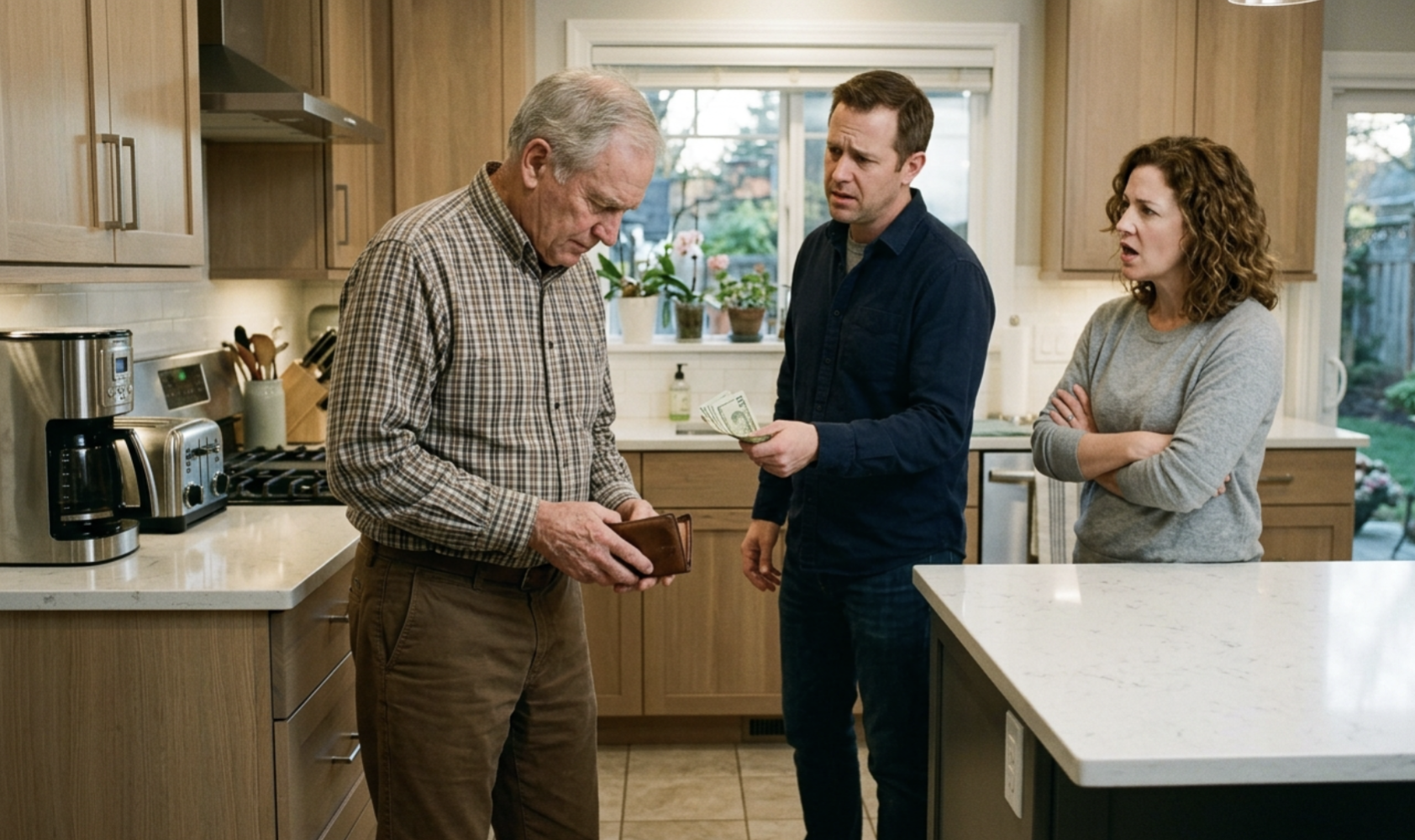
So when he appeared at my kitchen table one Thursday morning and said, “I need to borrow a thousand dollars,” I knew something was wrong.
His hands were trembling.
Not badly.
Just enough that the coffee in his mug moved against the rim.
“What happened?”
“Nothing happened.”
“Dad.”
He stared down at the table.
Jessica had been standing at the counter packing her lunch. She stopped closing a plastic container and looked over.
Dad rubbed his thumb against the handle of his mug.
“I need some certified records, a little legal advice, and a test.”
“What kind of records?”
He hesitated.
“Old adoption records.”
I looked at him.
“Whose adoption?”
He did not answer immediately.
Jessica did.
“For a thousand dollars?”
Dad glanced toward her.
“I don’t know what all of it will cost. The attorney needs a retainer. The records have fees. The test has to be done properly.”
Jessica let out a small breath through her nose.
“There’s always some mysterious emergency.”
I turned.
“What?”
She put the lid on her lunch container harder than necessary.
“I’m saying this sounds strange.”
Dad lowered his eyes.
That bothered me more than if he had gotten angry.
“Jess,” I said.
She ignored me and looked directly at him.
“If you need a thousand dollars for something, Arthur, maybe you should tell Ethan what it’s actually for.”
“I’m trying to.”
“No, you’re not.”
Dad pushed his chair back slightly.
“I should go.”
“No.” I reached for his wrist. “You came here for a reason.”
He sat again.
I could feel Jessica watching us.
“Whose adoption records?” I asked.
Dad looked at me for several seconds.
“I need proof first.”
“Proof of what?”
“Something I should have told you a long time ago.”
My stomach tightened.
Jessica became completely still behind me.
Dad continued.
“If I tell you now without the paperwork, someone is going to say I’m confused. Or that I’m getting old. Or that I’m trying to interfere with your marriage.”
I looked at Jessica without meaning to.
Her face changed.
Only for a second.
If I had not already been watching her, I might have missed it.
“Who would say that?” I asked.
Dad did not answer.
Instead, he reached across the table and put one rough hand on my shoulder.
“I’m trying to give you something I should have given you years ago.”
“What?”
“The truth.”
Jessica picked up her lunch bag.
“This is ridiculous.”
Dad flinched.
I stood.
“Enough.”
She stared at me.
“What?”
“He has never asked me for anything.”
“And that means you just hand him cash whenever he appears with some secret story?”
“He’s my father.”
“And this is our house.”
I do not know why that sentence bothered me as much as it did.
Maybe because it was technically true and emotionally false at the same time.
It was our home. Jessica had lived there with me for nine years.
But the deed was in my name because I had bought it before we married.
And Jessica knew exactly where the original down payment had come from.
My father.
Dad stood.
“Forget it.”
“No.”
I walked past Jessica and went into my office.
I kept some emergency cash in the small fire safe beneath my desk. Usually no more than fifteen hundred dollars.
Jessica followed me.
“You’re actually doing this?”
“Yes.”
“We agreed to discuss large expenses.”
“This isn’t a vacation or a new television.”
“A thousand dollars is a thousand dollars.”
“He has never asked me for money before.”
“That doesn’t mean he won’t start.”
I turned around.
For several seconds, neither of us spoke.
“He sold his land to help me buy this house.”
“That was his choice.”
“He sold his motorcycle so I could stay in college.”
“I know the story.”
“Then why are you talking about him like he’s some guy trying to scam us?”
Her face hardened.
“Because he refuses to tell you what he wants the money for.”
“He’ll tell me when he’s ready.”
“You always do this.”
“Do what?”
“Choose him.”
I still remember my answer because three days later, I wished I had paid more attention to Jessica’s face when I said it.
“He chose me every day of his life.”
I took ten hundred-dollar bills from the safe, placed them in a plain envelope, and walked back to the kitchen.
Dad was waiting near the front door.
When I handed it to him, his fingers shook again.
“I’ll pay you back.”
“You don’t need to.”
“I will.”
“Dad.”
He looked at me.
For a moment, I thought he was going to tell me everything right there.
Instead, his eyes moved past my shoulder toward Jessica.
Something passed across his face.
Fear, maybe.
Or resignation.
Then he hugged me.
It was brief and awkward, which was unusual for him.
Dad had never been embarrassed about hugging me.
“I’m sorry, Ethan,” he whispered.
“For what?”
He let go.
“I’ll call you.”
Then he walked out.
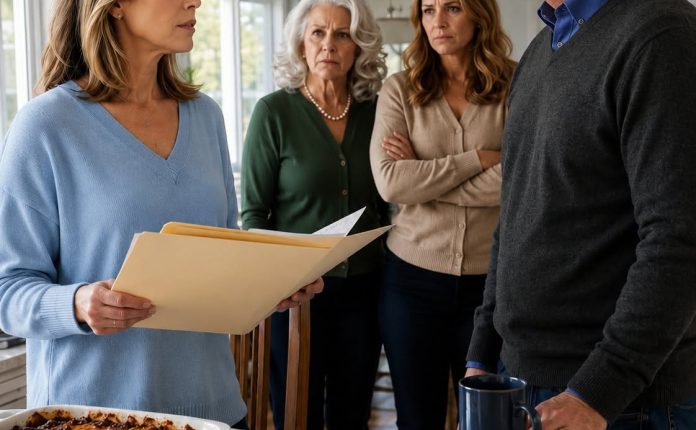
Jessica waited until the front door closed.
“You embarrassed me.”
I stared at her.
“I embarrassed you?”
“In front of your father.”
“You told a seventy-year-old man to get another job when he was asking his son for help.”
“He still works.”
“He picks up small repair jobs because he gets bored.”
“Then he has income.”
I looked at her in disbelief.
“You humiliated him.”
“He was manipulating you.”
“You don’t know that.”
“Neither do you.”
We barely spoke that evening.
By Saturday, the argument had settled into the kind of cold silence married couples sometimes mistake for peace.
Dad texted me once.
Working on it. I love you.
I called him.
He did not answer.
I assumed he was busy.
Sunday morning, Jessica and I had coffee at opposite ends of the kitchen island.
She asked whether I wanted to go grocery shopping with her.
I said no.
At 9:17, my phone rang from a number I did not recognize.
“Is this Ethan Hayes?”
“Yes.”
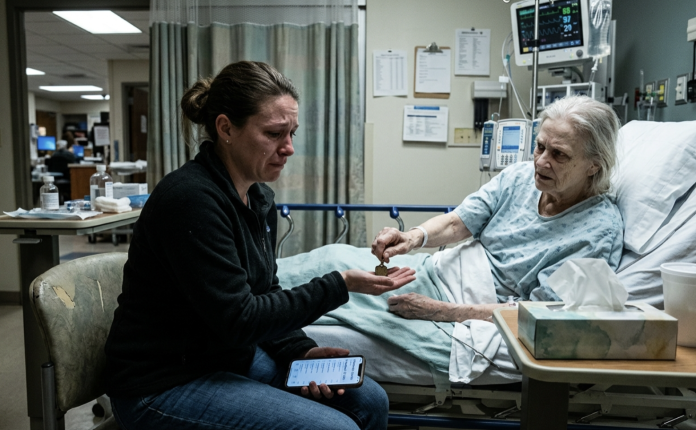
“I’m calling from Cascade Regional Hospital. Arthur Hayes listed you as his emergency contact.”
I stood so fast my chair rolled backward and struck the cabinet.
Jessica looked up.
“What happened?”
The woman on the phone kept speaking.
My father had collapsed that morning outside a hardware store.
Someone called 911.
At the hospital, imaging showed an aortic aneurysm that required immediate surgery.
I remember gripping the counter because the room seemed to tilt.
“Is he alive?”
“He was stable when he entered the operating room.”
“When?”
“About twenty minutes ago.”
“I’m coming.”
“There’s something else.”
I grabbed my keys from the bowl near the door.
Jessica was already getting her purse.
“What?”
“Before your father was sedated, he asked us to give you a sealed envelope. There is also an attorney here waiting to speak with you.”
I stopped.
“An attorney?”
“Yes. Her name is Maya Sharma.”
I had never heard the name.
The woman continued.
“Your father specifically asked that you speak with Ms. Sharma before discussing the envelope with your wife.”
I stopped cold.
Jessica was standing less than six feet away.
“What does Jessica have to do with this?”
“I’m sorry, Mr. Hayes. I don’t know.”
I ended the call.
Jessica was watching me.
“What did she say?”
“Dad’s in surgery.”
Her anger disappeared.
“Oh my God.”
She reached for my arm.
I stepped away without thinking.
“What kind of surgery?”
“Aortic aneurysm.”
“I’m coming with you.”
“No.”
She stared at me.
“What?”
“I’m going alone.”
“Ethan, don’t be ridiculous.”
“There’s an attorney waiting for me.”
“An attorney?”
“Yes.”
The same flicker crossed her face that I had seen three days earlier.
This time, I noticed.
“Why would Arthur have an attorney at the hospital?”
“I don’t know.”
“What did the nurse say?”
I picked up my wallet.
“Nothing else.”
That was the first lie I had deliberately told my wife in years.
I hated how easily it came out.
I drove to the hospital alone.
By the time I reached the surgical waiting area, the thousand dollars no longer mattered.
The adoption records did.
The attorney did.
But more than anything, I needed to understand why my father, on his way into emergency surgery, had been thinking about my wife.
A woman in a navy jacket stood when I entered the waiting room.
“Ethan?”
“Yes.”
“I’m Maya Sharma.”
She looked to be in her early forties, with dark hair pulled back and a leather portfolio tucked under one arm.
“Your father retained me on Friday.”
“For what?”
She glanced toward the hallway.
“Let’s sit.”
“I’d rather you just tell me.”
“I understand.”
She gestured toward a quieter corner of the waiting area.
I sat because my legs were beginning to feel unreliable.
Maya placed an envelope on the small table between us.
My name was written across the front in Dad’s blocky handwriting.
ETHAN ONLY.
Below that, in smaller letters:
PLEASE READ BEFORE SPEAKING TO JESSICA.
My chest tightened.
“What is this?”
“Your father asked me not to interpret his letter for you.”
“Then tell me why he hired you.”
“To help him obtain records connected to a closed adoption, verify what he had recently learned, and explain the legal process for contacting someone involved.”
“Someone involved in whose adoption?”
Maya met my eyes.
“Yours.”
For several seconds, I thought she had said the wrong word.
“Mine?”
“Yes.”
I laughed once.
Not because anything was funny.
Because my mind rejected the sentence.
“My parents didn’t adopt me.”
Maya did not argue.
“My mother gave birth to me in Tacoma.”
“That’s what you were told.”
“I have a birth certificate.”
“There are amended birth certificates issued after adoption.”
I stared at her.
“My father is Arthur Hayes.”
“He is.”
“You just said I was adopted.”
“I said your father retained me regarding your adoption. I am not telling you Arthur Hayes is not your father.”
“But biologically?”
She paused.
“No.”
The waiting room blurred at the edges.
I looked down at the envelope.
Dad’s handwriting suddenly seemed unfamiliar.
“My mother?”
“The mother who raised you was Ruth Hayes.”
“Was she my biological mother?”
“No.”
I leaned back.
Ruth Hayes had died six years earlier from pancreatic cancer.
She had packed my lunches through middle school, screamed louder than anyone at my high school graduation, cried through my wedding, and called me every Tuesday morning for most of my adult life.
There was no version of my childhood in which she was not my mother.
I felt angry at myself for even thinking the question.
“Why now?”
“That part belongs to your father’s letter.”
I picked up the envelope.
Then stopped.
“Did Jessica know?”
Maya became careful.
“Your father believed she did.”
“That’s not what I asked.”
“I can only tell you what I know directly.”
“Did you speak to my wife?”
“No.”
“Did Dad?”
“Yes.”
“When?”
“Before he hired me.”
“What did she say?”
“That should come from your father or from Mrs. Hayes.”
The formality of hearing my wife called Mrs. Hayes irritated me.
“Why did Dad tell the hospital not to let me talk to her first?”
Maya looked at the envelope.
“Because he wanted you to receive information about your own life without anyone else shaping your reaction before you had time to understand it.”
That sentence scared me more than anything else she had said.
I opened the envelope.
Inside were seven handwritten pages.
The first line nearly broke me.
Son, before you read anything else, understand this: I have been your father since the day I held you, and nothing written on any government record can change that.
I stopped reading.
My eyes filled.
I wiped them with the heel of my hand and continued.
Dad wrote that he and Mom had spent years trying to have a child.
After two miscarriages and a failed adoption placement, they received a call from an agency about a six-week-old boy whose biological mother had signed consent for a closed adoption.
That boy was me.
They brought me home on a rainy afternoon in November.
Dad remembered that I cried nearly the entire drive.
Mom sat in the back seat because she refused to let the car seat out of her sight.
For years, they planned to tell me.
When I was eight, they decided I was too young.
At twelve, Dad lost his construction job for five months, and the family was under too much stress.
At sixteen, I was struggling after my best friend died in a car accident.
At eighteen, I was leaving for college.
Every time they found a reason to wait, waiting became easier.
Mom eventually wanted to tell me after I got engaged to Jessica.
Dad talked her out of it.
That was the part he said he regretted most.
I reached the second page.
Your mother was braver about this than I was. If you are angry, be angrier with me.
I already was.
But then I reached the name.
Caroline Reed.
My biological mother.
According to Dad, Caroline was nineteen when I was born.
She had not abandoned me in an alley or disappeared without caring, as my frightened mind had already started inventing.
She had chosen adoption because she had no stable housing, no partner willing to help, and no family support she trusted.
The agency had been closed for years.
The adoption had been sealed under the rules in place at the time.
Dad had heard nothing from Caroline for more than four decades.
Until eleven months ago.
I stopped reading.
Eleven months.
Dad wrote that Caroline had tried to contact me directly after finding my name through a combination of public records and an online genealogy group.
She sent a letter to my home.
I never received it.
Two weeks later, Dad got a phone call.
Not from Caroline.
From Jessica.
I read the paragraph twice.
Jessica told me a woman had contacted the house claiming to be your birth mother. She said she had opened the letter because she thought it was junk. She wanted to know whether the woman was telling the truth.
My mouth went dry.
Dad had told Jessica the truth.
He had begged her not to tell me immediately because he wanted time to figure out what to say.
Jessica agreed.
Then, according to the letter, something changed.
Caroline tried contacting Dad directly several months later.
She told him that a woman identifying herself as my wife had called and said I knew about the adoption, wanted no contact, and did not want Caroline reaching out again.
Dad confronted Jessica.
She admitted speaking to Caroline.
She said she was protecting me.
Dad wrote that they argued.
Jessica warned him that if he suddenly told me the truth after more than forty years, I might never forgive him.
Then she accused him of trying to create problems in my marriage because he had never liked how much distance she wanted between us.
Dad admitted one painful thing in his letter.
For several months, he let that threat work.
He was afraid.
Afraid I would hate him for lying.
Afraid I would decide my entire childhood had been fake.
Afraid I would meet Caroline and somehow need him less.
Then he wrote:
That fear was selfish. Your life belongs to you, including the parts of it I was afraid to tell you.
The adoption records were for me.
The legal consultation was with Maya.
The test was an accredited DNA test Dad hoped to arrange if Caroline and I both agreed after I learned the truth.
He had not been trying to prove I belonged to him.
He had been trying to make sure Caroline really was the woman she claimed to be before dropping a forty-year-old secret into my life.
At the end of the letter, Dad wrote:
I came to your house Thursday because Maya told me I needed certified copies of additional records and because I wanted to move forward before I lost my nerve again. I should have told you that morning. I almost did.
Jessica knew why I was there.
That was why she wanted me gone.
Please do not let her explain this to you before you have had time to decide what you feel.
She already made one decision about your birth mother without asking you.
I do not want anyone, including me, making another.
I lowered the letter.
My hands were shaking worse than Dad’s had in my kitchen.
Maya sat quietly.
“You knew about the letter?”
“Arthur showed it to me after he wrote it.”
“Is Caroline real?”
“There is a woman named Caroline Reed who has been communicating with your father.”
“That’s not what I mean.”
“I know.”
She opened her portfolio.
“We obtained enough certified documentation to establish that your adoption occurred. The original records available to us list a birth mother with that name. There are still things I would want verified before telling you to accept every claim she has made.”
“And the DNA test?”
“Your father had not done one because he could not establish maternity without your participation.”
“So he was going to ask me.”
“Yes.”
I stared through the waiting room window.
Outside, people were crossing the hospital parking lot carrying coffee cups and overnight bags.
The world had continued moving while half my identity had shifted underneath me.
“Why didn’t he just tell me?”
Maya looked toward the operating-room doors.
“From everything I saw, he was ashamed.”
“That’s not an excuse.”
“No.”
I appreciated that she did not try to make one.
“Did Caroline know he was telling me?”
“She knew he intended to.”
“Does she know he’s in surgery?”
“Not yet.”
I folded the letter and placed it back inside the envelope.
My phone had been vibrating in my pocket.
Seven missed calls.
All from Jessica.
Then a text.
Please call me. Whatever Arthur told you, there is more to this than you think.
I showed Maya.
She did not comment.
I called Jessica from the hospital parking garage.
She answered immediately.
“Ethan.”
“Who is Caroline Reed?”
Silence.
Not confusion.
Not “Who?”
Silence.
That was my answer.
“You knew.”
“Where are you?”
“At the hospital.”
“Is Arthur okay?”
“I don’t know. He’s still in surgery.”
“I’m sorry.”
“How long have you known?”
“Ethan.”
“How long?”
She exhaled.
“Almost a year.”
I closed my eyes.
The concrete wall in front of me suddenly seemed easier to look at than anything living.
“You knew I was adopted for almost a year.”
“I found out when she contacted you.”
“She contacted me.”
“Yes.”
“But I never saw the letter.”
“I opened it.”
“Why?”
“It came to our house.”
“It had my name on it.”
“I thought it might be some kind of scam.”
“So you opened my mail.”
“I was worried.”
“And then?”
“I called Arthur.”
“He told you it was true.”
“Yes.”
“And you still didn’t tell me.”
“I wanted him to.”
“He says you told him not to.”
“That is not what happened.”
“What happened?”
She was quiet again.
“Come home.”
“No.”
“Ethan, please don’t do this in a parking garage.”
“What did you tell Caroline?”
Her voice changed.
“Arthur told you.”
“Yes.”
“He shouldn’t have put this on you while he was sick.”
“He wrote the letter before he collapsed.”
“He has been obsessed with this for months.”
“What did you tell Caroline?”
“I told her you didn’t want contact.”
I pressed my fist against my mouth for a second.
“You told a woman I have never met what I wanted?”
“I was trying to protect you.”
“From what?”
“From having your entire life ripped apart.”
“That wasn’t your decision.”
“You don’t understand what it was like when that letter arrived.”
“It was addressed to me. I probably would understand if you had let me read it.”
“You had just gotten through the anniversary of your mother’s death. You were worried about your job. Arthur was calling you constantly. We were already fighting about how much time you spent dealing with him.”
There it was.
My father had been right about that part too.
For years, Jessica had complained that Dad depended on me too much.
Sometimes she had a point.
After Mom died, Dad called frequently.
The water heater broke.
His truck needed work.
He needed help with online banking.
Then he would call because he had made too much chili and wanted to know whether I wanted some.
Sometimes Jessica would roll her eyes before I even answered.
I had always treated it as a normal disagreement between a wife and an aging parent.
Now it looked different.
“Was this about Dad?”
“No.”
“It sounds like it was.”
“It was about us.”
“How?”
Her voice cracked.
“Because I knew exactly what would happen.”
“What?”
“You would throw yourself into this. You would feel responsible for some stranger because she gave birth to you. You already feel responsible for Arthur every time he calls. There is never a limit with you when it comes to family.”
I stared at the cars moving up the parking ramp.
“She is my family.”
“You don’t even know her.”
“Neither do you.”
“I know she gave you away.”
That sentence made me go very still.
“She was nineteen.”
“You don’t know the full story.”
“Neither do you.”
“Exactly.”
“Then why did you decide I shouldn’t hear it?”
Jessica started crying.
“I was scared.”
“Of what?”
“Losing my husband to one more person who needed something from him.”
For the first time, I understood her.
Understanding her did not make me less angry.
It made the betrayal more believable.
Jessica had not hidden the truth because she was part of some elaborate conspiracy.
She had done something more ordinary and, in some ways, harder to forgive.
She had been afraid of losing control over the shape of our life.
So she decided she had the right to control mine.
“Thursday,” I said. “When Dad asked me for the thousand dollars, you knew exactly what the adoption records were about.”
She did not answer.
“You knew.”
“Yes.”
“That’s why you went after him.”
“I was angry.”
“Because he was finally going to tell me.”
“Because he was going to blow up our family without any idea whether this woman was even who she claimed to be.”
“That is why he wanted the records and the test.”
Another silence.
“He told you that?”
“He told me everything.”
She whispered, “Of course he did.”
The contempt in those four words hurt almost as much as the secret.
“Do you hear yourself?”
“I am tired of always being the villain whenever Arthur is involved.”
“This isn’t about him winning and you losing.”
“It always is.”
“My father is in emergency surgery.”
“I know.”
“And the last conversation you had with him in my house was you telling him to get another job when you knew why he was asking me for help.”
She started to speak.
I cut her off.
“You did know.”
Her crying stopped.
“Yes.”
I hung up.
Dad’s surgery lasted a little over five hours.
I spent most of that time in a plastic chair beneath a television I never watched.
Maya left after making sure I had her number.
She told me she would keep the records secure and that nothing concerning Caroline had to happen until I wanted it to happen.
That mattered.
For the first time in the entire situation, someone was telling me I was allowed not to decide.
Around three in the afternoon, a surgeon came into the waiting room.
Dad had made it through.
There had been complications.
He was going to the intensive care unit.
The next twenty-four hours would matter.
I thanked the surgeon, asked three questions I barely remember, then went into the restroom and cried with both hands braced against the sink.
I was still angry with Dad.
That surprised me.
I had imagined that nearly losing him would erase everything else.
It did not.
Love is not that tidy.
My father had lied to me for more than forty years.
My wife had lied to me for almost one.
Both had claimed fear.
Both had claimed love.
Both had made decisions about my life because they believed their reasons were good enough.
The difference was that Dad had finally tried to stop.
Jessica had tried to stop him.
I did not go home that night.
I slept for maybe an hour in the hospital family lounge.
Jessica came to the hospital the next morning.
I saw her walking toward the ICU waiting area carrying two coffees.
My first reaction was relief.
Then anger followed it so fast I almost laughed.
She held one cup toward me.
“Black. No sugar.”
I did not take it.
“How is he?”
“Stable.”
“Can he talk?”
“Not much.”
She sat across from me.
For a minute, neither of us spoke.
Finally she said, “I am sorry.”
“For which part?”
Her eyes filled.
“Everything.”
“That’s convenient.”
“I deserve that.”
I looked at her.
Jessica rarely said that.
She was a smart woman. Organized. Decisive. The person who remembered dentist appointments, compared insurance plans, and packed an extra phone charger before every trip.
Those were qualities I had loved.
They were also the same qualities that could turn controlling when she decided she knew the correct outcome before everyone else.
“I really did think it might be a scam at first,” she said.
“Then Dad confirmed it.”
“Yes.”
“After that?”
“I panicked.”
“For eleven months?”
“No. At first, I thought Arthur should tell you. He said he needed time. Then weeks passed. You were having a terrible year. We were arguing about money. Your company was cutting people. Your father was struggling. I thought adding this woman to everything would destroy you.”
“So you answered for me.”
“Yes.”
“You told Caroline I wanted no contact.”
“Yes.”
“Did she believe you?”
“I don’t know.”
“You never asked?”
“No.”
“Did she contact you again?”
“Once.”
“When?”
“About two months later.”
“What did she say?”
Jessica stared into the coffee she had bought for me.
“She asked whether you had really said you didn’t want to know anything about her.”
My chest tightened.
“What did you say?”
“I didn’t respond.”
I got up.
“Ethan.”
“I need to walk.”
“Please.”
I turned.
She looked smaller than she had in our kitchen three days earlier.
“This is our marriage,” she said.
“No. This is my life.”
“That’s not fair.”
“Fair?”
“I made a terrible decision. I know that now. But you are acting like I did it because I hate you.”
“I’m acting like my wife intercepted something addressed to me, learned the truth about my birth before I did, contacted my biological mother, and told her I wanted nothing to do with her.”
She looked down.
“That is what happened.”
The sentence hurt both of us because it was so simple.
I walked away.
Dad woke enough to recognize me that afternoon.
He had tubes everywhere, and his voice was little more than air.
I stood beside the bed.
His eyes opened.
“Hey.”
He blinked.
Then his eyebrows moved as if he were asking a question.
“You made it.”
He closed his eyes briefly.
I held his hand.
The skin on his knuckles was dry and rough, the way it had been my entire life.
He opened his eyes again.
“Letter?”
One word.
That was all he had.
“I read it.”
Tears appeared in his eyes.
I felt my own rise.
“You should have told me.”
He gave the smallest nod.
“Years ago.”
Another nod.
“I’m angry.”
He squeezed my fingers.
Not hard.
Enough.
“But I’m here.”
Dad started crying.
So did I.
I sat there for almost an hour while he drifted in and out of sleep.
Before I left, I leaned close.
“You are my father.”
His eyes opened.
“I need you to hear that part first.”
His mouth moved.
I had to lean closer.
“Sorry.”
“I know.”
It was not forgiveness.
Not yet.
But it was somewhere to begin.
Dad spent nine days in the hospital.
Recovery was slow.
For the first few days, he could barely stay awake long enough to speak.
I did not tell him about every argument with Jessica.
He had enough to survive.
Instead, Maya and I dealt with the adoption records.
She showed me copies of the documents Dad had obtained.
My amended birth certificate listed Arthur and Ruth Hayes.
A certified record connected to the adoption showed that I had been born under another surname.
Reed.
There it was in black and white.
I had spent forty-one years as Ethan Hayes.
For six weeks, before I could recognize a face or understand a name, I had been Ethan Reed.
That bothered me in ways I could not explain.
Not because I wanted a different name.
Because there had been a version of me that existed before my earliest memory, and everyone closest to me had known about him except me.
Maya gave me Caroline’s contact information in a sealed folder.
“You don’t have to call her.”
“I know.”
“You don’t have to decide today.”
“I know.”
“If you want the DNA testing, I can help arrange it through the lab your father contacted.”
I nodded.
Then I asked the question I had been avoiding.
“Does she want money?”
Maya did not look offended.
“According to your father, no.”
“What does she want?”
“To know whether you’re willing to speak with her.”
“That’s it?”
“That’s what she said.”
I left the folder unopened for four days.
It sat on the desk in my office at home.
Jessica and I were barely speaking.
She had moved into the guest room.
Not because I ordered her there.
She went herself.
Our house became unbearably polite.
“Do you need anything from the store?”
“No, thank you.”
“I’m making dinner.”
“I ate at the hospital.”
“I’ll leave the porch light on.”
“Okay.”
Nine years of marriage reduced to logistics.
On the fourth night, I opened the folder.
Caroline Reed lived two hours away.
She was sixty-one.
That surprised me.
For some reason, I had pictured an old woman.
Then I did the math.
Nineteen when she had me.
Of course she was only sixty-one.
The file contained a phone number.
I stared at it for nearly ten minutes.
Then I called.
She answered on the third ring.
“Hello?”
My mouth went dry.
“Is this Caroline Reed?”
Silence.
“Yes.”
“My name is Ethan Hayes.”
I heard a sound on the other end.
A breath.
Maybe a sob.
“Oh.”
That was all she said.
Just “Oh.”
Neither of us knew what came next.
Finally I said, “My father gave me your information.”
“Arthur?”
“Yes.”
“Is he all right?”
That surprised me too.
“He had emergency surgery.”
“Oh my God.”
“He’s recovering.”
“I’m glad.”
We were quiet again.
Then she said, “Ethan, I am so sorry.”
“For what?”
“For contacting you the way I did. I didn’t know if it was right. I spent years telling myself I had no right to interrupt your life.”
“Why now?”
“My husband died two years ago.”
“I’m sorry.”
“Thank you. After that, I started going through old things. I found the bracelet from the hospital when you were born.”
I sat down.
“You kept it?”
“Yes.”
Her voice broke.
“I kept more than I should have.”
I did not know what to say.
She continued.
“I found an online group that helps people understand adoption records. I thought I would look once. That was all. I told myself if you seemed happy, I would leave you alone.”
“You found me?”
“Eventually.”
“And you wrote.”
“Yes.”
“My wife opened the letter.”
Another silence.
“I know.”
“She called you.”
“Yes.”
“She told you I wanted no contact.”
“Yes.”
“Did you believe her?”
Caroline took a long breath.
“I tried to.”
“Why?”
“Because she was your wife.”
The answer cut deeper than I expected.
“She contacted you again?”
“I wrote once more to ask whether those were really your wishes. She didn’t answer.”
“Why did you contact Dad?”
“Because I needed to know I wasn’t doing harm. I found his number through an old business listing. When I told him my name, he hung up.”
That sounded exactly like Dad.
I almost smiled.
“He called back?”
“Two days later.”
“What did he say?”
“He apologized.”
Of course he did.
Caroline continued.
“He told me you didn’t know.”
“What did you say?”
“I got angry.”
“At him?”
“Yes.”
“Good.”
She laughed softly through tears.
“You sound like him.”
That unsettled me in a completely different way.
We spoke for thirty-two minutes.
I know because I checked afterward.
I did not call her Mom.
She did not call me son.
She did not tell me she had always loved me every day of her life.
She did not ask me to forgive her.
She told me simple things.
She had worked as a respiratory therapist for twenty-eight years.
She had married at thirty-one.
She had no other children.
Her husband had known about me.
Every November, on my birthday, she bought a cupcake.
“That sounds ridiculous when I say it out loud.”
“It doesn’t.”
I surprised myself by meaning it.
Before we ended the call, she said, “You don’t owe me another conversation.”
“Neither do you.”
“I think maybe I do.”
“No.”
I thought of Dad.
Of Jessica.
Of everyone deciding what other people owed because of love, fear, marriage, parenthood, history.
“No,” I repeated. “Let’s not start that way.”
She became quiet.
“Okay.”
“We can talk again.”
“I’d like that.”
The DNA test happened two weeks later.
It confirmed what the records already strongly indicated.
Caroline was my biological mother.
The result did not make the earth move.
There was no lightning bolt of belonging.
I looked at the report and thought, All right.
Then I cried in my car for twenty minutes.
Not because I had found my “real mother.”
I hate that phrase now.
Ruth Hayes was real.
Caroline Reed was real.
Arthur was real.
So was the damage created by pretending one truth had to erase another.
Dad came home from the hospital around the same time.
He looked twenty pounds lighter.
The first afternoon I visited, he was sitting in his recliner with a blanket over his knees and an unopened stack of mail beside him.
“Why aren’t you opening that?”
He looked at the envelopes.
“Figured I’d wait for my son to come handle my life.”
I stared at him.
Then he smiled.
I laughed before I could stop myself.
“That joke is too soon.”
“Probably.”
I sat across from him.
He looked nervous.
“I did the test.”
Dad’s smile disappeared.
“And?”
“She’s my biological mother.”
He nodded.
“I figured.”
“Dad.”
“Yes?”
“I talked to her.”
His face became unreadable.
“How was it?”
“Strange.”
“Good strange?”
“Some of both.”
He looked down at his hands.
“Do you want me to meet her?”
The question caught me off guard.
“I don’t know.”
“That’s okay.”
“You’re really okay with this?”
“No.”
His honesty made me smile.
He looked at me.
“I’m terrified.”
“Of what?”
“That you’ll look at me and realize I’m the guy who lied to you.”
“You are the guy who lied to me.”
He winced.
“But you’re also the guy who taught me to ride a bike, sat outside the emergency room when I broke my arm, sold his motorcycle for my tuition, and gave me a down payment when I couldn’t save fast enough.”
His eyes filled.
“One doesn’t cancel the other.”
“I wish it did.”
“It doesn’t.”
He looked toward the window.
“Your mother wanted to tell you.”
“I know.”
“I stopped her more than once.”
“I know that too.”
“I thought if you knew, you’d start wondering whether we were really your parents.”
“I’m wondering a lot of things.”
Dad nodded.
“But not that.”
He looked at me.
“You’re my father.”
He covered his face with one hand.
For almost a minute, neither of us spoke.
Then I asked him something that had bothered me since reading his letter.
“Why did you tell the hospital not to let me discuss it with Jessica?”
He lowered his hand.
“Because I had already taken the choice away from you for forty years.”
I waited.
“She took it away again when Caroline wrote.”
His voice remained quiet.
“I didn’t want the first hour after you learned the truth to belong to either of us.”
That answer stayed with me.
“I was also mad at her,” Dad added.
I laughed.
“There he is.”
“I’m not saying I was noble.”
“I appreciate the clarification.”
He smiled faintly.
Then his face became serious.
“I don’t want to break up your marriage.”
“You didn’t.”
“I started this.”
“No. You finally told me something I should have known.”
He looked unconvinced.
“Whatever happens between Jessica and me is about what she did, not about you telling me.”
Dad nodded.
Then he reached toward the side table.
There was an envelope there.
He handed it to me.
Inside were ten hundred-dollar bills.
I stared at him.
“You cannot be serious.”
“I told you I’d pay you back.”
“You almost died.”
“Still owed you money.”
“You spent money on the records.”
“Not all of it.”
“Dad.”
He folded his arms.
“I’m not dying with debt.”
“You’re not dying.”
“Then I have even more time to annoy you about it.”
I put the envelope back on the table.
He pushed it toward me.
We went back and forth until I finally took the money.
The next day, I deposited it into his checking account while he was at physical therapy.
He called me that evening furious.
It was the most normal conversation we had had in weeks.
My marriage was harder.
Jessica apologized many times.
At first, every apology contained a defense.
“I’m sorry, but you were overwhelmed.”
“I’m sorry, but Arthur should have told you years ago.”
“I’m sorry, but Caroline had no right to just show up.”
Finally, one night at the dining room table, I stopped her.
“If you’re going to apologize, I need you to stop explaining why you were entitled to do it.”
She stared at me.
“I don’t think I was entitled.”
“You keep telling me why your fear made the decision reasonable.”
She looked down.
We had started seeing a marriage counselor by then.
I had agreed for one reason.
Nine years mattered.
They did not excuse what she had done, but they mattered enough that I wanted to know whether there was anything left worth repairing.
Jessica twisted her wedding ring around her finger.
“I was jealous.”
I had never heard her say that before.
“Of Caroline?”
“Of your father first.”
I waited.
“You and Arthur have always had this thing.”
“What thing?”
“You don’t even see it. If he calls, you go. If he needs help, you find a way. If he wants Sunday dinner, suddenly our plans are flexible.”
“That’s not entirely fair.”
“I know.”
She swallowed.
“But some of it is.”
Some of it was.
There had been times when Dad called and I assumed Jessica would accommodate him.
Times when I had changed plans without asking.
Times when I treated her irritation as selfish because Dad was older and therefore his needs felt more urgent.
I could admit that without accepting what she had done.
Jessica continued.
“When Caroline appeared, I thought, great. Another person who is going to have a claim on you.”
“A claim?”
“That was how I thought about it.”
“Why?”
“Because I was already angry.”
She started crying.
“I told myself I was protecting you, but that wasn’t all of it.”
I said nothing.
“I was protecting the life I wanted.”
That was the first apology that sounded true.
She wiped her eyes.
“I was afraid if you learned Arthur had lied to you, you’d fall apart. Then I was afraid you’d become obsessed with finding Caroline. Then I was afraid she would need something. Then I was afraid Arthur would be involved in all of it.”
“So you made the decision.”
“Yes.”
“For me.”
“Yes.”
“And when Dad finally came to get the records?”
“I knew what he was doing.”
“And you tried to humiliate him until he left.”
Jessica covered her mouth.
“Yes.”
I looked away.
That part remained difficult.
If Dad had walked out without the money, maybe he would have delayed again.
If he had died during surgery, I might never have known why.
The thought made my stomach turn.
“You could have taken this from me forever.”
“I know.”
That was the first time she did not add anything after it.
No explanation.
No defense.
Just:
“I know.”
We lived in separate rooms for three months.
I did not announce a divorce.
I did not throw her belongings onto the lawn.
She did not suddenly become a cartoon villain because I discovered she had done something terrible.
She went to work.
She brought groceries home.
She cried in the shower when she thought I could not hear.
She sat beside me in counseling and answered questions she did not like.
Some days I remembered why I married her.
Other days I looked at her and heard Caroline saying, “Because she was your wife,” when I asked why she believed the lie.
Trust changes the sound of ordinary things.
A phone password.
A closed door.
A letter on the counter.
“Don’t worry, I handled it.”
Words that once sounded reassuring could suddenly feel like a threat.
Caroline and I spoke every Sunday afternoon.
Slowly.
Carefully.
I learned the names of my biological grandparents.
Both were dead.
I learned that my nose came from Caroline’s father.
I learned that she hated olives, just like I did.
I learned that she had wanted to name me Daniel.
I did not know what to do with that information.
“You don’t look like a Daniel,” Dad said when I told him.
“What does a Daniel look like?”
“Not you.”
“Excellent reasoning.”
He was getting stronger.
One afternoon, Dad asked whether I had a photograph of Caroline.
I showed him one she had sent from a hiking trip.
He looked at it for a long time.
“I remember her.”
“What?”
“Barely.”
“You met her?”
“Once.”
I sat forward.
Dad explained that he and Mom had briefly seen Caroline at the agency before the adoption was finalized.
It had not been planned as a meeting.
They had crossed paths in a hallway.
Caroline was crying.
Mom was holding me.
“She looked at Ruth,” Dad said, “and asked her one question.”
“What?”
“Will you love him when he makes it difficult?”
I laughed softly.
“What did Mom say?”
Dad smiled.
“She said, ‘Especially then.’”
That sounded like my mother.
I looked down.
“Why wasn’t that in the letter?”
“Couldn’t fit every bad decision and every memory into seven pages.”
“You could have tried.”
“I just had heart surgery. Show some compassion.”
“You wrote it before surgery.”
“Details.”
Four months after the hospital call, I met Caroline in person.
We chose a diner halfway between our homes.
Neutral ground.
I arrived early.
She arrived earlier.
I recognized her immediately.
Not because we looked exactly alike.
We didn’t.
But there was something in the way she held her coffee cup with both hands that felt familiar.
She stood when I approached.
Neither of us knew whether to hug.
So we shook hands.
Then both of us laughed because it was so absurd.
“I don’t know what the rules are,” she said.
“There aren’t any.”
“Good.”
We sat for nearly three hours.
No dramatic revelation waited inside her purse.
No inheritance.
No secret mansion.
No tragic family curse.
Just a sixty-one-year-old woman and the forty-one-year-old man she had given birth to trying to understand what they were allowed to be to each other.
She brought three photographs.
One was of her at nineteen.
I stared at it for a long time.
She looked terrified.
“You were a kid,” I said.
“So were you.”
“You were nineteen.”
“That felt older when I was nineteen.”
I smiled.
She told me she had almost changed her mind twice.
She also told me she still believed adoption had been the safest choice available to her then.
Those two truths could live together.
I respected her for saying it.
Before we left, I asked, “Do you want to meet Dad?”
Her eyes widened.
“Does he want that?”
“He’s scared.”
“So am I.”
“That might be the family trait.”
She laughed.
A month later, they met.
Dad insisted on grilling steaks.
He burned two of them because he kept forgetting to watch the grill.
Caroline brought potato salad.
Jessica did not come.
She and I were still living together, but we had agreed that this first meeting should not include her.
She did not argue.
That mattered.
At one point, I stood inside the kitchen and looked through the screen door.
Dad and Caroline were sitting on the patio.
Two people connected only because, forty-one years earlier, one of them had trusted strangers with a baby and the other had promised to raise him.
Dad said something.
Caroline laughed.
I could not hear what it was.
For some reason, that was the moment I finally felt something settle.
Not resolve.
Nothing that complicated resolves completely.
But the panic had gone.
I did not have to choose between them.
There had never been a competition except in the minds of people who were afraid there might be.
Jessica and I made our decision about six months after Dad’s surgery.
We stayed married.
Not because what she did became smaller.
It didn’t.
And not because I believed forgiveness was something marriage automatically required.
I stayed because, eventually, Jessica stopped asking me to understand her before she had fully understood what she had done.
She wrote Caroline a letter.
She showed it to me first, not for permission, but because she wanted to make sure it did not contain another explanation disguised as an apology.
It was short.
I made a decision that belonged to you and Ethan. I spoke for him when I had no right to. I am sorry.
Caroline replied with four sentences.
I appreciate the apology. What happened hurt. I hope you and Ethan find a healthier way forward. I don’t want to be placed in the middle of your marriage.
That sounded like her.
Jessica also apologized to Dad.
He was less graceful.
“I’m still mad at you,” he told her.
“I know.”
“Might be mad a while.”
“I understand.”
“You were really rude about the thousand dollars.”
“Arthur.”
“What? I was in emergency surgery three days later. I get to mention it.”
Jessica almost smiled.
Then Dad did.
It did not repair them.
But it opened a door.
The biggest change in our marriage was not dramatic.
Jessica stopped speaking for me.
I stopped assuming her needs could always wait whenever Dad called.
We both got better at asking rather than deciding.
“Do you want me to handle this?”
“Do you want advice or do you want me to listen?”
“Is tonight still okay for your dad to come over?”
“Do you want to call Caroline before we make plans?”
Ordinary questions.
They should have been ordinary all along.
A year after Dad stood in my kitchen asking for a thousand dollars, he came over for dinner on a Thursday.
Same day of the week.
Same kitchen.
He was stronger by then.
Still thinner than before surgery, but back to doing small repair jobs he absolutely did not need to be doing.
Jessica placed a bowl of mashed potatoes on the table.
Dad looked at me.
“Got any cash?”
Jessica froze.
I stared at him.
Then he started laughing so hard he had to hold his chest.
“Dad.”
“Too soon?”
“It has been a year.”
“So not too soon.”
Jessica shook her head.
“You are never borrowing money from us again.”
Dad pointed at her.
“See? We agree on something.”
She laughed.
I did too.
Later that night, after Jessica went upstairs, Dad stayed at the kitchen table.
He looked around the room.
“You remember what you said that morning?”
“What?”
“When Jessica said you always chose me.”
I did.
“He chose me every day of his life.”
I felt embarrassed hearing it repeated.
Dad looked down.
“I didn’t always choose you right.”
“What does that mean?”
“I loved you every day.”
He paused.
“But I was scared enough to lie to you for a lot of them.”
I sat across from him.
“You were also brave enough to finally stop.”
“Almost waited too long.”
“Yes.”
He looked toward the stairs.
“You think you two are okay?”
“I think we’re better than we were.”
“That wasn’t what I asked.”
“I don’t know what ‘okay’ means anymore.”
Dad nodded.
“Fair.”
I thought about the thousand dollars.
The hospital.
The envelope.
Caroline’s first letter, sitting somewhere in my house for months while I had no idea it existed.
For a long time, I had treated the story as though one person had betrayed me and another had saved me.
The truth was less convenient.
Dad loved me and lied to me.
Jessica loved me and controlled me.
Caroline loved the idea of me for forty-one years without knowing me at all.
And I had my own failures.
I had sometimes used loyalty to Dad as an excuse not to set reasonable boundaries.
I had sometimes assumed Jessica’s competence meant she was comfortable carrying more of our life than she actually was.
Families rarely break because one person wakes up and decides to become cruel.
More often, fear gets dressed up as protection.
Resentment gets disguised as practicality.
Silence calls itself timing.
And people who love each other start deciding things for one another because asking feels riskier.
Dad stood to leave.
At the door, he hugged me.
A real hug this time.
“Love you, son.”
“Love you too.”
He stepped onto the porch, then turned back.
“For what it’s worth, I never thought of you as adopted.”
I leaned against the doorframe.
“I know.”
“You were just mine.”
“That might have been part of the problem.”
He thought about it.
Then nodded.
“Probably.”
He walked toward his truck.
Before he got in, I called after him.
“Dad.”
He turned.
“Thank you for the envelope.”
He stood there for a moment.
Then he raised one hand and drove away.
The sealed envelope is still in my office safe.
Not because the paper itself matters anymore.
The adoption records are there too.
So is the DNA report.
There is also a copy of the first photograph Caroline ever gave me and a picture of Arthur and Ruth holding me on the day they brought me home.
For years, I thought a family story had to have one clean version.
One mother.
One father.
One truth.
I know better now.
The hardest part was never finding out that I had been adopted.
It was realizing how many people had loved me enough to be afraid of losing me, and how much damage they had caused when they let that fear make decisions in my name.
Dad’s thousand dollars bought certified records and a legal consultation.
It did not buy the truth.
The truth had been waiting for decades.
What it bought was Dad’s last attempt to stop hiding it.
Three days later, he nearly died.
If he had not made that trip to my kitchen, I do not know how long the secret would have stayed buried.
Maybe forever.
That thought still bothers me.
But whenever it does, I remember one sentence from his letter.
Your life belongs to you, including the parts of it I was afraid to tell you.
I wish he had understood that when I was eighteen.
Or twenty-five.
Or thirty.
I wish Jessica had understood it when Caroline’s letter arrived.
I wish I had never needed a hospital phone call and a sealed envelope to learn it.
But I understand it now.
Love gives people a place in your life.
It does not give them ownership of your choices.