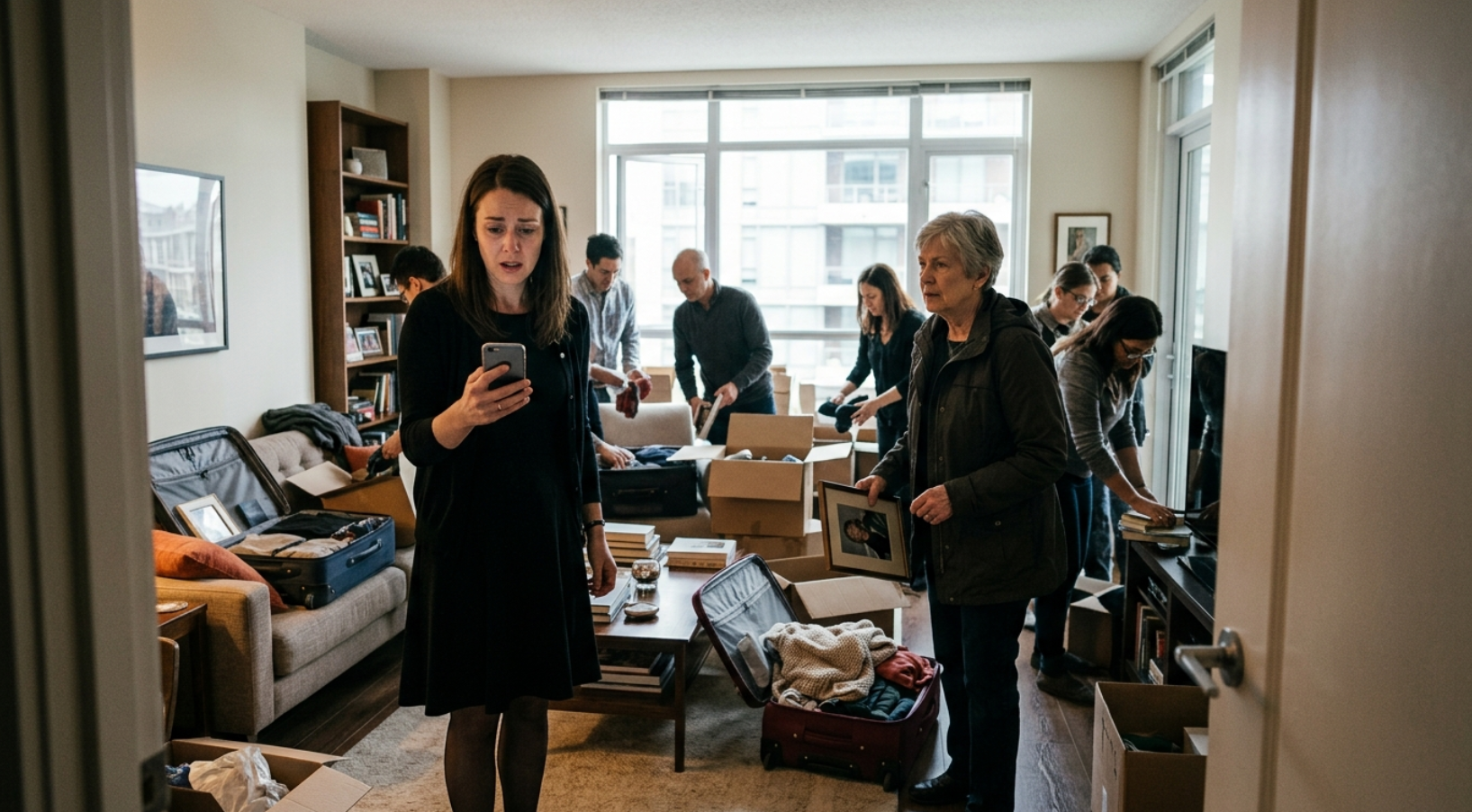
Chloe was holding the blue folder.
For one terrible second, I forgot how to breathe.
David’s message glowed on my phone like a warning sent from beyond the grave.
Do not give Eleanor the blue folder.
And now it was already in Chloe’s hands.
“Put that down,” I said.
My voice came out so calmly that everyone in the room turned toward me.
Chloe glanced at the folder, then back at my face.
“This?”
“Yes.”
She smiled.
That same smug little smile she had worn while digging through my dead husband’s desk.
“What is it?”
“I said put it down.”
Eleanor stepped forward immediately.
“No.”
The room went silent.
I looked at her.
She was staring at the folder differently now.
Not with curiosity.
With recognition.
And that frightened me more than anything.
“You know what that is,” I said.
Eleanor’s face changed for half a second.
It was enough.
“Chloe,” she said quickly, “bring it to me.”
Chloe started walking toward her.
I moved between them.
“Sarah,” Eleanor warned.
“You are not taking another step with that folder.”
Marcus laughed from beside the suitcase.
“Oh, please. What are you going to do? Call the police on David’s own family?”
“Yes.”
His smile disappeared.
I lifted my phone.
“I am going to call the police, report eight people removing property from my home without permission, and tell them one of those people is currently holding private financial documents belonging to my husband’s estate.”
Nobody laughed after that.
Chloe tightened her grip on the folder.
“You wouldn’t.”
I looked directly at her.
“Try me.”
Eleanor took another step.
“Do not threaten my family in my son’s home.”
“My husband’s home.”
“My son bought this place.”
“Then show me the deed.”
Her lips pressed together.
“Show me the document proving he bought it with your husband’s money.”
Silence.
“Show me the document proving you inherited it.”
Still nothing.
“Show me anything.”
Eleanor’s eyes hardened.
“You are emotional.”
I almost laughed again.
I had just buried my husband.
I had watched him disappear piece by piece for eleven months.
I had held his hand while machines counted the final beats of his heart.
And somehow this woman had decided grief made me stupid.
“No,” I said. “I am finally paying attention.”
My phone vibrated again.
Everyone heard it.
Eleanor’s eyes dropped toward the screen.
I looked.
Another message from David’s number.
My chest tightened.
The message read:
If Chloe found the blue folder, do not open it in front of them. Call Martin Bell. His number is taped beneath the bottom drawer.
Martin Bell.
I knew the name.
David had mentioned him twice during our marriage.
An attorney.
But not our family attorney.
Not anyone Eleanor knew about, as far as I could remember.
Chloe noticed my expression.
“What does it say?”
“Nothing that concerns you.”
“It came from David’s number, didn’t it?”
That stopped me.
Her voice had changed.
“How do you know that?”
Chloe froze.
Marcus looked at her.
Eleanor shot her a furious glance.
There it was again.
Something happening beneath the surface.
Something I did not understand.
I lowered the phone slowly.
“How do you know who is messaging me?”
“I guessed.”
“No, you didn’t.”
“Sarah—”
“Answer me.”
Eleanor cut between us.
“This melodrama is ridiculous. Chloe, give me the folder.”
Chloe obeyed.
Or tried to.
The moment she extended her arm, I grabbed the other side of the folder.
For several seconds, neither of us let go.
“Release it,” Eleanor said.
“No.”
“It belongs to my son.”
“Then it belongs to his estate, which means you still have no right to take it.”
“You think being married to David for nine years makes you understand him better than his own mother?”
“Yes.”
Her face went pale with anger.
“Yes,” I repeated. “Because I was there when he was sick. I was there when he couldn’t sleep. I was there when he was terrified. I was there when he signed hospital forms with hands that could barely hold a pen. Where were you?”
Eleanor said nothing.
I remembered exactly where she had been.
Cancún.
She had gone on vacation because, according to her, the tickets were nonrefundable.
David had spent that week vomiting after chemotherapy.
“Where were you?” I asked again.
“Enough.”
“No. You do not get to walk into our home after his funeral and suddenly pretend you were the person who knew him best.”
Chloe’s grip weakened.
I pulled the folder from her hands.
Eleanor lunged forward.
That was the moment everything changed.
Because Uncle Raymond, who had barely spoken since I entered the condo, suddenly stepped between us.
“Eleanor.”
She stared at him.
“Move.”
“No.”
Every head turned.
Raymond was David’s father’s younger brother, a quiet sixty-five-year-old man who had spent most of the funeral standing alone near the back of the church.
Eleanor looked stunned.
“What did you say?”
“I said stop.”
“You have no idea what is happening.”
Raymond looked at the blue folder in my hands.
His expression became strangely sad.
“I think I do.”
Eleanor’s face drained of color.
“You keep your mouth shut.”
That sentence confirmed everything.
Raymond knew something.
And Eleanor was terrified he would say it.
I held the folder against my chest.
“What do you know?”
“Nothing,” Eleanor snapped.
I ignored her.
“Raymond?”
He looked at me.
Then at David’s urn.
For a long time, he said nothing.
Finally he whispered, “David called me three months ago.”
Eleanor exploded.
“You promised me!”
Raymond turned toward her.
“No. I promised David.”
The room became completely still.
“What did he tell you?” I asked.
Raymond swallowed.
“He told me there would probably be a fight after he died.”
My stomach twisted.
“He knew you would come here?”
“He knew Eleanor would.”
I looked at my mother-in-law.
She did not deny it.
Raymond continued.
“He told me that if Sarah came home after the funeral and found the family inside the condo, I was supposed to watch what happened.”
I stared at him.
“Watch?”
He nodded.
“And make sure nobody removed the blue folder.”
My skin went cold.
Eleanor slowly backed toward the dining table.
“You are confused, Raymond.”
“No, Ellie. For once, I am not.”
Marcus stepped forward.
“Why would David involve Uncle Raymond?”
Raymond gave a humorless smile.
“Because apparently David trusted me more than the rest of you.”
That created an immediate eruption.
Everyone started talking at once.
Chloe accused Raymond of betraying the family.
Marcus demanded to know what was inside the folder.
One of the nephews quietly put down the box he had been carrying.
The uncle with the espresso machine started unwrapping it and setting it back on the counter.
Interesting.
The confidence was disappearing.
Fast.
I raised my voice.
“Everybody stop.”
They did.
“Put everything back.”
Eleanor laughed.
“Nobody is putting anything back.”
I looked toward the nephew nearest the hallway.
“You. Bring that box inside.”
He hesitated.
Then looked at Eleanor.
Then at me.
Finally, he carried the box back.
“Coward,” Eleanor hissed.
“No,” I said. “He is just beginning to understand that stealing from a widow on the day of her husband’s funeral might not look wonderful on a police report.”
The second nephew slowly brought his box back too.
Then the uncle returned the espresso machine.
Marcus cursed under his breath.
The tide was turning.
And Eleanor knew it.
She pointed at the folder.
“Open it.”
“No.”
“If David wanted you to have it, why hide it?”
That question hurt because part of me wondered the same thing.
David and I had shared everything.
Or I thought we had.
Why would my husband prepare secret messages?
Why hide documents?
Why involve Raymond?
Why anticipate his family invading our home?
My phone vibrated again.
A third message.
This time it contained only an address.
And beneath it:
Martin is waiting.
I stared at the screen.
The address was six blocks away.
A law office.
Eleanor watched my face carefully.
“What now?”
I slid my phone into my purse.
“Everyone leaves.”
“No.”
I walked toward the front door and opened it.
“You can leave voluntarily, or the police can escort you.”
Marcus stepped closer.
“You really think you can throw David’s mother out?”
“Yes.”
He towered over me.
For nine years, Marcus had used his size and loud voice to make people back down.
David never did.
He would simply stare at Marcus until Marcus became uncomfortable.
I finally understood why.
Bullies hated silence because silence gave them nothing to push against.
So I said nothing.
I simply stared.
Five seconds passed.
Ten.
Marcus looked away first.
“Fine.”
He grabbed his jacket.
One by one, the relatives began emptying their pockets and placing things back.
A watch.
Two envelopes.
David’s tablet.
A set of keys.
One of them had even taken the silver pen I gave David for our fifth anniversary.
I watched every item return.
Then Chloe placed something on the desk.
A small black flash drive.
I pointed at it.
“What is that?”
“Nothing.”
“Where did you get it?”
“His drawer.”
I picked it up.
Eleanor’s reaction was immediate.
“Give me that.”
Not the folder.
The flash drive.
Her mistake was obvious.
Raymond saw it too.
So did Chloe.
And for the first time, Chloe looked confused instead of arrogant.
“What’s on it?” she asked.
Eleanor turned on her.
“Stop asking questions.”
Chloe’s face changed.
“You told me we were looking for the property documents.”
“We are.”
“Then why do you care about a flash drive?”
“Because everything here belongs to the family.”
“That isn’t what you told me this morning.”
Eleanor went perfectly still.
I closed the front door again.
Nobody was leaving now.
“What did she tell you this morning?”
Chloe looked nervous.
“Nothing.”
“Chloe.”
Eleanor’s voice carried a warning.
I stepped closer.
“What did she tell you?”
Chloe looked between us.
Finally, she spoke.
“She said David had hidden evidence somewhere in the condo.”
My heartbeat quickened.
“Evidence of what?”
“She didn’t say.”
I looked at Eleanor.
Her face had become stone.
“What evidence?”
“There is no evidence.”
“Then why were you looking for it?”
“I wasn’t.”
“Chloe just said you were.”
“Chloe is upset.”
“I’m not upset,” Chloe snapped.
Eleanor turned toward her.
“You should be very careful about what you say next.”
That was when Chloe finally understood something important.
Eleanor was not protecting the family.
She was protecting herself.
Chloe slowly backed away from her.
“I thought we were here because the condo belonged to David’s side of the family.”
“It does.”
“You said Sarah might destroy the documents before probate.”
“She might.”
“You said we needed to collect David’s valuables before she sold everything.”
“She will.”
I shook my head.
“I haven’t even buried my husband for six hours.”
Chloe’s eyes dropped.
For the first time, shame appeared on her face.
It did not excuse what she had done.
But it was there.
“I didn’t know,” she whispered.
Eleanor whipped around.
“Do not start apologizing to her.”
I looked at Eleanor.
Then at the blue folder.
Then at the flash drive.
David had not expected a simple inheritance dispute.
He had expected a search.
And whatever they were searching for terrified his mother enough that she had brought eight people into our home immediately after his funeral.
I tucked the flash drive inside my purse.
“I am going to meet Martin Bell.”
Eleanor blocked the doorway.
“No.”
I almost smiled.
“You really need to stop saying that word to me.”
“You are not taking those documents anywhere.”
“I am.”
“Sarah, you have no idea what David was involved in.”
That sentence landed harder than anything else she had said.
I stared at her.
“What was David involved in?”
Eleanor realized too late that she had spoken too much.
Raymond closed his eyes.
Chloe whispered, “Aunt Eleanor?”
Nobody moved.
“What was my husband involved in?” I asked again.
Eleanor’s mouth tightened.
“Ask your lawyer.”
“I intend to.”
I stepped toward the doorway.
She remained in front of it.
Then Raymond moved beside me.
“Move, Eleanor.”
“You stay out of this.”
“I stayed out of it for thirty years.”
His voice cracked.
“And look where that got us.”
Thirty years.
Not nine.
Not since David became sick.
Thirty.
This had started long before I met my husband.
Eleanor stepped aside.
I walked into the hallway with the blue folder beneath my arm and David’s flash drive hidden inside my purse.
Raymond followed.
Behind us, Chloe called my name.
I turned.
She looked frightened now.
“If Martin Bell shows you something with my father’s name on it…”
She stopped.
“What?”
Her eyes moved toward Eleanor.
Then back to me.
“Don’t assume David put it there.”
Eleanor screamed, “Chloe!”
The elevator doors opened.
Raymond grabbed my arm.
“Go.”
We stepped inside.
As the doors began to close, I saw Eleanor standing in our condo surrounded by the family members she had brought to strip my husband’s home.
But nobody was packing anymore.
Nobody was smiling.
And for the first time that afternoon, Eleanor looked afraid.
The elevator descended.
I stared at the blue folder.
“What did Chloe mean?”
Raymond rubbed both hands over his face.
“I don’t know everything.”
“Then tell me what you do know.”
He looked at the floor numbers dropping above the door.
“David’s father did not give him the money for that condo.”
“I know.”
“No, Sarah. You don’t understand.”
He turned toward me.
“David’s father never had that kind of money.”
My stomach tightened.
“Then why has Eleanor told everyone that story for years?”
“Because she needed people to believe David inherited money.”
“Why?”
Raymond looked at me with exhausted eyes.
“Because otherwise people might have asked where David actually got it.”
The elevator doors opened into the lobby.
I did not move.
“Where did he get it?”
Raymond whispered, “That is what David spent the last three years trying to prove.”
Thirty minutes later, I entered the offices of Bell, Carter & Wynn with David’s blue folder pressed against my chest.
The receptionist looked up.
Before I could say my name, she stood.
“Mrs. Hayes?”
“Yes.”
“Mr. Bell has been waiting.”
Waiting.
For a widow coming directly from her husband’s funeral.
Just as David had planned.
Martin Bell was nearly seventy, silver-haired and thin, wearing a dark suit that looked as though it had been tailored twenty years ago and maintained perfectly ever since.
When I entered his office, he did not offer his hand.
He looked at my mourning dress.
Then at the folder.
Then his eyes filled with sadness.
“I’m sorry about David.”
That nearly broke me.
Because for the first time all afternoon, someone had spoken about my husband like a human being instead of an inheritance.
“Thank you.”
“Please sit.”
Raymond remained near the door.
Martin saw him and nodded.
“You came.”
“David asked me to.”
Martin turned back to me.
“Did Eleanor enter the condo?”
“Yes.”
“Were other relatives present?”
“Eight.”
“Did they search David’s office?”
“Yes.”
“Did anyone attempt to remove this folder?”
“Yes.”
Martin exhaled slowly.
Then he opened a drawer and removed a sealed envelope.
My name was written across the front.
Sarah Jenkins.
In David’s handwriting.
I touched the letters with my fingertips.
My husband had written my name.
Before he died.
Before I knew any of this was coming.
“What is this?”
“David instructed me to give it to you only if three things happened.”
My heart began pounding.
“What three things?”
“First, Eleanor entered the condo without your permission.”
I nodded.
“Second, she searched David’s private office.”
I nodded again.
“And third…”
Martin looked at the blue folder.
“…someone tried to take that.”
The room suddenly felt smaller.
“All three happened.”
“I know.”
“How?”
Martin looked toward my purse.
“Because if David’s messages are reaching you, then his contingency system activated.”
I stared at him.
“Contingency system?”
Martin pushed the envelope toward me.
“Open this first.”
My fingers trembled as I broke the seal.
Inside was a single handwritten letter.
Sarah,
If you are reading this, then I was right about my family.
I wish more than anything that I had been wrong.
I wanted your first day without me to belong to your grief, not to their greed. I am sorry I could not give you that.
There are things I should have told you years ago, but telling you would have placed you in the middle of something that began long before we met.
The condo is yours.
The accounts are protected.
The will exists.
And my mother knows it exists.
My eyes stopped.
I read that sentence again.
The will exists.
And my mother knows it exists.
Eleanor had stood inside my home and told me they searched David’s office because there was no will.
She had lied.
Knowingly.
Deliberately.
My hands began shaking harder.
I continued reading.
The blue folder does not contain the will.
It contains the reason my mother wants everyone to believe there isn’t one.
I looked up at Martin.
“What is inside the folder?”
He did not answer.
“Open it.”
I placed the folder on his desk.
The metal clasp seemed impossibly loud when I released it.
Inside were bank statements.
Corporate records.
Property transfers.
Copies of checks.
Photographs.
And one document bearing a name I recognized immediately.
HAYES FAMILY HOLDINGS.
I frowned.
“I’ve never heard of this company.”
Raymond whispered behind me, “Neither had David.”
I turned.
“What?”
Martin pulled the first document toward us.
“Hayes Family Holdings was created thirty-two years ago.”
He pointed toward the ownership section.
Three original partners.
Thomas Hayes.
Raymond Hayes.
And—
My breath stopped.
David Hayes.
“No.”
I shook my head.
“That’s impossible.”
David would have been a child.
Martin nodded.
“Exactly.”
I looked at Raymond.
His face had gone white.
“I never signed this,” he whispered.
Martin turned to another page.
There it was.
Raymond’s signature.
Or something pretending to be his signature.
Then Thomas’s.
Then a signature attributed to David.
Dated when my husband was nine years old.
“What is this?”
Martin looked directly at me.
“Fraud.”
The word sat between us.
Cold.
Simple.
Terrifying.
“Who created it?”
“That,” Martin said, “is what David spent three years investigating.”
I turned another page.
Then another.
Properties.
Investment accounts.
Trust transfers.
Millions of dollars passing through companies I had never heard of.
And again and again, one name appeared as an authorized representative.
Eleanor Hayes.
My vision blurred.
“His mother?”
Martin nodded.
“David discovered these documents after his father died.”
I remembered Thomas’s funeral six years earlier.
Eleanor had cried louder than anyone.
She had spent the entire reception telling guests how completely dependent Thomas had been on her.
“What does this have to do with our condo?”
Martin slid another document toward me.
The deed.
Our deed.
My name was on it.
Sarah Jenkins.
Sole beneficiary upon David Hayes’s death.
I pressed a hand to my mouth.
“The condo was never hers.”
“No.”
“David bought it.”
“Yes.”
“With whose money?”
Martin hesitated.
“With money recovered from an account that had originally been opened in his name when he was a child.”
I looked again at the corporate records.
“A stolen account?”
“Potentially.”
“Who stole from it?”
Before Martin could answer, my phone rang.
Not buzzed.
Rang.
David’s number appeared on the screen.
I stared at it.
Nobody spoke.
My dead husband’s phone number was calling me.
My fingers went numb.
“Martin…”
He looked shocked too.
“That was not part of the system.”
The phone continued ringing.
Raymond whispered, “Don’t answer.”
But I already had.
I pressed the phone to my ear.
For two seconds, there was only silence.
Then breathing.
Someone was there.
“Hello?”
No answer.
“Who is this?”
Another breath.
Then a distorted voice spoke four words.
“Close the blue folder.”
The call ended.
I stared at the phone.
Martin stood immediately.
“What did they say?”
My voice barely worked.
“They told me to close the folder.”
Raymond rushed toward the office door and locked it.
Martin crossed to the blinds and pulled them shut.
My phone buzzed again.
This time the message did not come from David’s number.
Unknown sender.
There was a photograph attached.
I opened it.
And the blood drained from my face.
The photograph showed me entering Martin Bell’s office.
Taken less than five minutes earlier.
Someone had followed us.
Beneath the photograph was one sentence:
DAVID SHOULD HAVE STOPPED DIGGING.
NOW YOU SHOULD TOO.
I slowly looked at Martin.
“You said David was investigating his family.”
Martin stared at the threatening message.
“No.”
“What do you mean, no?”
He raised his eyes.
“David began by investigating his family.”
My heart pounded.
“And then?”
Martin glanced at the blue folder.
“Then he discovered his family was only the beginning.”
PART 3 — THE COMPANY THAT SHOULDN’T EXIST
For several seconds, none of us spoke.
The photograph on my phone showed the glass entrance to Martin Bell’s office building, Raymond walking half a step behind me, and the blue folder pressed against my chest.
Someone had been close enough to see us.
Close enough to photograph us.
Close enough to know exactly what David had hidden.
I looked toward the closed blinds.
“Who is outside?”
Martin shook his head.
“I don’t know.”
“You just told me David discovered something bigger than his family.”
“Yes.”
“What?”
Martin stared at the blue folder.
“A company called Northbridge Asset Management.”
I waited.
The name meant nothing to me.
Raymond’s reaction was different.
He gripped the back of a chair.
“No.”
Martin looked at him.
“You know it?”
Raymond nodded slowly.
“Thomas mentioned that name once.”
Thomas.
David’s father.
My father-in-law.
“When?”
I asked.
“About twenty-five years ago.”
“Why?”
Raymond rubbed his forehead.
“He said Northbridge helped wealthy families protect property from lawsuits and taxes. He wanted me to invest.”
“Did you?”
“No.”
“Why not?”
“Because Thomas couldn’t explain what they actually did.”
Martin opened another section of the blue folder.
Inside were photocopies of old corporate filings.
He placed one in front of me.
NORTHBRIDGE ASSET MANAGEMENT LLC.
The company had been formed in Delaware thirty-one years earlier.
One year after Hayes Family Holdings had been created.
Martin pointed at a list of associated entities.
I read the names.
Lakeview Property Group.
Summit Heritage Trust.
Westmere Consulting.
Hayes Family Holdings.
My stomach tightened.
“They were connected.”
“Yes.”
“How?”
Martin slid another page toward me.
“They shared registered agents.”
“So?”
“So did forty-seven other companies.”
I looked up.
“Forty-seven?”
“At least the ones David found.”
Raymond sank into a chair.
Martin continued.
“Many of those companies were created in different states, under different names, with different stated purposes. Real estate. Consulting. Investments. Family trusts. But money moved between them in repeating patterns.”
“What patterns?”
“Funds entered one company, were transferred through two or three others, then ended up in property, investment accounts, or private trusts.”
“That sounds like money laundering.”
“It can resemble money laundering.”
“Can?”
“I am being careful because David never completed the investigation.”
That sentence hit me.
Because David had died before finishing.
I looked again at the message on my phone.
DAVID SHOULD HAVE STOPPED DIGGING.
NOW YOU SHOULD TOO.
“Did David think Northbridge was criminal?”
Martin answered carefully.
“He believed people were hiding ownership.”
“Of what?”
“Everything.”
I stared at him.
“Everything?”
“Businesses. Houses. Accounts. Land. Investment portfolios.”
“How much money?”
Martin looked at Raymond.
Then back at me.
“David estimated the network controlled assets worth more than eighty million dollars.”
My mouth went dry.
Raymond whispered, “Jesus.”
“And Eleanor is connected to this?”
“Yes.”
“How?”
Martin turned another document around.
It was an old authorization form.
Eleanor Hayes was listed as a beneficiary representative.
Then another.
And another.
But the strangest thing was the dates.
Some were signed before David turned eighteen.
Others years later.
One had been signed only four years ago.
“She was still involved.”
“Apparently.”
“Did David confront her?”
Martin hesitated.
“Once.”
“When?”
“Seven months before his diagnosis.”
I froze.
“What happened?”
Martin reached into a drawer.
He removed a small digital recorder.
My heart began pounding.
“David gave this to me.”
“What is on it?”
“A conversation between David and Eleanor.”
“Play it.”
Martin looked at me.
“You should understand something first.”
“I have spent the last six hours being threatened, robbed, followed, and lied to on the day I buried my husband. Play it.”
Martin pressed the button.
Static filled the office.
Then David’s voice.
My husband.
Alive.
Strong.
Not sick yet.
“Mom, I know about Northbridge.”
Silence.
Then Eleanor.
“I don’t know what you’re talking about.”
“Don’t do that.”
“Do what?”
“Lie to me.”
Her voice changed.
“David, where did you get those documents?”
“That’s not the question.”
“Yes, it is.”
“You used my name when I was nine years old.”
“I protected you.”
“You forged my signature.”
“I protected this family.”
“You moved money through accounts belonging to me.”
“Money your father earned.”
“No. Money other people deposited.”
A pause.
Eleanor’s voice became quieter.
“You have no idea how complicated this is.”
“Then explain it.”
“I can’t.”
“You mean you won’t.”
“David, listen to me carefully. There are people connected to this who do not care that you are my son.”
The recording stopped.
I looked at Martin.
“Why did you stop it?”
“There’s more.”
“Then keep playing.”
Martin pressed the button again.
David spoke first.
“Are you threatening me?”
“No.”
“That sounded like a threat.”
“It’s a warning.”
“From who?”
Silence.
“Mom?”
“You think this started with me?”
“Who started it?”
“I said stop asking.”
“No.”
Eleanor’s voice suddenly rose.
“You always were too much like your father.”
“What does that mean?”
“It means Thomas started asking the same questions.”
Another silence.
Then David whispered, “Dad knew?”
“Yes.”
“What happened?”
Eleanor did not answer.
The recording ended.
The office became completely silent.
I stared at the recorder.
“David’s father died of a heart attack.”
Raymond looked at Martin.
“At least that’s what we were told.”
My skin went cold.
“Don’t.”
Raymond looked at me.
“I’m not saying he was killed.”
“Good.”
“I’m saying Thomas was fifty-eight, healthy, and dead before the ambulance arrived.”
“People die suddenly.”
“Yes.”
“Do not turn this into something without evidence.”
Martin nodded.
“Sarah is right.”
I appreciated that.
I needed facts.
Not fear.
Not theories.
Not ghosts.
David had built his whole life around evidence.
I needed to do the same.
“What did David actually prove?”
Martin returned to the documents.
“He proved his childhood identity had been used to create financial accounts without his knowledge.”
“Illegal?”
“Potentially.”
“He proved money passed through those accounts?”
“Yes.”
“He proved Eleanor had access?”
“Yes.”
“Did he prove where the money came from?”
“Not completely.”
“Did he prove who controlled Northbridge?”
“No.”
There it was.
The missing piece.
“Then that is what someone is afraid I’ll find.”
Martin looked at the threatening photograph.
“Possibly.”
My phone rang again.
Unknown number.
We all stared at it.
I declined the call.
Immediately, a voicemail appeared.
Martin turned on speaker.
A man’s voice spoke.
Calm.
Almost polite.
“Mrs. Hayes, grief can make people curious about things that do not concern them. Go home. Burn the folder. Live your life. David had that choice too.”
The message ended.
Raymond stood.
“We call the police.”
“Yes,” I said.
Martin nodded.
“I agree.”
He reached for his phone.
Before he could dial, someone knocked on the office door.
Three slow knocks.
Nobody moved.
Martin looked at Raymond.
Raymond moved toward the door but did not open it.
“Who is it?”
A woman’s voice answered.
“Martin, it’s me.”
Martin’s face changed.
He unlocked the door.
A woman in her early sixties stepped inside carrying a leather briefcase.
Her gray hair was pulled into a severe bun.
Her eyes immediately found the blue folder.
“You opened it.”
Martin nodded.
“This is Sarah Hayes.”
“Jenkins.”
The woman looked at me.
“Good.”
I frowned.
“Why good?”
“Because David always said you would correct anyone who assumed you changed your name.”
For the first time that day, I almost smiled.
Almost.
“Who are you?”
“Rebecca Wynn.”
The name was on the office door.
Bell, Carter & Wynn.
“You’re Martin’s partner.”
“Yes.”
“And David knew you?”
“Very well.”
She placed the briefcase on the table.
“He hired me three years ago.”
“For what?”
“To audit Northbridge.”
Martin looked surprised.
“You never told me that.”
“David asked me not to.”
“What did you find?”
Rebecca opened the briefcase.
Inside were dozens of folders.
“Enough to understand why David became frightened.”
I sat slowly.
“Tell me.”
Rebecca pulled out a chart.
Boxes.
Arrows.
Names.
Companies.
Trusts.
Accounts.
At the center was Northbridge Asset Management.
She tapped the diagram.
“Northbridge does not really manage assets.”
“What does it do?”
“It creates distance.”
“Between what?”
“People and ownership.”
She pointed to a property company.
“A house belongs to this company.”
Then another.
“That company belongs to a trust.”
Another.
“The trust is administered by another entity.”
“And Northbridge?”
“Controls the administrators.”
“So Northbridge controls everything.”
“Not legally on paper.”
“But in reality?”
Rebecca nodded.
“That was David’s theory.”
“Who owns Northbridge?”
“No public filing identifies an individual controlling party.”
“How is that possible?”
“Layers.”
“Can we find out?”
Rebecca looked at me carefully.
“David tried.”
I thought about my husband lying beside me in bed during the early weeks of his illness.
Sometimes I woke to find him staring at the ceiling.
I assumed he was thinking about dying.
Maybe he had been thinking about this.
“Why didn’t he tell me?”
Rebecca’s expression softened.
“Because the moment he received his diagnosis, everything changed.”
“What do you mean?”
“Before the cancer, David wanted to expose Northbridge.”
“And after?”
“He wanted to protect you.”
My throat tightened.
Rebecca pulled out another letter.
“He closed most of the investigation.”
“Most?”
“He kept one part active.”
“What part?”
“The part involving you.”
I frowned.
“I’m not involved.”
Rebecca slid the document toward me.
My name was printed at the top.
SARAH JENKINS.
Beneath it was an account number.
I stared at the page.
“That’s not mine.”
“It was opened eighteen months ago.”
“By who?”
“Unknown.”
“How much is in it?”
Rebecca hesitated.
“Two point four million dollars.”
I laughed.
Not because it was funny.
Because it was impossible.
“I’m a high school librarian.”
“I know.”
“I have forty-three thousand dollars in retirement savings and twelve thousand in checking.”
“I know.”
“I do not have two million dollars.”
Rebecca leaned forward.
“On paper, you do.”
My heart began beating faster.
“Where did the money come from?”
“Four transfers.”
“From where?”
She rotated the page.
All four originated from Northbridge-connected entities.
“No.”
“David discovered this ten months ago.”
“Why would someone put money in my name?”
“That is the question.”
“Did David move it?”
“No.”
“Did Eleanor?”
“We don’t know.”
I stood.
“No. I want that account frozen.”
“It already is.”
“By who?”
“David.”
I stared.
“He froze an account in my name?”
“He filed a fraud claim through counsel.”
“When?”
“Three weeks before his first hospitalization.”
I felt sick.
David had been fighting this while his body was beginning to fail.
Rebecca continued.
“Then something happened.”
“What?”
“The fraud claim disappeared.”
“What does that mean?”
“It means the bank’s investigation record was removed.”
“That can happen?”
“It shouldn’t.”
“Who removed it?”
“We don’t know.”
The phrase was becoming unbearable.
We don’t know.
We don’t know.
We don’t know.
I looked at the chart.
“What do we know?”
Rebecca met my eyes.
“We know someone created an account using your identity.”
“We know Northbridge-linked companies deposited money into it.”
“We know David found it.”
“We know he challenged it.”
“And we know someone made the challenge disappear.”
I picked up the threatening message again.
“And now someone wants the folder destroyed.”
“Yes.”
I turned toward Martin.
“Call the police.”
He did.
This time nobody stopped him.
While we waited, Rebecca opened another section of her briefcase.
“There’s something else.”
Of course there was.
“What?”
She removed a photograph.
It showed David standing outside a restaurant beside a man I had never seen.
The image looked like it had been taken secretly from across the street.
“Who is that?”
Rebecca pointed at the man.
“Daniel Voss.”
“Who is he?”
“Former compliance officer for Northbridge.”
“Former?”
“He disappeared.”
The room seemed to shrink.
“When?”
“Fourteen months ago.”
“Disappeared how?”
“He stopped coming to work.”
“Police report?”
“His sister filed one.”
“Was he found?”
“No.”
“What did he tell David?”
Rebecca looked at the photograph.
“That Northbridge kept two sets of records.”
“One official.”
“And one real.”
My stomach tightened.
“Where are the real records?”
Rebecca reached into the briefcase one final time.
Then stopped.
The folder she expected to find was not there.
Her face changed.
“What?”
I asked.
She searched again.
More urgently.
“What?”
“The copy.”
“What copy?”
She emptied the briefcase onto the desk.
“It’s gone.”
Martin stepped closer.
“Rebecca.”
She looked pale.
“David gave me a partial ledger.”
“A ledger of what?”
“Names.”
“What names?”
“People using Northbridge.”
“What kind of people?”
Rebecca lowered her voice.
“Business owners. Attorneys. Developers. Investment managers.”
She hesitated.
“And two judges.”
I stared at her.
“Where is the ledger?”
“It was in this briefcase yesterday.”
Raymond looked toward the locked door.
“Who has access to your office?”
Rebecca did not answer.
Martin asked again.
“Rebecca.”
“Three partners.”
“Staff?”
“Some.”
“Cleaning crew?”
“Yes.”
“Security?”
“Yes.”
My phone buzzed.
Another unknown message.
I opened it.
This time there was no photograph.
Only three words.
CHECK DAVID’S WATCH.
I stared at the screen.
“What?”
Martin asked.
“David’s watch.”
I suddenly remembered.
The relatives had been packing his watches when I returned home.
They put them back.
At least I thought they had.
I grabbed my purse.
“We’re going back to the condo.”
Raymond shook his head.
“No.”
“Yes.”
“Someone followed us here.”
“And if David hid something in his watch, Eleanor may already be looking for it.”
Martin stepped forward.
“Wait for the police.”
But before he finished speaking, my phone rang.
Chloe.
I answered.
Her voice was shaking.
“Sarah?”
“What happened?”
“You need to come back.”
“Why?”
“It’s Aunt Eleanor.”
My stomach dropped.
“What did she do?”
“I don’t know.”
“What do you mean you don’t know?”
“She locked herself in David’s office after you left.”
I looked at Raymond.
“Is she still there?”
“No.”
“Then what happened?”
Chloe started crying.
“When she came out, she had something in her hand.”
“What?”
“I couldn’t see.”
“Chloe, what happened?”
“She left.”
“Where did she go?”
“I don’t know.”
“Did she take the blue folder?”
“No.”
“Any documents?”
“I don’t think so.”
“Did she take one of David’s watches?”
Silence.
“Chloe?”
Her voice became a whisper.
“Yes.”
My blood turned cold.
“Which one?”
“The silver one.”
I closed my eyes.
David owned six watches.
But only one silver watch mattered.
The old Omega his father had supposedly given him on his eighteenth birthday.
David almost never wore it.
But he kept it in a locked wooden case.
“Sarah,” Chloe whispered, “there’s something else.”
“What?”
“When Aunt Eleanor came out of the office, she was talking to someone on the phone.”
“Who?”
“I don’t know.”
“What did she say?”
Chloe hesitated.
Then repeated the words.
“She said, ‘I found what David hid. Tell Northbridge we have a problem.’”
The line went silent.
I stared at the wall.
The company David had spent three years investigating.
The company nobody seemed to own.
The company linked to secret accounts, forged signatures, and millions of dollars.
Eleanor had just called them.
And she was carrying David’s watch.
I grabbed my coat.
“Sarah,” Martin said, “what are you doing?”
I looked at him.
“My husband left me a trail.”
Then I looked at the threatening message on my phone.
“And his mother just took the next piece.”
The front door was open.
That terrified me more than if it had been locked.
Chloe stood in the hallway barefoot, her face pale, both arms wrapped around herself.
The moment she saw me, she rushed forward.
“Sarah, I’m sorry.”
“Where did Eleanor go?”
“I don’t know.”
“Did she drive?”
“Yes.”
“With the silver watch?”
Chloe nodded.
I stepped inside.
The condo looked different now.
Not because anything had changed.
Because I finally understood that David had been hiding an entire second life inside the rooms where we had eaten breakfast, argued over laundry, watched movies, and planned vacations we never got to take.
The wooden watch case sat open on his desk.
Five watches remained.
The empty space where the silver Omega had been looked enormous.
Raymond entered behind me.
“That was Thomas’s watch.”
I turned.
“You said David’s father gave it to him.”
“That’s what everyone believed.”
“What do you mean?”
Raymond looked toward Chloe.
Then at me.
“Thomas never gave David that watch.”
My chest tightened.
“Then who did?”
“David took it after Thomas died.”
“Why?”
“I don’t know.”
Chloe whispered, “Aunt Eleanor always hated that watch.”
I looked at her.
“Hated it?”
“She once told David to throw it away.”
“When?”
“Years ago. At Christmas.”
I remembered that Christmas.
David had disappeared onto the balcony with Eleanor after dinner.
When he came back inside, he was furious.
I had asked what happened.
He told me it was nothing.
Nothing.
That word had covered so many secrets in our marriage.
Nothing.
A work problem.
Nothing.
Family drama.
Nothing.
He couldn’t sleep.
Nothing.
He had been protecting me.
And I was beginning to hate how much protection looked like deception after someone died.
Martin and Rebecca arrived moments later.
Two police officers followed them.
We explained the break-in, the removed property, the threats, the photograph, and the missing watch.
One officer took notes.
The other inspected David’s office.
“Any reason to believe the watch itself is valuable?” he asked.
“Maybe financially,” I said.
“But I think something was hidden inside it.”
He raised an eyebrow.
“Inside a watch?”
“Yes.”
“Do you have evidence?”
I showed him the message.
CHECK DAVID’S WATCH.
The officer read it twice.
“Who sent this?”
“I don’t know.”
“And you believe your mother-in-law took the watch because of this?”
“No. I believe she took it because she knew something was inside.”
The officer looked toward Chloe.
“Did you see her remove it?”
“Yes.”
“Did she say why?”
“No.”
“Did she threaten anyone?”
“No.”
That was the problem.
Eleanor had not behaved like someone panicking.
She had behaved like someone executing a plan.
Rebecca walked into the office and studied the empty watch case.
“What exactly was the watch?”
“Silver Omega,” I said.
“Old?”
“Maybe thirty years.”
Rebecca’s eyes narrowed.
“Mechanical?”
“I think so.”
She looked at Martin.
Then at me.
“There are places inside older watch cases where someone could hide a very small object.”
“Like what?”
“A micro-SD card.”
My stomach dropped.
Raymond stared at her.
“In a watch?”
“Behind the movement, depending on the model. Or inside a modified caseback.”
I immediately remembered something.
David had taken that watch to be serviced six months before his diagnosis.
When it came back, he refused to wear it.
I had teased him.
Why spend hundreds fixing a watch you never use?
He had smiled and said, “Some things are worth maintaining even if you never wear them.”
At the time it sounded sentimental.
Now it sounded like a clue.
“We need to find Eleanor.”
The officer asked, “Do you have her phone number?”
“Yes.”
I called.
Straight to voicemail.
Again.
Voicemail.
Raymond tried.
Voicemail.
Chloe tried.
This time the call rang.
Once.
Twice.
Then Eleanor answered.
Chloe froze.
“Aunt Eleanor?”
“What?”
Everyone in the room became still.
“Where are you?”
“Why?”
Chloe looked at me.
I mouthed, Keep her talking.
“People are worried.”
“No one needs to worry.”
“Did you take David’s watch?”
Silence.
Then Eleanor said, “It belongs to the family.”
I stepped closer to Chloe’s phone.
“You mean the watch you told him to throw away?”
Another silence.
Then:
“Sarah.”
“Yes.”
“You have made an enormous mistake.”
“What mistake?”
“Opening that folder.”
“You knew what was inside.”
“I knew enough.”
“You lied about the will.”
“I did what I had to do.”
“You broke into my home.”
“You think this is about your home?”
Her voice was changing.
The anger was disappearing.
Something else replaced it.
Fear.
“You think I care about a condo?” she said.
“You brought eight people here to empty it.”
“To find what David hid.”
Finally.
The truth.
The officers exchanged a glance.
I put the call on speaker.
“What did he hide in the watch?”
Eleanor did not answer.
“What is inside it?”
“You need to stop.”
“Where are you?”
“Go home, Sarah.”
“I am home.”
“No.”
Her voice became very quiet.
“You have not understood anything yet.”
“What am I supposed to understand?”
“That David did not leave you clues so you could finish his investigation.”
I froze.
Rebecca leaned forward.
“Then why did he leave them?”
Eleanor heard her.
“Who is that?”
“Rebecca Wynn.”
Eleanor inhaled sharply.
“You brought her into this?”
“She was already in it.”
“Rebecca, you should know better.”
Rebecca’s voice was calm.
“I know exactly what David asked me to do.”
“You know half of it.”
Rebecca’s face changed.
“What does that mean?”
Eleanor laughed once.
A cold, exhausted laugh.
“David didn’t trust lawyers either.”
Martin looked offended.
I barely noticed.
“What did David want me to do?” I asked.
Eleanor replied immediately.
“Run.”
The room went silent.
“You expect me to believe you?”
“No.”
“That’s convenient.”
“You think I’m the villain because you found forged documents with my name attached.”
“Were they forged?”
“Yes.”
“By you?”
Silence.
“Eleanor.”
“No.”
That answer stunned everyone.
I had expected denial.
Not that kind.
“Who forged David’s signature?”
“I don’t know.”
“You had access to the accounts.”
“I was instructed to.”
“By who?”
“I can’t tell you.”
“Can’t or won’t?”
“Can’t.”
“Why?”
“Because every time someone tries to identify the person behind Northbridge, someone gets hurt.”
My heart beat harder.
“Is that what happened to Thomas?”
The line went silent.
Raymond stepped closer.
“Eleanor.”
She inhaled.
Then whispered, “Thomas should have walked away.”
Raymond gripped the table.
“What happened to my brother?”
“I’m sorry.”
His face drained.
“What happened?”
“I’m sorry, Raymond.”
“That is not an answer.”
“I know.”
The call suddenly crackled.
Then Eleanor gasped.
A sound in the background.
A door slamming.
“Eleanor?” I said.
No answer.
Then her voice returned, lower now.
“Sarah, listen to me.”
I stood perfectly still.
“If you ever loved David, destroy the blue folder.”
“What is inside the watch?”
“Something that should never have existed.”
“Where are you?”
“Do not find me.”
Then the call ended.
Chloe started crying.
Raymond immediately dialed back.
No answer.
The police officer looked at me.
“Do you have location sharing enabled with her?”
“No.”
“Vehicle information?”
Chloe gave him the make, model, and plate.
He stepped aside and radioed it in.
Rebecca closed the office door.
“What did she mean by something that should never have existed?”
Martin looked at her.
“The ledger?”
“No. She would have called it records.”
I stared at David’s empty watch case.
Something that should never have existed.
A recording?
A file?
A photograph?
A list?
I walked toward the desk.
“What are you doing?” Rebecca asked.
“Thinking like David.”
I sat in his chair.
The same chair he had used for years.
His keyboard.
His lamp.
His books.
His drawer.
I remembered how methodical he was.
He labeled cables.
Backed up family photos twice.
Kept receipts from seven years ago.
If David hid something inside a watch, he would leave a way to recover it.
I opened the bottom drawer.
Empty.
Then the second.
Pens.
Old chargers.
Receipts.
Nothing.
Then I saw the desk clock.
It was analog.
A small brass clock David kept beside his monitor.
Its hands had stopped.
4:17.
“That clock needs a battery,” Chloe said.
“No.”
I remembered replacing the battery two months earlier.
I lifted it.
Heavy.
Too heavy.
I turned it over.
There was a felt backing.
One corner was loose.
I pulled.
A tiny key fell into my palm.
Rebecca stared.
“What does it open?”
I looked around the room.
David did not own a safe.
At least, I thought he didn’t.
Then Raymond pointed toward the bookshelf.
“Those law books.”
“What about them?”
“David hated law books.”
He was right.
David read biographies, history, economics.
But on the bottom shelf were six thick legal volumes.
I pulled one.
Nothing.
Second.
Nothing.
Third.
It would not move.
I pulled harder.
Click.
The entire bottom shelf released forward two inches.
Chloe gasped.
Behind it was a steel panel.
A hidden safe.
I stared at Raymond.
“Did you know about this?”
“No.”
The key fit.
Inside were three things.
A passport.
An envelope.
And a second watch.
Silver.
Omega.
Identical to the one Eleanor had taken.
Nobody spoke.
I lifted it carefully.
Chloe whispered, “Then what did she take?”
Rebecca stepped closer.
“A decoy.”
My skin prickled.
David had known.
He had known Eleanor would search his office.
He had known she would take the first watch she found.
He had prepared a duplicate.
I opened the envelope.
Inside was a note in David’s handwriting.
SARAH,
IF THE DECOY IS GONE, THEN MOM DID EXACTLY WHAT I EXPECTED.
THE REAL WATCH IS HERE.
DO NOT OPEN IT YOURSELF.
TAKE IT TO HENRY VALE.
TRUST HIM ONLY IF HE ASKS YOU THIS QUESTION:
“DID DAVID EVER FINISH THE CHESS GAME?”
YOUR ANSWER:
“HE LEFT THE KING STANDING.”
I read it aloud.
Martin frowned.
“Who is Henry Vale?”
Rebecca turned pale.
“I know.”
Everyone looked at her.
“He was Northbridge’s chief systems architect.”
“Was?”
“He resigned twelve years ago.”
“Where is he now?”
“No one knows.”
I held up the passport.
It was David’s.
But the name was wrong.
DANIEL HART.
The photo was David.
The date of birth was David’s.
Everything else belonged to someone who did not exist.
“Why did my husband have a false passport?”
Rebecca stared at it.
“I don’t know.”
I opened the back cover.
A folded piece of paper slipped out.
An address.
Wisconsin.
No city name I recognized.
Just a rural route and coordinates.
Below it, one sentence.
HENRY WILL EXPLAIN WHY DANIEL HART HAD TO EXIST.
Raymond whispered, “Who the hell was your husband?”
The question hurt more than he intended.
Because I did not know anymore.
My phone buzzed.
Police update.
Eleanor’s car had been located.
Abandoned.
On the lower level of a downtown parking garage.
The driver’s door was open.
Her purse was inside.
Her phone was on the seat.
The watch was gone.
Chloe covered her mouth.
“Was she taken?”
The officer did not answer.
He was listening to his radio.
Then his expression changed.
“They found something else.”
“What?”
“Inside the vehicle.”
He looked at me.
“A photograph.”
“Of what?”
“Your husband.”
My stomach dropped.
“When was it taken?”
The officer paused.
“Yesterday.”
Everything inside me stopped.
“No.”
“Mrs. Jenkins—”
“David died three days ago.”
“I understand.”
“No. You don’t understand.”
I stepped toward him.
“I buried my husband today.”
He nodded slowly.
“The photo appears to have a timestamp from yesterday afternoon.”
“That’s impossible.”
Rebecca took the officer’s phone when he showed us the image.
I saw David.
Or someone who looked exactly like him.
Walking into a building.
Alive.
Head down.
Wearing a gray coat I recognized.
The coat David had worn constantly before he became too thin for it.
Under the photograph, someone had written five words in black ink.
YOU BURIED THE WRONG MAN.
PART 5 — THE MAN IN DAVID’S COAT
I stared at the photograph until the room seemed to tilt around me.
David.
Yesterday.
Alive.
Impossible.
My husband’s face was unmistakable.
The same jaw.
The same deep-set eyes.
The small scar near his left eyebrow from a bicycle accident when he was fourteen.
And the gray coat.
I knew that coat.
I had bought it for him on our seventh anniversary because he complained that every winter jacket made him look like a “retired detective.”
I had buried him without it.
Because the coat had disappeared months before his death.
At least, that was what I believed.
“You buried the wrong man.”
The words beneath the photograph seemed to pulse.
Chloe whispered, “Sarah…”
“No.”
My voice broke.
“No.”
The police officer stepped closer.
“We need to verify the image before drawing conclusions.”
“Then verify it.”
“We will.”
“Now.”
“Mrs. Jenkins—”
“I watched him die.”
Everyone became silent.
“I was there.”
My throat tightened.
“I held his hand.”
I could still hear the monitor.
The slowing beeps.
The nurse quietly lowering her eyes.
David’s fingers going slack inside mine.
“I watched the doctor pronounce him dead.”
Martin spoke gently.
“The photograph could be manipulated.”
I turned toward him.
“Then why was it in Eleanor’s abandoned car?”
Nobody answered.
Rebecca zoomed in on the image.
“Look at the background.”
Behind David was a glass entrance with part of a sign visible.
Only three letters.
V-A-L.
Henry Vale.
My pulse spiked.
“That can’t be coincidence.”
Rebecca nodded.
“It may be his building.”
“You know where he is?”
“No.”
“But David did.”
I looked at the address hidden inside the false passport.
Wisconsin.
Henry will explain why Daniel Hart had to exist.
The hidden watch.
The decoy.
The false passport.
The photograph.
My husband had built layers of secrets inside layers of secrets.
And now someone wanted me to believe he might still be alive.
I suddenly felt furious.
Not hopeful.
Not relieved.
Furious.
Because if David was alive, then everything I had suffered was a lie.
The hospital.
The hospice.
The funeral.
The coffin.
The dirt falling.
All of it.
But another voice inside me whispered something worse.
What if the man I buried was not David?
I looked at the officer.
“I need to see the body.”
He frowned.
“What?”
“The man I buried.”
“Sarah—”
“I want verification.”
Martin stepped forward.
“That may require legal authorization.”
“Get it.”
Rebecca watched me carefully.
“You are thinking someone substituted the body.”
“I don’t know what I’m thinking.”
I pressed both hands against my temples.
“I know what I saw.”
Chloe suddenly spoke.
“Did you ever see David after he died?”
I looked at her.
“What?”
“At the funeral home.”
“Yes.”
Her face was pale.
“Clearly?”
I opened my mouth.
Then stopped.
The funeral director had advised against an open casket.
David’s illness had changed him dramatically.
He had lost almost forty pounds.
His face had become hollow.
The cancer had turned my husband into a shadow of himself.
The casket had remained closed.
I had touched the polished wood.
Kissed my fingertips.
Pressed them against the lid.
But I had never seen his face after the hospital transferred his body.
My stomach turned.
“No.”
Raymond whispered, “Oh God.”
I looked at the officer.
“The hospital identified him.”
“Yes.”
“The death certificate?”
“Yes.”
“Fingerprints?”
He hesitated.
“Not routinely, unless required.”
“DNA?”
“No.”
“So everyone assumed the man was David because I said he was David.”
The officer remained careful.
“If he died while admitted under his identity, hospital records would reflect that identity.”
“That isn’t what I asked.”
“No.”
Rebecca stood.
“We need the hospital records.”
Martin nodded.
“And funeral home chain-of-custody documents.”
The officer looked between them.
“I’ll note both.”
My phone buzzed.
Another message.
UNKNOWN NUMBER.
I almost didn’t open it.
Then I did.
YOU ARE ASKING THE WRONG QUESTION.
Beneath it was another image.
This one showed David’s hospital room.
Taken from outside the glass panel in the door.
David was lying in bed.
I was beside him.
The timestamp read three days ago.
The night he died.
I zoomed in.
Someone had circled a figure standing at the far end of the hallway.
A man in medical scrubs.
His face was partially hidden by a surgical mask.
But his eyes were visible.
And he was staring directly toward David’s room.
A second message arrived.
ASK WHO SIGNED THE TRANSFER.
I showed it to Martin.
“The transfer?”
“From hospital to funeral home,” he said.
The officer immediately called someone.
Rebecca looked at me.
“David planned for you to uncover this.”
“How can you possibly know that?”
“The messages.”
“Maybe they aren’t from David.”
“No.”
“But they know details only someone inside his plan should know.”
I hated that she was right.
Raymond walked toward the window.
“What if Eleanor knew?”
I looked at him.
“Knew what?”
“That David didn’t die.”
Chloe shook her head immediately.
“No.”
“How do you know?”
“Because when we left the funeral today, she was crying.”
“She could fake tears.”
Chloe looked at me.
“You didn’t see her in the car.”
“What happened?”
“She kept saying, ‘You stupid boy.’”
My body went cold.
“Those exact words?”
“Yes.”
“Anything else?”
Chloe thought.
“She said, ‘You promised me you wouldn’t go this far.’”
Rebecca and Martin exchanged a look.
I stared at Chloe.
“And you didn’t think that was strange?”
“I thought she was grieving.”
Maybe she was.
Maybe Eleanor believed David was dead.
Or maybe she believed he had done something so dangerous that death was inevitable.
The officer ended his call.
“The funeral home is checking transfer documentation.”
“How long?”
“I don’t know.”
“Then we go there.”
“Sarah.”
“No.”
I grabbed my coat.
“I’m done waiting for other people to tell me what happened to my husband.”
Martin moved toward me.
“We should stay together.”
“Fine.”
Rebecca collected the documents.
“I’m coming.”
Raymond nodded.
“So am I.”
The officer raised a hand.
“You cannot interfere with evidence.”
“We won’t.”
He looked exhausted.
“Let me call ahead.”
Twenty minutes later, we entered the funeral home where I had arranged David’s burial.
Everything looked exactly as it had two days earlier.
Soft lights.
Cream walls.
Muted carpet.
The faint smell of flowers and disinfectant.
I hated the place immediately.
The funeral director, Mr. Collins, met us near the office.
He recognized me.
“Mrs. Jenkins.”
“I need to know who delivered my husband’s body.”
His expression changed.
“I’m sorry?”
“The hospital transfer.”
He looked toward the officer.
“What is this about?”
The officer showed identification.
“We need the transfer record for David Hayes.”
Mr. Collins nodded slowly.
“Of course.”
He led us into the office.
Files.
Forms.
Signatures.
Everything that made death administrative.
He found David’s folder.
“Here.”
The officer examined the first sheet.
“Transport received at 1:42 a.m.”
That matched.
David had died shortly before midnight.
“Who received the body?”
Mr. Collins pointed.
“One of our overnight staff.”
“Name?”
“Anthony Meyers.”
“Who delivered it?”
He frowned.
“The hospital’s contracted transport.”
“Driver?”
He turned the page.
Then stopped.
“What?”
The officer asked.
Mr. Collins stared at the signature.
“That’s strange.”
My heart began racing.
“What?”
“This driver doesn’t work for the hospital contractor.”
“Who is it?”
Mr. Collins turned the document toward us.
The signature was barely readable.
But the printed name below it was clear.
DANIEL HART.
The false name on David’s passport.
Nobody breathed.
I whispered, “No.”
Martin leaned closer.
“Daniel Hart delivered David’s body?”
Mr. Collins looked confused.
“I don’t know. That’s what the form says.”
Rebecca took out her phone.
“Can we see security footage?”
Mr. Collins hesitated.
“With police authorization.”
The officer nodded.
“Get it.”
We were taken into a small security room.
Mr. Collins searched the archive.
1:38 a.m.
A white transport van entered the rear driveway.
1:41.
Two men stepped out.
One wore a jacket.
The other wore medical scrubs.
The video quality was poor.
Mr. Collins enlarged it.
The man in the jacket walked around the van.
His face turned briefly toward the camera.
My knees almost gave out.
David.
Older.
Thinner.
But David.
Alive.
Rebecca caught my arm.
“Oh my God.”
The video continued.
David—if it was David—helped remove a covered stretcher from the van.
A body.
The man in scrubs opened the funeral-home service entrance.
Then David signed something.
Daniel Hart.
The name he had hidden in the false passport.
My mouth went dry.
“Play it again.”
Mr. Collins did.
David stepped from the van.
Looked toward the camera.
Helped deliver a corpse.
Then left.
At 1:49 a.m., the van drove away.
Eight hours after I had watched David die.
I stared at the screen.
“That’s him.”
Nobody contradicted me.
The officer said quietly, “We need to confirm identification.”
“I know my husband.”
He nodded.
“I understand.”
“No, you don’t.”
I pointed at the screen.
“That is the man I buried today.”
Except it wasn’t.
Apparently.
My grief cracked open.
Underneath it was rage.
David had stood outside this building while I was home crying until I couldn’t breathe.
He had signed another man’s body into his own funeral.
Why?
Why would someone fake his death from his wife?
My phone rang.
Unknown.
I answered immediately.
“Who is this?”
Silence.
Then a man spoke.
Not distorted this time.
A voice I knew better than my own.
“Sarah.”
The room vanished.
I couldn’t breathe.
David.
No.
Impossible.
“Sarah, listen to me.”
My knees buckled.
Rebecca pulled a chair behind me.
I sat.
“David?”
Silence.
Then a shaky breath.
“Yes.”
I began crying instantly.
Not softly.
Not beautifully.
Every ounce of grief from the last three days tore out of me.
“You’re alive.”
“I am.”
“You’re alive.”
“I’m sorry.”
“Sorry?”
My voice became a scream.
“YOU’RE SORRY?”
Everyone in the security room stood frozen.
“You let me bury you!”
“I know.”
“I watched you die!”
“I know.”
“I held your hand!”
“I know.”
“WHO WAS THAT?”
David said nothing.
“WHO DID I WATCH DIE?”
His voice broke.
“A man who was already dying.”
My entire body went cold.
“What does that mean?”
“I can’t explain everything over the phone.”
“You will explain it now.”
“Sarah, Northbridge found Eleanor.”
I froze.
“What?”
“She took the decoy watch exactly like I expected.”
“You expected your mother to disappear?”
“No.”
“Then where is she?”
“I don’t know.”
“You’re lying.”
“I’m not.”
“You lied about being dead.”
Silence.
That silence hurt worse than anything.
I whispered, “Were you ever going to tell me?”
“Yes.”
“When?”
“When you were safe.”
“I was safe until you turned my life into this nightmare.”
“I know.”
“No, David. Stop saying you know.”
He breathed slowly.
“I need you to listen.”
“Why?”
“Because the real watch contains something Northbridge cannot allow anyone to see.”
“What?”
“The ownership key.”
Rebecca leaned close enough to hear.
I put the phone on speaker.
“What is an ownership key?” she asked.
David went quiet.
Then:
“Rebecca?”
“Yes.”
“You found Sarah.”
“She found me.”
David almost laughed.
Almost.
Then his voice became serious.
“The ownership key is the one file that connects every shell company directly to the people controlling them.”
Rebecca went pale.
“You told me that file didn’t exist.”
“I lied.”
“Why?”
“Because two people died looking for it.”
Raymond stepped closer.
“Thomas?”
A long silence.
“Uncle Raymond?”
“Yes.”
David exhaled.
“My father found part of it.”
Raymond gripped the edge of the desk.
“Did they kill him?”
David did not answer immediately.
Then:
“I believe so.”
Raymond closed his eyes.
Chloe began crying again.
I felt numb.
“And you faked your death because you thought they would kill you too.”
“Yes.”
“Cancer too?”
“No.”
His answer came instantly.
“The cancer was real.”
That hurt differently.
“You were dying.”
“I still am.”
I stopped breathing.
“What?”
“I have weeks. Maybe less.”
Everything inside me collapsed again.
“You’re sick?”
“Yes.”
“But you’re alive.”
“For now.”
I pressed a fist against my mouth.
David continued.
“I needed Northbridge to believe I died before the cancer killed me.”
“So you staged your death.”
“Yes.”
“With whose body?”
“A man named Michael Reeves.”
“Who is he?”
“He had terminal cancer. No family. No identification anyone would immediately challenge.”
“You switched identities?”
“Temporarily.”
“How?”
“Sarah, please.”
“No. You don’t get to protect me anymore.”
He was silent.
“Where are you?”
“I can’t tell you.”
“Henry Vale.”
Another silence.
“David.”
“You found the passport.”
“Yes.”
“Then you found the real watch.”
“Yes.”
His breathing changed.
“Do you have it with you?”
“No.”
“Where is it?”
“At the condo.”
He swore softly.
“Go back.”
“Why?”
“Because the message telling you to check the watch did not come from me.”
Everyone froze.
I looked at Rebecca.
“What?”
“I never sent that message.”
My skin turned cold.
“Then who did?”
“I don’t know.”
My mind raced.
Someone else knew.
Someone else knew about the watch.
Someone had guided me directly to it.
“David, who knows about the hidden safe?”
“Only me.”
“That isn’t possible.”
“I built it myself.”
“Then how did someone know?”
David went silent.
Rebecca whispered, “Unless someone was watching him build it.”
David heard.
“No.”
“Or someone had access to the condo.”
Chloe gasped.
The old key.
Eleanor’s key.
But Eleanor had taken the decoy.
Someone else could have entered too.
David’s voice sharpened.
“Sarah, leave the funeral home now.”
“Why?”
“Because if someone knew enough to send you toward the real watch, they know where you are in the sequence.”
“What sequence?”
“The contingency sequence.”
I remembered the messages.
The blue folder.
Martin.
The watch.
Each clue leading to another.
“You built the sequence.”
“Yes.”
“Then who hijacked it?”
“I don’t know.”
A noise sounded through the phone.
David went quiet.
“What was that?”
“Nothing.”
“David?”
“Sarah.”
His voice changed.
Urgent.
Terrified.
“Do not go to Wisconsin.”
“Why?”
“Because Henry Vale is dead.”
Rebecca gasped.
“What?”
“He died nine years ago.”
I looked at the address in my hand.
“Then who is waiting at this address?”
David whispered something that made every person in the room go still.
“That is exactly what I have been trying to find out.”
Then the phone went dead.
For several seconds, nobody moved.
I kept the phone pressed to my ear even though the line was dead.
Henry Vale had been dead for nine years.
Yet David had hidden an address connected to him inside a false passport.
Someone had sent me toward the real watch.
And whoever had done it knew exactly how David’s contingency plan worked.
Rebecca broke the silence first.
“We need to leave.”
Martin nodded.
“Now.”
The police officer stepped toward the door.
“You’re coming with us.”
“Where?”
“Back to the condo.”
I shook my head.
“No.”
Everyone looked at me.
“I’m not going back there.”
Rebecca frowned.
“Sarah—”
“Think about it.”
I held up the phone.
“Someone knew David’s sequence. Someone knew I would find the blue folder. Someone knew I would go to Martin. Someone knew about the watch.”
Martin’s expression tightened.
“And the condo is the next obvious destination.”
“Exactly.”
Raymond looked at me.
“Then where do we go?”
I looked down at the Wisconsin address.
“The dead man’s address.”
Rebecca stared at me.
“David explicitly told you not to go.”
“He also faked his death.”
“That doesn’t make his warning meaningless.”
“No.”
I folded the paper.
“But it makes trusting him difficult.”
Martin rubbed his forehead.
“Sarah, this could be a trap.”
“It probably is.”
“That is not reassuring.”
“I’m not asking you to come.”
Raymond laughed once.
“You think I’m letting you drive into Wisconsin alone after hearing that my brother may have been murdered?”
Chloe stepped forward too.
“I’m coming.”
“No.”
She looked offended.
“You don’t get to decide that.”
“Yes, I do.”
“Why?”
“Because someone may already have taken Eleanor.”
Her anger disappeared.
I continued.
“If she’s alive, you’re the person she may call.”
Chloe swallowed.
“You want me to stay?”
“I want you somewhere safe, with police.”
The officer nodded.
“That I can arrange.”
Chloe looked toward the floor.
For the first time all day, she didn’t argue.
Rebecca grabbed the blue folder.
“I’m coming.”
Martin gave her a look.
“You’re sixty-three.”
She glared at him.
“And?”
“And nothing.”
He picked up his coat.
“I’m coming too.”
I stared at both of them.
“This is insane.”
Martin sighed.
“Most legal careers become considerably less interesting after seventy.”
Despite everything, I laughed.
One small, broken laugh.
Then my phone buzzed again.
Unknown sender.
A photograph loaded.
It showed the front door of my condo.
Taken seconds ago.
Beneath it:
TOO LATE.
My stomach dropped.
“What?”
Rebecca asked.
I showed them.
The officer immediately grabbed his radio.
A second message arrived.
WE HAVE THE WATCH.
My blood turned cold.
The real watch.
Gone.
David had told me to go back.
I hadn’t.
Someone had beaten us there.
Then a third message.
YOU STILL HAVE WHAT WE NEED.
I looked at the blue folder.
“No.”
Rebecca saw my expression.
“What?”
“They don’t want the watch.”
“What do they want?”
I stared at the messages.
“They want something we already took.”
Martin looked at the folder.
“The ownership key?”
“But David said the key was inside the watch.”
Rebecca shook her head.
“He said the watch contains something Northbridge cannot allow anyone to see.”
“That sounds like the key.”
“Unless the watch only tells you where the key is.”
The possibility hung in the air.
Raymond whispered, “Then what do we have?”
My hand moved instinctively to my purse.
The flash drive.
The one Chloe had pulled from David’s desk.
The one Eleanor had reacted to.
I took it out.
Rebecca stared.
“Where did you get that?”
“David’s desk.”
“Have you opened it?”
“No.”
Martin stepped closer.
“Do not plug that into anything connected to the internet.”
“Why?”
“Because if this is Northbridge-related, it could contain tracking software.”
Rebecca nodded.
“We need an isolated machine.”
The funeral home director, who had been silent in the corner for far too long, finally spoke.
“I have an old laptop in storage.”
Everyone turned.
“It hasn’t been connected to Wi-Fi in years.”
Martin looked at the officer.
The officer gave a tired sigh.
“Fine. But nobody leaves this room.”
Five minutes later, Mr. Collins returned with an ancient black laptop.
Rebecca removed the battery first.
Then disconnected anything wireless.
She powered it up.
The screen took nearly two minutes to load.
I held the flash drive between two fingers.
“Ready?”
“No,” Martin said.
Rebecca glared at him.
He sighed.
“Do it.”
I inserted the drive.
A folder appeared.
Just one.
DAVID.
Inside it were three files.
A text document.
An audio file.
And a video.
I clicked the text file.
One sentence appeared:
IF SARAH IS READING THIS, THEN I FAILED TO KEEP HER OUT OF IT.
My chest tightened.
Below it:
DO NOT TRUST THE FIRST PERSON WHO CLAIMS TO BE HENRY VALE.
Rebecca leaned closer.
“The first person?”
Martin frowned.
“How many people are claiming to be him?”
I scrolled.
THERE ARE TWO MEN USING THAT NAME.
ONE IS DEAD.
ONE NEVER EXISTED.
Raymond whispered, “What the hell does that mean?”
I kept reading.
THE REAL HENRY VALE DIED NINE YEARS AGO.
NORTHBRIDGE CONTINUED USING HIS IDENTITY AFTER HIS DEATH.
THE NAME BECAME A MASK.
A DIGITAL SIGNATURE.
A PERSON WHO COULD AUTHORIZE TRANSFERS WITHOUT EVER APPEARING IN PUBLIC.
Rebecca sat back.
“They created a ghost executive.”
Martin nodded.
“A dead man signing documents.”
“Exactly.”
I continued.
THE WISCONSIN ADDRESS DOES NOT BELONG TO HENRY.
IT BELONGS TO THE PERSON WHO CREATED HENRY’S SECOND LIFE.
My heartbeat quickened.
The next line contained a name.
ELIAS VOSS.
Rebecca inhaled sharply.
“Voss.”
“Daniel Voss?” I asked.
“His brother.”
I stared at her.
“You knew that?”
“No.”
She looked genuinely shaken.
“Daniel never mentioned a brother.”
The text continued.
ELIAS VOSS DESIGNED NORTHBRIDGE’S IDENTITY SYSTEM.
HE KNOWS HOW THE OWNERSHIP STRUCTURE WORKS.
HE ALSO KNOWS WHO ORDERED THOMAS HAYES SILENCED.
Raymond went pale.
I stopped reading.
Nobody spoke.
Then Raymond whispered, “Silenced.”
I reached for his hand.
He pulled away.
Not from me.
From the word.
For decades, he had believed his brother died naturally.
Now David had written otherwise.
I forced myself to continue.
ELIAS WILL NOT TRUST YOU.
HE WILL ASK ABOUT THE CHESS GAME.
ANSWER EXACTLY:
HE LEFT THE KING STANDING.
Rebecca nodded slowly.
“So that part was real.”
The next line made my stomach drop.
IF HE ASKS WHETHER YOU BROUGHT THE WATCH, LIE.
The room went silent.
Martin said, “Why?”
I scrolled.
BECAUSE THE WATCH IS NOT EVIDENCE.
IT IS A KEY.
A CRYPTOGRAPHIC TOKEN.
WITHOUT IT, THE OWNERSHIP FILE CANNOT BE OPENED.
Rebecca whispered, “So David was telling the truth.”
“But the watch is gone.”
“No,” she said.
“What?”
“If the watch is only the token, there may be another copy.”
I looked at the screen.
The final line read:
THERE IS A SECOND KEY.
SARAH ALREADY HAS IT.
I stared.
“What?”
Rebecca looked at me.
“Do you?”
“No.”
Martin said, “Think.”
“I am thinking.”
Jewelry?
Documents?
A password?
Something David had given me?
Then I remembered.
Our ninth anniversary.
David had given me a necklace.
Not expensive.
A simple silver pendant shaped like a small key.
I touched my neck.
Nothing.
I had removed it before the funeral.
It was still at home.
My condo.
The condo someone had just entered.
My breath caught.
“The necklace.”
Rebecca’s eyes widened.
“What necklace?”
“David gave me a silver key pendant last year.”
Martin swore.
“Where is it?”
“At home.”
Raymond stood.
“We need police there now.”
The officer was already speaking into his radio.
I scrolled further.
There was one more line.
SARAH, IF YOU STILL HAVE THE PENDANT, DO NOT LET ANYONE OPEN IT.
The pendant opened?
I had never known.
I closed my eyes.
“David.”
A new message appeared on the laptop screen.
Not from the file.
A system notification.
NEW DEVICE DETECTED.
Rebecca froze.
“That computer is offline.”
Martin stared.
“It shouldn’t be receiving anything.”
Then another notification.
REMOTE SESSION ACTIVE.
Rebecca lunged for the flash drive.
Too late.
The screen went black.
A white sentence appeared.
THANK YOU FOR OPENING THE DOOR.
Then every file began disappearing.
“Pull it!”
Rebecca shouted.
I yanked the flash drive out.
The screen remained black.
A countdown appeared.
00:29
00:28
00:27
Martin stepped back.
“What is that?”
Rebecca’s face went pale.
“Wipe command.”
“For the laptop?”
“No.”
She looked at the flash drive in my hand.
“For the drive.”
I dropped it onto the table.
“Can we stop it?”
“Maybe.”
She grabbed the laptop and ripped out the battery.
The screen died at fourteen seconds.
Silence.
No one moved.
Rebecca slowly picked up the flash drive.
“We don’t know if it worked.”
I stared at it.
“Can the data be recovered?”
“Possibly.”
Then my phone rang.
David.
I answered instantly.
“David.”
His voice was barely above a whisper.
“You opened the drive.”
“Yes.”
“Damn it.”
“You left it for me.”
“No.”
My stomach dropped.
“What?”
“I did not leave that flash drive.”
Nobody breathed.
I looked at Rebecca.
“Then whose is it?”
David was silent.
“David?”
“That drive was planted.”
“By who?”
“I don’t know.”
“But it had your files.”
“They copied part of my contingency plan.”
“How?”
“That is what scares me.”
My anger returned.
“You keep saying you don’t know.”
“Because I don’t.”
“Then tell me something you do know.”
His breathing sounded strained.
“I know the second key is your necklace.”
“I figured that out.”
“Do you still have it?”
“At the condo.”
“No.”
His voice became sharp.
“Sarah, listen to me carefully.”
“What?”
“The necklace is not in the condo.”
I froze.
“Yes, it is.”
“No.”
“How would you know?”
“Because I moved it.”
“When?”
“The night before I went to the hospital.”
My chest tightened.
“Where?”
“I put it somewhere Eleanor would never look.”
“Where?”
“In your mother’s grave.”
I stopped breathing.
My mother had died six years earlier.
Buried outside Chicago.
“You did what?”
“I hid the key inside the flower vase mounted beside her headstone.”
I could barely speak.
“You went to my mother’s grave while you were dying?”
“Yes.”
“Why?”
“Because nobody in my family knew where she was buried.”
Tears burned my eyes.
“You should have told me.”
“I know.”
“No, stop saying that.”
His voice cracked.
“I was trying to make sure you survived me.”
I closed my eyes.
Then David whispered:
“Sarah, there’s something else.”
“What?”
“You need to reach Elias before Northbridge does.”
“You said the Wisconsin address is his.”
“Yes.”
“Then we go there.”
“No.”
I clenched my jaw.
“You cannot keep telling me what to do after everything you hid.”
“Sarah, he moved.”
“When?”
“Yesterday.”
My blood went cold.
“How do you know?”
“Because he contacted me.”
Rebecca leaned toward the phone.
“Where is he?”
David hesitated.
Then:
“Chicago.”
I laughed bitterly.
“Of course he is.”
“Where?”
“He told me he would meet Sarah only.”
“Why?”
“I don’t know.”
“Where?”
David gave me an address.
I recognized it instantly.
My mother’s cemetery.
The same place where he had hidden the second key.
My entire body went cold.
“He’s waiting at her grave?”
“Yes.”
“When?”
David paused.
“Right now.”
I looked at the clock.
3:17 a.m.
“That’s impossible.”
“No.”
His voice became quiet.
“Sarah, Elias has been waiting for you since before the funeral ended.”
The line went dead.
PART 7 — THE MAN WAITING AT MY MOTHER’S GRAVE
The cemetery gates were locked.
That should have stopped us.
It didn’t.
The police officer contacted the night caretaker, and twelve minutes later, the iron gates slowly opened.
Cold mist hung low over the grass.
Rows of headstones disappeared into darkness.
My mother had been buried near the eastern edge of the cemetery, beneath an old maple tree.
I had not been there in months.
Now I was walking toward her grave at three in the morning because my supposedly dead husband had hidden a key there.
Nothing about my life made sense anymore.
Raymond walked beside me.
Rebecca and Martin stayed several steps behind with the officer.
The flashlight beam moved over names carved into stone.
Then I saw it.
JENKINS.
My mother’s headstone.
And beside it, a man was standing perfectly still.
He wore a dark coat.
Gray hair.
Tall.
Thin.
Hands visible.
The officer immediately raised his voice.
“Sir, step away from the grave.”
The man did not move.
“Are you Elias Voss?” I asked.
He looked at me.
His face was tired.
Older than I expected.
Then he asked quietly, “Did David ever finish the chess game?”
Nobody spoke.
My heart pounded.
I remembered the answer exactly.
“He left the king standing.”
The man closed his eyes.
Almost with relief.
Then he looked at the officer.
“You can lower your hand. I’m not armed.”
The officer did not.
“Identify yourself.”
“Elias Daniel Voss.”
Rebecca stepped forward.
“You’re Daniel Voss’s brother.”
Elias looked at her.
“You knew Daniel?”
“I met him once.”
“That was more than enough.”
“What happened to him?”
His expression hardened.
“Northbridge happened.”
The officer moved closer.
“What does that mean?”
Elias ignored him.
His attention stayed on me.
“You brought the blue folder.”
“Yes.”
“And the watch?”
I remembered David’s instruction.
Lie.
“No.”
Elias studied my face.
For a moment, I thought he knew.
Then he nodded.
“Good.”
“Why good?”
“Because if you had brought it here, we would already be surrounded.”
Raymond looked into the darkness.
“By who?”
Elias gave him a tired look.
“People who don’t knock before entering.”
I stepped closer.
“Where is Eleanor?”
Elias’s face changed slightly.
“You think I know?”
“I think everyone knows more than they tell me.”
“That part is true.”
“Then start telling me.”
He looked toward my mother’s grave.
“You came for the second key.”
“Yes.”
He nodded toward the metal flower vase attached beside the headstone.
I knelt.
My hands shook as I unscrewed the base.
Inside was a small plastic capsule wrapped in black tape.
I pulled it free.
My silver pendant was inside.
The anniversary gift David had supposedly lost.
I stared at it.
Elias whispered, “Do not open it here.”
“Why?”
“Because it broadcasts when opened.”
Rebecca frowned.
“Broadcasts what?”
“An authentication signal.”
“You designed it?”
“Yes.”
My eyes snapped to him.
“You created the ownership system.”
He nodded.
“I helped create it.”
“Then you helped create Northbridge.”
“No.”
“But David’s note said you designed their identity system.”
“I did.”
“That sounds like helping.”
Elias looked toward the graves.
“I thought I was building secure infrastructure for private wealth management.”
“And instead?”
“I built a machine that allowed people to own almost anything without their names appearing anywhere.”
Martin stepped closer.
“Shell companies.”
“Shell companies. Trusts. proxies. dead executives. synthetic identities.”
“Like Henry Vale.”
Elias looked at him.
“Yes.”
Rebecca crossed her arms.
“Why continue using a dead man’s identity?”
“Because dead men are convenient.”
“That’s a disturbing sentence.”
“It’s a disturbing business.”
I held the pendant tightly.
“What does the ownership key actually unlock?”
Elias finally looked nervous.
“A ledger.”
“We already know that.”
“No.”
He shook his head.
“You know about the financial ledger.”
“There’s another?”
“Yes.”
“What kind?”
“A beneficiary ledger.”
I frowned.
“Explain.”
“The financial ledger shows where money went.”
“And the beneficiary ledger?”
“Shows who ultimately benefited.”
Rebecca went still.
“Ultimate beneficial owners.”
“Yes.”
“Real names?”
Elias nodded.
“Real names.”
My stomach tightened.
“How many?”
“Hundreds.”
Martin whispered, “Jesus.”
“People with influence?”
Elias almost laughed.
“Influence is why Northbridge exists.”
I hated the way he said it.
“Who is on it?”
“I don’t know anymore.”
“You built it.”
“Years ago.”
“Then who controls it now?”
He looked directly at me.
“That is the problem.”
Before I could ask another question, my phone vibrated.
Unknown sender.
A photograph appeared.
Elias.
Standing beside my mother’s grave.
Taken from somewhere nearby.
The timestamp was now.
I showed him.
His face lost all color.
“We need to leave.”
The officer looked around.
“Where was that taken from?”
Elias backed away from the grave.
“They found me.”
“You knew they might.”
“I knew eventually.”
Raymond stepped closer.
“Who are they?”
Elias looked at him.
“Northbridge doesn’t have employees for this.”
“Then who?”
“Contractors.”
“What kind?”
“The kind who solve problems.”
That answer was vague enough to terrify me.
We started moving toward the vehicles.
Then a second message arrived.
OPEN THE PENDANT.
I stopped.
“No.”
Rebecca looked at me.
“What?”
“They want me to open it.”
Elias’s voice sharpened.
“Do not.”
Another message.
OPEN IT OR ELEANOR DIES.
My blood turned cold.
I showed Elias.
He swore.
Raymond whispered, “They have her.”
Chloe had been right.
My phone rang.
Video call.
Unknown number.
I answered.
Eleanor appeared on the screen.
Alive.
Sitting in a chair.
Her hands were restrained.
Her face was bruised.
Someone stood behind her, but only part of a dark sleeve was visible.
“Sarah.”
Her voice cracked.
For the first time since I had known her, Eleanor looked genuinely helpless.
“Where are you?”
“I don’t know.”
A man’s voice behind the camera said, “Show her the pendant.”
I didn’t move.
Eleanor started crying.
“Don’t.”
The voice continued.
“Mrs. Jenkins, open it.”
Elias stepped closer and shook his head.
I covered the microphone.
“What happens if I open it?”
“It creates a handshake with the ownership server.”
“And?”
“They can locate the second authentication point.”
“What is that?”
Elias looked terrified.
“David.”
I froze.
“The system needs two living authorizers.”
“David is one?”
“Yes.”
“And I’m the other?”
“No.”
He stared at Eleanor on the screen.
“She is.”
I looked at him.
“Eleanor?”
“Yes.”
Everything shifted.
Eleanor had not just been involved with Northbridge.
She was part of the access system.
The man on the video said, “Open the pendant.”
I uncovered the microphone.
“Why do you need me?”
No answer.
“Eleanor can authenticate.”
“She has one half.”
“And?”
“You have the other.”
I looked at Elias.
He nodded slowly.
The pendant was not simply a copy.
It was half of a two-part key.
“Sarah,” Eleanor whispered, “do not open it.”
I stared at her.
“You lied to me.”
“Yes.”
“You broke into my home.”
“Yes.”
“You tried to take David’s documents.”
“Yes.”
“Then give me one reason I should trust you.”
Tears filled her eyes.
“Because I’m the reason David survived this long.”
I stopped breathing.
“What?”
The man behind her shifted.
Eleanor spoke quickly.
“Years ago, when Thomas found the ledger, Northbridge marked David too.”
Raymond stepped closer.
“What does that mean?”
“It means they planned for him to disappear.”
My stomach turned.
“You protected him?”
“I moved his name out of the active beneficiary chain.”
“How?”
“I became the authorizer.”
Rebecca whispered, “You replaced him.”
Eleanor nodded.
“I made myself more useful than my son.”
The man behind her struck the chair.
“Enough.”
The screen shook.
I shouted, “Don’t touch her.”
He laughed.
“Then open the pendant.”
Elias whispered, “If you open it, they will get what they need.”
“What?”
“They will locate David’s live authentication.”
“Then they find him.”
“Yes.”
David had faked his death to disappear from Northbridge.
Opening the pendant could expose him.
I looked at Eleanor.
She shook her head slowly.
“Don’t.”
The man’s voice hardened.
“Ten seconds.”
The video tilted.
A hand appeared holding a syringe.
Chloe’s earlier words echoed in my head.
If Aunt Eleanor is alive, you’re the person she may call.
Now she wasn’t calling for rescue.
She was asking me to let her die rather than expose her son.
Ten.
Nine.
Eight.
I looked at Elias.
“There has to be another way.”
“Not in ten seconds.”
Seven.
Six.
Eleanor whispered, “Sarah.”
Five.
Her voice became strangely calm.
“Tell David I was wrong about you.”
Four.
“No.”
Three.
“Tell him I’m sorry.”
Two.
I grabbed the pendant.
One.
And snapped it open.
Elias shouted, “NO!”
A tiny blue light flashed inside.
The video call ended instantly.
For half a second, nothing happened.
Then Elias’s phone began screaming with alerts.
Rebecca’s phone buzzed.
Martin’s too.
Elias stared at his screen.
“What?”
I demanded.
He looked at me in horror.
“The ownership server just came online.”
“So?”
“No.”
His face drained.
“You didn’t activate one connection.”
“What did I activate?”
He turned the screen toward us.
A map had appeared.
Dozens of points.
Then hundreds.
Across Chicago.
New York.
Washington.
Miami.
London.
Zurich.
Singapore.
Accounts.
Servers.
Entities.
Everything suddenly connecting.
Rebecca whispered, “What is this?”
Elias barely managed to answer.
“The full Northbridge network.”
My phone rang.
David.
I answered.
“David.”
His voice came fast.
“Sarah, what did you do?”
“They had your mother.”
A long silence.
Then:
“You opened it.”
“Yes.”
He exhaled.
“Then they know I’m alive.”
“I’m sorry.”
“No.”
His voice became calm.
Too calm.
“This was always going to happen.”
“What?”
“David, what are you talking about?”
He did not answer me.
Instead, he said something that made Elias turn white.
“Ask Elias what happens when both keys wake up.”
I looked at Elias.
“What happens?”
He stared at the pendant.
Then at his phone.
“No.”
“What happens?”
He whispered:
“The network doesn’t just reveal the owners.”
“What does it do?”
“It unlocks every protected archive.”
Rebecca’s eyes widened.
“All the evidence?”
“Yes.”
Martin whispered, “Then this is good.”
Elias shook his head.
“No.”
“Why?”
“Because the archives are configured with a failsafe.”
My stomach tightened.
“What failsafe?”
“If the system detects unauthorized exposure, it automatically releases everything.”
“Releases where?”
Elias looked at us.
“To journalists.”
“To regulators.”
“To law enforcement.”
“To every beneficiary.”
“And to the public.”
Nobody spoke.
Then every phone around us started buzzing at once.
One notification after another.
News alerts.
Emails.
Messages.
Northbridge files were appearing everywhere.
Names.
Accounts.
Payments.
Properties.
Contracts.
Decades of hidden ownership spilling onto the internet in real time.
David whispered through the phone:
“Sarah.”
“Yes?”
“They’re not chasing the evidence anymore.”
“Then what are they chasing?”
His answer was quiet.
“Us.”
One alert after another.
Financial records.
Property records.
Internal emails.
Encrypted correspondence.
Names.
Dates.
Transfers.
Private trusts.
Shell companies.
Decades of secrets were pouring into the world faster than Northbridge could contain them.
Elias stared at his screen.
“They’ve lost control.”
Rebecca looked at him.
“Of what?”
“Everything.”
David was still on the phone.
His breathing was weak.
“Sarah, listen carefully.”
“I’m listening.”
“The release will trigger another protocol.”
Elias froze.
“No.”
I looked at him.
“What?”
He stared at David’s voice coming through the speaker.
“You never disabled it?”
David answered, “I couldn’t.”
“Disabled what?”
I demanded.
Elias turned toward me.
“The containment protocol.”
“What does that mean?”
“If Northbridge believes the network is permanently compromised, it destroys its own infrastructure.”
“Deletes the evidence?”
“Some.”
“Then we’re losing everything?”
Rebecca shook her head.
“Not if the release already copied it externally.”
Elias nodded.
“But the physical archives are another matter.”
Martin frowned.
“What physical archives?”
“Contracts.”
“Original signatures.”
“Private agreements.”
“Documents that prove the digital files were real.”
“Where?”
Elias looked at me.
“Chicago.”
My stomach tightened.
“Where in Chicago?”
“Northbridge headquarters.”
Rebecca stared.
“There is no public headquarters.”
“That is because officially, it is a consulting firm called Meridian Administrative Services.”
“Where?”
Elias gave the address.
Martin swore.
I recognized the building.
Downtown.
Glass.
Steel.
Respectable.
The kind of building nobody would look at twice.
“What happens under the containment protocol?”
I asked.
Elias answered quietly.
“Anything that can burn, burns.”
Rebecca’s expression changed.
“You mean literally?”
“Yes.”
My phone buzzed with a breaking-news alert.
Authorities were reportedly reviewing leaked financial records connected to dozens of corporate entities.
This was no longer hidden.
Northbridge had become public.
David whispered:
“Sarah.”
“Yes.”
“You need to leave the cemetery.”
“Why?”
“Because the people holding my mother now know they have nothing left to negotiate with.”
My blood turned cold.
“You think they’ll kill her.”
“I think they’ll run.”
“And take her with them?”
“I don’t know.”
Then another sound came through David’s phone.
A door.
Footsteps.
His voice lowered.
“I have to go.”
“David, where are you?”
Silence.
“Please.”
Another breath.
Then:
“St. Catherine’s.”
Rebecca looked up sharply.
“The abandoned hospital?”
David continued.
“Old oncology wing.”
My heart stopped.
“You’re in Chicago.”
“Yes.”
“You lied again.”
“To keep you away.”
“I am done staying away.”
“Sarah—”
“Stay alive.”
A long silence.
Then David whispered:
“I’m trying.”
The call ended.
I turned to the officer.
“We’re going to St. Catherine’s.”
“No.”
“What?”
“You’re not going anywhere near an abandoned building connected to this case.”
“That’s my husband.”
“And this is now an active investigation.”
“Then investigate.”
He radioed the address immediately.
Two units were dispatched.
Elias grabbed my arm.
“We have another problem.”
“What?”
He showed me his screen.
A map.
One flashing red point.
Moving.
“That’s Eleanor.”
I stared at him.
“How?”
“She still has an old Northbridge credential embedded in her authentication device.”
“Where is she?”
The point was moving south.
Rebecca leaned closer.
“Vehicle speed.”
“About fifty miles an hour.”
“Toward what?”
Elias zoomed out.
Then his face changed.
“St. Catherine’s.”
Everything inside me went cold.
“They’re taking her to David.”
Raymond whispered, “Why?”
Elias answered:
“Because if Northbridge cannot save itself, it will eliminate every remaining person who can reconstruct it.”
David.
Eleanor.
Elias.
Possibly me.
The officer immediately called for more units.
We moved.
Police vehicles ahead.
Our car behind.
The city outside looked normal.
Streetlights.
Empty intersections.
Buildings.
People sleeping.
And beneath all of it, a financial empire was collapsing.
When we reached St. Catherine’s, smoke was already visible.
Not from the hospital.
From downtown.
Meridian Administrative Services.
Northbridge’s hidden headquarters.
The containment protocol had begun.
But we had no time to watch.
St. Catherine’s had been abandoned for eight years.
Windows boarded.
Parking lot cracked.
One wing sealed behind construction fencing.
Police spread around the perimeter.
Then Elias pointed.
“There.”
A black SUV sat beside the service entrance.
Driver’s door open.
Engine running.
Inside:
Eleanor’s purse.
The officer ordered us back.
Then gunshots echoed from inside the hospital.
Chloe screamed.
Raymond grabbed her.
I stopped breathing.
One shot.
Then another.
Then silence.
“DAVID!”
I ran.
The officer caught me before I reached the entrance.
“No!”
“That’s my husband!”
“You stay here!”
Then a man stumbled through the doorway.
Gray coat.
Thin body.
Blood on one sleeve.
David.
Alive.
My husband.
For the first time since hearing his voice, I saw him with my own eyes.
“Sarah.”
Everything inside me broke.
I pulled free and ran to him.
David barely had time to open his arms before I collided with him.
He smelled different.
Medicine.
Sweat.
Smoke.
But underneath it was him.
I grabbed his face.
“You’re real.”
His eyes filled.
“I’m real.”
I hit his chest once.
Weakly.
Angrily.
“You let me bury you.”
“I know.”
I hit him again.
He caught my wrist.
“I know.”
“You don’t get to die twice.”
That broke him.
He pulled me against him and cried into my hair.
For three days, I had grieved a dead husband.
Now I was holding a living man who was still dying.
Police rushed past us into the building.
Then David pulled away.
“My mother.”
“Where?”
“Inside.”
“Who has her?”
David looked toward Elias.
“Victor Kane.”
Elias went pale.
Rebecca whispered, “Who?”
“The man behind Northbridge.”
Finally.
A name.
“Who is Victor Kane?”
I asked.
Elias answered.
“The original founder.”
“Why has nobody heard of him?”
“Because legally, Victor Kane has been dead for twenty-six years.”
Another ghost.
Of course.
David looked at me.
“He built Northbridge around dead identities so he could disappear inside his own system.”
“And Eleanor worked for him?”
“At first.”
“Then?”
“She tried to leave.”
Raymond stepped closer.
“After Thomas died?”
David nodded.
“My father discovered who Kane was.”
Raymond’s face twisted.
“He killed Thomas.”
David looked at him.
“Yes.”
No careful language this time.
No theory.
No hesitation.
Raymond turned away, shaking.
Inside the building, shouting echoed.
Then another shot.
David tried to move.
I stopped him.
“You can barely stand.”
“That’s my mother.”
“And those are armed police.”
He looked at me.
“Sarah.”
“No.”
He gave me the same expression he had given me for nine years whenever he had already made up his mind.
I hated it.
Then Eleanor appeared in the doorway.
Alone.
Bleeding from her forehead.
“David!”
He stumbled toward her.
She reached him.
And for the first time all day, Eleanor Hayes did not look powerful.
She looked like a mother.
She wrapped both arms around her dying son and sobbed.
“I thought they killed you.”
David closed his eyes.
“I’m sorry.”
She slapped him.
Hard.
Then hugged him again.
Even I almost laughed.
Behind them, police dragged a man from the hospital.
Late seventies.
White hair.
Expensive coat.
Blood on one cheek.
Victor Kane.
He looked ordinary.
That was the most frightening thing.
No monster’s face.
No theatrical villain.
Just an old man who had spent decades believing laws were obstacles for poorer people.
When his eyes found Eleanor, he smiled.
“You should have taken the deal.”
Eleanor stared at him.
“You killed my husband.”
“He made a choice.”
“You threatened my son.”
“He made a choice.”
“You built all this.”
Kane looked toward me.
“No.”
Then he smiled.
“People built it for me every time they decided secrecy was worth more than honesty.”
Police pushed him toward the vehicle.
Rebecca watched him go.
“The files are already everywhere.”
Kane shrugged.
“Files can be denied.”
Martin answered:
“Not when we have your physical archive.”
For the first time, Kane’s smile vanished.
He looked toward Elias.
Elias smiled faintly.
“I changed one thing in the containment protocol.”
Kane’s eyes narrowed.
“What?”
“The fire suppression locks.”
Rebecca understood first.
“You prevented the archive room from burning.”
Elias nodded.
“Eleven years ago.”
Kane stared at him.
“You.”
“Yes.”
“I knew there was a traitor.”
Elias stepped closer.
“No.”
His voice stayed calm.
“There were hundreds.”
“Every employee who copied a file.”
“Every accountant who kept a backup.”
“Every lawyer who saved an email.”
“Every victim who refused to forget.”
Then he looked at me.
“And one dying man who refused to leave his wife defenseless.”
David lowered his eyes.
I stared at him.
For all the lies, all the pain, all the secrets…
He had built the contingency around one final purpose.
Me.
But there was still something I needed to know.
I turned toward Eleanor.
“Whose body did I bury?”
Everyone went silent.
David looked away.
Eleanor closed her eyes.
Then she said:
“Michael Reeves.”
“And he agreed to this?”
David answered.
“Yes.”
“How?”
“He was dying alone.”
“That doesn’t explain it.”
David looked at me.
“He knew Northbridge.”
My stomach tightened.
“How?”
“He was one of their accountants.”
Rebecca inhaled.
“He helped them?”
“For years.”
David nodded.
“Then he discovered the money was connected to pension theft.”
“Whose pensions?”
“Hundreds of ordinary employees.”
Michael had tried to expose it.
Northbridge destroyed his career.
By the time David found him, Michael had cancer and weeks to live.
“He volunteered,” David whispered.
I felt sick.
“He let us bury him as you.”
“He wanted his death to expose what his life helped hide.”
I looked toward the hospital entrance.
A stranger had given me the illusion of my husband’s death.
I did not know whether to hate him or thank him.
Then David suddenly collapsed.
“DAVID!”
I caught him before he hit the pavement.
Blood appeared at his lips.
His face went gray.
Eleanor screamed for a medic.
Paramedics rushed over.
“David, look at me.”
His eyes opened weakly.
“Sarah.”
“I’m here.”
“Don’t let them make this about me.”
“What?”
“The story.”
“David—”
“Northbridge destroyed people nobody will put on television.”
His breathing became shallow.
“Tell their names.”
“Stop talking.”
“Tell their names.”
“I will.”
He smiled faintly.
“That’s my girl.”
Then the paramedics lifted him onto a stretcher.
As they pushed him toward the ambulance, Eleanor grabbed my hand.
For the first time in nine years, she did not squeeze like a challenge.
She squeezed because she was afraid.
And I squeezed back.
Because whatever happened between us next…
We were both terrified of losing the same man.
PART 9 — THE TRUTH DAVID COULD NOT OUTRUN
David survived the night.
Barely.
Doctors stabilized him and transferred him to a private oncology floor under police protection.
This time, his real name was on the door.
DAVID HAYES.
No Daniel Hart.
No false death.
No contingency plan.
Just David.
My husband.
Dying.
I sat beside his bed when he woke the next afternoon.
His eyes opened slowly.
“You’re still mad.”
I stared at him.
“You faked your death.”
“Fair.”
“You let me arrange your funeral.”
“Also fair.”
“You left instructions inside a watch.”
He almost smiled.
“I was proud of that part.”
I started crying.
“Don’t.”
His smile disappeared.
“I’m sorry.”
“I don’t know what to do with that apology.”
“I know.”
“Stop saying you know.”
He nodded.
“Fair.”
That almost made me laugh.
Almost.
I took his hand.
It felt thinner than I remembered.
“You should have trusted me.”
“Yes.”
“I would have helped.”
“I know.”
“David.”
“Sorry.”
We sat in silence.
Then I asked the question underneath all the others.
“Did you ever consider leaving me permanently?”
His face changed.
“No.”
“You built a new identity.”
“For weeks, not years.”
“You had a passport.”
“So Northbridge would follow Daniel Hart instead of Sarah Jenkins.”
“And when you died?”
His eyes filled.
“I wanted Daniel Hart to disappear too.”
“So I would never know.”
He turned toward the window.
“I thought grief would hurt you less than a bullet.”
That sentence destroyed my anger.
Not because it excused him.
It didn’t.
But because I finally understood the prison he had built inside his own mind.
Every decision had been measured against one question:
Will this keep Sarah alive?
Even if Sarah hates me afterward.
I leaned closer.
“You don’t get to decide what pain I can survive.”
He looked back at me.
“No.”
“That belonged to both of us.”
“Yes.”
“And you stole that choice from me.”
“I did.”
That was the first apology that mattered.
Not I’m sorry.
I did.
He owned it.
I squeezed his hand.
“I love you.”
His face broke.
“I love you too.”
“That does not mean I forgive everything.”
“I wouldn’t respect you if it did.”
Eleanor entered quietly.
She stopped when she saw our hands together.
“I can come back.”
“No.”
I looked at her.
“Stay.”
She sat across from me.
There were bruises on her wrists from where she had been tied.
She looked older.
Not weaker.
Just finally tired of pretending she was indestructible.
I asked:
“How long did you know about Victor Kane?”
“Twenty-eight years.”
Raymond, standing near the window, turned.
“You knew while Thomas was alive?”
“Yes.”
His face hardened.
“And you said nothing.”
“I was afraid.”
“So Thomas died because you were afraid.”
Eleanor took the blow without defending herself.
“Yes.”
Raymond looked away.
David whispered, “Uncle Ray.”
“No.”
Raymond’s voice shook.
“I loved your father.”
“I know.”
“I spent almost thirty years believing his heart just stopped.”
Eleanor said:
“I wanted you to believe that.”
“Why?”
“Because Kane threatened David.”
David closed his eyes.
“I was fourteen.”
Eleanor stared at her son.
“Kane showed me a photograph of David leaving school.”
The room became still.
“He said if I went to police, I would bury my husband and my son in the same week.”
Raymond sat down.
The anger remained.
But now it had nowhere simple to go.
Eleanor continued.
“So I became useful.”
“To Northbridge.”
“Yes.”
“I signed.”
“I authorized.”
“I moved papers.”
“And every year I told myself I was protecting David.”
She looked at me.
“Then protecting him became participating.”
No excuses.
Just truth.
That mattered too.
“What happens to you now?”
I asked.
She gave a tired smile.
“Probably prison.”
David opened his eyes.
“Mom.”
“No.”
She looked at him.
“I am done hiding inside fear.”
She had already agreed to cooperate.
Her testimony would help prove the forged identities, Thomas’s death, financial crimes, and Kane’s control.
Rebecca and Martin spent the next several days working with federal investigators, regulators, banks, and prosecutors.
Elias surrendered every remaining credential he had.
The physical Northbridge archive was recovered intact.
Boxes.
Servers.
Signed agreements.
Ledgers.
The kind of evidence Victor Kane believed would never be seen.
And then the victims began appearing.
A construction worker whose pension had vanished.
A widow whose trust had been quietly drained.
A family who lost land through a fake company transfer.
Employees whose retirement money had been routed through shell entities.
Northbridge had not only hidden rich people’s assets.
It had fed on people who could not afford lawyers.
That was what David wanted remembered.
Not Kane.
Not the scandal.
The victims.
Then came the question of Michael Reeves.
The man I had buried as my husband.
His identity was finally restored.
His sister was found in Arizona.
She had not spoken to him in eleven years.
When investigators told her what he had done at the end of his life, she cried.
She asked for one thing.
“Bring him home under his own name.”
I attended the reburial.
A small cemetery.
Six people.
No cameras.
I placed white lilies on Michael Reeves’s grave.
“I’m sorry I hated you,” I whispered.
I had never met him alive.
But his last choice had helped expose everything.
A week later, David’s doctors asked me to step into the hallway.
I knew before they spoke.
His liver was failing.
Then his kidneys.
The cancer had spread too far.
“How long?”
“Days.”
I went back into the room.
David knew from my face.
“Finally.”
“Don’t say that.”
“I’m tired, Sarah.”
“I know.”
He smiled weakly.
“You’re allowed to say it.”
I sat beside him.
“There’s something I need to know.”
“Anything.”
“Why did you schedule the first message for after the funeral?”
He smiled.
“Because I knew Eleanor.”
“That simple?”
“Yes.”
“You knew she would enter the condo.”
“I knew grief would make her reckless.”
“And you knew I would fight her.”
His smile grew.
“I knew you’d terrify her.”
I laughed through tears.
“You’re ridiculous.”
“I married a librarian who once got a city contractor fired because he blocked a disability ramp.”
“He deserved it.”
“Exactly.”
Then David’s expression became serious.
“I also knew something else.”
“What?”
“If you learned the truth while I was still alive, you would come after me.”
“Yes.”
“And I needed forty-eight hours.”
“For what?”
“To make Northbridge believe the death.”
I stared at him.
“You really thought of everything.”
“No.”
“What did you miss?”
“You.”
I frowned.
He squeezed my hand.
“I planned for Sarah Jenkins as if she were another variable.”
“My wife.”
“A person I needed to protect.”
“I forgot that you would change the plan simply by refusing to behave predictably.”
I smiled.
“You mean by opening everything.”
“Yes.”
“That was your fault.”
“I know.”
This time I let him say it.
That night, Eleanor sat beside David.
I remained near the window.
She thought I was asleep.
I wasn’t.
“I’m sorry,” she whispered to him.
David opened his eyes.
“For what?”
“All of it.”
“You protected me.”
“I also hurt people.”
“Yes.”
“I don’t know whether you should forgive me.”
He looked at her for a long time.
“Mom.”
“Yes?”
“Forgiveness isn’t pretending you didn’t do it.”
She began crying.
“It’s deciding what we do with the truth.”
She kissed his forehead.
“I don’t deserve you.”
He smiled.
“No parent does.”
She laughed through tears.
Two days later, David asked everyone to leave except me.
The room was quiet.
Sunlight came through the blinds.
No alarms.
No conspiracies.
No hidden files.
Just us.
“I’m scared,” he admitted.
Those were the most honest words he had spoken in years.
I climbed carefully onto the bed beside him.
“So am I.”
“What happens after?”
“I don’t know.”
“Good.”
I looked at him.
“What?”
“You finally said you don’t know.”
I laughed.
He smiled.
Then his eyes filled with tears.
“Sarah.”
“Yes?”
“Live.”
My throat closed.
“Don’t make that my final instruction from you.”
“Fine.”
He thought for a moment.
“Then argue with someone.”
I laughed harder.
“That I can do.”
“Travel.”
“Maybe.”
“Fall in love again.”
“No.”
He smiled.
“That sounded fast.”
“David.”
“I mean someday.”
“I don’t want someday.”
“I know.”
“And stop making plans for me.”
“Right.”
He closed his eyes.
Then whispered:
“Keep your maiden name.”
I cried so hard I could barely breathe.
“I will.”
His fingers tightened around mine.
And this time, when David Hayes died…
There were no hidden messages.
No false names.
No switched bodies.
No secret exits.
I held his hand.
The doctor came in.
The monitor slowed.
And my husband died exactly once.
With me beside him.
PART 10 — FINAL PART: THE HOME THEY TRIED TO TAKE
Six months later, I stood in the same condo where everything had begun.
Same doorway.
Same dining room.
Same desk.
But nothing felt the same.
The first time I had stood there in mourning clothes, Eleanor and eight relatives were packing my life into suitcases.
Now the condo was quiet.
David’s books were back on the shelves.
His silver pen sat beside my laptop.
The espresso machine still worked.
And on the wall beside his desk was one framed photograph.
David laughing.
Not sick.
Not hiding.
Not Daniel Hart.
Just David.
The criminal cases surrounding Northbridge were still unfolding.
Victor Kane had been charged in connection with financial crimes, fraud, conspiracy, and the investigation into Thomas Hayes’s death.
Elias became a cooperating witness.
Rebecca became one of the attorneys helping victims untangle assets from the Northbridge network.
Martin retired.
For exactly eleven days.
Then he returned “part-time,” which apparently meant forty-eight hours a week.
Raymond visited every Sunday.
Chloe apologized.
Not with flowers.
Not with excuses.
She came with boxes.
She personally returned everything the relatives had taken from my home that afternoon.
Then she volunteered to help investigators catalog property connected to the family.
I respected that more than an apology.
Eleanor pleaded guilty to charges tied to documents she had signed while working inside Northbridge.
Her cooperation reduced what might have been a much harsher sentence.
The day before sentencing, I visited her.
She sat across from me behind thick glass.
For a moment, neither of us spoke.
Then she smiled sadly.
“You still have the condo.”
“Yes.”
“David would be happy.”
“I think so.”
She looked down.
“I really did think it belonged to the family.”
I raised an eyebrow.
She laughed.
“Fine.”
“I wanted to think it belonged to the family.”
“That sounds more accurate.”
She nodded.
“I spent so many years believing family meant possession.”
“Thomas was mine.”
“David was mine.”
“The money was ours.”
“The name was ours.”
She looked up.
“Then you came along and David became his own person.”
“That bothered you.”
“I hated it.”
I appreciated the truth.
Then she surprised me.
“You were good for him.”
Tears burned my eyes.
“So were you sometimes.”
She laughed.
“That might be the nicest insult anyone has ever given me.”
I smiled.
Before I left, she touched the glass.
“Sarah.”
“Yes?”
“Thank you for staying with him.”
I pressed my hand against the other side.
“I loved him.”
“So did I.”
For once, neither of us tried to prove whose love mattered more.
One year after David died, the first Northbridge restitution fund began returning recovered money to victims.
Not all of it.
There was too much damage.
Too many years.
Too many hidden transfers.
But some families got homes back.
Some retirees recovered savings.
Some people who had been called liars finally received documents proving they had been right.
And I did what David asked.
I told their names.
Not publicly without permission.
Not as content for newspapers.
But whenever reporters wanted to turn David into some heroic mastermind, I corrected them.
“Start with the people Northbridge stole from.”
That became my rule.
The scandal was not about a clever dying man.
It was about what happens when secrecy becomes a business model and ordinary people are treated like acceptable losses.
Then came the condo.
David had been right.
The deed protected me completely.
No family claim survived.
No hidden trust owned it.
No Northbridge entity had rights to it.
It was mine.
Everyone expected me to sell.
I didn’t.
At least not immediately.
For another year, I lived there.
I cried there.
I healed there.
I learned how to make coffee for one person.
I learned that grief is not one enormous pain.
It is a thousand small absences.
The empty side of a bed.
One toothbrush.
No second opinion about dinner.
No keys by the door.
No one asking why I bought another book when I already had six waiting.
Then one spring morning, I opened David’s desk drawer.
The blue folder was gone.
Evidence now.
The false passport was gone.
Evidence too.
The watch was with investigators.
Everything dramatic had disappeared.
Only ordinary things remained.
A grocery receipt.
An old movie ticket.
A photograph of us in Milwaukee.
A birthday card I had written to him years earlier.
And beneath the card, one envelope.
My name.
Sarah.
I froze.
Investigators had searched this desk.
I had searched this desk.
How had everyone missed it?
Then I realized.
The envelope had been taped to the underside of the drawer itself.
Of course it had.
I sat down.
Opened it.
Inside was one page.
No passwords.
No bank accounts.
No instructions.
Just David.
Sarah,
If you found this one, then hopefully all the dangerous letters are finished.
I owe you one letter that asks nothing.
No lawyers.
No watches.
No folders.
No running.
No secrets.
Just this:
Our life was the best thing that ever happened to me.
I wasted too much time believing protecting something meant controlling every danger around it.
You taught me that love is not protection from life.
It is having someone beside you while life happens.
I learned that too late.
Do not turn our condo into a museum.
Do not turn my clothes into sacred objects.
Do not spend twenty years talking to my photograph because you are afraid moving forward means leaving me behind.
You cannot leave me behind.
I happened.
You happened.
We happened.
That is permanent.
And Sarah?
If Mom ever tells you the condo belongs to the family, please remind her that your name is on the deed.
I laughed.
Then cried.
Then laughed again.
Typical David.
I folded the letter.
Two months later, I sold the condo.
Not because Eleanor wanted it.
Not because Northbridge touched it.
Not because the memories hurt too much.
I sold it because David was right.
A home should not become a museum.
I bought a smaller place near the lake.
Books everywhere.
Terrible parking.
Beautiful morning light.
On moving day, Raymond helped carry boxes.
Chloe brought lunch.
Rebecca arrived with wine.
Martin complained that everyone was lifting furniture incorrectly.
And Eleanor called from prison.
When I answered, she said:
“So you finally sold my son’s condo.”
I replied:
“My condo.”
She laughed.
“David would be proud.”
“No.”
I looked around at the chaos.
“He would complain about how much I paid the movers.”
“That too.”
Before we hung up, she became quiet.
“Sarah?”
“Yes?”
“Are you okay?”
I looked out the window.
The lake was bright beneath the afternoon sun.
For so long, I thought being okay would mean I stopped missing David.
It didn’t.
I still missed him.
I always would.
But missing someone and continuing to live were not opposites.
“I think I’m getting there.”
“That’s good.”
After the call, I opened the last moving box.
Inside was David’s framed photograph.
I placed it on the bookshelf.
Not in the center.
Not like a shrine.
Just among the books and ordinary things.
Exactly where a memory belonged.
That night, I stood by the window alone.
No threatening messages.
No hidden identities.
No family trying to take my home.
No dead men calling my phone.
For the first time in years, nothing was waiting for me.
And I finally understood something David had spent his whole life learning too late.
A family is not the people who claim ownership of you.
It is not blood.
It is not a surname.
It is not a deed.
It is not who can shout the loudest over an inheritance.
Family is the person who sits beside you when everything collapses.
The person who tells the truth even when it costs them.
The person who gives back what they took.
The person who changes when changing hurts.
The person who loves without possession.
David had spent his final days trying to protect what we built.
But in the end, the greatest thing he left me was not the condo.
Not the money.
Not the evidence.
Not even the truth about Northbridge.
He left me the courage to stop letting other people decide what belonged to me.
My home.
My name.
My grief.
My future.
My life.
They had walked into my condo on the day of my husband’s funeral and told me:
“Take your mourning dress and leave.”
I did eventually leave.
But not because they ordered me to.
I left when I was ready.
I left with the deed in my name.
The truth in the open.
David’s letter in my bag.
And my head held high.
Because there is a difference between being forced out of a home…
and choosing to walk through the door toward a new life.
And this time,
nobody owned the key but me.
THE END