The House I Paid For
I rented a house for our family vacation, then i overheard my daughter-in-law say, “mom gets the master bedroom, she can sleep on the couch,” so i pretended i hadn’t heard a word, but what i quietly did next changed the entire vacation before anyone realized what was happening.
My name is Eleanor Morrison, and I was sixty-seven years old when I finally learned that generosity and surrender are not the same thing.
The vacation house sat three blocks from the water in Miami Beach, behind a low white wall lined with palms and flowering bougainvillea. It had five bedrooms, pale stone floors, wide sliding doors, a blue pool behind the kitchen, and a second-floor balcony where you could see a clean strip of Atlantic water between neighboring rooftops.
I had paid $3,500 for the week.
Every dollar came from my own savings.
Not inherited money. Not some forgotten investment. Money I had put aside slowly from my retirement checks, a little at a time, because after my husband died I became careful about every expense.
I had imagined that week for months.
Breakfast outside with my son Robert.
My grandchildren, David and Sophie, running barefoot between the pool and the kitchen.
Evenings when nobody was checking the clock.
Maybe, if I was being foolishly hopeful, a chance for my daughter-in-law Patrice and me to stop behaving like two people who happened to love the same family and start behaving like family ourselves.
That hope lasted less than four hours.
I heard Patrice through the partially open kitchen door while I was putting groceries away.
She was talking to her mother on the phone.
“Mom gets the master bedroom,” Patrice said. “Robert and I will take the room by the balcony. The kids get the bunk room.”
A pause.
Then she laughed softly.
“She can sleep on the couch.”
I froze with a carton of eggs in my hands.
Patrice continued as if she were discussing luggage.
“No, she won’t complain. Eleanor hates making scenes. She’ll say she’s fine.”
The refrigerator hummed beside me.
Outside, David shouted because Sophie had splashed him with the pool hose.
Everything around me continued normally.
Inside, something shifted.
I set the eggs down carefully because my hands had begun to shake.
Patrice laughed again.
“She paid for the whole place. That’s just how she is. She wants everyone happy.”
I moved closer to the doorway without letting my shoes scrape the floor.
Her voice dropped.
“She’ll adjust.”
Those two words hurt almost more than the sofa.
She’ll adjust.
As if that were the defining feature of my life.
As if the decades I had spent solving problems meant I had volunteered to become one more thing people could move around.
I stepped backward before she could see me.
Then I picked up the grocery bag again.
When Patrice came into the kitchen ten minutes later, I was slicing lemons.
She smiled.
“Need help, Mrs. Morrison?”
That was another thing.
After twelve years of marriage to my son, she still called me Mrs. Morrison when she wanted distance.
“Almost finished,” I said.
She studied my face.
For one second I wondered if she knew I had heard her.
Then her shoulders relaxed.
“Great. Mom should be here soon.”
I turned toward her.
“Your mother?”
Patrice blinked.
“Yes. I thought Robert told you.”
He had not.
“She’s joining us?”
“Just for the week. She’s had a difficult year, and I thought being around family would be good for her.”
Her mother, Karen, was sixty-two and perfectly capable of taking care of herself, but I said nothing.
“Of course.”
Patrice smiled brighter.
“I knew you’d understand.”
There it was again.
Understanding.
That word had been used to move me aside more times than I could count.
I understood when Sunday dinners were canceled.
I understood when Christmas morning became “too hectic.”
I understood when they needed to spend Thanksgiving with Patrice’s relatives.
I understood when David’s soccer schedule suddenly made my visits inconvenient.
I understood when Sophie’s birthday dinner was “just kids and parents” but Patrice’s mother was there in every photograph.
Understanding had become the tax I paid to stay close to my own family.
I had not always been that woman.
When Robert was little, nobody would have described me as easy to push around.
I became a widow at twenty-three with an eight-month-old baby and a bank account that barely covered one month of rent.
Robert’s father died suddenly after an accident at work.
One Friday I was married.
By Sunday I was sitting at my kitchen table with a baby monitor beside me and three bills I could not pay.
There was no room for helplessness.
I worked mornings at a textile plant outside Newark, then cleaned offices three evenings a week. When Robert started school, I added Saturday shifts whenever somebody called out.
I learned how to patch drywall.
Replace a faucet washer.
Negotiate with utility companies.
Stretch ground beef across three dinners.
I learned that exhaustion is easier to tolerate when someone small is waiting for you at home.
Robert was a good boy.
Not perfect.
Good.
When he was seven, he put a rock in his pocket because he thought it looked like the moon.
When he was eleven, he called me from school because he had gotten into an argument with a teacher and wanted me to hear his version before I heard hers.
When he was sixteen, he worked at a hardware store and spent his first paycheck buying me a winter coat because mine had a torn lining.
He wanted to be an engineer.
So I made sure he got there.
I never told him what I sold or skipped or postponed.
Parents don’t hand their children receipts for love.
At least I didn’t.
When he graduated from college, I sat in the front row wearing a navy dress I had owned for nine years.
He found me after the ceremony and hugged me so tightly my glasses slid sideways.
“We did it, Mom.”
We.
I remembered that one word for years.
Then Patrice came along.
At first, I liked her.
She was organized, polished, smart with numbers. She worked in financial administration and could make a dinner reservation, answer a client email, and correct someone’s billing error before the rest of us had found parking.
Robert adored her.
That mattered to me.
The first few years were pleasant.
Then the invitations changed.
Sunday lunch became once a month.
Once a month became “we’ll call you.”
Family photographs appeared online from gatherings I had never heard about.
My crocheted blanket disappeared from their living room because it did not fit the new furniture.
The framed photograph of Robert and me at his college graduation vanished from the hallway.
None of those things alone meant much.
That was Patrice’s talent.
Nothing she did was large enough to challenge without making you sound overly sensitive.
The distance came in teaspoons.
Then, by the time I noticed the cup was full, I was already standing outside it.
Three years earlier, on my sixty-fifth birthday, I cooked turkey because it was Robert’s favorite.
I set four places at the table, then six because I hoped he might bring the children.
At eight that night he arrived alone.
He stood in my entryway holding grocery-store flowers and looking ashamed.
“Sorry, Mom.”
I knew before he explained.
Patrice’s cousin had a birthday dinner.
They had combined events.
Everyone had already eaten.
I looked past him toward the empty driveway.
“Where are the kids?”
“At home.”
He rubbed the back of his neck.
“They’re tired.”
I took the flowers.
“Of course.”
That night, I ate cold turkey by myself.
I told myself dignity meant not begging.
For three years, I kept that promise.
Then Patrice called me about Miami.
Her voice was unusually warm.
“I’ve been thinking,” she said, “we need real family time.”
Those words found exactly the place in me she wanted them to find.
She described the house.
Ocean nearby.
Private pool.
Enough bedrooms for everyone.
A kitchen where we could all cook.
A yard for the grandchildren.
“A whole week,” she said. “No rushing. No complicated schedules.”
I should have recognized how carefully she was speaking.
Instead, I heard possibility.
Then came the money.
Robert’s business was tight.
School expenses had gone up.
They could probably manage a hotel for a few nights, Patrice said, but the house was beyond them.
“How much?”
“Oh, Mrs. Morrison, no. I shouldn’t have mentioned it.”
“How much, Patrice?”
“About thirty-five hundred.”
I had exactly enough in an emergency savings account.
I hesitated.
Then Patrice said, “The kids keep asking when they’ll get a real vacation with Grandma.”
That did it.
“I’ll pay.”
She protested for just long enough to sound polite.
Then she made the reservation.
For two weeks, I shopped as if I were preparing for Christmas.
Swimsuits for the children.
Sunscreen.
Coloring books for the plane.
A new straw hat for myself.
I even bought Robert the coffee beans he liked because I pictured us sitting on the balcony early in the morning while everyone else slept.
I wanted my family back.
That desire made me easy to steer.
When we arrived in Miami, Patrice took control before the driver had finished unloading the luggage.
“Kids, shoes off before the pool!”
“Robert, can you grab the larger suitcases?”
“Mrs. Morrison, just relax.”
I watched her carry the rental folder through the front door as if she had signed for the property herself.
She assigned rooms immediately.
Robert and Patrice took the upstairs room beside the balcony.
David and Sophie got the bunk room.
I was given a pleasant guest room at the back.
I told myself that was fine.
Then Karen arrived.
Her taxi had barely stopped before Patrice hurried outside.
“Mom!”
Karen stepped from the car wearing white linen pants, oversized sunglasses, and an expression of delighted ownership.
“This place is gorgeous.”
“You have to see your room.”
Patrice led her upstairs.
A minute later I heard Karen call from above.
“The ocean view is beautiful!”
I looked at Robert.
He was typing on his phone.
“Did you know Karen was coming?”
He glanced up.
“Patrice mentioned something.”
“To you.”
“Yeah.”
“Not to me.”
He looked uncomfortable.
“I assumed you knew.”
That phrase.
I assumed you knew.
Family problems often hide inside sentences like that.
At dinner, Patrice and Karen discussed the week’s schedule.
Everglades.
Boat tour.
Beach afternoon.
Special dinner.
Shopping.
Everything had been decided before I sat down.
I listened.
Then I asked, “When did we make this schedule?”
Karen looked up.
“Oh, just this afternoon.”
Patrice smiled.
“We didn’t want you worrying about planning.”
“I like planning.”
“Yes, but you paid for so much already. We want you to rest.”
I looked at my son.
He was reading an email.
“Robert?”
“Hm?”
“Nothing.”
That night, I went to bed with a pressure behind my eyes that had nothing to do with travel.
The next day, we toured the Everglades.
Ironically, I had the best time of anyone.
Karen complained about the heat.
Patrice spent half the afternoon trying to keep her hair from frizzing.
Robert answered two work calls.
I walked beside David and listened to him tell me facts about alligators as if he had personally conducted the research.
Sophie held my hand and collected leaves she insisted were “special.”
For several hours, I forgot the bedroom arrangements.
I forgot the phone call.
I forgot that I felt like a guest.
That evening, we returned tired and sun-warmed.
The children had fallen asleep in the car.
Robert carried Sophie upstairs.
I walked toward my room.
My suitcase was on the bed.
Closed.
My toiletries had been packed.
My shoes were inside.
The drawers I had used were empty.
I stood there without moving.
Then Patrice appeared in the doorway.
“Oh.”
She gave me an apologetic smile.
“I was going to tell you.”
“Tell me what?”
“My cousin Alexandra and her husband are nearby. Their hotel had a reservation problem.”
I looked at the suitcase.
“And?”
“They need somewhere to stay tonight.”
I waited.
Patrice shifted her weight.
“They’ll use this room.”
I looked at her.
“Where am I sleeping?”
“The couch is actually very comfortable.”
For the first time in years, I did not immediately smooth things over.
“I paid for this house.”
Her smile tightened.
“Yes.”
“And I’m being moved out of my bedroom.”
“Just for a night.”
“For people I wasn’t told were coming.”
“They’re family.”
I almost laughed.
Interesting how flexible that word became depending on who needed something.
Robert appeared behind her.
“What’s going on?”
Patrice turned quickly.
“Nothing. Alex and Ryan need a room tonight, so your mom is taking the sofa.”
He looked at me.
Not at the suitcase.
Not at Patrice.
At me.
And I watched him perform the calculation I had seen so many times over the previous years.
Would disagreeing with his wife create trouble?
Would defending me cause tension?
Would I probably accept it anyway?
He chose the easiest answer.
“It’s only one night, Mom.”
I stared at him.
That was the moment that hurt.
Not Patrice.
Robert.
My Robert.
The boy whose fever I once checked every hour through the night.
The teenager I drove forty miles in a snowstorm because he had forgotten his scholarship paperwork.
The man who once told me everything good in his life began with me.
“It’s fine,” I said.
Relief crossed his face immediately.
Of course it did.
I had just made his life easier again.
That night, I slept on the living-room sofa.
Or tried.
The house was quiet except for the air conditioner and the faint sound of the ocean beyond the windows.
Around one-thirty, I woke with my hip aching.
I heard footsteps.
Patrice entered the kitchen.
I kept my eyes closed.
The refrigerator opened.
A bottle cap twisted.
Then her phone rang softly.
She answered in a whisper.
“Susan?”
Her sister.
I stayed still.
“No, it worked.”
A pause.
“Yes. The couch.”
She laughed quietly.
“Exactly.”
My eyes opened.
The living room was dark enough that Patrice could not see me clearly from the kitchen.
“She didn’t complain,” Patrice said. “I told you she wouldn’t.”
Another pause.
Then her voice became more serious.
“Robert’s almost there.”
I stopped breathing.
“No, he doesn’t know everything. He thinks we’re just helping her get organized.”
Helping me.
Get organized.
I stared at the ceiling.
Patrice lowered her voice further.
“The papers are ready. I’m going to present them as planning documents.”
Silence.
“Yes, before we leave.”
My heart began beating hard.
I did not understand the details.
But I understood enough.
There were papers.
Robert was involved in something, at least partially.
And I was supposed to sign.
Patrice went upstairs.
I remained on the sofa for another hour.
At three, I went to the kitchen for water.
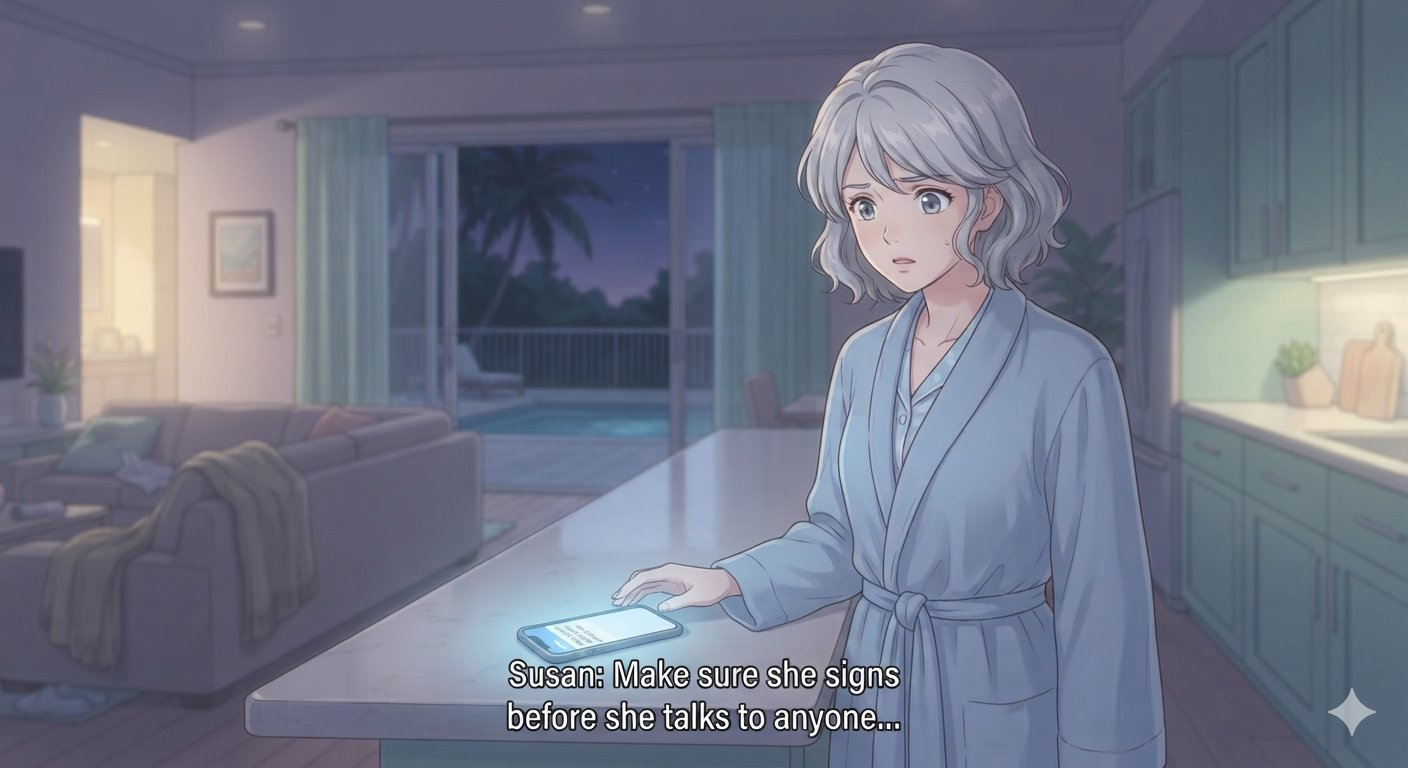
Her phone sat on the counter.
The screen lit up when a new message arrived.
I did not need to touch it.
The preview was visible.
Susan: Make sure she signs before she talks to anyone.
I stood there staring.
Another message appeared.
Susan: If Robert gets control, the house solves most of the problem.
My house.
The room seemed to tilt.
I reached for the counter.
Then I noticed a tan folder beside Patrice’s purse.
My name was handwritten on the tab.
Eleanor Morrison.
I opened it.
Inside were photocopies of financial forms.
A property summary.
An estimated value for my two-bedroom house in New Jersey.
A list of my bank accounts.
A document titled Durable Financial Power of Attorney.
My name appeared throughout it.
So did Robert’s.
There were sections authorizing broad control of property and finances.
The signature line was blank.
I sat at the kitchen island.
For several minutes, I simply stared at the papers.
Suddenly the vacation made sense in a way I wished it did not.
The urgency.
The kindness.
The money.
The strange comments about my age.
The insistence that I rest.
The way Patrice had started mentioning forgetfulness around Robert.
She had not invited me to Miami because she missed me.
She had brought me somewhere relaxed and unfamiliar because people sign things more easily when they believe they are safe.
I closed the folder.
My hands were no longer trembling.
That surprised me.
Shock had burned through something.
Underneath it was clarity.
I returned every page exactly where I found it.
Then I went back to the sofa.
At six-thirty, Patrice came downstairs.
I was already dressed.
Coffee was brewing.
Eggs were in the pan.
She stopped when she saw me.
“You’re up early.”
“I slept wonderfully.”
She blinked.
“Really?”
“Best sofa I’ve ever had.”
Something relaxed in her face.
I almost felt sorry for her.
Not because she deserved sympathy.
Because she still believed the version of me she had invented.
A tired old woman.
Grateful for scraps.
Afraid of conflict.
Easy.
We ate breakfast outside.
Halfway through, Patrice said, “Mrs. Morrison, you seem tired.”
“I’m fine.”
She looked at Robert.
“Doesn’t she seem tired?”
Robert glanced over.
“A little.”
“Travel is probably harder now.”
I buttered my toast.
“Maybe.”
Patrice leaned forward.
“And you’ve seemed more forgetful lately.”
I looked up.
“Have I?”
Robert shifted.
“Well, Mom, there was that thing with the stove.”
My fork stopped.
“What thing?”
“When you left it on.”
“I’ve never left my stove on.”
He frowned.
“Patrice said—”
I turned toward her.
“Patrice said?”
Her expression remained smooth.
“I thought Robert told me you mentioned it.”
“No.”
For the first time, the smile slipped.
Only briefly.
Then I smiled.
“It’s funny what people remember incorrectly.”
Patrice did not answer.
After breakfast, Robert went upstairs for a video meeting.
The children jumped into the pool.
Karen sat beneath an umbrella.
Patrice carried her coffee into the kitchen.
I followed.
“Your phone was on the counter last night,” I said casually.
She stopped.
“Was it?”
“Yes.”
I rinsed my cup.
“And a folder with my name.”
She became very still.
I turned.
We looked at each other.
There are moments when two people stop pretending at the same time.
That was ours.
“You went through my things?”
Her voice was quiet.
“I saw my name.”
“That doesn’t mean you had permission.”
“You’re right.”
She stared at me.
“What did you read?”
I dried my hands.
“Why?”
Her lips tightened.
“What did you read, Eleanor?”
It was the first time she had used my first name in years.
“Enough to know I won’t be signing anything.”
Her face changed.
Not dramatically.
She simply became less warm.
Less decorative.
More honest.
“You don’t understand what those documents are for.”
“Then explain them.”
“They’re planning documents.”
“For my house?”
“For your future.”
“My future belongs to me.”
She stepped closer.
“You’re making this bigger than it is.”
“No.”
I met her eyes.
“I think you counted on me making everything smaller.”
Neither of us spoke.
Then Sophie ran into the kitchen dripping water.
“Grandma, come see my underwater flip!”
The moment broke.