PART 1 – The Nurse Who Came Back
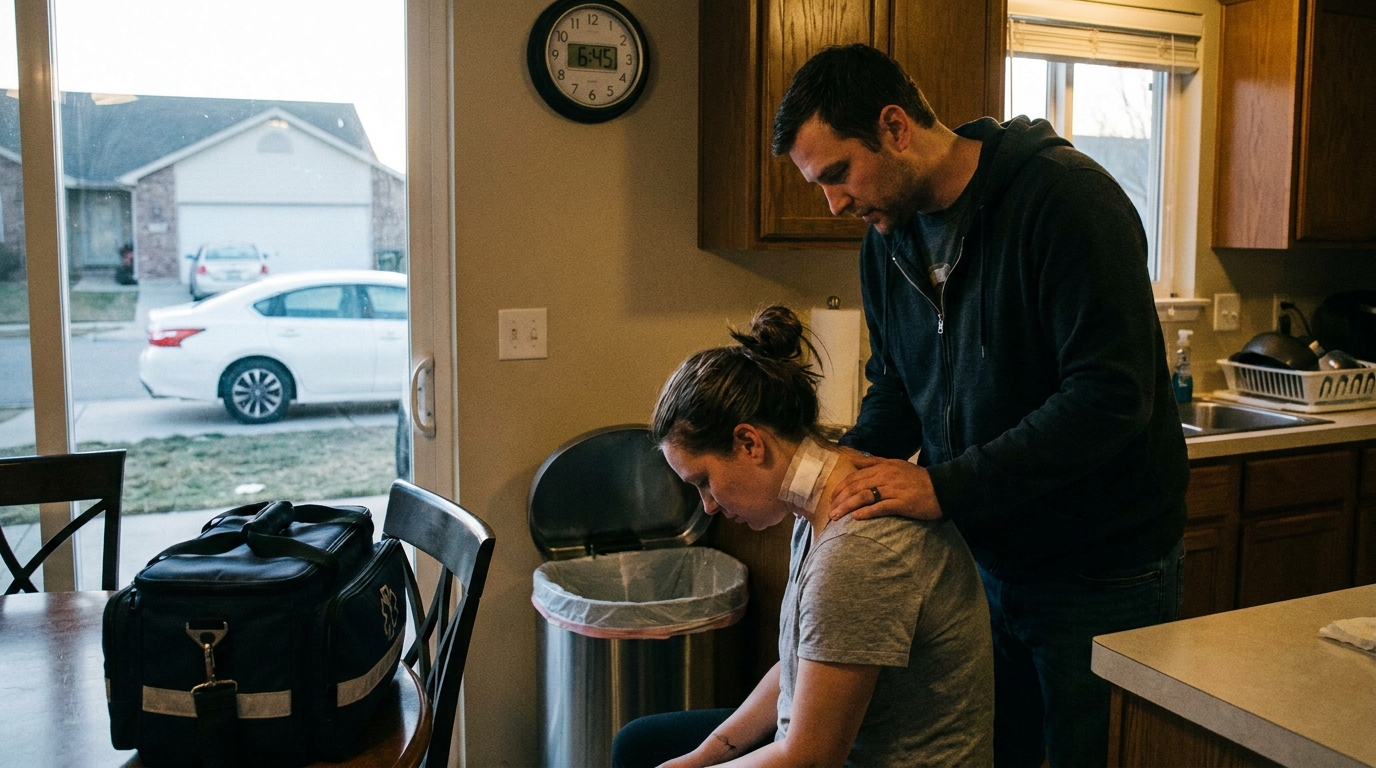
My husband waited until the home nurse drove away—or so he thought—before forcing my head over the trash can because I couldn’t keep dinner down.
Then he pressed one finger directly into the tender surgical area until I gasped and felt warmth spreading beneath the dressing.
“Tell the nurse the cancer did it,” he whispered.
What he didn’t know was that the nurse had forgotten something in our house.
And when the front doorknob turned seconds later, my husband’s face changed completely.
My name is Emily Carter.
I was forty-three years old, three weeks out from abdominal cancer surgery, and still learning how much energy ordinary things could take from me.
Showering felt like work.
Walking from the bedroom to the kitchen could leave me exhausted.
Food was unpredictable.
One morning I could eat toast.
By evening, the smell of soup could make my stomach turn.
My home health nurse, Rachel Monroe, came three times a week.
She checked my incision, blood pressure, temperature, medications, hydration, and the small collection of things doctors worry about after major surgery.
That Tuesday evening, Rachel changed my dressing.
She examined the area carefully.
“No redness I don’t like,” she said. “No drainage. It looks good.”
She took a photograph on her agency-issued phone with my consent.
The home health company used time-stamped wound photographs to track healing between visits.
Rachel wrote the time in her notes.
6:18 p.m.
Daniel stood behind her smiling.
He had become very good at smiling around other people.
“You hear that?” he said. “You’re doing great.”
Rachel looked at me.
“Keep dinner light.”
“I’ll try.”
Daniel touched my shoulder.
“I’ll make sure she eats.”
Rachel packed her supplies.
“Call the office if anything changes.”
Then she left.
I heard the front door close.
Daniel waited perhaps thirty seconds.
Then the smile disappeared.
He had made pasta.
The sauce smelled too rich.
I tried.
Three bites.
My stomach rolled.
I pushed the plate away.
Daniel stared at it.
“Seriously?”
“I can’t.”
“You said that yesterday.”
“I was sick yesterday too.”
He stood.
“I spent forty minutes making dinner.”
“I’m sorry.”
“You’re always sorry.”
I tried to get up because nausea was rising too fast.
I didn’t make it to the bathroom.
I grabbed the trash can beside the kitchen island and bent over it.
That should have been the end of it.
Instead Daniel grabbed the back of my neck.
“Stop making everything dramatic.”
“Daniel—”
He shoved my head lower over the can.
“I’m tired of watching you perform every time someone asks you to do something normal.”
I tried to pull away.
My abdomen tightened.
Pain shot beneath the dressing.
“Stop.”
He released my neck.
For one second I thought it was over.
Then he looked at the dressing beneath my loose shirt.
“You’ve got everyone convinced you’re helpless.”
His index finger pressed directly against the most tender part of the surgical area.
Hard.
I gasped.
“Daniel!”
He pressed again.
Heat spread beneath the gauze.
I felt something wet.
His eyes went to the stain appearing through the dressing.
He didn’t look frightened.
He looked annoyed.
“If Rachel asks, tell her the cancer did it.”
I stared at him.
“The cancer?”
“You know what I mean.”
“No. I don’t.”
Then we heard a car door outside.
Daniel turned his head.
Footsteps crossed the porch.
The front doorknob moved.
His hand left me instantly.
Rachel stepped inside.
“Sorry. I forgot my—”
She stopped.
Her nursing bag was sitting on the small bench near the entryway.
Then she saw me.
Bent beside the trash can.
One hand across my abdomen.
Her eyes went directly to the dressing.
“What happened?”
Daniel answered immediately.
“She got sick again. Her wound started bleeding.”
Rachel did not look at him.
She looked at me.
“I asked her.”
Daniel moved closer until I could feel his leg beside my chair.
I knew exactly what he expected.
For weeks, I had been making excuses.
Not because I thought what he did was normal.
Because cancer had made my world small.
Could I eat?
Could I sleep?
Could I make it through tomorrow’s appointment?
Could I get through one evening without an argument?
When your body is weak, avoiding conflict can begin to feel like survival.
But Rachel was standing there.
She had seen the dressing fifteen minutes earlier.
So I stopped protecting him.
“He pushed my head over the trash can.”
Daniel laughed once.
“She’s medicated.”
“And he pressed on the surgical area after you left.”
His face went blank.
Rachel approached slowly.
“When I left this house, that dressing was clean.”
Daniel started talking.
Nausea.
Recovery.
Pain medication.
Stress.
How hard everything had been for both of us.
Rachel let him finish.
Then she asked me:
“Emily, do you want me to stay?”
“Yes.”
Daniel’s jaw tightened.
“Do you feel safe being alone with your husband?”
“No.”
One word.
The first honest one I had said about Daniel in months.
I reached for Rachel’s arm and tried to stand.
Pain stopped me halfway.
She offered support but waited until I chose to take it.
I did.
Daniel stepped toward us.
Then moved directly in front of the door.
“This has gone way too far.”
Rachel straightened.
“Daniel, please step aside.”
“You’re not taking my wife anywhere.”
“I didn’t say I was.”
“You’re making her think she’s in danger.”
Rachel didn’t argue.
She reached into the nursing bag she had come back to retrieve.
Daniel watched her hand.
She pulled out her work phone.
“I need you to move away from the door.”
“You’re calling the police over this?”
“I’m asking you to move.”
Something in her voice changed him.
Not fear.
Certainty.
He stepped aside.
Rachel guided me toward the entryway.
Before we crossed it, she stopped.
“Emily, one question.”
I looked at her.
“Does Daniel manage your medications?”
My husband’s face changed.
I saw it.
Rachel saw it too.
“Yes,” I said.
“Most of them?”
“Yes.”
“Does he fill your pill organizer?”
“Yes.”
“Does he pick up your prescriptions?”
“Yes.”
Daniel interrupted.
“Because she’s sick.”
Rachel looked back at him.
“I didn’t ask you.”
Then she turned to me again.
“Have you ever felt more sleepy, confused, or nauseated after Daniel gave you medication than when someone else did?”
I thought about the previous three weeks.
The afternoons I could barely stay awake.
The appointment I had missed because Daniel said I was “too confused to go.”
The two times he told Rachel I had accidentally taken an extra dose.
The bottle that seemed to empty faster than it should have.
“I don’t know.”
Rachel nodded.
“That’s okay.”
But her expression told me she knew something I didn’t.
Later I learned that when Rachel had reached her car minutes earlier, she had opened her tablet to finish my visit notes.
That was when she noticed a pattern.
During visits when she personally counted and documented my medications, the numbers were consistent.
By the next visit, several counts sometimes didn’t match Daniel’s written log.
And almost every unexplained bruise, reopened dressing, episode of unusual sedation, or sudden worsening had happened after Daniel had been alone with me.
Rachel had blamed surgery.
Then cancer.
Then medication side effects.
Until she returned for her forgotten bag and saw what happened in the few minutes between two photographs.
That night was the first time someone else saw the difference between my illness and my husband.
And it was also the night we began discovering that Daniel had not simply been hurting me when he lost his temper.
He had been building a paper trail designed to make everyone believe I could no longer manage my own life.
PART 2 – The Photograph Taken Fifteen Minutes Earlier
Rachel called 911 from the porch.
She didn’t make dramatic accusations.
She gave facts.
Recent abdominal surgery.
New bleeding from a previously clean incision.
Patient reports intentional pressure by spouse.
Patient says she does not feel safe.
Possible medication concerns.
An ambulance arrived first.
Then a patrol officer.
Daniel stood in our driveway with both hands on his head.
I remember looking at him through the ambulance window.
For eleven years, he had been my husband.
He had held me after my mother died.
He had painted our first apartment.
He had once driven six hours through a snowstorm because I called and said my car wouldn’t start.
People sometimes imagine abusive marriages as evil from the first day.
Mine wasn’t.
That fact confused me for years.
At the emergency department, doctors examined the surgical site.
The pressure had caused a small section to reopen and bleed.
It did not require another major operation.
It did require cleaning, additional closure, antibiotics, and monitoring.
My surgeon came in close to midnight.
Dr. Alan Pierce was not an emotional man.
He looked at the wound.
Then at me.
“Did someone do this?”
“Yes.”
“Your husband?”
“Yes.”
He nodded once.
“Okay.”
No speech.
No disbelief.
Just okay.
Then:
“We’re documenting it.”
Rachel had already uploaded the earlier photograph through the agency system.
6:18 p.m.
Clean.
The ER photograph was taken at 7:07.
Fresh bleeding.
The time between them mattered.
So did Mrs. Henderson across the street.
She had a doorbell camera.
It showed Rachel leaving at 6:26.
Her car remaining in the driveway because she had sat inside finishing documentation.
At 6:32 she walked back to the house.
Nobody else had entered.
Daniel later tried to say I might have injured myself after Rachel left.
Technically possible.
Until there was my statement.
Rachel’s observations.
And something else.
The officer asked whether Daniel had ever hurt me before.
My instinct was to say no.
Then I stopped.
“No like this?”
The officer waited.
I understood what he was asking.
Had he grabbed me?
Yes.
Had he blocked doors?
Yes.
Had he squeezed my wrist hard enough to bruise?
Twice.
Had he pushed me onto the bed after surgery because I refused to discuss our finances?
Yes.
Had I told anyone?
No.
“Why not?”
the officer asked.
I stared at the hospital blanket.
“Because every time afterward, he had a reason.”
Stress.
Fear.
Exhaustion.
My cancer.
His fear of losing me.
His frustration because I refused help.
His childhood.
Alcohol.
Work.
There was always a reason.
Reasons can become a very effective cage when you confuse them with permission.
The hospital social worker came in.
She asked whether I had somewhere safe to go.
My older sister Laura lived forty minutes away.
We had not been close for years.
Cancer changed that.
She answered on the second ring.
“Emily?”
“Can I stay with you?”
Silence.
Then:
“For how long?”
“I don’t know.”
“Then yes.”
No questions.
I started crying.
Laura arrived at 1:15 in the morning wearing sweatpants and one slipper from one pair and another from another.
She looked at my bandage.
Then at my face.
“Did he do that?”
“Yes.”
She closed her eyes.
“Okay.”
Apparently okay was the right word that night.
Not because any of it was okay.
Because okay meant:
I believe you.
What next?
Daniel was not immediately sentenced or thrown into prison.
He was removed from the house under temporary conditions after police reviewed the initial evidence.
The next morning, with help from the hospital and an attorney, I sought an emergency protective order.
A hearing would follow.
Daniel texted until his attorney told him to stop.
The messages changed tone every ten minutes.
I’m sorry.
Then:
You know I didn’t mean it.
Then:
Rachel manipulated you.
Then:
If you destroy my life over one bad moment, that’s on you.
Then:
Please come home.
Then:
You are not mentally capable of handling all this right now.
That last message bothered my attorney.
Her name was Monica Reyes.
She read it twice.
“Why would he say that?”
“Because I have cancer.”
“That’s not the same as incapacity.”
“I know.”
“Has he ever said you can’t manage your own affairs?”
I hesitated.
During the previous month, Daniel had begun correcting me in front of people.
“She forgets things.”
“She gets confused from the medication.”
“I handle the finances now.”
At one oncology visit he had answered a question before I could.
The nurse had gently redirected it to me.
I hadn’t thought much about it.
Monica did.
“Does Daniel have power of attorney?”
“No.”
“Any financial authorization?”
“We have a joint checking account. That’s it.”
“Access to your email?”
“Probably.”
“Passwords?”
“He knows some.”
She closed her legal pad.
“Change them.”
We did.
Banking.
Email.
Insurance.
Medical portal.
Phone account.
Everything.
That afternoon Rachel’s supervisor called.
Their agency had begun reviewing my visit records because of the medication concern.
They weren’t accusing Daniel of poisoning me.
There was no evidence of that.
What they had was simpler.
And disturbing enough.
My prescribed pain medication counts repeatedly came up short.
My anti-nausea medication counts sometimes did too.
Daniel’s handwritten log did not match pharmacy refill dates.
Twice he had told Rachel I had taken medication incorrectly.
I remembered neither event.
Then Rachel asked something that made my stomach tighten.
“Emily, when Daniel said you took an extra dose, did you actually see the medication before you took it?”
“No.”
“Who gave it to you?”
“Daniel.”
The investigation was no longer about only one reopened wound.
But we still did not understand why Daniel seemed so invested in making me appear unable to handle my own treatment.
Three days later, Monica found the first answer.
Daniel had contacted our bank.
Not to report fraud.
Not to ask about medical bills.
He had asked what documents would be required if a spouse became medically unable to manage an investment account.
The investment account was mine.
And it held a little over $640,000.
Money my mother had left me before Daniel and I were married.
PART 3 – “She’s Not Thinking Clearly”
My cancer diagnosis came six months earlier.
I found blood where there shouldn’t have been any.
Then tests.
Scans.
More tests.
The words everyone fears.
Cancer.
The surgeon believed it was operable.
My prognosis was not hopeless.
Actually, once staging was complete, the doctors were cautiously optimistic.
But people hear the word cancer and often stop listening to everything after it.
Daniel did.
At first he was wonderful.
He took notes.
Made meals.
Sat beside me in waiting rooms.
Told everyone:
“We’re fighting this together.”
I believed him.
Then the bills began arriving.
Not catastrophic.
We had insurance.
But deductibles, time away from work, medications, home health, transportation—all of it added pressure.
Daniel’s consulting business had also been struggling.
He had always described it as temporary.
A few clients paying late.
One contract canceled.
Nothing serious.
I didn’t realize he had taken out two business loans.
I didn’t know he owed back taxes.
I didn’t know he had personally guaranteed nearly $190,000.
And I certainly didn’t know that three months before my surgery, he had asked a financial adviser how quickly assets could be accessed if a spouse became incapacitated.
Monica found that through discovery later.
At the beginning, we only saw small pieces.
My investment account had been created from my mother’s estate.
Separate property.
I used the income occasionally.
Daniel knew about it.
He also knew my will left most of it to my sister’s two children if I died without children of my own.
Daniel received other assets.
The house.
A life insurance benefit.
Our joint savings.
He had complained once.
“Your sister’s kids get more than your husband?”
I thought he was joking.
“Mom’s money stays in her bloodline.”
“I’m your family.”
“Yes.”
“Apparently not enough.”
We argued.
Then forgot about it.
Or I forgot about it.
Daniel didn’t.
After I was diagnosed, he began bringing documents home.
“Estate planning.”
“Emergency planning.”
“Just in case.”
Most were reasonable.
Advance directive.
Medical information.
Emergency contacts.
Then one afternoon, about ten days after surgery, he placed a thick document beside me.
“What’s this?”
“Durable power of attorney.”
“I already have one.”
“From years ago.”
“My sister is my agent.”
He frowned.
“You’d rather Laura make decisions than your husband?”
“It was written before we married.”
“So update it.”
I was tired.
In pain.
“Not today.”
He became angry.
Not explosive.
Cold.
“Everything with you is not today.”
I pushed the papers away.
A few hours later, he apologized.
Two days after that, he told Rachel I had been “confused all morning.”
I hadn’t.
Then came the medication problems.
At Laura’s house, I took control of my own pill organizer with help from a visiting nurse.
Something strange happened.
Within five days, I felt clearer.
Still exhausted.
Still nauseated.
Still recovering.
But clearer.
I told Dr. Pierce.
He reviewed my medication list.
My blood work.
Nothing suggested some dramatic poisoning.
What it suggested was that I had not always been receiving my medications consistently.
Sometimes too much of one prescribed sedating medication may have been given.
Sometimes pain medicine was missing.
Sometimes anti-nausea medicine had not been given when the log said it had.
Investigators later learned Daniel had been using some of my controlled pain medication himself.
He admitted that eventually.
He said his back hurt.
He said he was stressed.
He said he only took “a few.”
Pharmacy records and counts suggested more than a few.
But that still did not explain the paperwork.
Then Monica obtained a copy of an email Daniel sent to an elder-law attorney.
I was forty-three.
He described me as:
A spouse with cancer experiencing cognitive decline after major surgery.
Cognitive decline.
I read the line until the words blurred.
He asked whether a husband could obtain authority over finances if the wife became unable to understand documents.
The attorney’s reply was responsible.
A cancer diagnosis did not establish incapacity.
Medication side effects did not automatically establish incapacity.
A proper legal and medical process would be required.
Daniel never hired that attorney.
Instead he found another approach.
He began collecting examples of me being “confused.”
Missed appointments.
Forgotten conversations.
A grocery delivery ordered twice.
A check written incorrectly.
Except when Monica and I looked closely, several examples weren’t mine.
The duplicated grocery order came from Daniel’s phone.
The missed appointment had been canceled through my patient portal from our home computer while I was asleep.
The incorrect check had never cleared because the signature didn’t match mine.
Daniel had been creating the appearance of decline.
Not perfectly.
Not as part of some brilliant criminal mastermind’s plan.
Messily.
Opportunistically.
One incident at a time.
Monica asked:
“What happens financially if he controls your account?”
“He could access the money.”
“Anything else?”
“He could sell investments.”
“House?”
“The house is joint.”
“What about your mother’s cabin?”
I stared at her.
I had almost forgotten.
My mother had left me a small lake cabin in Virginia.
Value around $360,000.
Paid off.
Daniel loved it.
He had mentioned selling it after my diagnosis.
“Too much maintenance.”
I had said no.
Monica wrote it down.
Then we learned Daniel had already contacted a real estate agent.
He told her:
“My wife is very ill. I’m going to be handling the property soon.”
That was when fear replaced confusion.
Not because I thought Daniel was planning to kill me.
There was no evidence of that.
Because I understood something more ordinary.
He had begun planning my life as though I no longer had a voice in it.
Cancer had made me vulnerable.
Daniel had mistaken vulnerability for permission.
And when I resisted, his behavior escalated.
The trash can wasn’t the beginning.
It was simply the first moment another person walked back through the door soon enough to see it.
PART 4 – The Bag Rachel Forgot
People later asked Rachel what would have happened if she hadn’t forgotten her bag.
She always gave the same answer.
“I don’t know.”
I appreciated that.
No dramatic destiny.
No claim that everything happens for a reason.
She forgot a bag.
That mistake helped me.
That was enough.
The bag itself became almost symbolic in the case, though what mattered was inside it.
Her work phone contained the time-stamped wound photograph.
Her tablet contained contemporaneous nursing notes.
But the most important evidence was not one photograph.
It was consistency.
Rachel’s agency had seven visits documented.
At each visit:
vital signs,
wound appearance,
medication count,
mental status,
reported symptoms.
The pattern became clear only when investigators lined the dates up.
On mornings when Daniel had been away overnight for work, my medication counts were normal.
My alertness was better.
My complaints were ordinary for recovery.
After long periods alone with Daniel, discrepancies appeared.
Two missing pain tablets.
Then four.
Then six.
An anti-nausea medication bottle showing fewer pills than the administration log suggested should remain.
Once, a sedating medication had apparently been given at a time not ordered by the prescriber.
The handwritten entry was in Daniel’s writing.
Again:
No toxic murder plot.
No secret chemical.
Just misuse of prescription medication and a false record.
But why?
Daniel’s explanation changed.
First:
I had taken pills myself and forgotten.
Then:
He may have written the time wrong.
Then:
Rachel had counted incorrectly.
Then:
He admitted taking some pain medication.
“Because I was under pressure.”
That confession damaged him badly.
Not because addiction or misuse automatically made someone abusive.
Because he had blamed me for the missing doses.
He had told medical staff I was confused.
He had used his own theft to support a story about my incompetence.
The police also recovered deleted messages from his phone.
One to his brother Marcus:
If she keeps refusing the POA, I’m screwed.
Marcus replied:
Then stop pushing it for a week. You’re making her suspicious.
Daniel:
She’s too sick to manage this anyway.
Marcus:
That doesn’t make the account yours.
That message mattered.
His own brother had understood the boundary.
Daniel didn’t.
Another message:
If the doctor documents confusion, I can handle everything.
Marcus:
What are you talking about?
Daniel never answered.
Investigators interviewed Marcus.
He was horrified.
He told them Daniel’s business debts were worse than anyone knew.
Daniel had borrowed from him too.
$35,000.
He had also promised a lender he would inject $150,000 of “family capital” into the consulting business.
No such capital existed.
Unless Daniel got access to mine.
Now the motive made sense.
Not murder.
Money.
Control.
Desperation.
And the dangerous belief that because I was his wife and sick, my assets should rescue him.
At the protective-order hearing six weeks after the trash-can incident, Daniel’s lawyer tried to keep the focus narrow.
One argument.
One injury.
One stressed husband.
Monica didn’t overreach.
She presented Rachel.
The photograph.
The wound records.
My statement.
The medication discrepancies.
The financial inquiries only as context for coercive behavior—not as proof of every crime we suspected.
The judge extended the order.
Daniel could not contact me directly.
He could retrieve personal belongings from the house under arranged conditions.
He could communicate through counsel about the divorce we had now filed.
Yes.
Divorce.
I filed twenty-three days after leaving the hospital.
People asked whether I was sure.
I had cancer.
I was recovering.
Divorce would be stressful.
Did I want to make such a big decision while vulnerable?
That question annoyed me more than it should have.
Being sick did not erase my ability to recognize danger.
Monica asked once.
“Are you certain?”
“Yes.”
She never asked again.
Daniel reacted through his lawyer.
He wanted reconciliation counseling.
I declined.
Then he wanted access to the house.
We arranged retrieval.
Then he claimed half my inherited investment account should be marital because some income had been used for household expenses.
The accountants could sort out whatever legal tracing was necessary.
What he did not get was control.
The lake cabin remained mine.
The investment account remained frozen against unauthorized transfers while ownership issues were reviewed.
Our joint checking account was divided under temporary orders.
The business debts were investigated separately.
Then something happened that none of us expected.
A woman contacted Monica.
Her name was Beth Avery.
She worked at a branch of the bank where Daniel had our joint accounts.
She had seen my photograph in a local article about the protective-order hearing.
Not details.
Just enough.
She told Monica:
“Your client needs to know her husband came in with a document I didn’t trust.”
“What document?”
“A power of attorney.”
My stomach dropped.
“I never signed one.”
Beth knew.
That was why she was calling.
Three weeks before the trash-can incident, Daniel had attempted to use a notarized power of attorney naming himself as my financial agent.
The bank refused to accept it immediately because one of Beth’s internal checks raised questions.
Daniel had become angry.
He told her:
“My wife has cancer. She can barely remember what day it is.”
Beth asked to speak to me directly.
Daniel said I was too ill.
The bank placed the request on hold.
Then Daniel never returned.
Monica obtained the document through proper legal channels.
My name was at the bottom.
So was a signature.
It looked like mine.
But I had never seen the paper.
And the notary stamp belonged to someone I knew.
Daniel’s cousin.
PART 5 – The Signature I Never Gave Him
Daniel’s cousin was named Natalie Shaw.
She was a mobile notary.
I had met her maybe six times.
Birthday parties.
A funeral.
One Fourth of July barbecue.
We were not close.
When investigators showed me the power of attorney, my first reaction wasn’t anger.
It was embarrassment.
How many people had Daniel recruited into a story about me before I even knew the story existed?
The document was dated twelve days after my surgery.
That date mattered.
I had spent almost the entire day at home.
Rachel visited from 10:00 to 11:15.
Laura came from noon until three.
Daniel was there.
Natalie’s notarial certificate claimed I had personally appeared before her at 4:30 p.m.
I remembered the afternoon.
At 4:30 I had been asleep.
Laura had texted me at 4:12:
Left soup in your fridge. Call me when you wake up.
My home security camera showed Natalie entering at 4:19.
Leaving at 4:31.
Could I have awakened and signed something?
Possible.
Except Daniel texted Natalie at 4:33:
Thanks. She didn’t need to be bothered.
Investigators recovered that message.
Natalie hired an attorney almost immediately.
Her explanation:
Daniel told her I had already signed the document and only needed acknowledgment.
That did not make the notarization proper.
A notary must perform required identification and witnessing/acknowledgment procedures.
She admitted she had not.
She claimed she did not know the signature was false.
Maybe.
The forensic examiner compared the signature with others.
It appeared to have been copied from a medical release form I had signed before surgery.
Daniel had access to the scanned file.
Natalie eventually admitted she had notarized without me present because Daniel said I was too sick to come downstairs.
“I thought I was helping family.”
There it was again.
Helping family.
A phrase capable of carrying almost anything if you let it.
Natalie faced consequences.
Her notary commission was suspended and later revoked.
She was charged in connection with the false notarization and reached a plea that included probation, a fine, and cooperation.
She gave investigators Daniel’s messages.
Those messages opened a larger door.
Daniel had sent her three different versions of the power of attorney.
The first gave him ordinary financial authority.
The second added power over real estate.
The third included authority over investment accounts and the lake cabin.
Natalie had asked:
Does Emily know you’re adding the cabin?
Daniel replied:
She will eventually. I’m trying to protect us before she gets worse.
Protect us.
I read those words in Monica’s office.
“I was expected to get better.”
Monica looked at me.
“What?”
“Even then. My doctors were optimistic.”
Daniel had turned the possibility of my death or incapacity into something more certain because certainty was useful to him.
He needed a reason not to ask.
Cancer provided one.
The bank’s refusal prevented the power of attorney from being used there.
What about elsewhere?
That became the next investigation.
No property had been sold.
The lake cabin deed was untouched.
My investment firm had received an inquiry but refused access because Daniel could not answer security questions.
He had not gotten my $640,000.
He had tried.
That mattered legally.
But emotionally, I kept returning to the same question.
When did he decide I was no longer a person he needed permission from?
I asked him that months later.
Not directly.
At a mediated divorce session, we sat in separate rooms.
The mediator carried proposals back and forth.
At one point Daniel sent a message through her:
I made mistakes because I thought Emily was dying.
I told the mediator:
“Please take him my answer exactly.”
She nodded.
“I wasn’t.”
He replied twenty minutes later:
I know that now.
That response stayed with me.
Because he had known it then too.
Maybe not emotionally.
But medically.
He had attended appointments.
He heard the surgeon say the tumor had been removed with clear margins.
He heard them explain the follow-up plan.
He heard cautious optimism.
But a sick wife with a possible future was inconvenient.
A dying, confused wife was financially simpler.
He did not cause my cancer.
He did not try to kill me.
I want to be precise about that.
What he did was exploit uncertainty.
He turned fear into authority.
He treated my recovery as a window during which he could gain control over decisions I had refused while healthy.
That was enough.
Meanwhile, I continued recovering.
My next scans showed no immediate evidence of disease.
I would need monitoring.
More appointments.
The future was not guaranteed.
It never is.
But I began walking every morning.
First to Laura’s mailbox.
Then around the block.
Then a mile.
Food got easier.
My hair, which had thinned from stress and treatment, began filling in again.
I stopped sleeping with my phone beneath my pillow.
And one afternoon, Rachel visited me at Laura’s house just because she wanted to.
No uniform.
No medical bag.
She brought coffee.
We sat outside.
“I keep thinking about that bag,” I said.
She laughed.
“My supervisor never lets me forget it.”
“What if you hadn’t come back?”
Rachel looked at me.
“I don’t know.”
“Would you have noticed the medication pattern?”
“Eventually, maybe.”
“Would I have said anything?”
She reached across the table.
“You did say something.”
“Because you came back.”
“No.”
I looked at her.
“You said it because when I asked if you wanted me to stay, you said yes.”
I started crying.
Rachel squeezed my hand.
“I opened the door. You walked through it.”
That was generous.
But over time I understood what she meant.
Rescue rarely feels like one person carrying another out of a burning building.
Sometimes it is one person asking a clear question.
Do you want me to stay?
And another person finally answering honestly.
PART 6 – Cancer Was Not the Thing Destroying My Life
My divorce took sixteen months.
Cancer recovery was faster in some ways.
Slower in others.
The first follow-up scan terrified me.
Every ache became a recurrence in my imagination.
Every lab result felt like a verdict.
But medically, things went well.
The surgery had removed the known disease.
My oncologist recommended additional monitoring and treatment based on pathology.
I followed it.
Not perfectly.
Nobody does anything perfectly while frightened.
But I followed it.
Daniel’s lawyers tried to subpoena broad portions of my medical records in the divorce.
Monica objected where appropriate.
Relevant medical information could be addressed.
My entire history was not an invitation.
Daniel claimed he needed to prove I had cognitive side effects.
An independent evaluation found no evidence that I lacked decision-making capacity.
I was fatigued.
Anxious.
Occasionally forgetful.
Which described half the adults I knew.
The evaluation became important because Daniel had spent months telling people a different story.
His mother believed him.
His brother didn’t.
His cousin Natalie had.
Two business associates had.
Even one of our neighbors later admitted Daniel told him:
“Emily’s not really herself anymore.”
I had been myself.
A scared, sick, exhausted version.
Still myself.
The financial case became clearer too.
Daniel’s consulting business had been losing money for nearly eighteen months.
He had hidden the worst of it from me.
Not because spouses must disclose every business worry every evening.
Because some of his debts were personally guaranteed and he had used joint funds without discussing them.
About $74,000 had moved from our joint savings into his company over two years.
Some transfers I knew about.
Most I didn’t.
Our divorce accountant separated what could actually be proven.
No fantasy accounting.
No assumption every business expense was theft.
The final marital balance sheet showed:
joint savings reduced substantially by business transfers,
a retirement loan Daniel had taken against his own account,
tax liabilities related to his business,
and approximately $26,000 spent on personal expenses he had disguised as business costs.
There was no mistress.
No secret second family.
For a while I almost wished there had been.
An affair would have been easier to explain.
Instead the other person in my marriage was Daniel’s fear of failure.
He had spent years building an image.
Successful consultant.
Reliable husband.
Man who handled everything.
When the business began collapsing at the same time I got cancer, he couldn’t tolerate being powerless in both places.
So he found somewhere he could create control.
Me.
That explanation came from Daniel himself eventually.
Not as an excuse I accepted.
As a fact.
He began individual therapy after his criminal attorney advised him to get treatment for substance misuse and anger.
He later entered a program related to prescription medication misuse.
Again:
Treatment did not erase conduct.
But it explained some of the chaos.
He had been taking my pain medication while using alcohol more heavily than I knew.
He was sleeping badly.
Panicked about debt.
Ashamed.
Then lying to cover the previous lie.
None of that put his hand on my neck.
None of it forged my signature.
Those were decisions.
The criminal case moved slowly.
The prosecutor brought charges related to domestic assault, prescription theft, attempted financial fraud, and the false power-of-attorney document.
Not every allegation became a charge.
Some were difficult to prove.
Some were better handled civilly.
Natalie cooperated.
Beth from the bank testified about Daniel’s attempt to use the document.
Rachel testified about the wound and medication counts.
Mrs. Henderson’s doorbell footage established timing.
My surgeon documented the injury.
And then there was Daniel’s phone.
A message he had sent himself.
Not another person.
A note.
Need Emily POA before loan review 5/30. If she won’t sign, incapacity route?
When Monica showed me, I felt strangely calm.
There it was.
My entire nightmare reduced to twelve words and a date.
If she won’t sign.
Not:
If she cannot understand.
If she won’t sign.
He knew the difference.
That became one of the most important pieces of the case.
My refusal had been conscious.
His problem was never that I lacked capacity.
His problem was that I had it.
PART 7 – The Day Daniel Finally Stopped Calling It an Accident
The criminal case did not end with a dramatic jury verdict.
Daniel accepted a plea agreement.
His attorneys had reasons.
So did the prosecutor.
Trials are uncertain.
Victims relive everything.
Some charges had stronger evidence than others.
The agreement required Daniel to admit conduct he had spent more than a year minimizing.
I attended the hearing.
Rachel came too.
She sat behind me.
Laura held my hand.
Daniel looked different.
Thinner.
Older.
No expensive suit.
Just a dark jacket and a pale blue shirt.
The judge asked him about the kitchen incident.
Daniel said:
“I grabbed my wife and forced her down toward the trash can.”
The courtroom was silent.
“And her surgical wound?”
“I pressed on it.”
“Intentionally?”
Daniel looked at the floor.
“Yes.”
“Why?”
He swallowed.
“I was angry.”
“About?”
“She was sick. She wasn’t eating. We were arguing.”
The prosecutor corrected gently.
“You had also been arguing about finances and her refusal to sign documents, correct?”
Daniel closed his eyes.
“Yes.”
Then the power of attorney.
He admitted he had taken an old image of my signature.
He admitted asking Natalie to notarize the document without me appearing.
Natalie had not known every detail, he said.
But she knew enough to violate her responsibility.
He admitted bringing the document to the bank.
The judge asked:
“Did your wife lack capacity at that time?”
“No.”
“Did you believe she lacked capacity?”
Long silence.
“No.”
There it was.
“Then why did you tell the bank she did?”
Daniel’s voice dropped.
“Because I needed them to accept the document.”
My eyes filled.
Not because I had learned anything new.
Because truth sounds different when the person who hurt you is finally required to speak it without decoration.
The judge asked about my medication.
Daniel admitted taking prescribed pain medication that was not his.
He admitted altering the handwritten log.
He denied intentionally giving me medication to make me incapacitated.
The prosecution had not claimed they could prove that beyond a reasonable doubt.
What they could show was inconsistent administration and false documentation.
That distinction mattered.
Daniel received a custodial sentence of several years, followed by supervised release, along with restitution obligations and treatment requirements.
Not life.
Not twenty years.
A real consequence.
The judge also ordered him to stay away from me under the applicable protective conditions.
Natalie’s case ended separately.
Probation.
Loss of her notary commission.
Community service.
A fine.
Her attorney later sent a letter asking whether I would accept an apology.
I said yes to the letter.
Not a meeting.
Natalie wrote:
I told myself I was helping a sick family member by making paperwork easier. I knew you were supposed to be present. I chose Daniel’s urgency over your rights.
That sentence mattered.
Not because I forgave her.
Because she named the thing.
Daniel’s mother, Patricia, never faced criminal charges.
She had believed much of what he told her.
But she had also helped him pressure me about money after my diagnosis.
When she learned about the forged document, she stopped speaking to him for nearly a year.
She called me once.
“I thought you were confused.”
“I wasn’t.”
“I know.”
“You believed him.”
“Yes.”
“You wanted to.”
Silence.
Then:
“Yes.”
I appreciated that answer more than an hour of excuses.
She asked if she could apologize in person.
I declined.
She accepted it.
That was growth enough for both of us.
The divorce decree came two months after Daniel’s sentencing.
The house was sold.
My share went to me.
His business debts remained his where legally separate.
Joint obligations were handled according to the settlement.
My inherited investment account remained mine after tracing.
The lake cabin remained mine.
Daniel got no control.
No forced sale.
No magical financial windfall for me either.
I still had cancer-related bills.
Attorney fees.
Therapy.
Lost work.
A life to rebuild.
Justice did not make me rich.
It made the paperwork match reality again.
That was enough.
PART 8 – The Woman I Had Been Before Cancer
After everything ended, people expected me to become inspirational.
I hated that.
They wanted the story to become:
Cancer survivor defeats abusive husband and starts a beautiful new life.
I did start a new life.
It was not beautiful every day.
Sometimes it was boring.
Sometimes lonely.
Sometimes I cried because a restaurant played the song Daniel and I danced to at our wedding.
Sometimes I missed him.
That confused people.
“How can you miss someone who did that?”
Easy.
I missed the man I married.
I missed the years before fear.
I missed Sunday mornings.
Inside jokes.
Road trips.
The version of myself who did not know what would happen.
Missing a person is not a legal argument for letting them back into your life.
I learned that in therapy.
I also learned that I had spent too much time dividing Daniel into two men.
Good Daniel.
Bad Daniel.
The husband who made soup.
The husband who shoved my head over a trash can.
The man who held me after diagnosis.
The man who forged my signature.
They were the same person.
That was harder.
People can love you and still hurt you.
They can care about you and still feel entitled to control you.
Recognizing one does not cancel the other.
My scans continued.
One year.
Then eighteen months.
No evidence of recurrence.
I never used the phrase “cancer-free” casually because my oncologist was more precise.
But I was well.
Getting stronger.
I went back to work part-time.
I was a public library administrator.
Not glamorous.
I loved it.
The first day back, my coworkers decorated my office.
I told them it looked like a funeral home.
They removed half the flowers.
I laughed until my abdomen hurt.
Normal pain.
Not surgical pain.
Not fear.
Just laughing too hard.
Rachel and I stayed in touch.
She refused every gift more expensive than coffee.
So each year on the anniversary of the forgotten bag, I sent her coffee.
The first card said:
To the woman who came back.
The next year she sent one to me.
To the woman who answered.
I kept it.
Laura and I grew closer too.
Cancer had revealed how ridiculous our old distance was.
We had stopped speaking much after an argument over our mother’s estate.
Not money.
Furniture.
A ridiculous china cabinet neither of us even wanted.
Years wasted.
One afternoon at the lake cabin, she pointed at it.
Yes.
I had moved the china cabinet there.
“You still have that ugly thing?”
“You fought me for it.”
“I was grieving.”
“So was I.”
We stared.
Then laughed.
Later that night, we burned nothing.
Sold nothing.
We just drank wine and admitted we had both been idiots.
Healing is disappointing if you expect fireworks.
Mostly it is people finally having conversations they should have had years earlier.
PART 9 – Five Years Later
Five years after Rachel came back for her nursing bag, I received a letter from Daniel.
By then he had served his sentence and was living in another state under post-release supervision.
He had written before.
I had never responded.
This letter was different.
Short.
Emily,
I used to tell myself cancer changed our marriage.
That was easier than saying I changed when I became afraid.
I kept reading.
I believed I deserved access to your money because my business was failing and because I had supported us before. I believed being your husband meant I could decide what was best when you said no.
When you got sick, I saw your weakness before I saw your fear. I hate admitting that.
Then:
I took your medication. I lied about it. I used the missing pills as proof that you were confused. I knew you were not incompetent. I needed other people to think you might be.
No vague language.
I hurt you in the kitchen. I did not intend to reopen the wound, but I intended to hurt and frighten you. Then I told you to blame cancer because I was more concerned about protecting myself than protecting you.
I stopped reading.
Walked outside.
Came back twenty minutes later.
The last paragraph said:
I do not expect a reply. I am writing because for years I made you carry explanations for things I chose. They belong to me.
I folded the letter.
I cried.
Then I put it away.
Three weeks later I wrote back.
Not forgiveness.
Not reconciliation.
Daniel,
I read your letter.
You are right that those choices belong to you.
My recovery belongs to me.
I hope you continue treatment and build a life where nobody else has to become smaller for you to feel safe.
Emily
That was all.
We never became friends.
We never met for coffee.
I did not need that ending.
I had already lived the important one.
A year later, I sold the lake cabin.
That surprised everyone.
Laura said:
“After everything he tried to do?”
“That’s exactly why.”
“What?”
“I don’t want to keep something forever just because Daniel wanted control of it.”
The cabin had been my mother’s.
I loved it.
But I didn’t want it anymore.
I sold it to a young couple with two children who ran through every room asking where bunk beds could go.
The wife apologized.
“Sorry. They’re excited.”
“Let them be.”
At closing, I signed the deed.
Voluntarily.
My hand.
My signature.
My choice.
I took part of the money and bought a smaller place near Laura.
The rest stayed invested.
No dramatic mansion.
No revenge purchase.
A two-bedroom house with a porch and terrible kitchen cabinets.
I loved every inch.
The first night, I ate cereal for dinner.
Nobody commented.
Nobody demanded another bite.
Nobody called it a performance.
I sat at the table and cried into a bowl of cornflakes because freedom can look ridiculous when it finally becomes ordinary.
PART 10 – What Rachel Really Saved
I am fifty-one now.
My cancer is still something doctors ask about.
History.
Follow-up.
Risk.
It is part of my life.
Not the title.
The scar on my abdomen faded.
Not completely.
When I see it, I no longer immediately remember Daniel’s finger pressing against the dressing.
Most days I think:
That is where they went in to save my life.
That change took years.
Rachel retired from home health nursing last spring.
Her coworkers threw a party.
She invited me.
Someone gave a speech about her thirty-one years as a nurse.
Patients.
Families.
Night calls.
Storms.
Missed holidays.
Then her supervisor mentioned the famous forgotten bag.
Everyone laughed.
Rachel looked at me.
“Still the most important bag I ever forgot.”
After the party, we sat outside.
She was sixty-three now.
Gray streaks in her hair.
Same calm eyes.
I asked:
“Do you remember what was actually in the bag?”
She laughed.
“Gauze. Charger. Blood pressure cuff. Half a granola bar.”
“That’s very disappointing.”
“I know.”
“For years I made it sound like some mysterious evidence kit.”
“The evidence was already uploaded.”
“I know.”
She looked at me.
“You know what I remember?”
“What?”
“Your face when I asked if you wanted me to stay.”
I looked down.
“I was terrified.”
“I know.”
“I thought if I said yes, everything would explode.”
“Did it?”
I considered.
“In a way.”
Rachel smiled.
“But?”
“But the right things.”
The marriage ended.
Daniel went to prison.
His business disappeared.
Natalie lost her commission.
I sold the house where the attack happened.
Friends chose sides.
Some disappeared.
Finances became complicated.
My life broke open.
But I survived the breaking.
Rachel said:
“People always tell stories like someone saves someone.”
“You did save me.”
She shook her head.
“No.”
“Rachel.”
“I came back.”
“Yes.”
“I asked questions.”
“Yes.”
“You answered.”
I smiled.
“We’re going to argue about this until one of us dies.”
“Probably.”
A few months later, I spoke at a small training event for home health nurses.
Rachel had suggested me.
I almost refused.
I did not want to become a professional survivor.
But the topic mattered:
How illness can make domestic abuse harder to see.
I told them something simple.
“Please don’t assume every injury belongs to the disease.”
Then:
“And don’t assume a spouse who knows every medication is automatically a helpful spouse.”
I didn’t teach them to investigate.
That wasn’t their job.
I told them to document.
Ask.
Give the patient room to answer.
Notice change.
One nurse raised her hand.
“What question mattered most?”
Easy.
Do you want me to stay?
Because it gave me a choice at a time when almost every part of my life felt chosen for me.
Cancer chose surgery.
Doctors chose schedules.
My body chose what I could eat.
Daniel tried to choose my money, my voice, my story.
Rachel gave one choice back.
Do you want me to stay?
Yes.
Then:
Do you feel safe being alone with him?
No.
Two tiny words.
Yes.
No.
My whole life changed between them.
I sometimes think about the clock on the kitchen wall that evening.
Rachel left around 6:26.
She returned around 6:32.
Six minutes.
Daniel believed six minutes were private.
He believed that if nobody saw something happen, he could explain it afterward.
Cancer.
Medication.
Stress.
Confusion.
Anything except his own choice.
He was wrong.
But not only because Rachel returned.
He was wrong because I eventually stopped agreeing to carry his explanation for him.
That was the real evidence.
Not the photograph.
Not the medication counts.
Not the bank file.
Not the false power of attorney.
Those proved what happened to other people.
My own life changed when I finally proved it to myself.
I was sick.
I was weak.
I was frightened.
I sometimes forgot things.
I sometimes needed help getting dressed.
I sometimes threw up dinner.
None of that made me less capable of saying:
This is mine.
This hurts.
Stop.
No.
Stay.
Help me.
Daniel had treated my cancer as evidence that I could no longer be trusted with my own life.
In the end, cancer taught me the opposite.
Bodies can become vulnerable without people becoming voiceless.
Needing help does not mean surrendering authority.
Love is not a power of attorney.
Marriage is not consent to everything.
And illness does not belong to anyone who wants to use it as an excuse for the harm they cause.
I still have Rachel’s old card.
To the woman who answered.
It sits inside my desk.
Beside it is one photograph.
Not the wound photo.
I never wanted that.
It’s a picture Laura took two years after treatment.
Rachel and I are standing on my porch.
I’m holding two coffees.
Rachel is laughing.
The front door behind us is open.
For years, doors frightened me.
Daniel blocking one.
Rachel reopening one.
Leaving one.
Locking another.
Now I barely think about them.
That may be the best ending I could have asked for.
Not spending the rest of my life standing in a doorway remembering who once tried to keep me inside.
Just opening it when I want.
Closing it when I want.
And knowing exactly who gets to come through.