The first time my son called me after I boarded the cruise ship, he screamed so loudly that the woman standing beside me at the railing turned to see whether someone had fallen overboard.
“Mom, what the hell did you do?”
I held the phone away from my ear.
Behind me, the ship’s horn thundered across San Diego Bay.
Ahead of me stretched the Pacific Ocean, black-blue beneath a brightening sky.
And somewhere behind us, on land that was already shrinking into the horizon, my forty-three-year-old son stood inside the house where I had raised him, clutching a legal notice that told him something he had apparently never imagined.
His mother had finally stopped sacrificing herself for him.
“Good morning, Derek,” I said.
“Don’t you good-morning me! There’s some court officer here saying the house is being transferred. Megan’s freaking out. Where are the animals? Where are you?”
I watched gulls wheel above the ship.
For the first time in my adult life, nobody was standing in front of me waiting to be fed, soothed, rescued, financed, forgiven, chauffeured, or obeyed.
“I’m unavailable.”
“What does that mean?”
“It means exactly what it sounds like.”
“Mom, stop playing games.”
I almost laughed.
That was rich.
For forty years, everyone else had played games with my time, my money, my guilt, my grief.
Now that I had removed myself from the board, suddenly I was the unreasonable one.
Derek’s voice grew harsher.
“There’s a folder here with my name on it.”
“I know.”
“What’s in it?”
“You should read it.”
“I’m not opening some legal crap without talking to you first.”
“That would be a first.”
Silence.
He understood the insult immediately.
“Mom.”
There was something different in his tone now.
Less anger.
More unease.
I leaned against the railing while the sun broke slowly over the water.
“Call your lawyer, Derek.”
Then I ended the call.
My hands were shaking.
Not from fear.
From withdrawal.
There is a strange thing that happens when you spend most of your life being useful to people.
The first moment you stop, your body thinks you are committing a crime.
For three days after Arthur died, I had barely slept.
For seven days, I cried.
On the eighth, I bought a ticket for a year-long cruise.
On the fifteenth, my son and daughter-in-law dumped three animal cages in my living room and told me I needed “purpose.”
And before dawn on the sixteenth, I disappeared.
But that morning, as the California coastline faded behind me, I knew the truth.
The cruise was not the beginning of my escape.
It had begun three months before Arthur died.
And Arthur had known exactly what I was planning.
Arthur had been sick for nearly two years.
At first, illness arrived politely.
A little fatigue.
A cough.
Then tests.
Appointments.
A diagnosis that changed the rhythm of our house.
Eventually, our calendar stopped being marked by birthdays and holidays and became a procession of specialists, lab appointments, prescription refills, and quiet conversations in parking garages.
Arthur hated being helpless.
He had been a carpenter for most of his life, the kind of man who believed anything could be repaired if you had enough patience and the right tool.
May you like
They Told Me I Wasn’t Family, So I Let Them Pay for the Wedding They Thought I Had Given Them. Five Days Later, a Forty-Nine-Thousand-Dollar Bill Exposed the Secret My Parents Had Been Hiding for Thirty-Five Years. 440
The Message That Arrived While My Newborn Twins Slept Destroyed Every Lie My Husband Had Built. When His Father Walked Through Our Door in Full Dress Uniform, I Thought He Had Come to Expose an Affair—but the Secret He Revealed Was Far Worse. 440
His Mother Called Me a Gold Digger Before She Knew My Name. By the Time She Learned Who Had Really Trapped Whom, Her Son Was the One Begging Us Not to Leave. 440
Cabinets.
Roofs.
Broken chairs.
Old marriages.
Stubborn sons.
But his own body refused to cooperate.
One evening, about four months before he died, I found him sitting at our kitchen table with a yellow legal pad.
“What are you doing?” I asked.
He closed the pad too quickly.
“Nothing.”
“Arthur.”
He smiled.
Even near the end, he had a boy’s smile when he knew I had caught him hiding something.
“I’m organizing things.”
“What things?”
“Things you’ll need.”
I hated conversations like that.
“I need you.”
His expression changed.
“You need more than me, Evie.”
“Don’t.”
“I’m serious.”
I turned toward the sink so he wouldn’t see my eyes fill.
Arthur waited.
Then he said quietly, “Derek came by today.”
That got my attention.
“What did he want?”
“He asked whether the mortgage was paid off.”
I froze.
Arthur had always understood our son better than I wanted him to.
“He’s worried about us.”
“No.”
“Arthur.”
“He asked what happens to the house when I die.”
I stared at him.
“What did you say?”
“That you’d still be living in it.”
Arthur gave a humorless laugh.
“He said maybe a place this size would be too much for you.”
Something hard pressed against my ribs.
I could already hear Derek saying it.
Not cruelly.
Not directly.
That was never his style.
He wrapped selfishness in concern.
You shouldn’t be alone, Mom.
You don’t need all this space.
You shouldn’t worry about bills.
Maybe we should handle the finances.
Maybe it’s time to simplify.
Arthur tapped the legal pad.
“He thinks when I die, he becomes head of the family.”
“You’re imagining the worst.”
Arthur looked at me.
“No, Evelyn. You’ve spent your whole life imagining the best.”
That sentence stayed with me.
Because it was true.
I had turned every one of Derek’s selfish acts into a misunderstanding.
When he borrowed money and didn’t repay it, he was struggling.
When he ignored my birthday, he was busy.
When he missed Arthur’s medical appointments, work was demanding.
When Megan treated our house like a free hotel, she was tired.
When they expected me to babysit their daughter Lily every weekend for five years, they needed couple time.
When they left me with bills, pets, errands, and responsibilities, they trusted me.
I had spent decades translating disrespect into love because the alternative hurt too much.
Arthur reached across the table.
“I need you to promise me something.”
“What?”
“When I’m gone, don’t disappear into him.”
I frowned.
“What does that mean?”
“It means you’re going to feel empty. He’ll sense it. Megan will sense it. They’ll fill the emptiness with obligations until you forget you’re alive.”
“Arthur—”
“Promise me.”
I started crying.
He squeezed my hand.
“Promise.”
So I did.
But neither of us knew how quickly Derek would prove him right.
The funeral was on a Monday.
The church smelled of lilies and polished wood.
Arthur’s favorite white linen shirt looked too crisp against the stillness of his body.
I tucked our anniversary photograph into his breast pocket myself.
Lake Tahoe.
Twenty-two years earlier.
Arthur laughing with snow caught in his eyebrows while I pretended to be furious that he had thrown a snowball down the back of my coat.
In the photograph, I looked young.
Not because my face lacked wrinkles.
Because my eyes still expected life to surprise me.
At the burial, Derek stood beside Megan under a black umbrella.
He did not cry.
I told myself grief looked different on everyone.
Afterward, while people hugged me and offered casseroles and said all the things people say when language fails them, Derek waited near my car.
“Mom.”
I looked up.
“Have you figured out what you’re going to do with the house?”
Cemetery dirt still clung to my black pumps.
Behind us, workers were lowering his father into the earth.
I stared at my son.
He must have seen something in my face, because he added quickly, “I’m just thinking ahead. You know. For you.”
I got into my car without answering.
That night, I sat at the kitchen table where Arthur had once hidden the yellow legal pad.
For two hours I stared at nothing.
Then I opened the bottom drawer.
Inside was the pad.
Arthur had left it there.
On the first page, in his shaky handwriting, were six words:
EVIE, PLEASE LIVE BEFORE YOU DIE.
Underneath was a list.
Places.
Things.
Dreams I had once mentioned casually during our marriage.
See Santorini.
Learn Spanish.
Dance in Buenos Aires.
Cross the Pacific.
Visit Japan during cherry blossom season.
Stand under the northern lights.
Take a year and go somewhere nobody needs me.
The last one was underlined twice.
I cried until dawn.
Then I searched for cruises.
By the time Derek and Megan arrived with the animals, my ticket had been booked for six days.
It was a global itinerary that would carry me through Mexico, Polynesia, New Zealand, Australia, Southeast Asia, India, the Middle East, the Mediterranean, northern Europe, Iceland, Canada, and eventually back to California.
Three hundred forty-nine days.
Arthur would have called it outrageous.
Then he would have asked whether the cabin had a balcony.
I had told only three people.
My attorney, Martin Weller.
My neighbor, Mrs. Higgins.
And Mrs. Higgins’s nephew, who ran a licensed animal rescue and had agreed to collect Derek’s pets if necessary.
I had hoped it wouldn’t be necessary.
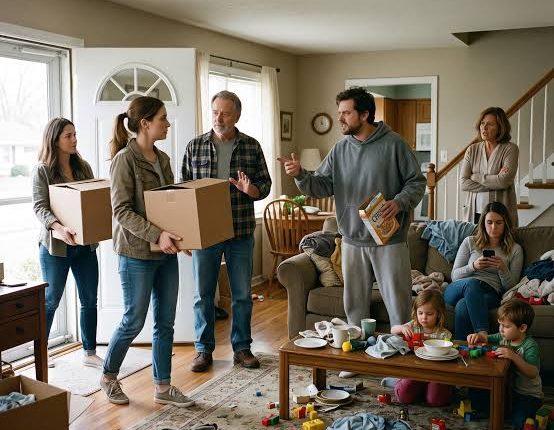
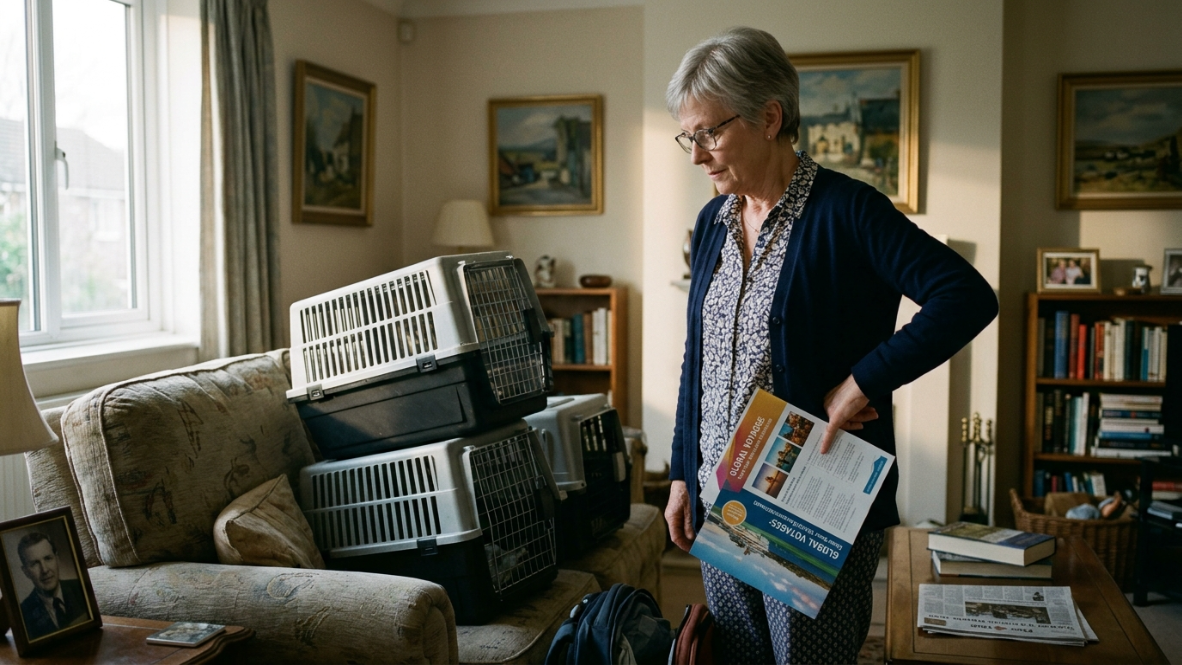
Then Megan marched into my living room carrying cages like a prison warden delivering inmates.
“Here are your instructions.”
I stared at her.
She wore oversized sunglasses on top of her head and never looked up from her phone.
Two parakeets shrieked.
A white rabbit trembled in wire confinement.
The cat pressed himself against the rear of his carrier.
Arthur’s memorial portrait sat three feet away.
Not one flower.
Not one hug.
Not one question about whether I had slept.
Derek put down a bag of food.
“We’re taking a trip to Hawaii for a few days.”
“That sounds lovely.”
“You’re going to watch the pets.”
Not will you.
Not could you.
You’re going to.
Something inside me became very quiet.
Megan began listing instructions.
“Fresh water twice a day. No iceberg lettuce. The cat has severe anxiety, so keep him locked up.”
I looked at her.
“Megan, I literally just buried my husband.”
Her sigh was theatrical.
“Oh, Evelyn, everyone goes through hard times.”
Derek added, “Besides, it gives you a purpose, Mom. You’d just sit around getting bored all by yourself anyway.”
That was the moment.
Not the funeral.
Not the question about the house.
Not forty years of being taken for granted.
That moment.
Purpose.
As though my existence needed to be justified through labor performed for them.
As though grief itself were laziness.
As though I had become an appliance whose usefulness required maintenance.
I looked at my son.
And smiled.
“Of course, sweetheart.”
Megan glanced up, surprised by my surrender.
She should have been suspicious.
But people who are accustomed to obedience rarely imagine rebellion.
“We left our apartment key on the counter,” Derek said. “In case you need more food.”
Then he kissed my forehead.
“Thanks, Mom. We know we can always count on you.”
After they left, I stood motionless for almost a minute.
Then I called Mrs. Higgins.
At four in the morning, the rescue van arrived.
At four thirty, my house was quiet.
At five, I placed the note beside my keys.
At five fifteen, I placed two legal folders on the coffee table.
The first concerned the house.
The second concerned Derek.
I looked at his name on the label.
And whispered, “I’m sorry.”
Not to Derek.
To Arthur.
Because I finally understood why he had insisted we prepare it.
By noon on my first day at sea, Derek had called twenty-three times.
Megan had called seventeen.
I turned off notifications.
At lunch, I sat alone beside a window in the dining room.
A silver-haired woman wearing an enormous turquoise necklace lowered herself into the chair opposite me.
“You look like someone who has either escaped a cult or gotten divorced.”
I nearly choked on my water.
“Widowed.”
Her face softened.
“Oh, honey. I’m sorry.”
“Thank you.”
She held out a hand.
“Caroline Mercer. Seventy-one. Former high school principal. Current menace to mediocre men.”
I laughed for the first time since Arthur’s death.
“Evelyn Harper.”
“First cruise?”
“Yes.”
“Running from something?”
I looked toward the ocean.
“Maybe.”
Caroline followed my gaze.
“Running toward something is usually healthier.”
That evening, I returned to my cabin to find seventeen new voicemails.
I listened to none of them.
Instead, I opened Arthur’s yellow pad.
On the last page, beneath all the travel dreams, he had written something else.
Do not come home just because they panic. Panic is not love.
I touched the handwriting with my thumb.
“You really did know,” I whispered.
The house transfer had not happened overnight.
That was what Derek initially assumed.
He thought I had spitefully sold his inheritance.
The truth was more complicated.
Six months before Arthur’s death, after a lifetime of careful saving and one lucky property investment made in the 1980s, we had placed the house into the Harper Family Preservation Trust.
Derek knew the trust existed.
What he did not know was that he was not its beneficiary.
The beneficiary was a nonprofit foundation Arthur and I had quietly created.
The house would become transitional housing for widowed women over sixty who were at risk of losing their homes.
Arthur had chosen the mission.
His sister had spent her final years couch-surfing after her husband died and medical debt swallowed everything they owned.
He never forgot it.
We intended to tell Derek eventually.
Then Arthur overheard our son discussing our property value with a real estate agent while Arthur was still alive.
After that, we changed our minds.
The first legal folder informed Derek that the house had never been his inheritance.
But that alone did not explain the court official.
That was connected to the second folder.
The one with his name.
For the first three days of the cruise, he did not open it.
I know because Martin told me.
Martin was seventy-six, had handled our affairs for twenty-eight years, and viewed Derek with the weary suspicion of a man who had watched too many families become feral around estates.
“He called me,” Martin said on the fourth morning.
I was standing on my balcony watching the coast of Mexico.
“What did he say?”
“That you were mentally unstable.”
I laughed.
“He said you were overcome by grief and probably being manipulated by strangers.”
“Of course.”
“He threatened to challenge the trust.”
“Can he?”
“He can challenge gravity if he likes. Doesn’t mean he’ll win.”
I smiled.
Martin continued.
“He hasn’t mentioned the second folder.”
“So he still hasn’t opened it.”
“Apparently not.”
That surprised me.
Derek loved shortcuts.
But he feared paperwork.
As a child he once hid a report card inside a cereal box for three weeks.
“How are you?” Martin asked.
The question caught me off guard.
“Fine.”
“That wasn’t a legal question.”
I looked down at the glittering water.
“I don’t know.”
“Good. That’s more honest.”
He paused.
“Evelyn, Arthur wanted you protected. Remember that.”
“I do.”
“And when Derek opens that folder, things will change.”
My stomach tightened.
“I know.”
“You still have time to reconsider.”
“No.”
I closed my eyes.
“No, Martin. I don’t.”
I met people on the ship.
Real people.
People who asked what I liked rather than what I could do for them.
Caroline dragged me to trivia.
A widower named Thomas taught me backgammon.
A retired nurse named Priya persuaded me to try watercolor painting.
In Cabo San Lucas, I walked along the marina wearing a red sundress Arthur had once said made me look dangerous.
In Puerto Vallarta, I bought earrings I did not need.
In Honolulu, I stood barefoot at the edge of the water and cried.
Not because I was miserable.
Because Derek and Megan had been here only days earlier.
They had flown to Hawaii expecting me to stay behind feeding their animals.
And I had arrived by sea as a free woman.
For once, the inconvenience belonged to them.
Then my phone rang.
Derek.
I almost ignored it.
But something made me answer.
“Hello?”
He did not shout.
That frightened me more.
“Mom.”
“Yes?”
“I opened the folder.”
I sat down on the edge of my bed.
For a long time neither of us spoke.
Then he said, “Is this real?”
“Yes.”
“No.”
“It is.”
“No, I mean… all of it?”
“Yes.”
His breathing changed.
“How long have you known?”
“Your father and I found out eight months ago.”
“And you didn’t tell me?”
“We were waiting.”
“For what?”
“For you to become someone we could trust with it.”
Silence.
Then rage returned.
“You had no right.”
I closed my eyes.
“There it is.”
“What?”
“The reason we didn’t tell you.”
“Mom, this is my life!”
“And mine was mine.”
He said nothing.
I continued.
“For decades, Derek, you treated my time, my house, my money, and my labor like things you were entitled to.”
“That has nothing to do with this.”
“It has everything to do with this.”
“You’re my mother!”
“Yes.”
“And he was my father!”
“Yes.”
“Then why the hell is there a document saying he might not have been?”
The ocean beyond my balcony suddenly seemed very far away.
There it was.
The secret.
The thing Arthur had made me swear not to reveal unless he died first.
The thing inside the second folder.
A forty-two-year-old letter.
A private investigator’s report.
And the results of a DNA comparison Arthur had secretly ordered.
I whispered, “Because we needed certainty.”
Derek’s voice cracked.
“Certainty about what?”
I looked at Arthur’s yellow legal pad lying on the desk.
“About whether you were Arthur’s biological son.”
Before Derek was born, Arthur and I separated for three months.
No one knew.
Not our families.
Not our friends.
We were twenty-six, foolish, broke, angry, and deeply in love without yet understanding that love alone did not make two people good at marriage.
Arthur had lost his first construction job.
I blamed him for drinking too much.
He blamed me for controlling everything.
One night we fought.
I packed a bag and stayed with my cousin in Sacramento.
During those three months, I briefly dated a man named Raymond Vale.
Raymond was charming in a way Arthur never tried to be.
He wore polished shoes.
He remembered wine labels.
He talked about investments and travel and expensive restaurants.
For six weeks, I mistook attention for character.
Then I discovered he was engaged to someone else.
I ended it.
Three weeks later, Arthur appeared at my cousin’s door holding a toolbox.
“I fixed your stupid lamp,” he said.
I started crying.
We reconciled.
Two months later, I learned I was pregnant.
The dates overlapped.
Barely.
Arthur knew.
I told him everything.
He sat on the edge of our bed for an entire night.
At dawn he asked one question.
“Do you want this baby?”
“Yes.”
“Then he’s mine.”
We never tested.
We never spoke Raymond’s name again.
Arthur signed the birth certificate.
He cut Derek’s umbilical cord.
He taught him to ride a bicycle.
He sat through every school concert.
He built his first treehouse.
He paid for community college.
He loaned him money to start a business.
He loved him.
Biology was the least important part of fatherhood until money made it important to Derek.
Arthur’s illness changed things.
One afternoon, Derek made a casual remark about “Dad’s family bloodline” while discussing estate planning.
Arthur laughed afterward.
Then became thoughtful.
“What if he isn’t mine?” he asked me.
“He is yours.”
“You know what I mean.”
I did.
Arthur eventually ordered a private DNA analysis using a legal sample preserved from an earlier medical test.
The result showed no biological parent-child relationship.
Arthur had sat quietly with the report for an hour.
Then he folded it.
“He’s still my son.”
I burst into tears.
“But?”
Arthur looked at me.
“But I need to know who he becomes when he discovers I wasn’t required to love him.”
That was the real test.
Not DNA.
Character.
The second folder contained the report.
But that was not the worst part.
It also contained a name.
Raymond Vale.
And Raymond Vale was not an obscure man anymore.
He had become one of California’s wealthiest private real estate developers.
No children.
No acknowledged heirs.
And three months before Arthur died, Raymond had died too.
Leaving behind an estate rumored to be worth hundreds of millions.
Derek’s reaction was exactly what Arthur had feared.
Not grief.
Not confusion.
Not a single question about my past.
His first question was:
“How much was Raymond worth?”
I stared at the phone.
“Derek.”
“How much?”
“I don’t know.”
“Was he married?”
“Years ago.”
“Kids?”
“Not that I know of.”
“Then I could be his heir.”
There was no sorrow in his voice now.
Only acceleration.
Calculation.
I felt something inside me break cleanly in two.
“Your father raised you for forty-three years.”
“I know that.”
“Do you?”
“Mom, don’t make this emotional.”
I laughed.
The sound was ugly.
“Don’t make your father emotional?”
“I didn’t say that.”
“You just learned the man who raised you may not have been your biological father, and within thirty seconds you’re calculating another man’s estate.”
“You’re twisting this.”
“No. For once, I’m hearing it clearly.”
He lowered his voice.
“Megan thinks I should speak with an inheritance attorney.”
“Of course she does.”
“Raymond’s estate might legally belong to me.”
There it was again.
Belong.
Everything always belonged to Derek.
My house.
My time.
Arthur’s estate.
Raymond’s estate.
Perhaps the moon, if paperwork could be arranged.
“I have to go,” I said.
“Mom, wait. Do you have anything else? Letters? Photos? Proof you were with him?”
I ended the call.
Then I went to the bathroom and vomited.
That evening, Caroline found me on the observation deck.
“Bad news?”
“Old news.”
“Worse.”
I told her some of it.
Not everything.
Enough.
She listened without interrupting.
When I finished, she asked, “Do you regret telling him?”
“I didn’t tell him. Arthur did. From the grave.”
She nodded.
“Smart man.”
“You don’t even know him.”
“I know he left his wife a travel list instead of a guilt list.”
That made me cry.
Caroline handed me a napkin.
After a while she said, “What are you afraid of?”
I answered immediately.
“That Derek will find Raymond’s estate and become worse.”
“That’s not the real fear.”
I looked at her.
She shrugged.
“Principal for thirty-five years. People usually give me the surface answer first.”
I turned back toward the dark sea.
“My real fear is that Arthur was right.”
“About?”
“That my son never loved us. He loved what we provided.”
Caroline was quiet.
Then she said, “Those aren’t always separate things.”
I frowned.
“Children can love you and still become entitled to you. Love doesn’t automatically make people good.”
“That doesn’t help.”
“It isn’t supposed to.”
She leaned on the railing.
“The useful question is whether you’re going to keep rewarding the part of him that hurts you.”
I thought of the pets on my carpet.
Megan’s sigh.
Derek’s kiss on my forehead.
We know we can always count on you.
“No,” I said.
Caroline smiled.
“Then there you are.”
Two weeks later, Derek hired a lawyer.
Three weeks later, he challenged the house trust.
Four weeks later, the challenge was dismissed.
Then he filed a petition questioning my capacity when the trust documents were signed.
Martin destroyed that argument with medical affidavits, witness statements, and video from the signing.
Derek lost again.
Then something unexpected happened.
He found Raymond’s estate.
And the estate found him.
It happened while the ship was crossing toward Fiji.
Martin called me at six in the morning.
“Sit down.”
I sat.
“What?”
“Derek’s DNA was independently verified.”
My mouth went dry.
“So Raymond was his father.”
“Yes.”
I closed my eyes.
“All right.”
“There’s more.”
Of course there was.
Raymond Vale had established a private family foundation years before his death.
And buried inside the foundation documents was a clause concerning any biological descendant who might appear after his death.
The clause was bizarre.
If verified, that descendant would be eligible to claim a substantial inheritance.
“How substantial?” I asked.
Martin hesitated.
“Approximately sixty-eight million dollars.”
I nearly dropped the phone.
I thought of Derek at age nine crying because I would not buy him a second pair of brand-name sneakers.
I thought of him at twenty-eight asking us to refinance the house so he could open a restaurant that failed in fourteen months.
I thought of Megan complaining that our Christmas gifts felt “impersonal” because we gave them ten thousand dollars toward their mortgage instead of a European vacation.
“Sixty-eight million?”
“Yes.”
“Then he got what he wanted.”
“Not yet.”
I heard something in Martin’s voice.
“What?”
“The inheritance has conditions.”
I groaned.
“Raymond apparently distrusted heirs.”
“Wise man.”
“Potential beneficiaries must complete a character review.”
I blinked.
“A what?”
“Financial disclosure. Personal references. Legal background. Debt review. Recorded interviews. A six-month probationary period.”
I laughed despite myself.
“Raymond built an obstacle course.”
“Apparently.”
“What does Derek need from me?”
“Nothing, officially.”
That word mattered.
“Unofficially?”
“He has asked me for a statement verifying your relationship with Raymond.”
“Of course.”
“He’ll call.”
“I won’t answer.”
Martin sighed.
“Evelyn, this may become ugly.”
“It already was.”
“No. I mean uglier.”
He was right.
Derek did not call.
Megan did.
By then, the ship had reached Auckland.
I answered because curiosity sometimes defeats wisdom.
“Evelyn.”
No hello.
“Megan.”
“We need your help.”
I smiled at the familiar phrase.
“I thought I needed purpose.”
“This isn’t the time.”
“What time is it?”
“What?”
“I’m in New Zealand. I genuinely don’t know what time it is where you are.”
She exhaled sharply.
“Derek has an interview with Raymond’s trustees next week. They need family background.”
“Then he should give them family background.”
“They want information about you and Raymond.”
“I have nothing to say.”
“You dated him.”
“For six weeks, forty-four years ago.”
“You had his child.”
“I had Arthur’s child.”
“You know what I mean.”
“Yes. Unfortunately.”
Her voice hardened.
“Evelyn, do you understand what sixty-eight million dollars could do for this family?”
There it was.
Family.
Money always made us family again.
“What could it do, Megan?”
“We could pay off the apartment. Buy a proper house. Set up Lily for life. Derek could invest. We could help you.”
I laughed so loudly that a couple passing my balcony looked over.
“Help me?”
“Yes.”
“With what?”
“With whatever you need.”
“I needed help when Arthur was sick.”
Silence.
“I needed someone to sit with him so I could sleep.”
“Evelyn—”
“I needed Derek to drive his father to appointments once in a while. I needed you to bring a meal instead of asking me to babysit. I needed someone to ask whether I was scared.”
“That’s not fair.”
“It’s perfectly fair.”
“You never asked.”
That sentence stopped me.
I had heard versions of it my entire life.
You should have asked.
As though love were a vending machine requiring exact change.
I lowered my voice.
“Arthur never had to ask me.”
Megan snapped, “Well, Arthur is gone.”
The world went silent.
Even the harbor noise seemed to disappear.
Megan realized what she had said.
“Evelyn, I didn’t mean—”
I ended the call.
Then I blocked her number.
My life aboard the ship expanded.
That surprised me.
I had expected travel.
I had not expected resurrection.
In Sydney, I climbed the steps of the opera house alone.
In Bali, I woke before sunrise and watched mist hover above rice terraces.
In Singapore, I ate chili crab with strangers who became friends by dessert.
In Sri Lanka, I rode a train through green hills and remembered Arthur describing our honeymoon as “the grand beginning of never having enough money.”
In Mumbai, I bought a silk scarf so bright it looked like flame.
I sent photographs to nobody.
For decades, every experience had required reporting.
Arthur would have wanted to know.
Derek would have wanted something.
Megan would have compared it to somewhere better.
Now I simply lived.
Freedom felt selfish for approximately six weeks. Then it began to feel normal.
My hair grew longer.
I lost eleven pounds without trying.
I danced badly.
I learned enough Spanish to embarrass myself.
I stopped checking my bank account every morning.
I stopped answering calls immediately.
I stopped saying sorry when people bumped into me.
Then, in the Mediterranean, four months after I left California, I received a message from a number I did not recognize.
Grandma, can we talk? It’s Lily.
I stared at the screen.
Lily was seventeen.
Derek and Megan’s only child.
The one person in their household I had desperately missed.
I called her.
She answered on the first ring.
“Grandma?”
Her voice nearly broke me.
“Hi, sweetheart.”
She started crying.
I pressed my hand against my mouth.
“Are you okay?”
“Yes.”
“Are you sure?”
“No.”
I sat down.
“What happened?”
“Dad and Mom are fighting all the time.”
My heart tightened.
“About the inheritance?”
“Yes.”
Of course.
“Dad quit his job.”
“What?”
“He says there’s no point because he’ll be rich soon.”
I closed my eyes.
“Megan?”
“Mom keeps looking at houses online.”
“They don’t have the money yet.”
“I know.”
“Does your father?”
“I don’t think so.”
Lily hesitated.
“Grandma, Dad keeps saying this proves Grandpa Arthur stole his life.”
My chest went cold.
“What?”
“He says if Grandpa had told him the truth years ago, he could’ve known Raymond.”
I gripped the phone.
“Your grandfather never stole anything from him.”
“I know.”
“Arthur loved him.”
“I know.”
Lily was crying again.
“I told Dad that.”
“What did he say?”
“He said I’m too young to understand.”
I stared out at the Italian coast.
“What do you understand?”
“That Grandpa was my grandpa.”
A tear slid down my face.
“Yes.”
“And Dad is being horrible.”
I closed my eyes.
“Lily—”
“I know I shouldn’t say that.”
“No.”
I swallowed.
“You should tell the truth.”
There was silence.
Then she whispered, “Are you coming home?”
I looked toward the sea.
“Not yet.”
“Okay.”
“Are you angry?”
“No.”
But I heard the disappointment.
“I miss you,” she said.
“I miss you too.”
“Grandpa used to say you were scared of becoming invisible.”
I froze.
“What?”
“He told me that once.”
“When?”
“When we were painting the fence last year. He said if anything happened to him, I should remind you not to disappear inside everyone else.”
Arthur.
Always planning.
Always seeing.
I smiled through tears.
“He worried too much.”
“No,” Lily said softly. “I think he worried exactly enough.”
Derek’s inheritance review became a disaster.
I learned about it indirectly.
Mostly through Lily.
Partly through Martin.
Derek missed two required financial counseling meetings.
He took out loans based on the expectation of receiving the estate.
Megan leased a luxury SUV.
They made a deposit on a five-bedroom house they could not afford.
Derek also told several people he was the “sole Vale heir” before the trustees had approved anything.
The foundation investigators noticed.
Then they found his old debts.
His failed businesses.
The loan from Arthur and me he had never repaid.
The credit cards he had opened and closed.
The mortgage assistance.
The personal loan from his best friend.
None of that automatically disqualified him.
What caused concern was his attitude.
According to Martin, Derek treated the process like an inconvenience.
He repeatedly referred to the money as “my inheritance.”
He argued with trustees.
He accused them of delaying him unfairly.
Worst of all, he submitted a personal statement describing Arthur as a man who had “knowingly concealed my true identity for his own emotional benefit.”
When Martin told me, I could not speak.
Arthur had raised him.
Loved him.
Forgiven him.
And Derek reduced forty-three years of fatherhood to emotional theft.
That night, I went to the chapel on the ship.
I was not especially religious.
Arthur had been.
I sat alone beneath soft lights.
“Why did you love him so much?” I whispered.
I knew the answer.
Because Arthur loved fully or not at all.
That was his great strength.
And sometimes his great mistake.
Five months into my journey, I received a certified electronic notice from the Vale Foundation.
They requested an interview.
I almost refused.
Martin urged me to participate.
“Why?”
“Because their investigation concerns your history with Raymond.”
“I barely knew him.”
“Exactly. Tell them that.”
The interview took place by secure video while the ship was docked in Barcelona.
Three trustees appeared.
Two men.
One woman.
The woman introduced herself as Marianne Vale.
I stared at her surname.
“My husband was Raymond’s younger brother,” she explained.
I had never met her.
She was perhaps sixty-five.
Elegant.
Calm.
She asked about 1982.
I told the truth.
Six weeks.
A brief relationship.
A betrayal.
A pregnancy discovered afterward.
“Did Raymond ever know you were pregnant?” she asked.
“No.”
“Did you attempt to contact him?”
“No.”
“Why?”
“Because Arthur chose to raise my child.”
She studied me.
“And because Raymond was engaged?”
“Yes.”
“Did Arthur resent Derek?”
“Never.”
“Did you?”
My throat tightened.
“Never.”
She asked about my current relationship with Derek.
I could have protected him.
Every instinct trained into me wanted to.
I could have said we had ordinary family tensions.
That grief had made things difficult.
That Derek’s behavior was understandable.
Instead, I remembered Arthur’s words.
You’ve spent your whole life imagining the best.
So I told the truth.
I told them about the funeral.
The house question.
The pets.
The money.
The inheritance obsession.
Not cruelly.
Not dramatically.
Simply.
When I finished, Marianne was silent.
Then she asked, “Do you believe Derek should inherit Raymond’s estate?”
The question felt like a trap.
“I don’t believe I should decide.”
“But what do you believe?”
I thought for a long time.
“I believe money reveals people more often than it changes them.”
Marianne nodded.
Then the interview ended.
Two weeks later, Derek’s provisional inheritance claim was suspended.
He blamed me.
Of course.
This time he emailed.
The subject line read:
YOU DESTROYED MY FUTURE.
I did not open it for three days.
When I finally did, the message was twelve paragraphs long.
He called me bitter.
Manipulative.
Jealous.
Controlling.
He accused Arthur of deliberately withholding the truth to keep him dependent.
He accused me of sabotaging the inheritance because I hated Megan.
Then came the sentence that ended something in me permanently.
Maybe if you had been a better wife forty-three years ago, none of this would have happened.
I read it twice.
Then a third time.
The shame I had carried for four decades returned instantly.
Young Evelyn.
Twenty-six.
Separated.
Lonely.
Foolish.
Confused.
A woman who made one mistake and then spent a lifetime believing gratitude should be her punishment.
Arthur had never punished me.
My son just had.
I closed the email.
Then I called Martin.
“I want to change my will.”
He was quiet.
“All right.”
“Everything that would have gone to Derek goes to Lily.”
“Directly?”
“In trust until she’s thirty.”
“And if she doesn’t want it?”
“The foundation gets it.”
“All of it?”
“All.”
Martin hesitated.
“Evelyn, don’t make this decision while angry.”
“I’m not angry.”
And I wasn’t.
I was finished.
By month seven, Derek and Megan’s lives began collapsing exactly as my original note had predicted.
Not because I destroyed them.
Because I stopped holding them up.
The luxury SUV was repossessed.
They lost the house deposit.
Derek’s former employer refused to rehire him.
Megan’s credit cards were maxed out.
Their marriage deteriorated.
They started blaming each other for everything.
Lily applied to colleges quietly, without telling them where.
One evening, while I was in Athens, she called.
“I got into Berkeley.”
I screamed so loudly Caroline spilled wine.
Lily laughed.
“Grandma!”
“I’m sorry! Oh my God.”
“There’s aid, but not enough.”
“We’ll handle it.”
She went silent.
“No.”
“What?”
“I don’t want Dad’s money.”
“It isn’t your father’s.”
“I don’t want yours either.”
My heart hurt.
“Why?”
“Because I don’t want to become like him.”
That was such a young person’s idea of morality.
Beautiful.
Terrifying.
I smiled.
“Money doesn’t make you your father.”
“It made him worse.”
“No. It gave him permission.”
She was quiet.
“I’ll make you a deal.”
“What?”
“You accept enough help to graduate without crushing debt.”
“And?”
“And you work. You budget. You make mistakes. You call me when you do. And one day, when you can, you help someone else.”
“That’s it?”
“That’s it.”
She laughed.
“You sound like Grandpa.”
“That’s because he trained me.”
Month nine brought the first real shock.
Marianne Vale contacted me again.
She asked whether I would meet her in person when I returned to California.
“Why?”
“There are matters concerning Raymond’s estate you should understand.”
“I’m not an heir.”
“No.”
“Then what matters?”
She paused.
“Raymond left something that concerns you.”
I felt uneasy.
“What?”
“I’d prefer not to explain by phone.”
I almost laughed.
Everyone in my life suddenly had folders.
“Is this about Derek?”
“Partly.”
I agreed.
Then I spent the next three months trying not to think about it.
I saw the northern lights in Iceland.
They appeared after midnight.
Green curtains moving across black sky.
Arthur had always wanted to see them.
I stood on deck wearing his old knit cap, which I had packed at the last minute.
Caroline stood beside me.
“Talk to him,” she whispered.
So I did.
“I’m living,” I said.
The lights trembled above us.
“I hope you can see.”
For the first time since he died, grief did not feel like drowning.
It felt like carrying someone inside me.
That was different.
Lighter.
Three hundred forty-nine days after leaving San Diego, the ship returned.
I was seventy years old.
I looked different.
Not dramatically.
But enough.
My hair was silver now because I stopped dyeing it in month four.
My skin was darker from sunlight.
I stood straighter.
And I had learned that the world did not end when someone disapproved of me.
Caroline hugged me at the terminal.
“You going home?”
“I don’t own a home.”
“Good.”
“What?”
“Homes make people lazy. Go make trouble.”
I laughed.
Lily was waiting outside.
She ran toward me.
I dropped my bag.
We held each other for a long time.
When she stepped back, she stared.
“You look…”
“Old?”
“Cool.”
“Liar.”
“I’m serious.”
She touched my silver hair.
“Grandpa would love this.”
My eyes burned.
“How are your parents?”
Her expression changed.
“Separated.”
I had expected it.
“Your father?”
“Staying with a friend.”
“Megan?”
“In the apartment.”
“And you?”
“Dorm next week.”
Good.
Safe distance.
Then Lily said, “Dad wants to see you.”
I sighed.
“Of course.”
“He says he needs to apologize.”
That surprised me.
But not enough to trust it.
“Not today.”
She nodded.
“I figured.”
My meeting with Marianne Vale took place two days later.
The Vale Foundation occupied the upper floors of a downtown office building overlooking the bay.
Marianne greeted me alone.
She looked exactly as she had on video.
Composed.
Careful.
She led me into a conference room.
On the table sat a single black box.
No folders.
That somehow made it worse.
“Thank you for coming,” she said.
“I’m tired of mysterious meetings.”
She smiled faintly.
“I imagine.”
I sat.
“Is Derek getting the inheritance?”
“No.”
I expected relief.
Instead I felt sadness.
“Why?”
“He failed the character review.”
“What happens to the money?”
“It remains with the foundation.”
I nodded.
“So that’s it?”
“No.”
Marianne opened the black box.
Inside was an old envelope.
My name was written across the front.
EVELYN MARSHALL.
My maiden name.
I stopped breathing.
“What is that?”
“Raymond wrote it in 1984.”
My hands went cold.
“That’s impossible.”
“It was found in his private files after his death.”
“Why would he write to me?”
Marianne slid the envelope across the table.
“I think you should read it.”
I did not touch it.
“Did you?”
“No.”
“Then how do you know what it says?”
“We don’t.”
I stared.
“Why give it to me now?”
“Because of the second item.”
She reached into the box.
A photograph.
Arthur.
Young Arthur.
Standing beside Raymond.
My heart stopped.
“What the hell is this?”
Marianne’s face changed.
For the first time, she looked uncertain.
“That is why we needed to see you.”
I picked up the photograph.
Arthur looked maybe twenty-seven.
Raymond beside him.
Both men were standing outside a construction site.
On the back, someone had written:
- Harper + R. Vale — Sacramento, 1981.
My hands began to shake.
“No.”
Marianne said nothing.
“Arthur said he never knew Raymond.”
“I believe Arthur lied.”
I stood so fast my chair scraped backward.
“No.”
“Evelyn—”
“No. Arthur knew everything.”
I stared at the photograph.
A year before my separation.
A year before Raymond and I met.
My brain refused to process it.
“How?”
Marianne folded her hands.
“In 1981, Raymond invested quietly in several small construction companies. Arthur worked for one.”
I sat down again.
“Why would Arthur hide that?”
“We don’t know.”
I looked at the envelope.
Then tore it open.
The paper inside was yellow.
The handwriting was unfamiliar.
Evelyn,
If you ever read this, then Arthur has either finally told you the truth or we are both gone and the truth has survived us.
I stopped.
My throat closed.
Marianne leaned forward.
“Are you all right?”
“No.”
I kept reading.
Arthur came to me before you and I ever met.
He knew I was reckless. He knew I was engaged. He knew my father intended to cut me off unless I straightened out.
He also knew you.
He talked about you constantly.
When you left him, he was devastated.
Then he did something I did not understand until years later.
He asked me to meet you.
I dropped the letter.
“No.”
Marianne whispered, “What?”
I stared at the wall.
Arthur had sent Raymond to me?
That made no sense.
Nothing made sense.
I forced myself to continue.
Arthur believed you would never return to him unless you felt free to choose.
He thought you needed to see another kind of life.
I thought he was insane.
I agreed because I liked you.
Then I betrayed both of you. I let it become real.
When Arthur learned, he nearly killed me.
He disappeared for weeks.
Then you became pregnant.
I thought the child might be mine.
Arthur knew it too.
But he told me to stay away.
He said if I entered your life again, I would only confuse everything.
I hated him for that.
Years later I understood.
He wasn’t keeping my son from me.
He was protecting a family I had no right to damage.
My eyes flooded.
There was more.
So much more.
Raymond had written that he followed Derek’s life from a distance.
He knew where he went to school.
He knew when he married.
He knew when Lily was born.
He had quietly sent money twice through anonymous grants when Derek’s businesses failed.
I stared at Marianne.
“The grants?”
She nodded.
“Foundation money.”
Arthur had known.
The letter said so.
Arthur and Raymond had remained in contact.
For decades.
Not friends.
Not exactly.
But connected by a child.
Derek.
My hands shook so violently I could barely hold the final page.
Then came the sentence that changed everything.
Evelyn, there is one more truth. Derek is not my biological son.
I stopped breathing.
I read it again.
No.
The DNA.
The report.
Raymond.
All of it.
I looked at Marianne.
“What?”
She went pale.
“What does it say?”
I handed her the letter.
She read.
Her eyebrows drew together.
“This doesn’t make sense.”
I laughed once.
A broken sound.
“No. It doesn’t.”
Raymond continued.
Arthur asked me to provide a DNA sample in 1983.
The result showed I was not Derek’s father.
Arthur cried when he told me.
Not from relief.
From joy.
Because Derek was his.
My vision blurred.
I remembered the report in Derek’s folder.
The one stating no biological relationship between Arthur and Derek.
Impossible.
Unless—
I looked at Marianne.
“The report Arthur ordered before he died…”
She understood.
“Was wrong?”
“No.”
My heart began pounding.
“He knew.”
“Knew what?”
I stood.
“He switched the samples.”
Martin came to the Vale office forty minutes later.
He looked older than I remembered.
When I showed him the letter, he sat down heavily.
“Dear God.”
“You knew.”
His face told me before he spoke.
“Evelyn—”
“You knew.”
He closed his eyes.
“Arthur made me promise.”
I slapped the table.
“Enough promises!”
Marianne quietly left the room.
Martin remained.
I stood above him.
“Tell me everything.”
He sighed.
“Arthur learned the truth decades ago. Derek was biologically his.”
“Then why fake the report?”
“To test him.”
The words were obscene.
“Test him?”
“Arthur became afraid of what money had done to Derek.”
“So he lied to his own son?”
“Yes.”
“He made Derek believe he wasn’t his?”
“Yes.”
“Why?”
Martin’s eyes filled.
“Because Raymond was dying too.”
I froze.
“What?”
“Arthur knew Raymond’s estate plan. Raymond had no children. Arthur knew Derek might eventually discover the old connection.”
I sat down.
Martin continued.
“Arthur and Raymond agreed on something.”
My stomach twisted.
“They created the inheritance test together.”
“Yes.”
The room seemed to tilt.
All those months.
The foundation.
The conditions.
The character review.
Derek believed he was Raymond’s biological heir.
But he wasn’t.
Arthur was his father.
Always had been.
Raymond’s sixty-eight million was never a true inheritance.
It was a test.
A potential gift.
Designed by two dying men.
One biological father.
One man who had once almost become one.
“Why?” I whispered.
Martin looked at me.
“Because Arthur wanted to know what Derek valued when he believed blood and money offered him a better father.”
Tears streamed down my face.
“And Derek failed.”
Martin said nothing.
I laughed bitterly.
“Oh, Arthur.”
I wanted to be furious.
I was furious.
But beneath it was terrible understanding.
Arthur had known our son.
Maybe better than I did.
He had watched Derek become increasingly entitled.
Had watched him measure love in usefulness and property.
So he created a final question.
If Derek discovered that a wealthy stranger might be his biological father, would he abandon the poor carpenter who raised him?
Derek had answered.
Immediately.
Publicly.
Completely.
He called Arthur a thief.
My chest hurt.
I whispered, “That’s why the foundation rejected him.”
Martin nodded.
“Not because of debt.”
“No.”
“Not because he quit his job.”
“No.”
“Because of what he said about Arthur.”
“That was a major factor.”
I covered my face.
For several minutes I could not speak.
Then another thought came.
“The fake DNA report. That’s fraud.”
Martin grimaced.
“It was privately commissioned, never filed as a public record. Arthur arranged the sample substitution personally. Legally messy. Morally messier.”
“That is an understatement.”
“There’s more.”
I looked up.
“Stop saying that.”
He almost smiled.
Then he placed one final envelope on the table.
Arthur’s handwriting.
My name.
EVIE — ONLY AFTER THE VOYAGE.
I started crying before opening it.
Arthur’s letter was six pages.
I read it alone.
My dearest Evie,
If you are reading this, then you came back.
Good.
That means you went.
I hope you saw everything on the list.
I laughed through tears.
He continued.
You are going to be furious with me.
You should be.
What I did to Derek was cruel.
But I was dying, Raymond was dying, and I was afraid.
Not that Derek was a bad man.
That we had made him weak.
You and I rescued him too often.
Every time life tried to teach him consequence, we arrived with money, time, forgiveness, or excuses.
We called it love.
Sometimes it was.
Sometimes it was fear.
We were afraid that if we stopped helping, he would stop loving us.
I lowered the letter.
Arthur had seen through both of us.
I kept reading.
Raymond and I agreed to give Derek one final opportunity.
Not to prove perfection.
To prove loyalty.
If he learned Raymond might be his biological father, he could ask questions. Be angry. Be confused. Seek the truth.
But if he immediately rejected the father who raised him for the promise of money, Raymond would know what kind of heir he was considering.
And I would know what kind of son we had enabled.
I wish there had been another way.
Maybe there was.
Forgive me for not finding it.
My tears fell onto the page.
Then I reached the final section.
There is something else you need to know.
The sixty-eight million Raymond set aside was never meant to return to the foundation automatically.
If Derek failed, Raymond gave the trustees a second beneficiary.
You.
I stopped.
No.
I read the sentence again.
You.
Not because you dated him.
Not because of guilt.
Because forty-three years ago, when Raymond nearly destroyed our marriage, you chose honesty. You told me everything. You came back. You built a life with me. You cared for our family. You gave more than anyone ever had a right to ask.
Raymond believed the money should go to the person who proved what loyalty looked like.
I stood up so fast the chair fell backward.
Sixty-eight million dollars.
My heart hammered.
Arthur’s handwriting continued.
You do not have to accept it.
But if you do, spend some foolishly.
Please.
I am serious.
Buy earrings you do not need.
Stay in ridiculous hotels.
Tip too much.
Take Lily somewhere beautiful.
And use the rest to make life easier for people who spent too long believing suffering was their duty.
Most important:
Do not give Derek the money just because he asks.
If he changes, love him.
If he doesn’t, love him from far away.
But do not confuse rescue with love again.
I pressed the letter against my chest and sobbed.
For Arthur.
For Derek.
For the years.
For the deception.
For the unbearable, ridiculous tenderness of a dying man who had arranged sixty-eight million dollars and still worried I would refuse to buy jewelry.
The final line nearly destroyed me.
Evie, you were never the dependable old woman in the room. You were the whole damn house. Now go be the sky.
I did not accept the money immediately.
I spent six weeks thinking.
Then I created the Arthur Harper Second Horizon Foundation.
Its mission was simple.
Housing.
Legal assistance.
Emergency financial support.
Travel grants.
Education.
All for women over fifty-five rebuilding lives after widowhood, divorce, caregiving, or financial exploitation.
I accepted Raymond’s inheritance on the condition that fifty million dollars went directly into the foundation.
Ten million went into a long-term family trust for Lily and future generations.
Five million became my personal investment fund.
Three million remained flexible for scholarships and housing projects.
Caroline called the arrangement “aggressively responsible.”
Then she forced me to spend twenty-two thousand dollars taking both of us to Paris.
“For Arthur,” she said.
“Arthur hated Paris.”
“Then for Raymond.”
“I barely knew Raymond.”
“Fine. For me.”
So we went.
Derek finally came to see me eighteen months after Arthur died.
By then, I lived in a modest two-bedroom condo overlooking the marina.
Not a mansion.
Not a penthouse.
A place with windows that caught the sunset.
He stood outside my door looking older.
Thinner.
No designer sunglasses.
No expensive shirt.
Just jeans and a wrinkled jacket.
“Hi, Mom.”
“Hello, Derek.”
“Can I come in?”
I considered saying no.
Then stepped aside.
He entered slowly.
On the wall was a photograph of Arthur at Lake Tahoe.
The same trip.
Different picture.
Arthur was laughing.
Derek stopped.
His face crumpled.
I had not expected that.
Neither, I think, had he.
He sat on my sofa.
For several minutes he said nothing.
Then he whispered, “He was my dad.”
“Yes.”
“I know now.”
“Yes.”
“I was his.”
“Yes.”
He covered his face.
“I called him a liar.”
I sat across from him.
“You called him worse.”
“I know.”
“You told strangers he stole your life.”
“I know.”
I waited.
He cried quietly.
For a moment, instinct surged through me.
I wanted to move beside him.
Touch his shoulder.
Say it was all right.
Make it better.
That reflex had ruled my life.
I stayed seated.
Eventually he lowered his hands.
“Why didn’t you tell me the test was fake?”
“I didn’t know.”
He stared.
“You didn’t?”
“No.”
“Grandpa— Arthur— Dad did all this without telling you?”
“Yes.”
Derek laughed bitterly.
“That sounds like him.”
“It does.”
He wiped his face.
“I hated you.”
“I know.”
“I thought you destroyed everything.”
“I know.”
“I thought if I got Raymond’s money, I’d finally…”
He stopped.
“Finally what?”
He looked toward the window.
“Prove something.”
“To whom?”
“I don’t know.”
I waited.
He looked back at me.
“Did you get the money?”
There it was.
Not first.
Not immediately.
But eventually.
I almost smiled.
“Yes.”
His eyes widened.
“How much?”
“Enough.”
“Mom.”
“Sixty-eight million.”
He inhaled sharply.
For a second, the old Derek appeared.
Calculation.
Shock.
Want.
Then something changed.
He looked away.
“I’m not going to ask.”
I said nothing.
“I want you to know that.”
“Good.”
“I mean it.”
“I hope so.”
He nodded.
Silence.
Then he said, “Megan and I are divorcing.”
“I heard.”
“Lily barely talks to me.”
“She’s hurt.”
“I know.”
“I lost my job.”
“I know.”
“I’m working at a hardware store.”
That surprised me.
“Full-time?”
“Yes.”
“What do you do?”
“Inventory. Deliveries. Whatever.”
A strange smile touched his face.
“Dad would find that funny.”
“He would.”
“He always said I didn’t know the difference between a Phillips and a flathead.”
“He was right.”
Derek laughed.
A real laugh.
For one heartbeat he was twelve years old again.
Then he became serious.
“I’m sorry.”
I looked at him.
“For what?”
“All of it.”
“That’s too large.”
He frowned.
“Then start smaller.”
He thought.
“I’m sorry I asked about the house at Dad’s funeral.”
I nodded.
“I’m sorry I left those animals with you.”
I nodded again.
“I’m sorry I told you grief was boredom.”
His voice broke.
“I’m sorry I treated you like you existed when I needed something.”
Tears filled my eyes.
Derek continued.
“And I’m sorry that when I thought Dad wasn’t my biological father, I acted like forty-three years disappeared.”
That one landed deepest.
I whispered, “Thank you.”
He wiped his cheek.
“I don’t expect you to forgive me.”
“I probably will.”
He looked surprised.
“Not today.”
He nodded.
“And forgiving you won’t mean financing you.”
A tiny smile appeared.
“I figured.”
“Or cleaning up your life.”
“I know.”
“Or making excuses.”
“I know.”
I stood.
“So what do you want from me?”
Derek looked at Arthur’s photograph.
“Dinner.”
I stared at him.
“That’s it?”
“If you want.”
“What kind?”
He smiled nervously.
“Whatever you’re cooking.”
I shook my head.
“No.”
His face fell.
Then I continued.
“You’re cooking.”
For the first time in years, my son laughed so hard he cried.
Three years later, the first Second Horizon House opened in Sacramento.
Twelve apartments.
A garden.
Legal clinic.
Community kitchen.
No animal cages in the living room.
Caroline insisted that detail go into the opening speech.
Lily graduated from Berkeley two years after that.
She studied social policy.
She joined the foundation.
Derek did not become rich.
I never gave him millions.
He never asked again.
He became assistant manager of the hardware store.
Then manager.
He attended therapy.
He rented a small apartment.
He called before visiting.
Sometimes people change because they discover virtue.
Sometimes they change because consequences finally remain in place long enough to teach them.
I learned not to care which explanation sounded prettier.
Megan remarried.
We became civil.
Not close.
Civil was enough.
And me?
I kept traveling.
Not for a year.
For life.
Three months home.
Six weeks away.
Two months home.
Another journey.
Argentina.
Norway.
Morocco.
Vietnam.
Everywhere Arthur had written down.
On what would have been our forty-eighth anniversary, I returned to Lake Tahoe.
Lily came with me.
We carried Arthur’s yellow legal pad.
The old anniversary photograph was still with him, buried years before.
But I had another copy.
We stood near the lake while snow began falling.
Lily read the final page.
“Grandpa really wrote, ‘Go be the sky’?”
“He did.”
“That’s dramatic.”
“He was dying. People get dramatic privileges.”
She laughed.
Then she reached into her backpack.
“I have something for you.”
A small envelope.
My name.
I groaned.
“No more envelopes.”
“Open it.”
Inside was a cruise ticket.
Thirty days.
Alaska to Japan.
I stared at her.
“What is this?”
“Your birthday present.”
“You cannot afford this.”
“I can.”
“Lily.”
“The foundation board gave me a bonus.”
“I’m the foundation board.”
“You abstained from compensation votes.”
I narrowed my eyes.
She grinned.
“Grandpa taught me loopholes.”
I laughed.
Then saw another ticket.
“Who is this for?”
Lily’s smile became suspicious.
Footsteps crunched behind us.
I turned.
Derek stood there.
Older.
Nervous.
Holding a navy-blue suitcase.
I stared at him.
“No.”
He lifted both hands.
“I paid for my own cabin.”
“No.”
“I have vacation time.”
“No.”
Lily was laughing.
“Grandma.”
I pointed at Derek.
“You are not making me feed anything.”
“I don’t own pets.”
“You are not borrowing money.”
“I brought a credit card.”
“You are not asking me to do laundry.”
“I’m forty-nine.”
“You were forty-three when you dumped a rabbit in my living room.”
He winced.
“Fair.”
Snow landed in his hair.
For a long moment, none of us spoke.
Then Derek looked toward the lake.
“Dad would’ve liked this.”
“Yes.”
He nodded.
“I wish I could tell him.”
My throat tightened.
“Tell him what?”
Derek swallowed.
“That being his son was the biggest inheritance I ever got.”
I closed my eyes.
There are words you wait your whole life to hear.
Sometimes they come too late for the person who deserved them.
But perhaps love is strange enough to carry messages backward.
I looked at the mountains.
At the snow.
At the place where Arthur and I had once stood laughing while neither of us knew how difficult and beautiful our family would become.
Then I slipped my arm through my son’s.
“Come on.”
“Where?”
“We have packing to do.”
Lily grinned.
“You’re going?”
I looked at her.
Then at Derek.
Then at the enormous sky above Lake Tahoe.
Arthur had been wrong about one thing.
I had not become the sky.
The sky was too distant.
Too untouchable.
I had become something else.
A woman who finally understood that love did not require disappearing.
A mother who could forgive without surrendering.
A widow who had discovered grief was not the end of a life.
A seventy-three-year-old woman with a passport full of stamps, silver hair, unreasonable sandals, and absolutely no intention of asking permission for the rest of her days.
And as the three of us walked back toward the car, Derek carrying his own suitcase for once, snow crunching beneath our feet, I understood the final gift Arthur had left me.
It had never been the house.
It had never been the cruise.
It had never been Raymond’s sixty-eight million dollars.
The greatest inheritance Arthur left me was the courage to stop proving my love through sacrifice.
Because sometimes the moment you stop being everyone’s safety net is the moment they finally learn how to stand.
And sometimes the person who needs rescuing most is the woman who has spent her entire life rescuing everyone else.
I looked once more at the lake.
Then at the yellow legal pad tucked safely beneath my arm.
“Thank you,” I whispered.
The wind lifted the words and carried them across the water.
And somewhere inside me, Arthur laughed.