PART 3: The first was a plain brass key on a metal ring.
The second was a manila folder.
I placed them on the table between us.
Brittany looked down.
“What are these?”
“The key belongs to a small studio apartment in Bridgeport. It’s clean, safe, and close to a bus line. The rent and utilities are paid for ninety days.” She opened the folder.
Inside was a printed job application for a neighborhood coffee shop, information about public transportation, a basic monthly budget, and enrollment forms for community-college courses beginning in the fall.
She looked at me in confusion.
“You’re not letting me come home.” “I love you.”
“That isn’t what I asked.” “No. You’re not moving back into the penthouse.” Her face crumpled.
“I apologized.”
“I believe you’re sorry.” “Then why are you still punishing me?” “I’m not punishing you.” “It feels like punishment.” “Consequences often do.” She stood, leaving the folder on the chair.
“I have nowhere else.” “You have an apartment.” “For three months.”
“You have ninety days to get a job, learn how to manage your expenses, and create a plan.” “I don’t know how.”
“Then you’ll learn.” “I don’t even know how to take the bus.” “The route map is in the folder.” “Mom.”
Her voice carried the frightened softness of the child she had once been.
I wanted to hold her.
Instead, I spoke carefully.
“When I was seventeen, I worked mornings at a diner and nights cleaning offices. I measured every grocery purchase. I knew which utility could wait three days and which one could not. I learned because I had no choice.” “I’m not you.”
“I know. I’m giving you something I never had.” “What?”
“Ninety days of safety while you learn.” She sat again.
Tears dropped onto the job application.
“I’ll work,” she whispered. “I’ll go to school. I’ll do whatever you want.” “This is not about doing what I want. That is the lesson you still need to understand. You said I controlled you because my money paid for your choices. So now your choices need to belong to you.” “What about the trust?” “The remaining funds will stay restricted. At twenty-five, the trustee will review your education, work history, financial habits, and plans.” “So I have to earn it.” “You have to become someone capable of using it without allowing it to use you.” She looked at the brass key.
“What happened to the Mercedes?” “I sold it back to the dealer.” Her eyes lifted.
“The money went to the scholarship foundation.” For a moment, I saw disappointment.
Then she nodded.
“That makes sense.”
It was the first thing she had said in days that did not center on what had been taken from her.
She picked up the key and closed her fingers around it.
“I really am sorry,” she said.
“I know.”
“Do you forgive me?” “Yes.”
Relief moved across her face.
“But forgiveness does not rebuild trust in one morning,” I continued. “That takes time and consistent choices.” She swallowed.
“Will you ever want me in your life again?” “You are my daughter. I want you in my life now.” “It doesn’t feel like it.” “Wanting you in my life does not mean removing every difficult thing from yours.” She held the folder against her chest.
“Can I call you?”
“Yes.”
“Will you answer?”
“I’ll answer as your mother. Not as an emergency bank.” A faint, embarrassed smile appeared through her tears.
“That’s fair.”
Before she reached the elevator, I said her name.
Brittany turned.
I crossed the room and hugged her.
For a second, she stood rigidly in my arms. Then she held me with both hands and began to cry again.
I did not tell her everything would be easy.
I told her I loved her.
Those were not the same promise.
The studio apartment was barely three hundred square feet.
It had white walls, a narrow galley kitchen, a clean bathroom, and one window overlooking an alley where delivery trucks rumbled each morning.
Brittany had never lived anywhere so small.
During her first week, she called me because the bathroom sink drained slowly.
I gave her the property manager’s number.
She called again because she had missed the bus and arrived late for her job interview.
“Take the next one,” I said.
“They might not hire me.” “Then apologize and ask for another chance.” The coffee-shop manager did give her another chance.
PART 4: Her first shift began at six in the morning.
By noon, her feet hurt. She had entered two orders incorrectly and spilled milk across the counter during the breakfast rush.
That evening, she called me.
“This is harder than it looks.” “Most honest work is.”
“A customer yelled because his drink took too long.” “What did you do?”
“I apologized and remade it.” “How did that feel?”
“Humiliating.”
“Did you survive?”
“Yes.”
“Then tomorrow will be easier.” For the first month, Brittany struggled.
She had never planned meals, compared grocery prices, or calculated how long a bus transfer would take. She purchased expensive prepared food during her first week and had almost no money left by Friday.
She called me.
“I made a mistake with my budget.” “What are you going to do?” “I don’t know.”
“What do you have in the apartment?” “Rice. Eggs. Half a bag of frozen vegetables.” “That sounds like dinner.” She was silent.
“You’re not sending money.” “No.”
“Okay.”
The next week, she learned to shop with a list.
She sold several designer handbags and used the money to purchase a refurbished laptop for school. She bought a secondhand bicycle, then learned which streets were safest for riding.
Her friends from the country club gradually stopped messaging.
At first, the silence hurt her. Then she began spending time with coworkers who cared less about what she owned.
One was a nursing student named Kayla who worked mornings before class. Another was Luis, a father of two studying accounting at night.
They taught Brittany how to use grocery coupons and prepare meals that lasted several days.
She helped Luis practice a presentation for one of his classes. Kayla showed her how to clean the espresso machine without flooding the counter.
When the ninety days ended, Brittany paid her own rent.
She sent me a photograph of the receipt.
The message beneath it contained only four words.
I did it myself.
I stared at the screen for a long time before replying.
I’m proud of you.
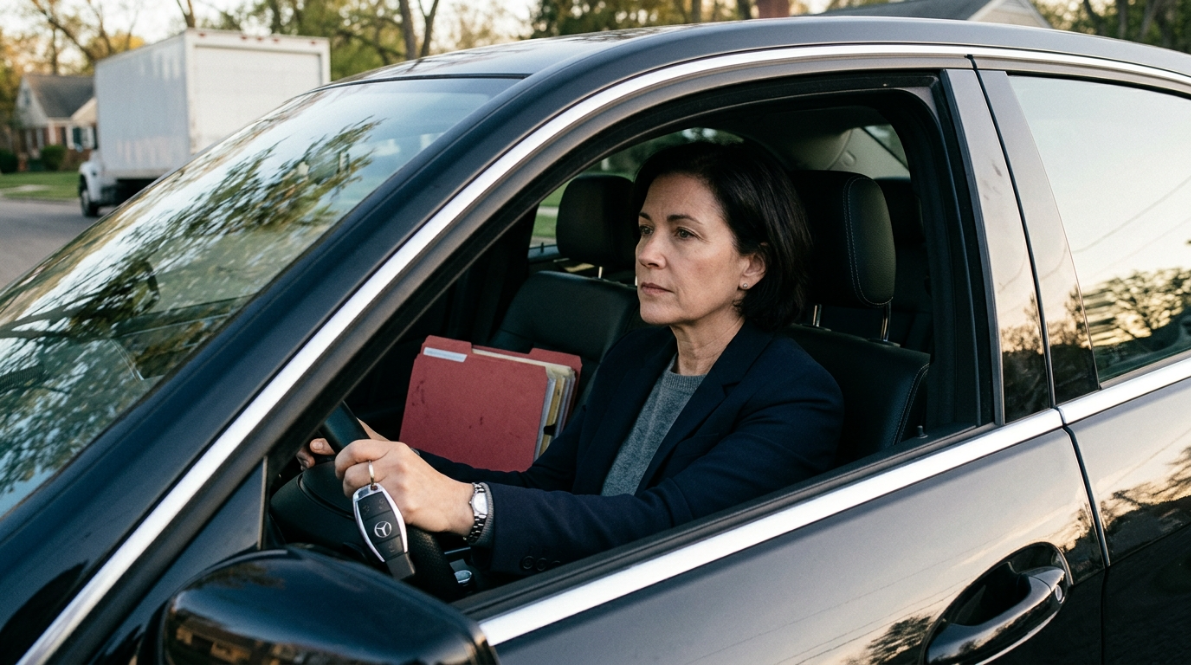
Six months after the birthday party, I parked across the street from the coffee shop during the morning rush.
Brittany did not know I was there.
Through the window, I watched her move behind the counter wearing a green apron and practical shoes. Her hair was tied back. She greeted customers, wiped tables, and restocked cups without being asked.
An impatient man returned a drink and complained that it was incorrect.
Brittany listened.
She remade it.
When he left, she did not roll her eyes or blame someone else. She took a breath and moved to the next order.
I had once believed success meant ensuring my daughter never felt the pressure I had known.
Now I understood that healthy pressure shaped people. Responsibility was not cruelty. Boundaries were not rejection.
Sometimes protection meant standing nearby without stepping in.
Travis’s life continued to unravel, though not with the dramatic collapse he had predicted for mine.
The private lender pursued repayment through civil proceedings. The luxury reservations were canceled, but most of the deposits were lost. His unpaid obligations followed him into bankruptcy.
Without the house, the trust, or Vanessa’s support, the image he had built disappeared.
He moved to a modest apartment in another suburb and began working for a building-supply company. Whether the change humbled him, I could not say.
For months, he sent Brittany messages blaming me.
She rarely answered.
When she did, she refused to discuss money.
Eventually, his messages became less frequent.
Brittany never asked me to stop him from contacting her. She had finally learned that forming her own judgment did not require rejecting mine.
Nearly a year after the party, she invited me to dinner.
Not at a country club.
Not at a restaurant with white tablecloths.
She chose a small neighborhood diner near her apartment.
Disclaimer : This content may be created by AI for entertainment purposes. Any resemblance to real persons, events, or places is coincidental.
Disclaimer: This story is fictional and created for entertainment purposes only. Any names, characters, places, or events are fictitious or used fictitiously. No real person or organization is intended to be portrayed.