On my 70th birthday, I cooked roast, green beans with bacon, and my own coconut cake for nine people. By six o’clock, every chair was still empty. My son said “something came up,” and my daughter claimed the kids had a thing. Three days later, my neighbor casually mentioned seeing photos of my entire family together at Miller’s Lake that same afternoon. I didn’t confront anyone. I wrote it down and waited. Then my son suddenly announced a “proper” birthday party for Friday, calling twice to make sure I would come. The timing was interesting: a large certificate my husband had left me matured that Monday, and my son-in-law had spent months talking about moving it into his office. So on Tuesday morning, I went to the credit union alone.
Nobody came to my seventieth birthday dinner. I cooked for nine and ate alone. Tonight they are throwing me a late party at my son’s house, and they have no idea I know why, or that the account my son-in-law has been planning around went empty on Tuesday.
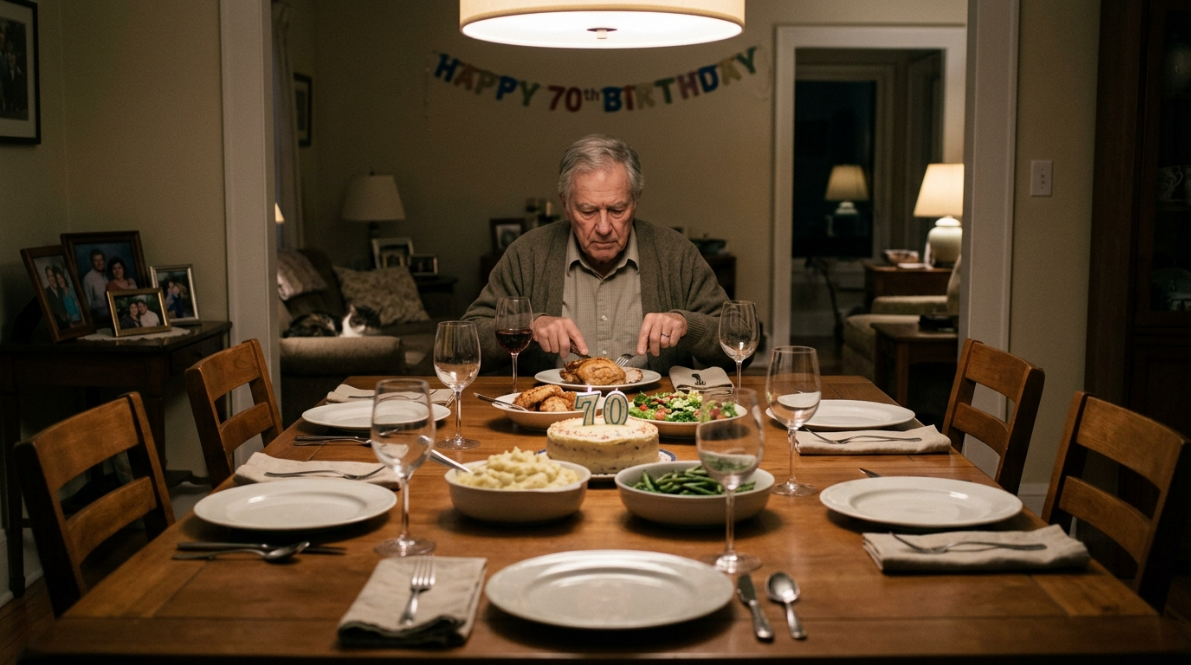
My birthday is the second of August. Nine places meant my son’s family, my daughter’s family, and me. I made a roast, green beans with bacon the way the grandkids like them, and my own coconut cake. A woman should not have to bake her own seventieth birthday cake, but I wanted the evening to be nice.
At three o’clock my son called.
“Mama, something came up.”
“Is everyone all right?”
“Everybody’s fine. We just can’t make dinner.”
I looked at the table, though he could not see it. “I’ve already cooked.”
“I know. I’m sorry. Raincheck?”
I said yes because I did not want to ask him to choose me when he had already decided not to come. He ended the call before I could ask whether my daughter still planned to bring her family.
At four, my daughter sent a message to the neighbor girl and asked her to read it to me. The kids had a thing. They would not make it either.
The girl stood by my table with my daughter’s words on her phone. “Do you want me to answer?”
“Tell her I got the message.”
“Just that?”
“Just that.”
She glanced at all nine places and then at the coconut cake. She was kind enough not to say anything about either one.
By six, I knew there would be no last-minute knock at the door. I sat at the head of that full, empty table and cut one slice of roast for myself. The candles stayed beside the cake, still in their box.
I want to say I took it well. What I did was eat alone and wash the dishes for nine. That is how I took it.
Three days later, Charlene told me where my family had been. Charlene is my neighbor, and she does not know how to hold a thing back. God love her, she generally starts talking before she has considered whether the listener might prefer not to know.
“I saw those pictures from Miller’s Lake,” she said. “Your whole bunch looked like they had themselves a time.”
“My whole bunch?”
“Your son and daughter, all the kids. Your daughter-in-law’s sister had that boat out.”
She stopped when she saw my face. “Dee, wasn’t that Saturday?”
“It was.”
“Oh, honey. I thought you knew.”
“The grandkids have fun?”
“They looked happy. Sunburnt, though. Every one of them.”
Saturday had been the second of August. Something came up, and it was a boat.
I did not call my son or my daughter. If I had called that afternoon, I would have said too much or accepted too little. Neither one would have helped me understand what I needed to do next.
Instead, I wrote it in my little book, the one where I keep things now. I wrote the date of my son’s call, my daughter’s message, and what Charlene had told me. Then I went on making my Sunday pies like a woman with no memory at all.
This next part matters.
My husband left me a certificate at the credit union, a big one, in my name only. It was due to mature that month. I had known the date for years, and so had my son-in-law.
He calls himself a money manager. Maybe he is good at it. I would not know, because I had never asked him to manage mine. That had not stopped him from circling the certificate for the better part of a year.
He brought it up carefully at first. He would ask whether I had reviewed my plans or thought about earning more from the money. If I said I was satisfied, he would smile as though I had not quite understood the question.
At Easter, I heard him talking to my son on the porch while I was inside. They had moved close to the kitchen window, and neither man lowered his voice enough.
“Once it matures, it is basically the family’s money,” my son-in-law said. “We just have to get her to roll it over to my office.”
My son said something I could not make out.
“She trusts you,” my son-in-law replied. “You talk to her first.”
I stayed where I was until they changed the subject. Then I walked outside with what I had been carrying, and both men looked at me a little too quickly.
“What are you two planning?” I asked.
“Nothing,” my son said.
His brother-in-law smiled. “Just talking business.”
“Whose business?”
“General business,” he said, still smiling.
I let them think I believed that. I had been married too long and widowed too long to confuse silence with ignorance.
Basically the family’s money. That sentence stayed with me. It was my husband’s money first, then mine, and somehow my son-in-law had already moved it in his mind. All he lacked was my signature.
And this was the family that had a thing on my seventieth birthday.
Early in the week after Charlene’s visit, my son called again. His voice had more warmth in it than it had on the second of August.
“Mama, we feel terrible.”
“About what?”
“Missing your birthday. We want to make it right.”
I waited.
“We’re throwing you a proper party Friday at my house. All of us.”
“All of you can come this time?”
“Yes. Everybody. You don’t have to cook or bring anything.”
His wife offered to drive me. Then my son called back twice before Friday to make certain I was coming. The first time, he asked whether I had written down the day. The second time, he said he wanted no misunderstandings.
There was no misunderstanding. The certificate matured Monday. The party was Friday.
My son-in-law called too.
“We’re looking forward to seeing you,” he said.
“Are you?”
“Of course. And don’t worry about a thing. I’ll bring all the paperwork to the house.”
“What paperwork?”
“For the certificate. We can take care of the rollover while everybody’s together. Two birds with one stone.”
I let a moment pass. “My birthday and my money.”
“It’s just convenient.”
“For whom?”
He gave a small laugh. “For you, obviously. I don’t want you making extra trips.”
“That is thoughtful.”
“Then we’re all set?”
“We’ll talk Friday,” I said.
He heard agreement because agreement was what he wanted to hear.
I have been a widow for six years. I count my own birds.
Tuesday morning, I rode the senior van to the credit union and sat down with a young man who had good manners and did not talk to me as if turning seventy had emptied my head.
“I want to handle this today,” I told him.
He checked the information and explained my options. I asked questions until I understood the answers, then asked some of them again in different words. We worked through the morning because I was not going to sign anything merely to avoid taking up someone’s time.
“No one else is on this certificate?” I asked.
“No. It is in your name.”
“And no one else can change what I decide here?”
He answered me clearly. I had him go through the arrangements once more before I signed. I was not looking for revenge. I wanted my husband’s money put where my son-in-law’s plans could not reach it.
Most of it went into arrangements for my grandbabies, with their names on it and a date far in the future. No parent and no son-in-law could touch it. The papers went into my purse.
One part went somewhere else.
Years before our children were born, my husband and I made a promise to each other. We said we would take a trip together once the responsibilities eased and the time belonged to us again. Responsibilities did not ease. Then he died, and the promise became one more thing I thought I had lost with him.
I could not take the trip with him, but I could still keep my half of it. I set aside enough to go on my own.
He would have laughed out loud in heaven at the thought of me finally doing it after everyone else had tried to schedule my money for me. I owed the two of us that promise, and Tuesday morning I paid it.
When I left the credit union, the account my son-in-law had been planning around was empty. Not missing. Not stolen. Not mishandled. I had simply decided where my own money would go before he could slide a signature page beneath my hand.
There was one more thing from my real birthday that I had not solved. That evening, I had found a vase of white lilies on my porch with a card tucked among them.
“Happy birthday, Dee.”
There was no signature.
My family does not call me Dee. Nobody has called me that since before I was married. I thought about the card every night and narrowed the sender down to two people. One of them was supposed to be dead.
I had no answer for that, and I would not pretend I did. The lilies and the unsigned card were a separate mystery, one I could leave alone until I had facts. Friday’s party required no guessing at all.
My daughter-in-law picked me up as promised. She talked quickly on the drive to my son’s house, telling me about the bakery cake, the decorations, and how excited the children were. She did not mention Miller’s Lake.
“We really are sorry,” she said.
“For missing dinner?”
“For everything getting crossed up.”
“Nothing was crossed up. Everyone went to the same lake.”
Her hands tightened on the steering wheel. “Charlene told you.”
“Charlene tells most things eventually.”
“It wasn’t meant to hurt you.”
“Not meaning to hurt somebody does not make an empty table less empty.”
She had no answer for that. We drove the rest of the way without arguing.
There were balloons at my son’s house, just as I had expected. There was a bakery cake, and my grandbabies rushed me as soon as I walked in. I kissed and squeezed every one of them because none of this was theirs to carry.
They showed me the decorations and argued over who would stand closest when I blew out the candles. One of them said the lake had been fun, then looked toward the adults as if remembering they were not supposed to mention it.
“I’m glad you had fun,” I said.
The child studied my face. “Are you mad?”
“Not at you.”
That was all the child needed to hear. The grandkids went back to the cake, and I looked around the room.
My son would not hold my gaze for long. My daughter hugged me twice and spoke too brightly. Her husband stood near the punch bowl with a leather folder tucked under one arm.
There is always a leather folder.
We ate. They sang. I blew out the candles on my second seventieth birthday cake, four days after I had washed nine untouched plates. I thanked the children for the cards they had made. I did not rush the part of the evening that belonged to them.
Once they had finished their cake and wandered away from the table, my son-in-law set down his plate. He cleared his throat.
“While we’re all together,” he said.
My son looked at me, then at the leather folder.
My daughter said, “Maybe this can wait.”
“It will only take a minute,” her husband replied.
He opened the folder and removed several pages. He had marked the place where I was meant to sign. Then he took out a pen and clicked it.
“We discussed the rollover,” he said. “This keeps everything simple.”
“You discussed it,” I said.
“We talked on the phone.”
“You told me you would bring paperwork.”
He pushed the signature page across the table with his office smile. “And here it is.”
I set my purse on my lap and took out the papers from Tuesday morning. I placed the receipt beside his signature page, then patted his hand the way he had patted mine for six years whenever he wanted me to feel looked after.
“This certificate?” I said. “There is nothing left to roll over.”
His smile disappeared. “What do you mean, nothing left?”
“I went to the credit union Tuesday. I handled it.”
“You shouldn’t make a decision like that without talking to us.”
“It was my decision.”
My son leaned forward. “Mama, where did the money go?”
“Most of it is set aside for the grandbabies. Their names are on it. None of you can touch it, and neither can he.”
The room became very still. My daughter glanced toward the children, but they were occupied elsewhere and not listening.
Her husband picked up my receipt as if he expected to find a mistake in it. “You already signed all this?”
“Yes.”
“You don’t understand what you’ve done.”
“I spent a whole morning understanding it.”
He put the receipt down. “This was supposed to benefit the family.”
“It will. The children will receive most of it later.”
“I could have managed it properly.”
“You had already started calling it family money before it belonged to anyone but me.”
My son’s face changed. He knew at once which conversation I meant.
“Mama,” he said quietly.
“At Easter,” I told him. “Through the kitchen window.”
My son-in-law turned to him. “You said she didn’t hear us.”
“I didn’t know she did.”
My daughter stared at both of them. “You talked about her money behind her back?”
Her husband lowered his voice. “We were planning ahead.”
“No,” I said. “You were planning around me.”
My son rubbed a hand across his face. “This isn’t why we had the party.”
“Then tell me why you went to Miller’s Lake on my birthday and lied about it.”
Nobody answered immediately. My daughter finally said the lake day had been arranged, and they had chosen to go rather than change their plans. The adults had agreed it would be easier to give me excuses and make up the birthday later.
“Easier for whom?” I asked.
“For us,” she said, barely above a whisper.
That was the first honest answer I had received from any of them.
My son looked at the full table. “We should have told you.”
“You should have come.”
“I know.”
“No. You know now because your plan did not work. On my birthday, you knew only that I would be sitting there and that you preferred the boat.”
My daughter began to cry, but I did not soften the facts to stop her. I also did not raise my voice. I told them about the roast, the green beans with bacon, the coconut cake, and the nine dishes I washed after eating alone.
“I did not need a large party,” I said. “I needed you to tell me the truth. Better yet, I needed you to want to be there.”
My son-in-law tapped one of the papers. “You said most of it went to the children. What happened to the rest?”
I looked at him. Even after everything I had said, he still wanted an accounting.
“The rest is mine.”
“I’m only asking because there may be tax consequences.”
“You are asking because you thought it would be under your management by tonight.”
He started to protest, but my daughter stopped him.
“Leave it alone,” she said.
He looked at her in surprise.
“She said leave it alone,” my son added.
For once, nobody asked me to keep the peace by surrendering something. My son-in-law closed the leather folder. The signature page disappeared inside it, unsigned.
I told them I had set aside part of the money to keep the promise my husband and I had made long before they were born. I was taking the trip we had postponed through years of raising children and tending to responsibilities.
My son asked, “By yourself?”
“That is how I have to take it now.”
My daughter wiped her face. “When?”
“I will decide that without a committee.”
That almost made my son smile, but he caught himself. I was not ready to make him comfortable.
The party did not end with anyone being thrown out or forgiven on the spot. Real families rarely settle themselves that neatly. My son-in-law put away his pen. My children apologized, first in the general way people do when they want pain to pass quickly, and then with more care when I would not accept vague words.
My son said, “I lied to you because telling the truth would have made me look selfish.”
“It would have.”
“I was selfish anyway.”
“Yes.”
My daughter said, “I let him send the message because I didn’t want to call.”
“I know.”
“I’m sorry.”
I believed she was sorry. Believing it did not erase the table, but it gave us somewhere honest to begin.
Before I left, I gathered the grandchildren again and thanked them for my cards. I did not tell them about the money waiting far in their future. They did not need to grow up counting it, and they certainly did not need to hear that their parents had once counted it for them.
My daughter-in-law drove me home. At my porch, she asked whether I wanted help carrying anything inside.
“I can manage.”
She hesitated. “Are you going to be all right?”
“I was all right before the party. I am simply less confused now.”
She nodded. “I’m sorry about the lake.”
“Next time, tell me the truth before somebody else does.”
“I will.”
After she drove away, I took the credit union papers from my purse and put them where I had decided they belonged. The money was settled. The leather folder had left my son’s table with the same blank signature page it arrived with. My grandchildren’s future was protected, and my old promise to my husband was mine to keep.
The white lilies and the unsigned card remained unexplained. I still had two possible names in mind, including the one I could hardly allow myself to believe. But I did not force an answer where I had none.
On Friday night, I answered the question I could answer. I told my family exactly where the money had gone, why it would never pass through my son-in-law’s office, and what it had cost them to mistake my trust for permission.
They had arranged a second birthday because they wanted my signature. They left with an unsigned page, and I left with my life still in my own name.