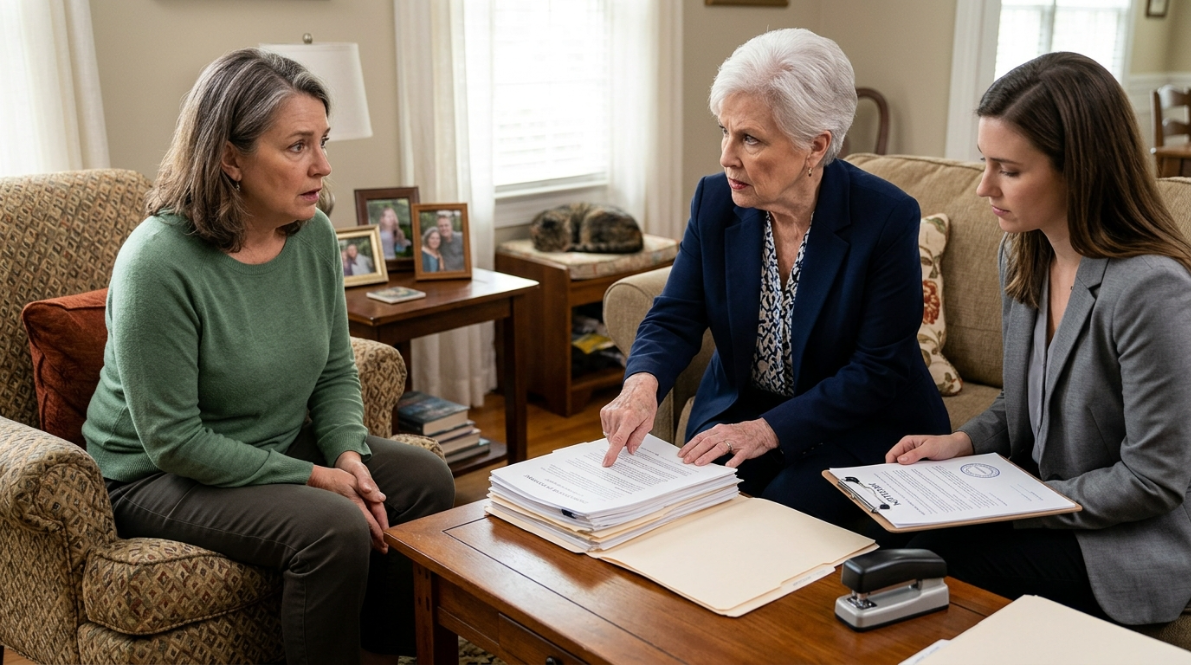
Eight days after I married Marcus, his mother arrived at my kitchen table with a mobile notary and a leather folder full of documents I had never seen. One would give Marcus financial power of attorney. Another would make him co-trustee and primary beneficiary. Beatrice smiled and called it “responsible planning,” while my new husband stood by the counter insisting nobody was pressuring me. I refused to sign. Four days later, Marcus’s phone lit up with a message: “You need her signature before the lender completely withdraws.” That was when I called my attorney and checked the locked file cabinet in my home office. The metal latch had been bent—and one very specific document was missing.
You need her signature before the lender completely withdraws.
My pulse quickened. What lender?
I waited until Marcus left for the office, then immediately called my estate attorney, Diane Sterling. Diane had handled my finances for eight years. She was calm, meticulous, and absolutely impossible to intimidate.
When I described the kitchen ambush, she went dead silent. “Do you have copies of the papers?” “No. Beatrice took them.” “Do not sign a single thing Marcus or his mother puts in front of you. Not a tax return, not an insurance update, not a banking document. Absolutely nothing until I review it.” “I wasn’t planning to.” “Good. Now, go check your records.”
My home office contained a heavy, locked file cabinet. At first glance, nothing looked disturbed. Then I noticed the lock cylinder no longer caught properly. The metal latch had been bent.
Inside, my hanging folders were arranged neatly. Too neatly.
One specific document was missing. The annual portfolio summary. It listed all six Tybee Island addresses, their estimated market values, the yearly rental income, and the contact information for the management company.
I sat on the hardwood floor beside the cabinet and suddenly remembered something. Two weeks before our wedding, Marcus had offered to “organize” my office while I was away at a gallery board meeting. He had spent an entire afternoon completely alone in that room. That evening, he had joked that I hoarded more records than the IRS.
I called Diane back. “He knew before we even got married.” “Do you have hard proof?” “Not yet.” “Then do not confront him. Change every single password you have. Freeze your credit with all three bureaus. Move your original documents to a secure safety deposit box.”
She also strongly advised me to stay with my friend Clara for a few nights while she investigated. I told Marcus that Clara had sprained her ankle and needed a caretaker.
It was the very first lie I had ever told him. Unlike his lies, mine was designed to keep me safe.
The next morning, Diane called with an update. Someone had submitted a preliminary joint commercial loan application using my personal information. The application listed Marcus as the primary borrower and me as the co-borrower. It relied heavily on expected collateral income from a Georgia property holding company.
The lender had paused the process, requesting proof of my formal consent, ownership deeds, and signed trust documents before moving forward.
The application was incomplete, but the imminent danger was crystal clear. Marcus had fully expected to obtain my signature after applying. The papers Beatrice had slapped on my kitchen table were not about responsible estate planning. They were the missing pieces of a massive loan scheme.
Diane immediately helped me lock down my credit and file a formal fraud report concerning the unauthorized application. The exact nature of the debt remained murky; the lender wouldn’t disclose everything without a subpoena.
For the moment, I just went home and pretended I knew absolutely nothing.
The Thanksgiving Revelation
A week later, Beatrice hosted Thanksgiving dinner. I almost stayed home. Diane advised me to attend only if I felt physically safe.
“Marcus doesn’t know how much you’ve uncovered,” she noted. “People often reveal far more when they believe their master plan is still functioning.”
So, I went.
Beatrice’s dining room was packed with Marcus’s extended relatives and his two adult children. His son, Julian, was unusually quiet. His daughter, Sophie, hugged me warmly but seemed incredibly tense.
The turkey was carved. The wine was poured. Everyone was working way too hard to appear perfectly normal.
Then Marcus’s sister, Brenda, looked across the table at me and asked, “So, Elaine, do you plan to keep all six Georgia cottages as short-term rentals?”
My fork stopped halfway to my mouth. The entire dining room went dead silent.
“What cottages?” I asked smoothly.
Brenda blinked in confusion. “The ones down on Tybee Island.”
Beatrice shot her a murderous glare. Marcus just stared blankly at his plate.
“How exactly do you know about them?” I asked.
Brenda’s face flushed deep red. “I… I thought everyone knew.” “No,” I said firmly. “Everyone did not know.”
Silence suffocated the room. Then Julian violently pushed his chair back from the table.
“Dad told us.”
Marcus’s head snapped up. “Julian.” “You did,” his son shot back.
Sophie began anxiously twisting her cloth napkin. “Dad told us you had already agreed to put them into a family trust.”
I turned my gaze directly onto Marcus. “Did he?” “It was only a preliminary discussion,” Marcus stammered. “A discussion that I was never a part of.”
Beatrice reached a hand across the table toward me. I quickly pulled my hand away.
“You are misunderstanding the situation,” Beatrice hissed. “What exactly am I misunderstanding?” “That Marcus has obligations.” “What obligations?”
No one at the table answered. Finally, Julian did.
“Debt.”
Marcus stood up abruptly. “That is enough!” “How much?” I demanded.
Julian looked at his father with disgust. “More than $300,000.”
The room seemed to violently narrow around me.
Marcus’s chair scraped loudly across the floorboards. “That number is entirely misleading.” “It was exactly $318,000 when you showed me the bank statements,” Julian replied coldly.
Beatrice slammed her open palm on the table. “You had absolutely no right to share that!”
Julian turned his anger on his grandmother. “You sat there and told me Elaine had already agreed to this!”
Sophie began to openly cry. “Dad said the cottages would secure a bridge loan and pay everything off cleanly.”
There it was. The ugly truth on a silver platter.
Marcus had racked up catastrophic debt through failed private startup investments, shady personal loans, and offshore online sports betting. Beatrice had already refinanced her own mortgage once just to bail him out. Now, the remaining aggressive lenders were demanding immediate payment.
My grandfather’s cottages had secretly become their rescue plan.
Marcus looked at me with pleading eyes. “I was going to sit down and explain it all to you.” “When?” “After the holidays.” “You mean after I signed the papers?”
His silence was my answer. I stood up and reached for my wool coat.
Beatrice followed me into the foyer. “You cannot leave a marriage over some debt!” “The debt is not the core problem here.” “He was just ashamed!” “So he broke into my files and stole my records?”
Her expression flickered. Only for a fraction of a second. But I caught it. She knew.
Marcus rushed into the hallway. “I did not steal anything from you.” “Then how did you get the exact property addresses and the precise income figures?”
He opened his mouth. Nothing came out. Julian appeared in the doorway behind him.
“He photographed the entire file.”
Marcus spun toward his son, furious. “How would you know that?” “Because you texted the pictures to me and asked if the appraisals looked high enough to use as collateral.”
My knees nearly gave out. Julian looked deeply ashamed.
“You swore to me that Elaine knew about the loan,” Julian said to his father. “You said it was a joint retirement strategy.”
Marcus’s face darkened with rage. “That was strictly private!” “You only made her property private when you needed to hide what you were doing behind her back.”
I walked out the front door. Marcus called my phone repeatedly as I drove straight to Clara’s house. I didn’t answer a single one.
The Forgery
The next morning, I called Warren Miller, the mobile notary. I asked if he remembered the documents from my kitchen.
He grew very quiet. “I do,” he said. “Did anyone contact you after that night?” “…Yes.”
He asked to meet Diane and me at her law office. That afternoon, he walked in carrying a stack of printed emails.
The day after I had refused to sign, Beatrice had emailed him a scanned signature page. It appeared to contain my exact signature. She asked if he could just apply his notary stamp to it remotely and backdate it to the night of the kitchen meeting.
Warren had flatly refused.
He had also proactively contacted the attorney whose name was printed on the legal headers. That attorney completely denied ever preparing them. Someone had digitally copied his law firm’s letterhead from an old, public county filing.
Warren had then received a second, frantic email from Marcus. Marcus claimed there had been a “massive misunderstanding” and begged Warren to destroy all copies of the paperwork.
Warren had saved everything instead.
Diane carefully examined the scanned signature page. It was attached to a transfer document officially assigning my ownership interest in the Tybee Island LLC directly to the new marital trust. Had it been successfully notarized and accepted, Marcus could have easily used the trust documents to push the commercial loan application through.
The scheme was no longer a vague suspicion. It was a fully visible, documented crime.
-
Marcus had stolen my financial information.
-
He had submitted an unauthorized joint loan application.
-
Beatrice had attempted to validate a forged transfer document.
-
And both of them had fully expected me to blindly sign enough papers to make the entire deception look legitimate.
Diane immediately helped me report this new evidence to the authorities. I had the locks changed on my house. Marcus was forced to move in with Beatrice.
For the next month, he sent me long text messages every single day. Some were deeply apologetic. Some blamed blind panic. Some blamed his mother’s interference. Some even tried to blame me for hiding the cottages in the first place.
One text read: > I only did it because I was terrified you would leave me if you knew the actual truth.
He was right that the truth might have ended the marriage. But not because financial debt automatically made him unworthy of love. The sheer amount of debt terrified me, especially knowing that gambling and reckless borrowing were the root causes. Still, debt was something that could have been faced honestly as a team.
The theft, the extreme pressure, and the calculated manipulation could not.
The Christmas Eve Ultimatum
By Christmas Eve, I had become incredibly calm. Marcus begged for one final, face-to-face meeting. He claimed he wanted to explain everything.
I agreed, but strictly on three conditions:
-
The meeting would take place at one of the Tybee Island cottages.
-
Diane would be sitting right there as my legal counsel.
-
Marcus and Beatrice would leave the property immediately the moment I asked them to.
The cottage was the exact pale blue one I had originally reserved for our first Christmas together.
Marcus arrived first. He stood on the wooden porch, staring out toward the Atlantic.
“So this is one of them,” he murmured. “Yes.”
Beatrice pulled up ten minutes later wearing a bright red wool coat. she looked around the cozy living room with open, greedy interest.
“This would have made a lovely family vacation house,” she commented. “It already is a house,” I replied coldly. “It was just never yours.”
Diane sat at the dining table right beside me. Beatrice scowled at her.
“Why is the lawyer sitting here?” “Because you personally taught me never to attend a financial meeting without my own attorney.”
No one had an answer for that.
I placed two heavy gold envelopes on the table. One for Marcus. One for Beatrice.
Marcus stared down at his. “What is this?” “The truth.”
He tore his open first. Inside was a certified copy of the divorce petition Diane had filed that very morning. (Formal process servers would deliver the official copies later). Behind it were printed copies of the fraudulent loan application, the photographs of the portfolio he had taken in my study, and the desperate emails he had sent to the commercial lender.
His face completely lost its color. “Elaine.” “Keep reading.”
The lender’s correspondence clearly showed that Marcus had explicitly promised to complete the trust transfer by Christmas. He had formally described the Georgia cottages as “marital assets” that would imminently secure the loan.
I handed Beatrice her envelope.
It contained printed copies of her emails to Warren the notary, the forged signature page, and a formal cease-and-desist notice demanding that all future communication with me go strictly through Diane.
Her manicured hands began to shake violently. “This proves absolutely nothing.” “The file was sent directly from your personal IP address,” Diane stated flatly. “The digital metadata also proves it was created directly on your laptop.”
Beatrice whipped her head toward Marcus. “You explicitly told me the transfer had to be finalized before the lender withdrew the offer!” Marcus stared at her in horror. “You told me Elaine had agreed and signed it after I left for work!” “She was supposed to sign it!” “That is not what I asked you!”
Beatrice’s face hardened into a vicious mask. “You were completely out of time. I did what was necessary to save you.”
Marcus jumped to his feet. “You forged her signature?!” “You photographed her private documents! You submitted the fake loan application! Do not sit there and pretend this was all my idea!” “I never once agreed to commit forgery!”
I almost laughed out loud. He had stolen my financial records, lied to my face, and legally promised away property he didn’t own. But forgery was apparently where his moral compass finally drew a boundary.
Beatrice pointed an accusing finger at him. “You came to my house crying because your creditors were threatening you. You said your kids were going to find out. You said Elaine had enough hidden property to save everyone!”
Marcus’s voice echoed off the tin roof. “I said I needed help! I did not tell you to fake my wife’s signature!”
Diane looked at me. I gave her a small nod. Then, I placed one final manila folder on the table.
Inside were six vibrant photographs of all the cottages beautifully decorated for Christmas. There was also a confirmed reservation receipt, and an unfinished, handwritten letter I had penned a week before our wedding.
Marcus instantly recognized my handwriting. “What is this?” “What I had fully intended to give you tonight.”
He read the letter in dead silence.
In it, I had explained the history of the cottages. I wrote about how much I wanted us to spend our winters together in Georgia. I detailed my plan to update my estate so that Marcus would have the legal right to live in one of the cottages for the rest of his life if I passed away before him. I had also intended to name him as the sole beneficiary of a separate, massive life-insurance policy.
I was never going to transfer outright ownership to him. But I was going to give him absolute, ironclad security.
Marcus slowly lowered the letter. “You were going to take care of me.” “I was going to share my entire life with you.”
His eyes welled up with tears. “Then why didn’t you just tell me before we got married?” “Because I needed to know that you loved me without knowing exactly what I owned.” “I did love you.” “Perhaps a small part of you did.”
He sank back into the wicker chair, defeated. “I just panicked.” “No, Marcus. Panic is making one terrible decision in the heat of the moment. You made dozens of them, methodically.”
Beatrice scoffed loudly. “This is just sentimental nonsense. Married people are supposed to support each other.” “Support is requested honestly,” I snapped. “It is not stolen through deception.” “You just think you are better than us because you inherited some property.” “No. I just think I have the fundamental right to decide what happens to it.”
Marcus looked up at me, his eyes red. “Is there any chance in the world we can repair this?”
I studied the man I had married. He looked a decade older than he had just six weeks earlier. Not because of the new lines on his face, but because every single lie had stripped away the decent person I thought I knew.
“No.”
Beatrice violently grabbed her purse. “You will deeply regret humiliating this family.” “I was humiliated in my own kitchen, eight days after my wedding. Tonight, I am simply refusing to stay a silent victim.”
She stormed out into the humid night.
Marcus remained seated for a long time. He just stared at the photographs of the decorated cottages.
“I really wish I had just told you the truth,” he whispered. “So do I.”
He carefully placed the letter back in the folder, stood up, and walked out the door.
The Aftermath and the Real Inheritance
The legal process dragged out over many exhausting months.
Marcus eventually accepted full legal responsibility for using my sensitive information on the loan application and for stealing my records. Beatrice stubbornly continued to deny the forgery until the undeniable digital forensics and Warren’s sworn testimony directly connected her to the altered document.
Both of them eventually accepted strict plea agreements to avoid prison time. Marcus was ordered to pay heavy restitution related to the fraudulent commercial application and received three years of probation with intense financial monitoring. Beatrice received probation and mandated community service for her central role in the forged transfer and attempted false notarization.
Their relationship did not survive the criminal investigation. They spent the entire time bitterly blaming each other.
Several months later, Sophie came down to visit me at the blue cottage. She sat on the screened-in porch with me and cried into her tea.
“I really thought Dad had finally changed,” she said. “Changed from what, exactly?” I asked gently.
She hesitated for a long time. Then she finally told me the truth about Marcus’s first marriage.
His former wife had inherited a substantial sum of money from an aunt. Marcus had aggressively pressured her to invest every penny of it into one of his doomed business ventures. When she put her foot down and refused, Beatrice had viciously accused her of being selfish and disloyal to the family. The marriage exploded soon afterward.
Marcus had always told me his ex-wife was a controlling, cold-hearted woman. In reality, she had just recognized the exact same toxic pattern I had nearly missed.
“Why didn’t anyone warn me?” I asked softly.
Sophie wiped her eyes. “Dad told us your finances were totally private. Grandma assured us that you were different and that you actually understood family loyalty.”
Family loyalty. A beautifully weaponized phrase used to disguise pure entitlement.
I didn’t blame Sophie or Julian. They had been repeatedly lied to, told that I approved of the trust and genuinely wanted to bail him out. They had believed their father because children—even adult children—often automatically inherit the fictional stories their parents build around themselves.
My divorce was finalized exactly nine months after the wedding.
I worked with Diane to completely restructure the Tybee Island LLC so that no property could ever be transferred, pledged, or borrowed against without an independent, third-party legal review.
When I pass away, three of the cottages will be sold to fully fund university scholarships for women returning to school after age 50. The other three will be placed in a trust to support temporary, safe housing for widows and older women trying to escape financially abusive relationships.
I kept the right to enjoy all six of them for the rest of my natural life.
On the very first Christmas after the divorce was finalized, I returned to the blue cottage entirely alone.
At first, the quiet felt suffocatingly heavy. Then, I walked over and pushed open all the windows. The warm air smelled of sea salt and approaching rain. Neighborhood children rode their bicycles past my front porch. A retired couple staying two houses down waved warmly at me as they walked toward the beach.
I spent the afternoon decorating the cottage with simple white lights and placed a small, fragrant pine tree beside the front bay window.
On Christmas morning, I carried a hot cup of coffee out onto the porch and watched the sky slowly brighten over the Atlantic Ocean.
For months, I had allowed myself to believe that Marcus had stolen that Christmas from me. But he hadn’t actually taken the cottages. He hadn’t taken my future. He had only revealed that he simply did not belong in it.
My grandfather left me six houses.
But the far greater inheritance was the hard-earned wisdom to firmly close a door when someone enters my life believing that love entitles them to everything behind it.