For three years, my son told me the same thing every November: “Just us this year, Mom. You understand.” So I roasted a little hen alone while quietly accepting that my family wanted a smaller holiday. Then my daughter-in-law’s bakery order landed in front of me: four pies, table of fourteen. She had no idea I was the woman in the back of Hartley’s who had been baking her Thanksgiving desserts all along. I already knew something was wrong—last year, my granddaughter’s photo showed a long family table and my mother’s missing white gravy boat with the gold rim sitting in the middle. This time, I saved the ticket, tied my apron, and made one decision my daughter-in-law never expected: I assigned myself the delivery.
For three years, it had been the same explanation.
“Just us this year, Mom. You understand.”
“I understand,” I would tell him.
Then I would roast a little hen alone and tell the church ladies my family kept things quiet. That was easier than admitting I had not been invited. I am nervous to put that in writing because some people will think I should have confronted my son sooner. Maybe I should have. At the time, I was trying to keep what dignity I had left.
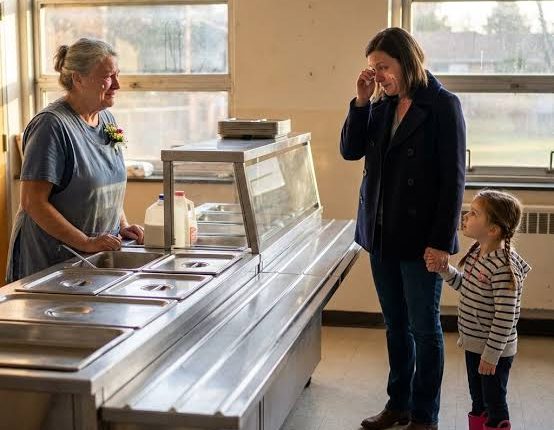
I work the ovens at Hartley’s, in the back, starting at five in the morning. The counter girls hand over the finished boxes, so most customers never see me. My daughter-in-law has never once come in at dawn, and she has never seen my face there.
Her order comes in under her name every year, with my son’s phone number on the ticket. I have dialed that number for thirty years. I would know it upside down.
The first year, I told myself there must have been a misunderstanding. The second year, I wondered whether my son was embarrassed to tell me they wanted to spend the day with her side of the family.
By the third year, I knew enough to stop making excuses for what I could see, though I still did not know who had said what to whom.
Last year, the neighbor girl who helps me with my phone showed me pictures my granddaughter had posted. She enlarged one, then looked at me as if she wished she had not.
“That’s Thanksgiving, isn’t it?” I asked.
“It looks like it,” she said quietly.
“How many chairs do you count?”
She hesitated. “Fourteen.”
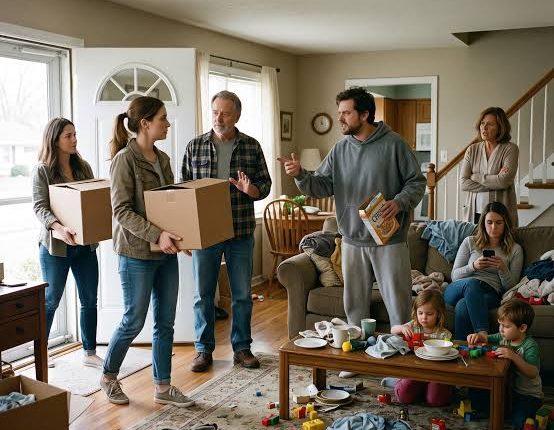
There was a long table, fourteen chairs, and a turkey the size of a footstool. My son had not been having a quiet holiday at home. The house was full.
Then I saw what sat in the middle of the table.
“Can you make that part bigger?” I asked.
“The thing near the turkey?”
“Yes. The white dish.”
She zoomed in. It was my mother’s gravy boat, white with a gold rim. It had gone missing from my china box the week after my husband’s funeral, when my son and daughter-in-law came to help me pack.
I had searched for it then. I checked the china box twice and opened cupboards where it had never been kept. Eventually, I told myself I must have wrapped it with something else or given it away without remembering. Grief can make you distrust your own memory.
But there it was, on my daughter-in-law’s Thanksgiving table, filled with gravy and surrounded by the family I had been told was not gathering.
I looked at that photograph for a long time. Then I made my tea and went to bed. The next morning, I returned to Hartley’s and baked ninety pies for other people’s families.
I never said a word to my son. A mother who invites herself gets pity, and I wanted no seat I had to beg for. I also did not want to call him with a claim I could not prove beyond a photograph posted online. So I started keeping what I could prove.
I saved the order tickets. Three years of dates and head counts went into my recipe tin. I listened at the counter too, the way only an invisible woman can listen.
My daughter-in-law likes to chat when she collects things around town. One of the counter girls mentioned her to me after a pickup, without knowing the woman was related to me.
“That nice lady with the big Thanksgiving order was in again,” she said.
“What did she say?” I asked, trying to keep my voice ordinary.
“She said her husband’s mother never comes.” The girl adjusted the stack of receipts. “Apparently they invite her every year.”
“Every year?”
“That’s what she said. ‘His mother never comes. We invite her every single year, bless her heart. She prefers to be alone.’”
I had to turn back toward the worktable before my face told her too much.
That was when I understood how the lie had been arranged. My son believed I refused his invitations. I believed there were no invitations because they were keeping Thanksgiving small. My daughter-in-law had built a fence out of those two stories, and for three years neither of us had looked over it.
This year’s ticket made the whole thing harder to swallow. At the bottom, in her round handwriting, she had added, “Extra nutmeg on the sweet potato please, family recipe, it’s a tradition!”
The family recipe was mine, and my mother’s before me. My daughter-in-law had eaten that pie at my table enough times to know the taste. Apparently they missed my pie at their Thanksgiving table. They just did not miss my chair.
There was one more detail in the photographs that I had not told anyone. At the head of the table sat a man I did not know, wearing my late husband’s green cardigan. It was the one I had donated with his other things after he died.
I asked the neighbor girl to enlarge that part once.
“Do you know him?” she asked.
“No.”
“Do you want me to look at another picture?”
“No, leave it.”
I stopped asking her to zoom in after that. I had no evidence that my daughter-in-law had taken the cardigan, and I did not know how the man had come to own it. I still do not. I could not accuse anyone of more than I knew.
Hartley’s offers holiday delivery for large orders. Drivers are assigned on Wednesday, and this year I assigned myself to my daughter-in-law’s route.
I did not plan to shout. Shouting would have made it easy for everyone to dismiss me as upset. I had the paperwork, the photographs I had seen, and a simple question about an item that belonged to my mother.
That morning, I pressed the crusts and thought about my husband carving at our old table with his sleeves rolled up. I baked those four pies as carefully as I had ever baked anything. I used the extra nutmeg she requested. Let them taste exactly what they had been ordering.
Before I left Hartley’s, one of the counter girls noticed the address on my delivery sheet.
“You’re taking that one yourself?” she asked.
“Yes.”
“Four boxes is a lot for the front steps.”
“I can manage four.”
She offered to carry them to the car, but I told her I was fine. I put on my good coat and placed the three folded tickets with the current receipt. Her parents came at eight, according to the order information. By nine, the whole table would be there.
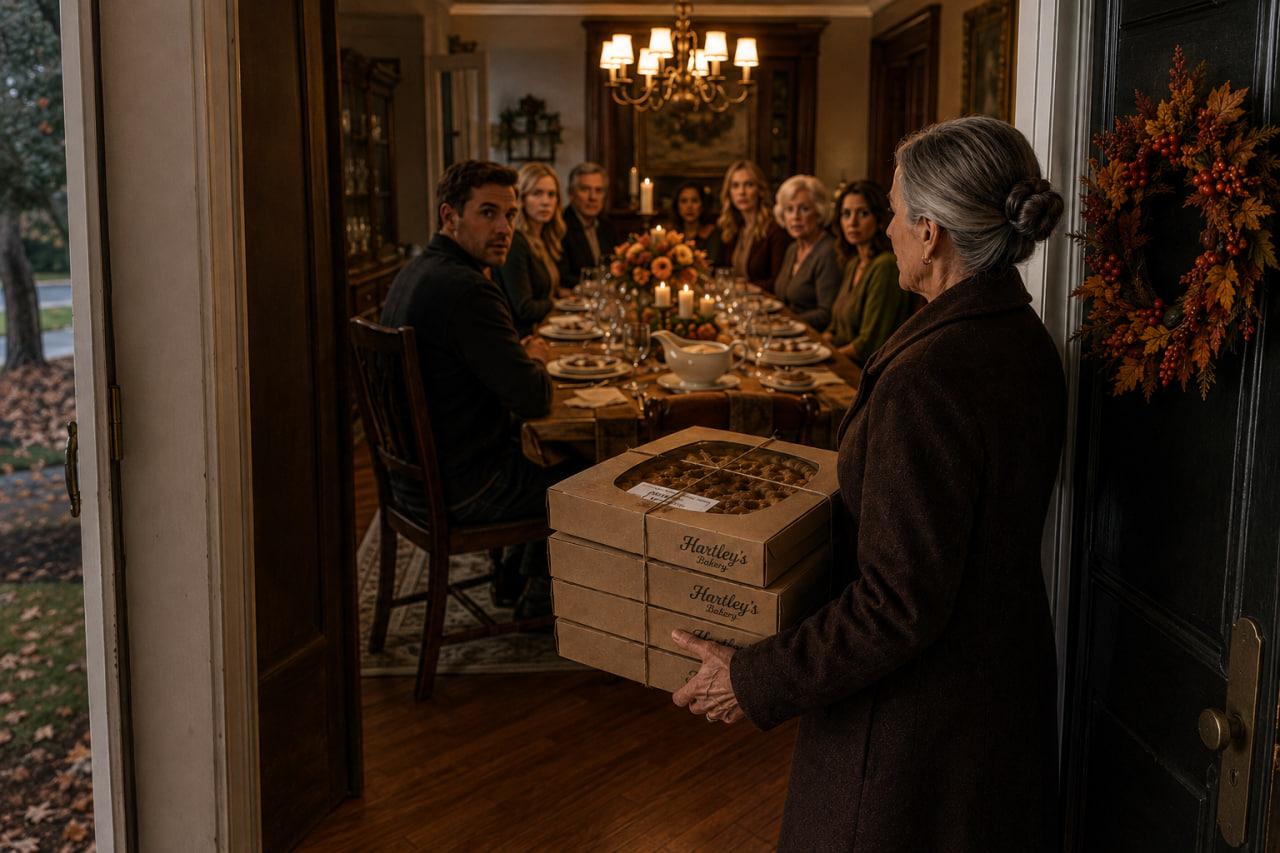
At ten minutes to nine, I climbed my son’s front steps with four pie boxes stacked in my arms. The smell of nutmeg rose through the cardboard. I had imagined this moment so many times that the actual weight of the boxes helped keep me steady.
I rang the bell.
Noise carried through the door, chairs moving and several people talking at once. Then the door opened, and my son stood there with his mouth open. He was holding, of all things in this world, my mother’s gravy boat.
“Mom?” he said.
“Good morning. I have your pies.”
He looked at the boxes, then past me toward the street. “You delivered these?”
“I baked them too.”
Behind him, the conversation stopped a little at a time. His wife’s mother rose from her chair and came close enough to see me clearly.
“Melissa,” she said, “isn’t that the pie lady you told us never comes to Thanksgiving?”
Melissa did not answer immediately. Her eyes went from me to the bakery boxes and then to the papers tucked beneath the receipt.
My son stepped aside so I could enter. “What does she mean, you baked them?”
“I work at Hartley’s,” I said. “I work the ovens in the back.”
“You never told me.”
“You never asked who made the pies.”
I set the boxes down near the entry rather than carry them to the table. Then I handed him the receipt and the three folded order tickets. He opened the first one, then the second.
“What are these?”
“Your Thanksgiving orders. Three years of them.”
He looked at the head counts. “You said you didn’t want to come.”
“No,” I said. “You told me it was just you this year, and I said I understood.”
He turned toward Melissa. “You told me Mom refused every invitation.”
Melissa’s mother looked at her too. “You told us the same thing.”
Melissa began to say that it was complicated. My son interrupted her, not loudly, but before she could build another explanation.
“Did you invite her?” he asked.
She looked down. “Not directly.”
“Did you tell me she said no?”
Melissa did not answer.
I had expected anger to carry me through the doorway, but standing there, I mostly felt tired. Three years had been reduced to a few pieces of paper in my son’s hands and one silence from his wife.
I pointed to the gravy boat he was still holding.
“I came for one thing,” I said. “That belonged to my mother. It disappeared after your father’s funeral.”
My son stared at it. “I thought this was ours.”
“It was mine,” Melissa said softly.
“No,” I told her. “It was in my china box. You and my son helped me pack that week.”
Her mother closed her eyes briefly, then looked at Melissa. “Give it back.”
Melissa’s face tightened. “I was going to.”
“When?” my son asked.
She had no answer for that either.
My son carried the gravy boat to the sink, emptied it, washed it carefully, and dried it. Nobody at the table resumed eating. The man in my husband’s green cardigan stayed seated. I did not ask about it. The cardigan had been donated, and whatever path had brought it to him was still unknown. The gravy boat was different. I knew where it had come from, where it had been kept, and when it vanished.
My son brought it back to me with both hands.
“I’m sorry, Mom,” he said.
“I believe you did not know,” I told him. “But you should have called me yourself.”
“I should have.”
Melissa stood near the table, saying nothing. Her mother asked me to stay, and my son did too.
“We have a chair,” he said.
I looked at the fourteen places. They could have found a fifteenth chair that morning, just as they could have found one during any of the previous three years. But I did not want my first honest Thanksgiving with my son to happen while everyone watched to see whether I would forgive his wife before the pies were cut.
“Not today,” I said. “Today you need to talk to each other.”
“Can I come see you later?” he asked.
“Yes. Call first, and call me yourself.”
He nodded. I took my mother’s gravy boat and left the four pies behind. They had been ordered and paid for, and the people at that table could decide whether they still had an appetite for them.
My son came to see me after the holiday. He did not defend Melissa or ask me to pretend the misunderstanding had been mutual. He told me plainly that she had admitted giving him one story and both families another. We did not repair three years in one conversation, but we stopped allowing messages to pass through her.
After that, he called me directly about family plans. When there was an invitation, I heard it from him. When I answered, he heard the answer from me. That was the ordinary change that should have happened years earlier, and it was enough to keep the same lie from working again.
I did not demand a grand apology in front of the family, and I did not ask anyone to choose sides. Melissa returned what was mine. My son learned exactly why I had been absent. Her parents learned that I had never refused those dinners, and I no longer had to tell the church ladies that my family preferred quiet holidays.
The next Thanksgiving was not described as “just us.” My son called and invited me himself. I accepted, and I brought the sweet potato pie because it really is our family recipe.
My mother’s white gravy boat with the gold rim came with me. It sat on the table because I put it there, and when dinner was over, I carried it home.