The candles were still burning when Cody Howerin ruined my son’s birthday.
That is the part I remember first.
Not my sister’s smile.

Not the frosting.
Not even the sound of all those parents going quiet at once.
I remember the candles.
Eight tiny flames trembling on top of a baseball-diamond cake in a rented party room in Bay Ridge, Brooklyn.
The room smelled like buttercream, hot wax, cardboard pizza boxes, and that sharp lemon cleaner places use when they need one room to host four parties in one afternoon.
Kids were still bouncing from the arcade machines near the back wall.
Sneakers squeaked on the hardwood floor.
Somebody’s paper coffee cup had gone lukewarm near the gift table.
My son Theo stood behind his cake with his cheeks puffed out, both hands gripping the edge of the table, ready to blow out the candles and make his wish.
He was eight years old.
He had been talking about that cake for three weeks.
Not because it was expensive.
It was not.
I had found a small bakery that could make the green frosting look like a baseball field without charging what some people spend on a car payment.
Theo had chosen every detail.
The tiny bases.
The little white frosting lines.
The fondant baseball glove sitting near home plate.
He had corrected the baker twice when she called it a soccer field by accident, and I had watched him stand there in his clearance sneakers, serious as a coach, explaining that baseball fields had diamonds.
That was my boy.
Careful.
Hopeful.
The kind of child who thanked people for napkins.
The kind of child who saved the blue balloon from a party favor bag because he thought I might want it for my office.
I had rented that party room because I wanted him to feel like one thing in his life was not discounted, delayed, or explained away.
Divorce teaches children to accept halves before they understand what halves cost.
Half a house.
Half a weekend.
Half a parent at school concerts because somebody else is stuck working.
I could not give Theo everything.
But I could give him one birthday where nobody made him feel like a leftover.
Then my nephew Cody sprinted across the room.
At first, I thought he was running for the game tokens on the back table.
Cody was eleven, long-legged, loud, and used to adults clearing a path for him.
His private-school polo was untucked.
His sneakers flashed under the party lights.
His mother, my sister Drew, stood by the gift table with her arms folded and that amused little curve at her mouth that always meant she had decided something cruel was actually funny.
I saw Cody gather speed.
I saw one parent turn.
I saw Theo’s eyes flick toward him.
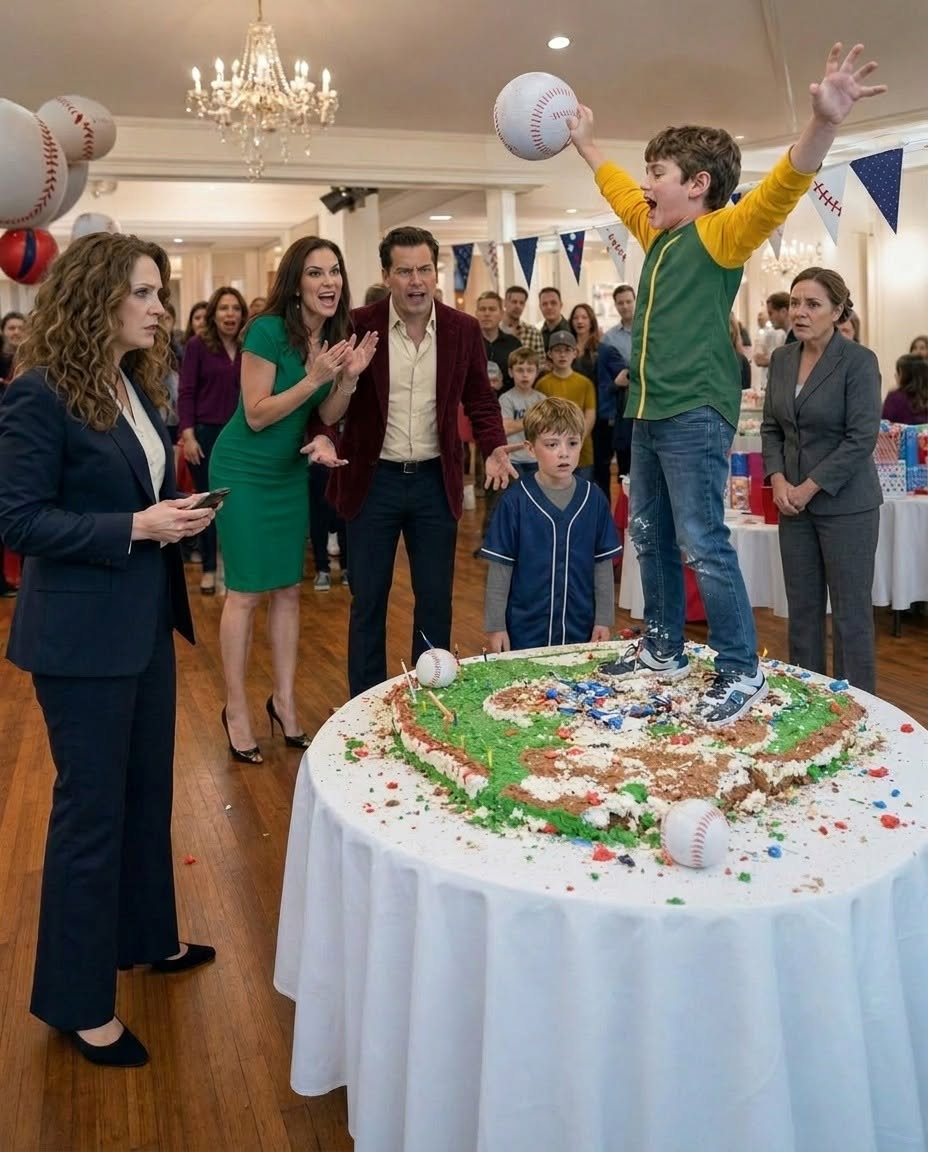
Then Cody jumped.
Both feet left the floor.
Both sneakers came down in the center of the cake.
Buttercream exploded across the white tablecloth.
Green frosting sprayed over the paper plates.
One of the candles bent sideways and disappeared under Cody’s left shoe.
Another candle rolled into a ridge of frosting, still smoking.
The little fondant baseball glove flew off the cake and tapped a girl in the cheek before landing in her lap.
The room made one sound.
A soft, collective inhale.
Then nothing.
Theo did not cry.
That was worse than crying.
He just stared at the destroyed cake with his mouth still open, still shaped around the breath he never got to release.
His cheeks had not even fallen yet.
It was like his body had not caught up to the humiliation.
The room froze around him.
A father near the wall stopped with his hands halfway together, caught between clapping and not clapping.
The party host in a black apron stood near the doorway with a roll of paper towels in her hand.
A little boy in a Mets hoodie stared down at the floor as if the frosting had embarrassed him, too.
One mother reached toward her daughter’s face, then stopped when she realized the girl was not hurt, only shocked.
The candles kept giving off that bitter burnt-wick smell.
Nobody moved.
Then Cody threw both arms into the air.
“Mom said you’d laugh!” he shouted. “Then I get my new iPhone!”
His voice bounced off the bright walls.
Every adult in that room heard it.
Every child heard it.
Most importantly, Theo heard it.
I turned toward my sister.
Drew slow-clapped from beside the gift table.
Not nervous clapping.
Not the embarrassed kind people do when a child has gone too far and they are trying to soften it.
She clapped like she had directed a scene and was pleased with the performance.
“Honestly, Maggie,” she said, “you should thank him. He made this boring little party memorable.”
There are moments when a family shows you the shape of your life so clearly that you cannot pretend you misunderstood.
Not teasing.
Not a joke.
A demonstration.
Drew wanted me laughed at, and she wanted my son to learn that my pain was part of the entertainment.
For one ugly second, I imagined grabbing the nearest tray and sweeping every cupcake, every napkin, every wrapped gift onto the floor.
I imagined telling the room everything.
I imagined saying that Drew’s children wore private-school uniforms because I paid for them.
I imagined saying her car was still in her driveway because I had agreed to help cover the loan.
I imagined saying that my son had clearance sneakers while her children walked into St. Catherine’s Academy with tuition paid by the woman she had just mocked in public.
I did none of that.
My hand found Theo’s shoulder instead.
His shirt was warm from running around the party room.
A smear of green frosting had landed near his sleeve.
He still had not blinked.
My name is Maggie Barrymore.
I was forty-one years old that day, divorced, and the owner of a small bookkeeping firm above a bakery on 86th Street.
Every weekday morning at 9:12, I unlocked the office, started the coffee machine that made more noise than coffee, and opened other people’s books.
I knew how to find missing money.
I knew how to track expenses.
I knew how to tell the difference between a one-time mistake and a pattern.
My sister had been a pattern for most of my adult life.
Drew was two years younger than me, but somehow I had always been assigned the older-sister version of motherhood.
When she missed rent at twenty-three, I covered the late fee.
When her first child needed summer camp, I paid the deposit.
When her husband changed jobs and the insurance gap left them scrambling, I handled the bill she called “temporary.”
Temporary was Drew’s favorite word.
It made permanent help sound like an emergency.
Six years before Theo’s birthday, Drew had called me crying from her kitchen.
Her oldest had been accepted at St. Catherine’s Academy.
Then the second child got in.
Then Cody.
She told me it would change their lives.
She told me public school would crush their confidence.
She told me I was the only person who understood how smart they were.
I told her I could not afford all three.
She cried harder.
By the end of that week, I had set up automatic tuition payments.
Five thousand three hundred fifty dollars every month.
Not once.
Not for a semester.
Every month.
For six years.
I did it quietly because Drew said she did not want the children to feel ashamed.
I believed her.
That was the trust signal I handed her.
Silence.
I gave her my silence so her kids could keep their dignity.
She used that silence to build a life where nobody knew what I had sacrificed.
Theo knew only pieces.
He knew I said no to the expensive sneakers.
He knew we bought store-brand cereal unless it was his birthday week.
He knew I sometimes sat at the kitchen table after he went to bed with a calculator, a yellow legal pad, and my hair clipped badly on top of my head.
He did not know why his cousins had blazers with school crests while he wore shirts from the clearance rack.
I never told him.
A child should not have to measure his mother’s love against somebody else’s tuition bill.
Thirty-two days before the party, Drew had called again.
This time she was in her car.
I could hear traffic through the speaker.
She said the lender had sent a repossession warning.
She said if she lost the car, she could not get the kids to school.
She said Cody had been anxious lately and losing the car would destroy him.
She said she hated asking.
That part was almost funny.
Drew never hated asking.
She hated hearing no.
I agreed to send eight hundred forty dollars a month toward the loan.
I saved the lender notice.
I saved the confirmation email.
I labeled the folder “Drew—car assistance.”
I also printed the tuition schedule and filed it with the monthly transfer confirmations.
Bookkeeping had taught me what family never did.
Love without records becomes a place people hide knives.
So while Drew stood in that party room acting like I was too dull to entertain children, I already had six years of receipts sitting in a locked cabinet above a bakery.
I looked at Cody’s shoes sinking into Theo’s cake.
I looked at Drew’s smile.
I looked at my son.
Theo’s hand slid into mine.
His fingers were sticky from the balloon ribbon he had been carrying earlier.
They curled around my palm without a word.
That was the moment the old Maggie stopped arriving.
The old Maggie would have apologized to the room.
She would have told Theo we would fix it later.
She would have cleaned Cody’s shoes.
She would have pulled Drew aside and whispered, please, not here.
Then she would have paid the tuition on Monday at 8:00 a.m.
I took out my phone.
At first Drew laughed.
“Oh, come on,” she said. “Don’t make this dramatic.”
I did not answer.
The banking app opened under the bright party-room lights.
My thumb shook once.
Only once.
Then the screen recognized my face, and there it was.
Scheduled transfers.
St. Catherine’s Academy.
Three student accounts.
Monday, 8:00 a.m.
Five thousand three hundred fifty dollars.
I tapped the first one.
Paused.
I tapped the second.
Paused.
I tapped the third.
Paused.
Drew crossed the room so fast her bracelet snapped against her wrist.
“What are you doing?” she hissed.
Her voice was low enough to pretend privacy, but the room had gone so quiet that everyone heard it.
I looked at Theo first.
He had finally closed his mouth.
He was watching me now.
Not the cake.
Me.
“I’m fixing something,” I said.
Drew’s face tightened.
“You can’t punish my kids because Cody made a joke.”
“A joke?” I asked.
Cody shifted in the cake.
His left sneaker made a wet sound in the frosting.
He looked suddenly younger than eleven.
“Mom,” he said, softer this time.
Drew did not look at him.
She looked at my phone.
That was when the email notification dropped down from the top of the screen.
It was from the lender.
The subject line was about the car payment.
The amount sat there in black type.
Eight hundred forty dollars.
Due in two business days.
Drew saw it at the same time I did.
The color left her face.
Not all at once.
It drained slowly, like she was realizing the floor beneath her had never belonged to her.
“Maggie,” she said.
There it was.
My name.
Not Mag.
Not sis.
Not the responsible one.
My name, because she needed something.
I opened the loan payment tab.
The cancel button waited at the bottom of the screen.
I placed my thumb over it.
“You wanted him to make this memorable, Drew,” I said. “So let’s make sure you remember the exact moment.”
I canceled the payment.
Ninety seconds.
That was all it took.
Six years of being treated like a wallet with a pulse ended in ninety seconds under a wall of party balloons.
Drew grabbed my wrist.
Not hard enough to hurt.
Hard enough to make every parent in the room see it.
“Undo it,” she said.
I looked down at her hand.
Then I looked back at her.
“Take your hand off me.”
She did.
The party host stepped closer with the paper towels still in her hand.
“Maggie,” she said carefully, “do you want us to bring out replacement cupcakes? We have some in the kitchen.”
Her kindness almost broke me.
Not because of the cupcakes.
Because she had seen my son standing in humiliation and offered a solution without making him beg for one.
I knelt beside Theo.
His eyes were wet now, but he was holding himself together with a force no eight-year-old should have to use.
I wiped frosting off his sleeve with my thumb.
“This is not your fault,” I said.
He swallowed.
“You are not boring.”
His chin trembled.
“We are leaving in ten minutes,” I said, “and we are getting a new cake just for us.”
He looked at the ruined baseball diamond.
Then he nodded once.
Behind me, Drew made a small sound of disbelief.
“You’re really going to do this over cake?”
I stood up.
That was the question that told me she had understood nothing.
“It was never cake,” I said.
I turned to the venue manager, who had arrived near the doorway with a clipboard tucked under one arm.
Her name tag said manager, not miracle worker, but the look on her face told me she had handled enough children’s parties to recognize adult cruelty when it walked in wearing nice jeans.
“Please remove my sister and her family from this party,” I said.
Drew’s mouth opened.
No sound came out.
For the first time in my life, my sister looked at me like I was not furniture, not a safety net, not a monthly transfer she could insult and still collect.
She looked at me like a locked door.
The manager did not raise her voice.
“Ma’am,” she said to Drew, “I’m going to have to ask you to gather your things.”
Drew snapped back then.
“This is a family matter.”
The manager’s eyes flicked to Theo.
“Not in my party room.”
A mother near the wall covered her mouth.
The father who had frozen mid-clap bent down and picked up one of the fallen paper plates.
Someone moved the little girl with the fondant glove away from the table.
The room started breathing again.
Cody stepped out of the cake.
Frosting clung to the soles of his sneakers.
He looked at his mother, waiting for her to save him from the consequences of the thing she had encouraged.
Drew gathered her purse from the gift table with jerky little movements.
Her husband, who had spent the entire party checking his phone near the wall, finally appeared alive.
“What happened?” he asked.
Drew shot him a look sharp enough to cut ribbon.
“Ask your son.”
Cody’s face crumpled.
I did not enjoy that.
I want to be clear about that.
Cody was a child.
A spoiled child, yes.
A child who had humiliated my son, yes.
But still a child who had been promised a reward for cruelty by the adult responsible for teaching him better.
The problem had never begun with Cody’s sneakers.
It began with Drew’s smile.
As they moved toward the door, Drew turned back one last time.
“You’ll regret this,” she said.
I believed her.
Not because she was right.
Because people who depend on your silence always call your first boundary a betrayal.
That evening, Theo and I bought a small chocolate cake from the bakery under my office.
No fondant.
No baseball diamond.
Just chocolate frosting and eight new candles.
We ate it at my kitchen table with the window open and the neighborhood sounds drifting in.
A car rolled past.
A dog barked somewhere down the block.
Theo blew out every candle in one breath.
I did not ask what he wished for.
Some wishes deserve privacy.
After he went to bed, I opened my laptop.
The old Maggie might have ignored the messages already stacking up.
Drew had sent fourteen texts.
My mother had sent six.
One cousin had written, “I heard there was drama at the party. Call me.”
Drama.
That word people use when they want to flatten cruelty into entertainment.
I did not call anyone.
I opened my records.
Tuition confirmations.
Bank transfers.
Loan assistance emails.
Dates.
Amounts.
Receipts.
Six years of quiet sacrifice arranged in folders with boring names.
At 10:43 p.m., Drew sent one more text.
“You are destroying my children’s future because you can’t take a joke.”
I stared at it for a long time.
Then I typed back, “No. I am no longer funding the lesson you are teaching them.”
She did not respond for seven minutes.
Three dots appeared.
Then disappeared.
Then appeared again.
Finally, she wrote, “Mom knows.”
Of course Mom knew.
Our mother had known many things over the years.
She knew Drew borrowed money and forgot to repay it.
She knew I worked late and still brought side dishes to family gatherings.
She knew Theo’s father sent child support when he remembered and apologies when he did not.
She knew I carried more than my share.
She also knew it was easier to praise me for being strong than to stop people from loading more weight onto my back.
My mother called at 11:02 p.m.
I let it ring.
Then I turned off the phone.
The next morning was Sunday.
I expected anger.
I expected guilt.
I expected a lecture about family.
I did not expect St. Catherine’s Academy to call my office line on Monday at 8:17 a.m.
The woman in the billing office sounded cautious.
Professional.
The way people sound when money has made a private matter official.
She said the automatic payments had been paused.
She asked whether that was intentional.
“Yes,” I said.
She asked whether I wanted to update the payment method.
“No,” I said.
There was a pause.
Then she said Drew had listed me as the responsible payer on all three accounts.
Not emergency contact.
Not sponsor.
Responsible payer.
I closed my eyes.
There it was.
A document.
A line.
A truth I had never signed but somehow had been made to carry.
“Please send me copies of anything bearing my name,” I said.
She said she could email the account summaries.
I asked for the billing authorization forms, too.
She hesitated.
Then she said she would have to check with administration.
I knew that tone.
It was the sound of a file becoming less friendly.
At 9:04 a.m., the email arrived.
The summaries were exactly what I expected.
The authorization forms were not.
Drew had filled out my name.
My address.
My business email.
Next to “financially responsible party,” she had typed Margaret Barrymore.
Margaret.
Not Maggie.
The formal version I used only on tax filings and bank documents.
I had never given St. Catherine’s permission to use it.
I printed everything.
I highlighted dates.
I placed the tuition records beside the car-loan emails.
Then I called the school billing office back and used the voice I saved for clients who thought numbers were feelings.
Calm.
Exact.
Unmovable.
“I am disputing responsibility for these accounts,” I said.
By noon, Drew was calling again.
This time I answered.
She started crying before I said hello.
She told me Cody had cried all night.
She told me the school might embarrass the kids.
She told me her husband was furious.
She told me Mom thought I was being cruel.
I listened.
Then I asked one question.
“Did you put my legal name on those forms?”
Silence.
There are different kinds of silence.
The party room had been shocked silence.
This was caught silence.
“Maggie,” she whispered.
“Did you?”
“I thought it was just for billing.”
“You thought listing me as financially responsible was just for billing?”
“You were paying anyway.”
There it was again.
The whole family gospel in three words.
You were paying.
As if habit created consent.
As if generosity, repeated often enough, became ownership for the person receiving it.
I said, “You need to call the school and correct it.”
She started sobbing harder.
I did not comfort her.
Not because I had no heart.
Because my heart was in the next room, packing his baseball cards into a shoebox and pretending he had not heard me say the word dispute.
“I can’t fix what you taught Cody yesterday,” I said. “But I can stop paying for it.”
Then I hung up.
That week was ugly.
My mother came over on Wednesday with a casserole and a face full of disappointment.
She stood in my doorway and told me Drew had always been fragile.
I looked at the casserole dish.
Then at her.
“Fragile people can still be cruel,” I said.
She flinched like I had slapped the word into the air.
“She is your sister.”
“Theo is my son.”
That ended the conversation for a while.
She set the casserole on the counter anyway.
Theo came out of his room and hugged her because he loved her.
Children do that.
They love people before they learn what those people avoid seeing.
On Friday, I picked Theo up from school.
He got into the car quieter than usual.
Halfway home, he asked, “Did Aunt Drew hate my party because it was boring?”
I pulled into a gas station parking space because I could not answer that question while driving.
“No,” I said.
He looked down at his backpack zipper.
“Then why did she say it?”
Because she wanted me small.
Because she thought you were the easiest way to make me feel small.
Because some adults use children as tools and call it humor.
I did not say any of that.
I said, “Sometimes grown-ups say something mean because they think nobody will stop them.”
He thought about that.
Then he asked, “You stopped her?”
“Yes.”
He nodded.
Out by the pumps, a man in a baseball cap wiped his windshield with a paper towel.
A small American flag sticker curled at the corner of the gas station door.
Ordinary life kept moving.
Inside my car, my son was rebuilding a little piece of himself.
The next month, the tuition did not come out.
The car payment did not come out.
My rent was paid early for the first time in years.
I bought Theo the sneakers he had been pretending not to want.
Not the most expensive pair.
The pair that fit.
He wore them out of the store and kept looking down at his feet like they might disappear.
Drew did not apologize.
At least not right away.
She sent messages through other people.
She told my mother I had ruined Cody’s confidence.
She told our cousin that I had humiliated her in front of strangers.
She told anyone who would listen that I had weaponized money.
Maybe I had.
Maybe the difference was that I used it to stop harm instead of excuse it.
Two months after the party, Drew came to my office.
She looked tired.
No polished cardigan.
No smug smile.
Just a woman standing above a bakery with her purse held against her ribs.
Cody waited downstairs near the front window with his father.
I saw him through the glass.
He was not wearing his school polo.
Drew sat across from my desk.
For once, she did not start with tears.
She said, “He asked me why you hated him.”
I closed my ledger.
“I don’t hate Cody.”
“He knows you stopped paying.”
“He should know why.”
Drew looked at the floor.
The office smelled like coffee and cinnamon from the bakery downstairs.
Rain tapped softly against the window.
For a second, she looked like the little sister who used to crawl into my bed during thunderstorms.
Then she said, “I told him it was my fault.”
I did not speak.
“I told him I should never have said that about Theo’s party.”
My throat tightened despite myself.
Drew swallowed.
“And I told him no phone.”
It was not enough to erase what happened.
Nothing erases the moment an eight-year-old realizes adults can laugh while he is hurt.
But it was the first true sentence Drew had offered without asking for something in return.
I said, “You still need to fix the school forms.”
“I did.”
She slid an envelope across my desk.
Inside was a letter from St. Catherine’s confirming that my name had been removed from the accounts.
The document was dated the day before.
I read it twice.
Then I put it in the folder with the others.
Drew watched me do it.
“You really keep everything,” she said.
“Yes.”
“I used to think that was cold.”
I looked at her.
“It was how I survived people who depended on me forgetting.”
She cried then.
Quietly.
No performance.
No audience.
I let her cry.
I did not rush to fix it.
That was new for both of us.
Theo’s next birthday was at home.
Backyard table.
Store-bought burgers.
A cake from the same bakery under my office.
No fondant baseball glove this time.
He chose chocolate with vanilla frosting and little blue candles.
We invited three friends from school, my mother, and eventually, after a long conversation with Theo, Drew and Cody.
Cody arrived holding a plain white bakery box.
He stood on the back steps with his shoulders hunched.
“I brought cupcakes,” he said.
Theo looked at me.
I looked at him.
His choice.
Theo opened the door wider.
“Okay,” he said.
Not forgiveness.
Not yet.
But a beginning.
When it was time for candles, Cody stood far from the table.
Drew stood behind him with one hand on his shoulder.
My mother watched from a lawn chair, quiet for once.
Theo leaned over his cake.
Eight had become nine.
His new sneakers were dusty from running through the yard.
The candles flickered in the warm evening air.
For a heartbeat, I remembered that rented party room.
The frosting.
The silence.
The way my son had stood with his mouth open around a wish he never got to make.
Then Theo blew out every candle.
Everyone clapped.
Nobody laughed at him.
That sounds small unless you have spent years paying for people who taught your child he was small.
But to me, it felt like the whole room had finally learned the right lesson.
My son was not boring.
He was not a joke.
And I was no longer the quiet one carrying everyone else’s perfect life while my own child stood beside the crumbs.