Miss Bernie
“I was fourteen,” the tall man said. “My name was Marcus Reed. I hadn’t eaten since Tuesday.”
He didn’t raise his voice. He didn’t need to. The hallway behind him had gone so quiet that I could hear the fluorescent lights hum, and the squeak of a baby’s shoe against somebody’s shoulder, and Dr. Whitfield’s expensive sneakers shifting on the break room linoleum.
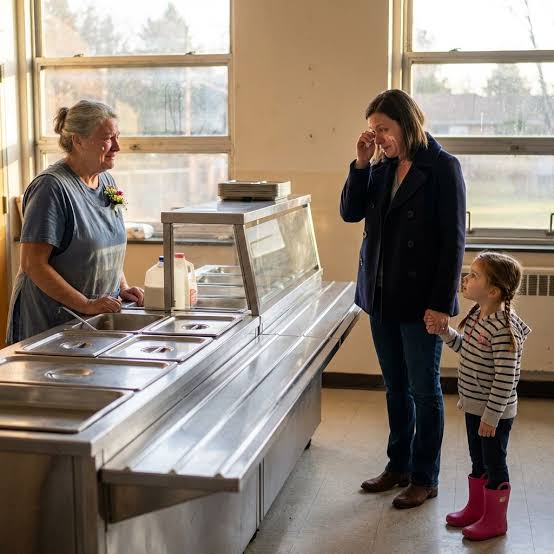
“It was February. My mother had lost her job at the laundry. The heat was off. I came through the lunch line with a tray and no money, and I had a speech ready. I was going to say I wasn’t hungry.” He smiled, slow and cracked. “Miss Bernie looked at my tray. She looked at my face. And she said, ‘Oh, honey, I made too many of these. Help me out.’”
Mom’s hand flew to her mouth.
“She said it every day for three months. I figured out, around the second week, that the ‘too many’ was always exactly one. Mine.” He turned to Whitfield. “I’m a cardiac surgeon now, sir. I run the heart institute at Mercy General. I have never, in my life, eaten a better meal than that tray of meatloaf.”
My name is Danielle Pruitt. I’m forty-two, a dental hygienist in Dayton, and I am the daughter of Bernice Pruitt, who in the town of Oakmont, Ohio, has never once been called anything but Miss Bernie.
She started at Jefferson High in September of 1984, the year I was born. She was twenty-six, a farmer’s daughter with a hairnet and a laugh that carried across the cafeteria. My father, Walt, drove a delivery truck for the dairy. We lived in a small brick house on Cherry Street with a vegetable garden and a dog named Biscuit. We were not rich. I knew that the way you know the weather.
Mom never talked about what she did. She came home smelling of rolls and bleach, with her feet swollen, and made supper again. She’d sit at the kitchen table, rubbing her ankles, and ask about my day. I thought that was what mothers did.
I found the receipts after Dad died.
He passed six years ago, in March, of a heart that had been quietly failing. I was clearing out the pantry, looking for his old tackle box, when I found a shoebox behind the flour. It was full of slips. Grocery receipts, mostly. Pale pink, faded. A few were from a school-supply store.
I sat on the pantry floor and read them. Dates going back to 1991. Notes in my mother’s slanting hand across the backs. Tommy R., shoes. Keisha, coat. Don’t tell. Luis, lunch acct., $41. The Brandt girl, glasses.
There were hundreds. When I added them up that night, at the kitchen table, with Dad’s calculator, I had to stop and put my head down.
Forty-one years of Miss Bernie, spending her own paychecks on other people’s children. It came to more than a hundred and sixty thousand dollars.
I asked her about it the next morning. She was at the stove, flipping an egg.
“Mom. What is this?”
She glanced at the box. She turned back to the egg.
“Just receipts, honey.”
“Mom.”
“Eat your breakfast.”
I never got more out of her than that. She said it was nobody’s business. She said a child who’s hungry shouldn’t have to feel like a charity. She said she’d had a mother who sometimes went without supper so that Mom could eat, and she’d always figured it was a debt you paid forward.
“Besides,” she said, with a small, dry smile, “your father always said I’d spend our last nickel on a stranger.”
“Did he mind?”
“He drove me to the shoe store.”
The new principal arrived a year before the party.
Dr. Gregory Whitfield. Forty-five, tall, with product in his hair and expensive sneakers under a navy suit. He’d come from a charter-school network in Columbus. He said optimize and leverage and student-centered metrics. In his first assembly, he told the faculty that Jefferson High was “a legacy institution in need of a modern operating system.”
Mom said he seemed nice enough. Mom says that about everyone.
By October, he’d announced the cafeteria plan. The kitchen would close in June. A contract company, Fresh Forward Dining, would replace the hot lunch line with vending machines and “grab-and-go kiosks.” It would save the district two hundred and ten thousand dollars a year.
The old kitchen staff, five women, had been told, kindly, by letter. Three took early retirement. One found another job. Mom was the last.
“It’s progress,” she said, folding laundry. “I’m too old to argue.”
“You’re sixty-eight.”
“Exactly.”
I told her it wasn’t right. She said, “Danielle, nothing’s right. It’s just what comes next.”
She said it the way she says everything. With a little smile, and her hands busy, so you couldn’t tell what it cost.
I took the Friday off.
She didn’t want me to. She said it was just a little cake. I said I’d drive. She said she could drive herself. I said, “Mom, I’d like to see it.”
We pulled into the Jefferson lot at two. The building looked smaller than I remembered, brown brick with a flagpole and a faded mural of a bulldog. Mom wore her good navy cardigan and the pearl earrings Dad had given her in 1999. She’d pinned her gray hair back. She looked, I thought, like a woman dressing for a funeral she wasn’t sure was hers.
Eight teachers waited in the break room. A long, bright, cluttered space, with a coffee maker, a microwave, and a bulletin board of faded flyers. A sheet cake sat on the table. White frosting. Blue letters.
HAPPY RETIRMENT BERNICE.
Somebody had misspelled it. A math teacher, Mr. Okafor, was already trying to scrape the M off with a plastic knife.
“It’s fine,” Mom said. “It’s lovely.”
I stood by the door with my arms folded and felt something hot climbing my throat.
You know what happened at 2:41.
Dr. Whitfield came in looking at his watch. He handed Mom a small white envelope. A ten-dollar coffee shop gift card. He raised a paper cup of water.
In education, we like to say nobody is irreplaceable. Especially in food service.
A teacher near me winced, visibly. Mr. Okafor put down his knife.
Mom smiled. “Thank you, Dr. Whitfield. It’s been an honor.”
He was already looking at his phone. “I’ve got a budget meeting. Enjoy the cake.”
I opened my mouth. I had a great many things to say. I’d been composing them since October.
Mom touched my wrist. Two fingers. The same tiny pressure she’d used when I was eight and wanted to hit a boy.
Not yet.
He opened the break room door.
And stopped.
I heard it before I understood it. A low, rolling, shuffling thunder, like a train coming through a tunnel. Then clearer. Footsteps. Hundreds of them. Boots and heels and sneakers, crossing the old waxed floor of the main hall.
The double doors at the far end, the ones to the gym, stood wide open. And through them, in a long, slow, rising tide, came people.
Men in work boots and business suits. Women in scrubs and church dresses. A firefighter in a navy station shirt. A mother with a baby on her hip and a toddler by the hand. A young man in Army dress greens. A white-haired woman in a wheelchair, pushed by a teenager. A kid in a hoodie who looked about nineteen and was crying openly.
They kept coming.
Two hundred. Three hundred. They filled the hallway wall to wall, shoulder to shoulder, and still more spilled in behind, from the parking lot, the side doors, the bus loop. The walls seemed to bulge.
Dr. Whitfield backed up, step by step, into the break room, until the backs of his knees hit the table.
“What is this?” he said. His voice had gone high. “Who authorized this? This is a, there’s a, this is a fire code issue.”
Nobody answered.
Mom had set down her paper plate. Her hand was shaking. She was staring through the doorway at the mass of faces, and her lips were moving.
“Oh my Lord,” she whispered. “Oh my Lord.”
I’d like to say I knew. I didn’t.
I learned later that it had been Marcus Reed’s idea. Six weeks earlier, he’d come to the school for a career day, and seen, on the cafeteria wall, a laminated notice about the kitchen closure. He’d stood in front of it for a long time. Then he’d gone to his car, and sat in the lot, and called three old classmates from the class of ’98.
Within a week, there was a group chat. Within two, a Facebook page. Miss Bernie’s Kids. It had four hundred members by the first of the month, and eleven hundred by the end.
They had organized it quietly. A Friday, a time, a gym. They’d asked the custodian, a gentle man named Hollis, to unlock the doors. They’d asked nobody else.
“It wasn’t a secret,” Marcus told me afterward, with a sheepish grin. “We just didn’t think anyone would stop us.”
Nobody had.
Marcus stood in the break room doorway, in his gray suit, with a hospital lanyard around his neck. He was forty-four. He had a close-cut beard going silver and a face I recognized, after a moment, from a photograph on Mom’s refrigerator. Marcus, class of ’98. Doctor now!!
He looked at the sheet cake. At the gift card in Mom’s hand. At the misspelled blue letters.
Then he looked at Dr. Whitfield.
“Sir,” he said. “Before we start, I think somebody should tell you what Miss Bernie did for me in the winter of 1996.”
And he did. You’ve heard it. The tray. The too many. The three months of meatloaf. He told it plainly, in a doctor’s careful voice, with his hands folded.
When he finished, nobody breathed.
“She never said a word,” he said. “Not to me. Not ever. I didn’t know until I was thirty that she’d paid for it herself. A teacher told me, at a funeral.”
He turned to my mother, and his voice cracked.
“Miss Bernie. I’ve saved four hundred and eleven lives. I’d like you to know the first one was mine.”
Mom put her face in her hands.
I had never seen her cry in public. Not at Dad’s funeral. Not at mine, the day I got married. She was a woman who cried in the pantry, quietly, with the door shut. Now she stood in the doorway of a school break room in her navy cardigan, with her shoulders shaking, and three hundred people watching.
Somebody in the hall started clapping.
It wasn’t loud at first. One pair of hands, a woman’s, near the back. Then another. Then the sound rolled forward, wave after wave, until the whole hallway was applauding, and the sound hit the lockers and came back doubled. A man in a suit near the front was weeping openly. A boy of about ten, holding his father’s hand, clapped with a face of enormous, solemn dignity.
Dr. Whitfield stood with his back against the table. His face had gone the color of old paper.
“I, I had no idea,” he said. It came out thin.
“No,” Marcus said. “You didn’t.”
“Nobody told me.”
“Nobody had to.” Marcus’s tone wasn’t cruel. It was weary, and terribly gentle. “You could have asked her, sir. For one minute. In one year.”
Whitfield’s mouth moved. Nothing came out.
The crowd parted.
I watched it happen, a narrow aisle opening down the middle of the hall, as people stepped back against the lockers. And through it, one by one, they began to come forward. Not Marcus. Others. They came to the break room door, and stopped, and held out their hands.
A heavyset man in a mechanic’s uniform. “Miss Bernie. Tommy Rizzo. Class of ’91. You bought me work boots.”
A woman in scrubs. “Keisha Davis. A coat. Do you remember? It was green.”
A man in a firefighter’s shirt, whose voice caught. “I was the kid who lied about being allergic. So I could eat the plain rice. You knew. You gave me chicken, and you said, ‘Oh, I must have mixed up the tickets.’”
“Luis,” Mom whispered. “Luis Ortega.”
“I’m a captain now.”
“Look at you.”
A young woman with a baby. “Miss Bernie. I’m Tia. You don’t know me. My mother was Anna Brandt. The glasses.”
Mom’s hands flew to her cheeks. “Little Anna. Oh, she had such bad eyes.”
“She passed in March.” Tia’s voice trembled. “She told me, at the end, ‘There was a woman in the cafeteria who made me see.’ I looked for you for six years.”
Mom opened her arms. The young woman stepped into them, with the baby between, and held on.
I stood in the corner, with the gift card envelope, which someone had pressed into my hand, and I cried until my face was wet.
It took two hours.
I won’t tell you all of it. They moved the party to the gym. Somebody produced a microphone, and a sound system, and a podium. The bleachers filled. Folding chairs came out of nowhere. A woman I didn’t know wheeled in a cart of food, trays and trays of it, catered by a restaurant owned by a former student, a big, laughing man named Dewey who said, “Miss Bernie, I’m gonna make you meatloaf like you’re gonna die.”
They put Mom in a chair at the center of the basketball court, a plain wooden chair with a red cushion, and brought them to her one at a time.
They told her stories. Some were funny, some were not. A man named Raymond, a plumber, said she’d once given him a roll and told him a joke about a goat, and he’d never forgotten the goat. A woman said Mom had cut her sandwich into triangles every day for a year, because her mother had died, and she’d stopped eating. A tall, quiet man, a lawyer, said nothing. He knelt in front of the chair, took Mom’s hand, and pressed it to his forehead.
By four, there was a line out the door.
Marcus came and found me during the second hour, by the water fountain. I was wiping my eyes with a paper towel.
“Danielle.”
“You remember me?”
“You were the little girl who did homework in the corner of the kitchen. I used to wave.” He smiled. “I’m sorry we didn’t tell you.”
“Why didn’t you?”
“We were afraid she’d say no.”
“She would’ve.”
“She’d have said, ‘Oh, honey, it’s just a job.’” He laughed. “That’s why we had to do it ourselves.”
I looked across the gym. Mom sat in her chair, small and straight, with a plate of cake in her lap. A little girl of six had climbed up beside her. Mom was cutting the cake into triangles.
“I found the receipts,” I said.
“I know. We all have. Not the receipts. Our own.” He rubbed his jaw. “That’s the thing, Danielle. Every one of us thought we were the only one.”
“What do you mean?”
“I thought I was the only kid she saved.” His voice shook. “I told myself, I was special. And then I found the Facebook page, and there were eleven hundred of us, and I thought, my God. She did this a thousand times.”
“Forty-two years.”
“Forty-two years, one tray at a time.” He wiped his eyes. “I’d like to do something about that.”
I’ll tell you what they did. It’s the part people ask about.
At five o’clock, Marcus took the microphone. He stood in the middle of the gym, in his gray suit, with his lanyard, and waited for the noise to die.
“I’m not a speaker,” he said. “I fix hearts.”
A ripple of laughter.
“But I’d like to say something. And then I’d like to ask for something.”
The gym went still.
“Forty-two years ago, a woman came to work in a hairnet. She was twenty-six. She made two thousand dollars a year, and she spent a quarter of it on strangers’ children.” He paused. “She never told anyone. She never asked for a dime. And today, her school gave her a ten-dollar gift card.”
A low, angry murmur.
“I don’t want to make anyone feel bad.” His eyes found Whitfield, near the doors, standing pale and rigid with his phone forgotten in his hand. “I think the district made a decision. I think it was a cheap one. But I’d like to offer an alternative.”
He held up a folded sheet of paper.
“Six weeks ago, a group of us started a fund. We’ve raised, as of this morning, four hundred and eighty thousand dollars.”
A gasp. Someone cried out. Mom, in her chair, put both hands over her mouth.
“It’s called the Bernice Pruitt Lunch Fund,” Marcus said. “It will pay off every unpaid lunch debt in the Oakmont school district. Every one. As of Monday. And it will pay, in perpetuity, for a hot lunch for any child who can’t afford it. No forms. No stigma. No questions.” He smiled, wet-eyed. “Just a tray. And a sentence.”
He looked at Mom.
“Oh, honey, I made too many of these.”
I don’t think I can describe the sound. A roar, but with a crack in the middle of it, as though four hundred people were laughing and sobbing and shouting at once. Somebody started to chant her name. Miss Bernie. Miss Bernie. It rolled over the bleachers.
Mom sat in the middle of the floor, with a little girl in her lap and a paper plate on her knee, and her mouth open.
“Oh my Lord,” she said, again. Almost inaudible. “Oh, my Lord.”
I crossed the floor. I knelt beside her chair. She took my face in her hands, her red, chapped, powerful hands, and looked at me with her tired, shining eyes.
“Danielle. Did you know?”
“No.”
“Did you do this?”
“I didn’t.”
“It’s too much.”
“It’s not enough.”
She laughed, a startled, wet sound. “It’s too much, honey. I only made meatloaf.”
“Mom.” I held her wrists. “You’ve been making it for forty-two years. They’re just finally saying thank you.”